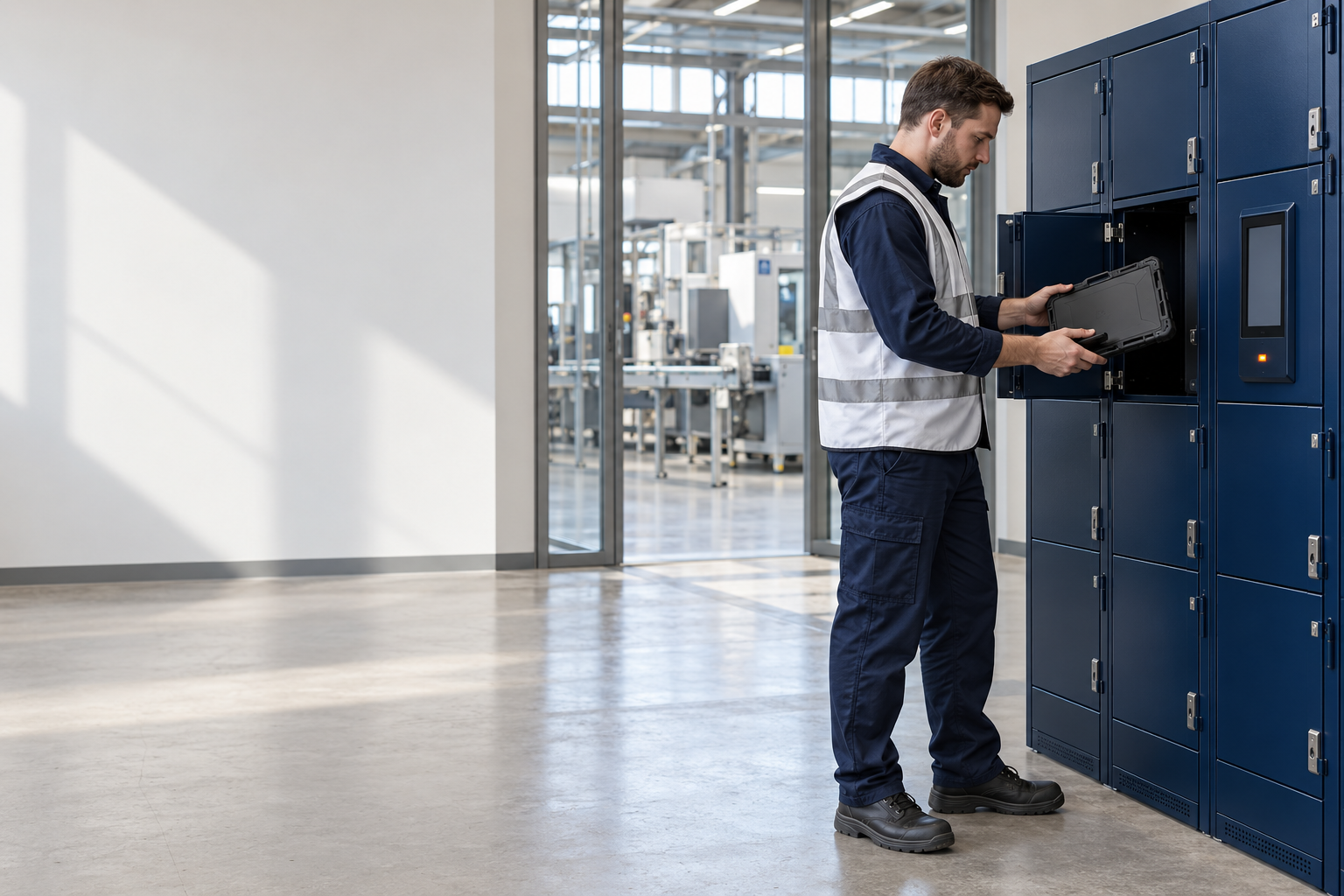
The minute the line stops, the cost compounds.
Manufacturing and engineering organisations run an IT estate where every productive hour depends on the right tool, the right part and the right device being in the right hands at the right time — across production floors, engineering centres and a supplier network that may span continents. Smart Collect® is the ServiceNow-native platform built to deliver that fulfilment without breaking the chain of custody.
A majority of manufacturing and engineering IT leaders surveyed expressed willingness to invest in Digital Workplace Technology to enhance productivity and convenience for engineers, technicians and production staff — recognising the cost of friction at the line.
Production floors don't queue for tech bars. They lose money instead.
Manufacturers and engineering firms run two parallel IT estates — the engineering and design environment where standard enterprise IT applies, and the production floor and supplier-network estate where every minute of fulfilment delay translates to production output lost.
Design centres, R&D, planning offices.
Standard enterprise hardware for engineers, designers, planners, programme managers. The volume is normal, the workflow is familiar — but the IP exposure is high, the project-allocation reporting is granular, and the asset lifecycle is tightly tracked from prototype to production handover.
- Self-service swap, lend, return for engineering and design staff
- Every transaction bound to a named user and a ServiceNow record
- Project and programme allocation built into the ticket model
- IP-sensitive hardware tracked end-to-end
Production floors, supplier sites, distributed plants.
Where the line is. Tool check-out and check-in, parts pipeline to assembly, calibration scheduling for instruments, IT support for production engineers and shift supervisors. Every fulfilment delay here is a production-output cost — and traditional engineer-dispatch models are far too slow.
- Tool, parts and equipment self-service at the line, 24/7
- Maintenance and calibration scheduling tied to the asset record
- Inter-site tool mobility across plants and supplier sites
- Estate-wide audit chain from one ServiceNow management plane
Built for the production line. Engineered for the audit.
Smart Collect runs as a certified application inside your existing ServiceNow platform. The chain of custody for every IT asset, every tool, every component — whether it's a laptop on the engineering floor or a calibrated meter at a supplier site — is written as the transaction happens, inside the system you already trust.
Production-line uptime
When the line stops, every minute costs. Smart Collect's vending and locker workflows put critical tools, parts and replacement devices directly into operators' hands 24/7 — with no tech-bar queue and no engineer-dispatch delay. The line keeps running. The audit chain keeps writing.
Tool and parts accountability
Tools, instruments and high-value components misplaced or damaged across shifts and sites add up to substantial losses every year. Smart Collect's loan-and-return workflow binds every borrow to a named user, every return to a closed ticket — closing the accountability loop that paper handovers can't.
Inter-site mobility, properly tracked
When tools and equipment move between plants, supplier sites and engineering offices, the transit-and-handover gap is where chain of custody usually breaks. Smart Collect handles the inter-site transfer as a single ServiceNow workflow with full traceability from origin to destination.
Manufacturing is ready. The model is proven in adjacent sectors.
We're actively scoping reference deployments in manufacturing and engineering. While our first published manufacturing case study is forthcoming, the architectural model Smart Collect uses for production-line uptime, parts pipeline, tool accountability and inter-site mobility is already proven at scale in two of the manufacturing sector's nearest cousins.
72% of manufacturing leaders are ready to invest. The model is sector-tested.
The sector signals readiness: a majority of manufacturing and engineering IT leaders are willing to invest in Digital Workplace Technology to remove production-line friction, automate tool accountability and accelerate inter-site mobility. Smart Collect's underlying architecture — ServiceNow-native, parts-pipeline-ready, distributed-estate-built — is already delivering measured outcomes in two of manufacturing's nearest operational cousins.
Parts pipeline to the production line.
A US defence prime moved 170+ critical parts per month directly to operators across 34+ engineering and manufacturing sites — with 35% engineer travel reduction and a defence-grade chain of custody preserved on every movement. The model transfers directly to commercial manufacturing.
Read the case studyShared tools, properly tracked, at distributed scale.
A UK national utilities provider drove 90% reduction in shared field-equipment loss by moving its tool and equipment loan loop onto Smart Collect. The same shared-equipment accountability model applies to manufacturing tool and instrument management.
Read the case studyFour workflows where manufacturing IT recovers the most production.
Every use case Smart Collect supports applies to manufacturing — but four matter disproportionately. They're the ones where production-line uptime, tool accountability and the inter-site mobility constraint combine to drive the biggest operational drag.
Tool and equipment check-out / check-in.
The backbone workflow for engineering and production. Engineers and technicians self-serve tools, instruments and test equipment from a locker or vending point — with every borrow bound to a named user, every return tied to a closed ticket, every overrun visible in ServiceNow.
Critical parts pipeline to the production line.
When the line needs a calibrated sensor, a controller replacement or a serialised component, the cost isn't the part — it's the line minutes lost while the engineer drives the stores. Smart Vending puts critical parts at the production point, with a full audit chain on every dispense.
Maintenance & calibration scheduling.
Tools and instruments tied to calibration windows and maintenance schedules. Smart Collect can hold an instrument out of circulation when its calibration is due, auto-route it to the calibration team, and re-issue it once the new calibration certificate is in the asset record.
Inter-site tool and IT mobility.
When tools, equipment or laptops need to move between plants, supplier sites or engineering offices, Smart Collect handles the transfer as a tracked ServiceNow workflow — with origin-to-destination chain of custody and arrival confirmation built in.
Designed for the quality frameworks your sub-sector already runs on.
Manufacturing compliance varies widely by sub-sector — automotive runs IATF 16949, aerospace manufacturing runs AS9100, regulated products run GMP. Smart Collect doesn't generate compliance by itself, but because it runs as a certified application inside ServiceNow, the quality and accountability posture you already have extends to it natively.
ISO 9001 QUALITY MANAGEMENT
The baseline quality management framework most manufacturers operate under. Smart Collect's transaction-level traceability supports the document and asset control, calibration management and corrective-action evidence ISO 9001 audits typically probe.
IATF 16949 AUTOMOTIVE
Automotive industry quality management standard. Smart Collect's tool, parts and instrument accountability workflows align with the production-traceability and supplier-management expectations of automotive OEMs and Tier-1/2 suppliers.
AS9100 / EN 9100 AEROSPACE MFG
Quality management standard for aerospace, defence and space manufacturers. Smart Collect's chain-of-custody architecture — proven at scale in defence prime deployments — supports the configuration control and traceability requirements specific to aerospace manufacturing.
ISO 27001 alignment INFOSEC
Velocity Smart Technology is ISO 27001 and ISO 9001 certified. Smart Collect's architecture — ServiceNow-native, no external database, no third-party data plane — is designed to extend rather than complicate your existing information security and IP-protection posture.
How a manufacturing rollout actually goes.
Smart Collect's ServiceNow-native architecture means manufacturing deployments don't take the year that most standalone tool-management systems take. Here's the typical shape of the first ninety days.
Production estate & quality scoping.
We work alongside your IT, quality and production engineering teams to map Smart Collect against your existing ISO 9001, IATF 16949 or AS9100 framework. The data plane doesn't move — the integration is usually narrower than teams expect.
Pilot plant install.
Locker, vending or kiosk units land at the pilot plant or engineering centre. Smart Collect application installs into your ServiceNow instance during a standard change window. Production teams start self-serving tools and parts the same week.
Estate rollout planning.
With pilot evidence and quality sign-off in hand, your team plans the multi-plant rollout. For manufacturers with multiple production sites and supplier networks, the rollout runs as a phased programme — with the production-line uptime gains and tool-accountability savings compounding plant by plant.
Common questions from manufacturing & engineering IT teams.
The architecture is proven at scale. The manufacturing case study specifically is forthcoming — we're actively scoping reference deployments in the sector.
The underlying model — ServiceNow-native, parts-pipeline-ready, distributed-estate-built — is delivering measured outcomes today in aerospace and defence (170+ critical parts per month, 35% engineer travel reduction across 34+ engineering and manufacturing sites) and energy and utilities (90% reduction in shared field-equipment loss). The parts-pipeline and shared-equipment-accountability models transfer directly to commercial manufacturing.
Yes. Smart Collect can hold an instrument out of circulation when its calibration window is due, auto-route it to the calibration team via a ServiceNow workflow, capture the calibration certificate against the asset record, and re-issue it once the new certificate is in place.
This is one of the highest-value workflows for regulated manufacturers — the calibration-slip that traditionally costs production rework or audit findings becomes a tracked, automated workflow.
Inter-site tool and equipment mobility is one of Smart Collect's core workflows. When a tool or device needs to move from plant A to plant B (or to a supplier site), the transfer runs as a single ServiceNow workflow — origin record at dispatch, transit reference, arrival confirmation at the destination locker.
For manufacturers with multi-plant operations and supplier networks, this closes the chain-of-custody gap where assets traditionally go missing in transit.
Smart Collect runs inside your ServiceNow platform. Anything your ServiceNow instance integrates with today — PLM, ERP, MES, CMDB, identity providers — is available to Smart Collect transactions through your existing integration layer.
For manufacturers with mature ServiceNow estates, this means Smart Collect inherits the integration work you've already done rather than introducing a new system that needs its own connectors.
Yes. Smart Collect can deploy at supplier or contract-manufacturer sites under your programme — either as part of your own estate (with the supplier as a managed user) or as a federated deployment depending on the contract structure.
For programmes where supplier compliance is part of your own quality posture, having Smart Collect at supplier sites means the same audit chain extends across the full supply network rather than ending at your own perimeter.
All transactional data lives inside your ServiceNow instance. Every dispense, return, swap and lend is a ServiceNow record under your data residency, your retention policy and your access controls.
For manufacturers with IP-sensitive production processes, this is one of the biggest architectural differences between Smart Collect and any other locker vendor — there is no vendor cloud holding production transactional records.
Three ways to take this further.
Take the ROI Challenge.
Use our interactive ROI calculator to model what Smart Collect could deliver across your manufacturing estate. Get a directional view in 30 seconds, or book the workshop for a bespoke business case calibrated to your production footprint, tool inventory and supplier network.
Open the calculatorParts pipeline at distributed scale.
The full write-up of how a US defence prime moved 170+ critical parts per month directly to operators across 34+ engineering and manufacturing sites — with 35% engineer travel reduction and a full chain of custody. The model that delivered this is the model we'd bring to your factory floor.
Read the case studyHow Smart Collect® actually works.
The full technical breakdown of the only ServiceNow-certified locker and vending application — architecture, features, integration model, and the reasons it's built differently to every other vendor in the category.
See the platform pageA 60-minute workshop, scoped to your manufacturing estate.
We work through your production footprint, your engineering centres, your supplier network and the specific workflows that move your numbers. You leave with a sector-anonymised view of what we'd build, what it'd cost, what it'd save in production-line minutes recovered and tool-accountability gains, and when it'd pay back. No slideware. No sales pitch. Just the maths and the model.