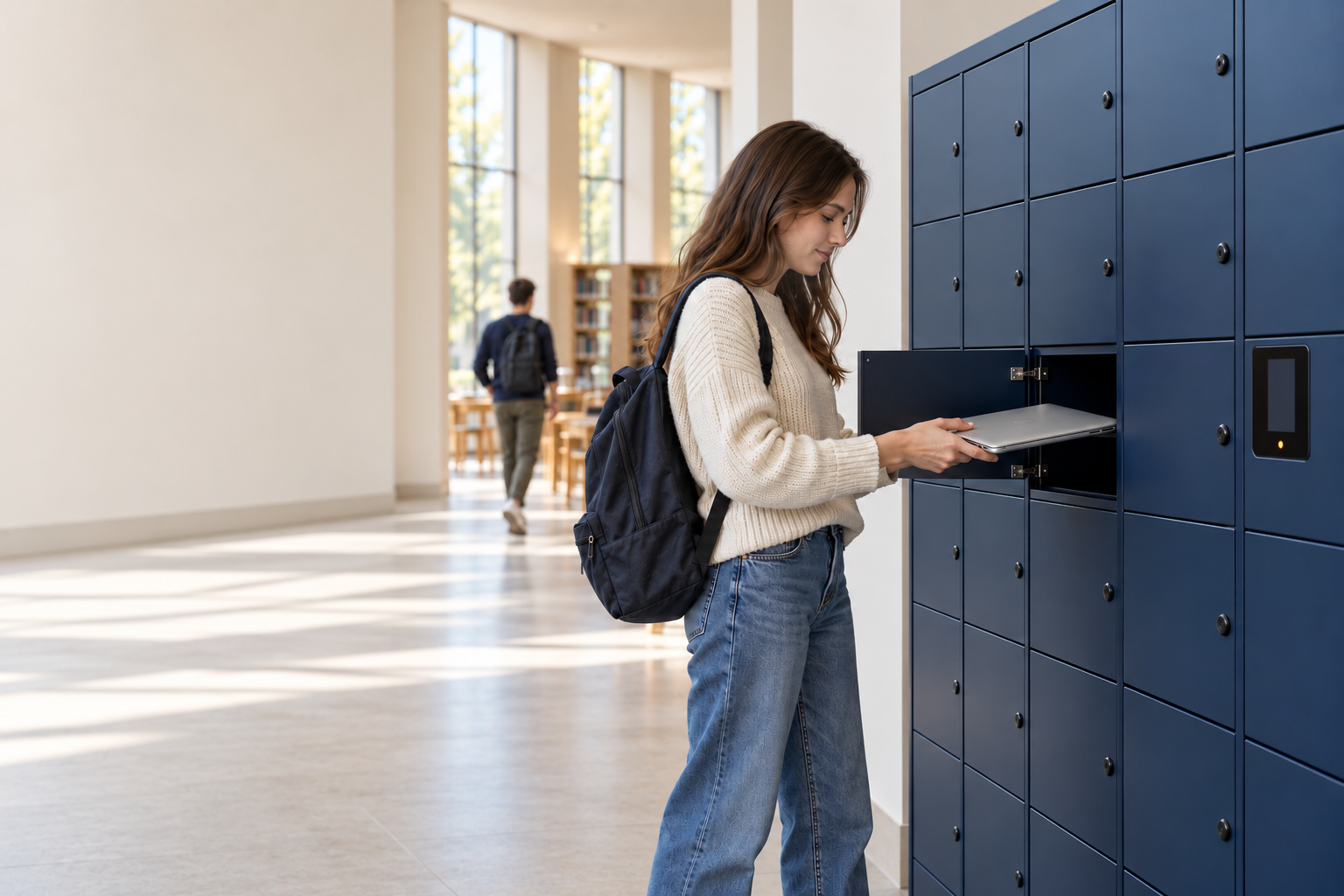
The transaction volume nobody else has to deal with.
Universities run the most transaction-heavy IT environment in the regulated world. Tens of thousands of devices borrowed, returned, swapped and reissued every academic year — with peak loads during fresher's week and semester turnover that crush traditional tech-bar models. Smart Collect® is the ServiceNow-native platform built for that volume.
A US university automated loaned-equipment handover at scale — tens of thousands of transactions through Smart Collect lockers per year, as the highest-rated IT service in the institution, and a 90% reduction in IT staff time on equipment returns.
Two populations, one IT team, and a transaction volume nothing else in the regulated world has to handle.
Universities run two parallel IT estates — the staff and faculty estate where the rules are normal enterprise IT, and the student-facing estate where the volume is multiples larger and the experience drives student satisfaction scores, which drives recruitment, which drives institutional revenue.
Enterprise IT, with research kit on top.
Academic staff, professional services, research groups, visiting scholars, contract researchers. Standard enterprise hardware plus the long tail of specialist research equipment that needs loan, return and accountability across multiple projects and grants.
- Self-service swap, lend, return for academic and professional staff
- Research-equipment loan tracking with grant-allocation reporting
- Visiting scholar provisioning without tech-bar bottleneck
- Audit trail extending into research equipment accountability
Transaction volume nothing else has to handle.
Tens of thousands of students borrowing devices, returning them at semester end, swapping peripherals, picking up loaner laptops for exams, accessing AV equipment for clubs and societies. Peak loads at fresher's week and semester turnover that no tech-bar model can scale to.
- Self-service device loan and return, 24/7, no tech-bar queue
- Peak-period throughput nothing manual can match
- Lost-equipment write-offs reduced through full accountability
- Student experience uplift measured by the institution
Built for the volume. Engineered for student experience.
Most IT-fulfilment platforms can handle a department or a campus. Higher education needs something that handles the entire institution — with the experience expectations of students who compare every interaction to consumer apps and the audit expectations of an institution running public funding.
Built for peak-period volume
Fresher's week. Semester end. Exam periods. The transaction volume isn't smooth — it spikes in ways that crush manual tech-bar models. Smart Collect's locker-and-vending model absorbs those peaks because the locker doesn't queue and the locker doesn't sleep.
Designed for student experience
Student experience is a recruitment lever and a retention lever. The reference customer saw Smart Collect become the highest-rated IT service in the institution — because self-service in 30 seconds beats a 45-minute tech-bar queue every time. Marketing notices.
Lost-equipment accountability
Universities write off significant equipment value every year through informal handover and porous return processes. Smart Collect closes the loop — every transaction bound to a named student, faculty member or staff record. The write-off line item shrinks, the equipment lifecycle gets clean.
US university. 70,000+ transactions. Top-rated IT service.
A large US university deployed Smart Collect to automate the most transaction-heavy parts of its IT-equipment workflow. The transaction volume tells one story. The student experience tells the other.
"The IT service students rate highest is also the one the institution worried most about scaling."
Before Smart Collect, the institution's loaned-equipment programme was tech-bar bound — queues during fresher's week, manual returns at semester end, write-offs from informal handover. After Smart Collect, the same workflow ran through self-service lockers — tens of thousands of transactions per academic year, the highest-rated IT service in the institution, and 90% of the IT-staff hours previously spent on equipment returns reclaimed for higher-value work.
Four workflows where university IT recovers the most hours.
Every use case Smart Collect supports applies to higher education — but four matter disproportionately. They're the ones where transaction volume, peak periods and student-experience expectations turn into IT-fulfilment bottleneck.
Student device loan and return at scale.
The backbone use case for universities. Laptops, tablets, AV kit, calculators, programme-specific equipment. Borrow workflows that absorb fresher's-week peaks, return workflows that absorb semester-end peaks, with full accountability on every transaction.
Peripheral fulfilment for students, staff and clubs.
Chargers, dongles, headsets, presentation clickers, USB drives. The long tail of small kit that consumes disproportionate tech-bar time. Smart Vending puts it directly into students' and staff hands 24/7 with no queue.
Break-fix swap during exam periods.
When a laptop fails the day of an exam, the cost isn't the laptop — it's the student experience and (in some institutions) the academic appeals process. Smart Collect's swap workflow keeps students moving even during peak academic-pressure periods.
Faculty & new starter kit-out.
New academic staff, visiting scholars, contract researchers. The institution wants Day-1 productivity without sending IT to every office. Smart Collect makes Day-1 self-service across campus.
Designed for the frameworks higher education already answers to.
Higher education has its own compliance landscape — student record privacy, public-sector procurement, research-funding accountability. Smart Collect doesn't generate compliance by itself, but because it runs as a certified application inside ServiceNow, the posture you already have extends to it natively.
FERPA US STUDENT RECORDS
Family Educational Rights and Privacy Act student record protections. Smart Collect transactions inherit your ServiceNow access controls and audit logs — supporting the FERPA-aligned access and accountability requirements applied to student-facing systems.
UK GDPR & OfS expectations UK HE
UK GDPR student-data handling and Office for Students transparency expectations. Smart Collect keeps all transactional data inside your ServiceNow instance — under your existing institutional data classification, retention and access controls.
Public-sector procurement VFM REPORTING
Public-funded institutions face value-for-money reporting expectations on capital purchases. Smart Collect's transaction-level visibility and lifecycle reporting support the VfM and audit narratives institutions present to boards, councils and funding bodies.
ISO 27001 alignment INFOSEC
Velocity Smart Technology is ISO 27001 and ISO 9001 certified. Smart Collect's architecture — ServiceNow-native, no external database, no third-party data plane — is designed to extend rather than complicate your institutional information security posture.
Common questions from university IT teams.
The reference customer's 70,000+ transactions per year aren't smooth — they spike in exactly the patterns you'd expect. Fresher's week, semester start, exam periods, semester end returns.
Smart Collect's locker-and-vending model absorbs these peaks because the locker doesn't queue and the locker doesn't sleep. Students self-serve in 30-second transactions. Capacity planning is about how many lockers, not how many tech-bar staff.
Yes. Every transaction is bound to a named user (student or staff) and a ServiceNow ticket. Non-return workflows can integrate with your student record system through your existing ServiceNow integration layer — meaning the institutional follow-up (registration holds, deposit deductions, graduation-blocking flags, depending on your policy) can be triggered automatically rather than chased manually.
This is one of the early-win outcomes our HE customers point to — the write-off line shrinks because the accountability is built in.
Yes. Universities with multiple campuses, residential life buildings, or distributed facilities deploy Smart Collect uniformly across the estate, with location-specific access controls and a single management plane inside ServiceNow.
For institutions with multiple sites and federated IT teams, the unified management plane is often part of the appeal — rather than each site running its own loan programme on its own spreadsheet.
Hardware accessibility is a configuration decision at deployment — locker height, touchscreen positioning, audio-prompt support, integration with existing campus accessibility services. We work this through during the workshop based on your existing accessibility posture.
For students who need staffed support specifically, Smart Collect doesn't replace the tech bar entirely — it removes the routine transactions so the staffed service can focus on the students who need it.
UK HE institutions typically work with us through either capital purchase or our leasing model — depending on whether the budget headroom is CapEx or OpEx and which framework agreements (CCS, Crescent Purchasing Consortium, sector-specific frameworks) you procure through.
We'd map the commercial structure during the workshop alongside the operational case. The ROI Challenge calculator produces a directional view of payback period based on your institution's size and use-case mix.
The case study headline (70,000+ transactions) comes from a large institution, but the unit economics work at smaller scale too — FE colleges, mid-sized universities, single-campus institutions, sixth-form colleges with significant device-loan programmes.
The right test is whether your device loan, return and peripheral workflow is currently consuming disproportionate tech-bar capacity — not how many students you have on roll.
Three ways to take this further.
US university case study, in full.
The complete write-up of how a large US university deployed Smart Collect to absorb 70,000+ equipment transactions a year, achieve top-rated IT-service status across the institution, and reclaim 90% of the IT staff time previously spent on equipment returns.
Read the full case studyTake the ROI Challenge.
Use our interactive ROI calculator to model what Smart Collect could deliver across your institution. Get a directional view in 30 seconds, or book the workshop for a bespoke business case calibrated to your transaction volume, peak periods and procurement model.
Open the calculatorHow Smart Collect® actually works.
The full technical breakdown of the only ServiceNow-certified locker and vending application — architecture, features, integration model, and the reasons it's built differently to every other vendor in the category.
See the platform pageA 60-minute workshop, scoped to your institution.
We work through your campus model, your transaction volume, your peak-period patterns, your procurement framework and the specific workflows that move your numbers. You leave with a sector-anonymised view of what we'd build, what it'd cost, what it'd save and when it'd pay back. No slideware. No sales pitch. Just the maths and the model.