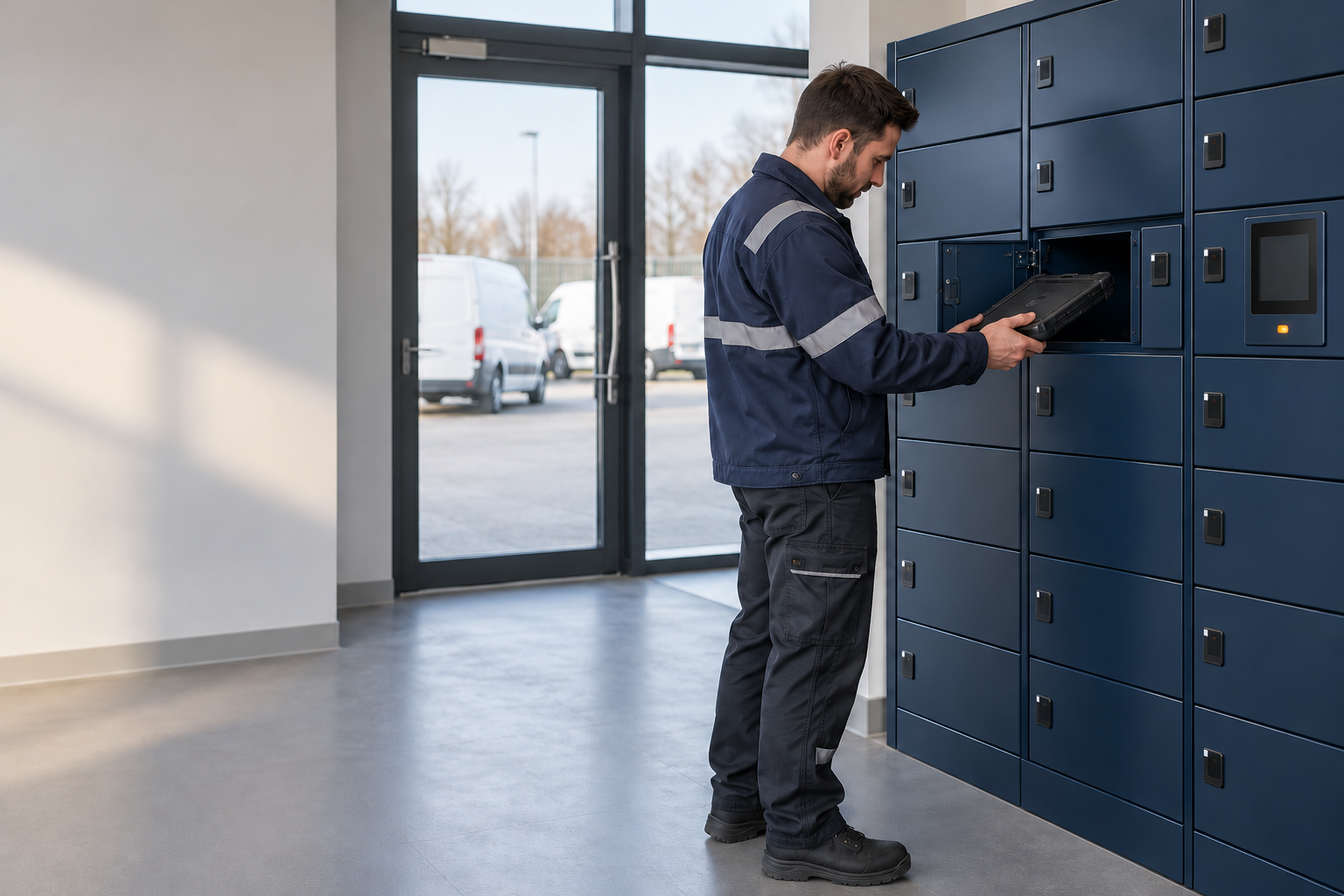
Distributed by definition. Regulated to the kilometre.
Substations, generation sites, treatment plants, depot networks, pipelines, distributed field assets — the operational estate dwarfs the office estate. IT support has to reach all of it, and the kilometres engineers drive between sites are the single largest line item in your IT operating cost. Smart Collect® is the ServiceNow-native platform built to remove those journeys without losing the audit chain.
Engineer travel between sites is the largest line item. It shouldn't be.
Energy operators and utilities providers run two parallel IT estates — a relatively contained HQ environment, and an operational estate measured in hundreds of remote sites. Most IT-fulfilment platforms are built for the first. Smart Collect is built for both.
Enterprise IT, regional offices, dispatch centres.
Engineering teams, network operations, planners, billing, customer service. Standard enterprise hardware, normal volume, but with the layered requirement that some users (control room, dispatch) cannot be without working kit for any period.
- Self-service swap, lend, return for office and control-room teams
- Every transaction bound to a named user and a ServiceNow record
- Faster fulfilment for control-room hardware swaps
- Estate-wide visibility from one ServiceNow management plane
Substations, plants, depots, field crews.
The operational estate that can dwarf the office one. Field engineers, asset technicians, mobile crews, regulated environments where every IT-asset movement against a site boundary needs an audit-grade record.
- Locker and vending self-service at remote sites, 24/7
- Shared field-equipment loan and return with full audit chain
- Carbon-measurable reduction in engineer dispatch mileage
- Site-specific access controls in regulated environments (nuclear, gas, water)
The kilometre is the unit of cost. Smart Collect reduces it.
Energy and utilities IT teams measure operating cost in kilometres travelled. Smart Collect attacks that number directly — by turning every remote site into a self-service IT and shared-equipment point, with the audit chain still written inside your existing ServiceNow platform.
Built for distributed estates
Energy operators and utilities providers don't have one site — they have hundreds. Substations, plants, depots, treatment works, field-asset locations. Smart Collect deploys uniformly across the estate, with site-specific access controls and a single management plane inside ServiceNow.
Shared equipment, properly tracked
Test kit, calibration tools, mobile hotspots, ruggedised laptops, safety equipment. The shared-equipment loop is where audit chains and asset accountability usually break in field operations. Smart Collect closes it inside ServiceNow with no clipboards and no porous handover.
Regulator-grade chain of custody
Nuclear sites have NRC and ONR. Network operators have NERC CIP. UK operators face NIS Directive and Ofgem. Whichever framework you answer to, the audit chain on every IT-asset movement is written inside the system the regulator already inspects.
Two energy & utilities transformations. One model, two outcomes.
We've published two case studies in this sector covering very different parts of the energy and utilities landscape — a US nuclear-energy operator focused on engineer-travel reduction and audit compliance, and a UK national utilities provider focused on shared-equipment loss reduction at scale.
60% reduction in on-site IT tickets across regulated sites.
A US nuclear-energy operator removed engineer travel between regulated sites for routine IT handovers — recovering staff time, cutting carbon-heavy mileage substantially, and maintaining a regulator-grade audit chain on every IT-asset movement.
90% reduction in shared-equipment loss and damage.
A UK national utilities provider turned a porous shared-equipment model — where field tools were habitually lost or damaged between handovers — into a measured, audited workflow with instant-SLA fulfilment. The 90% loss reduction translated directly to procurement spend recovered.
1,500+ km per month per operator. At scale, that's a Scope 3 reduction.
For energy and utilities operators with ESG reporting obligations, engineer-travel reduction is one of the few IT-led initiatives that produces an auditable carbon outcome. Smart Collect's travel-reduction numbers can be tied directly to Scope 3 reporting, and we model the carbon side as part of the ROI workshop.
Four workflows where energy & utilities IT recovers the most kilometres.
Every use case Smart Collect supports applies to energy and utilities — but four matter disproportionately. They're the ones where engineer travel, shared-equipment accountability and regulator-grade audit most often turn into IT-fulfilment delay.
Break-fix swap at remote sites.
When a laptop, ruggedised tablet or control-room device fails at a substation, treatment plant or remote depot, the cost isn't the device — it's the engineer drive time, the lost field-operations hours, and (for nuclear) the access-clearance overhead. Smart Collect drops fulfilment to minutes.
Shared field-equipment loan and return.
Test meters, calibration kit, ruggedised laptops, safety equipment. Shared kit that moves between field crews, projects and sometimes sites. The borrow-and-return loop is where loss and damage usually accrue. Smart Collect closes it inside ServiceNow with full accountability.
New starter kit-out for field crews and operators.
A new field technician starting at a regional depot or generation site needs the same Day-1 productivity as a HQ hire — without an IT engineer driving 60 km to hand over equipment in person. Smart Collect makes Day-1 self-service at any site.
Peripheral fulfilment across the distributed estate.
Headsets, dongles, mice, monitors, ruggedised cases, mobile-hotspot replacements. Low value individually, high volume across the operational estate, and almost always the work that turns engineer travel into porter work. Smart Vending removes the trip entirely.
Designed for the regulators your sub-sector already answers to.
Energy and utilities regulatory frameworks vary widely by sub-sector and geography — nuclear is not gas, US is not UK. Smart Collect doesn't generate regulatory compliance by itself, but because it runs as a certified application inside ServiceNow, the posture you already have extends to it natively.
NERC CIP US ELECTRIC GRID
North American Electric Reliability Corporation Critical Infrastructure Protection. Smart Collect transactions inherit your ServiceNow record integrity and access controls — supporting the asset-tracking and access-control requirements applied to bulk electric system cyber assets.
NIS Directive & NIS2 UK / EU OPERATORS
UK and EU regulatory frameworks for operators of essential services. Smart Collect's ServiceNow-native model keeps asset-movement records inside your existing classification and accountability framework — aligned with the reporting expectations of UK NCSC and EU NIS2 supervisors.
IEC 62443 OT & ICS SECURITY
Industrial automation and control system security standards. Smart Collect operates at the IT layer (asset and equipment fulfilment), inheriting your existing IT/OT boundary controls rather than introducing a new boundary — designed to support rather than complicate OT/ICS security postures.
ISO 27001 alignment INFOSEC
Velocity Smart Technology is ISO 27001 and ISO 9001 certified. Smart Collect's architecture — ServiceNow-native, no external database, no third-party data plane — is designed to extend rather than complicate your existing information security posture.
How an energy or utilities rollout actually goes.
Smart Collect's ServiceNow-native architecture means energy and utilities deployments don't take the year that most standalone field-asset systems take. Here's the typical shape of the first ninety days.
Estate scoping & regulator alignment.
We work alongside your IT, asset management and regulatory compliance teams to scope Smart Collect against your existing controls — NERC CIP for US grid, NIS Directive for UK / EU, ONR / NRC for nuclear. The data plane doesn't move, so the compliance question is narrower than teams expect.
Pilot site install.
Locker, vending or kiosk units land at the pilot site — usually a single depot, plant or substation. Smart Collect application installs into your ServiceNow instance during a standard change window. Pilot users start using it the same week.
Estate rollout planning.
With pilot evidence and regulatory sign-off in hand, your team rolls the same configuration across additional sites. For energy and utilities customers with hundreds of remote sites, the rollout typically runs as a phased programme — with the carbon and travel-reduction numbers compounding wave by wave.
Common questions from energy & utilities IT teams.
The reference customers are running across distributed estates that include nuclear generation sites, substations, depots and treatment facilities — each with its own access patterns and audit requirements.
Multi-site rollouts typically run as a phased programme — pilot at one site first, validate the configuration, then roll out in waves. One ServiceNow management plane, site-specific controls layered on top of a common base. We map the rollout sequence and economics during the workshop.
Smart Collect supports a range of connectivity models. For sites with normal IT network connectivity, the standard cloud-managed deployment applies. For genuinely air-gapped sites — some nuclear environments, some critical control facilities — we have specific deployment patterns that we'd discuss during the workshop based on your security architecture.
The general principle — that the audit chain lives inside ServiceNow, not in a vendor cloud — still applies.
This is precisely the UK national utilities customer's primary use case. Smart Collect's loan-and-return workflow is built to handle any shared equipment that moves between users and sites — not only IT.
Test meters, calibration tools, ruggedised laptops, mobile hotspots, safety equipment. Anything that gets borrowed, used, returned and re-allocated. The 90% loss-reduction outcome they reported came from putting this category of equipment through Smart Collect rather than leaving it on porous paper handover.
Yes. The travel-reduction outcomes Smart Collect produces are kilometres-measurable. The nuclear-energy reference customer reported 1,500+ km per month saved per operator — a number that translates directly into Scope 3 carbon reduction under standard reporting methodologies.
For ESG-reporting energy and utilities organisations, we include the carbon-impact model as part of the ROI workshop output. It's one of the few IT-led initiatives that produces an auditable carbon outcome alongside an operational efficiency one.
All transactional data lives inside your ServiceNow instance. Every dispense, return, swap and lend is a ServiceNow record under your data residency, your retention policy and your access controls.
For energy and utilities operators with NERC CIP, NIS Directive or other critical-infrastructure data-handling requirements, this is the single biggest architectural difference between Smart Collect and any other locker vendor — there is no vendor cloud holding critical-infrastructure transactional records.
The US nuclear-energy reference customer is operating Smart Collect across multiple nuclear-licensed sites. The access patterns, audit chain and personnel-clearance integration were specifically scoped against US NRC requirements during their rollout.
For UK ONR-regulated sites or equivalent national-body regulated environments, the deployment pattern adapts to the local framework — with the underlying ServiceNow-native chain of custody remaining the constant.
Three ways to take this further.
US nuclear energy case study, in full.
The complete write-up of how a US nuclear-energy operator removed 60% of on-site IT tickets, recovered 31-42% of staff time and saved 1,500+ km of engineer travel per month — while maintaining a regulator-grade audit chain.
Read the case studyUK national utilities case study.
The complete write-up of how a UK national utilities provider turned its shared field-equipment model from porous paper handover into a measured, audited workflow — producing a 90% loss reduction and an instant-SLA fulfilment model.
Read the case studyTake the ROI Challenge.
Use our interactive ROI calculator to model what Smart Collect could deliver across your distributed energy or utilities estate. Get a directional view in 30 seconds, or book the workshop for a bespoke business case calibrated to your operations.
Open the calculatorA 60-minute workshop, scoped to your distributed estate.
We work through your operating environment, your distributed estate, your regulatory framework and the specific use cases that move your numbers. You leave with a sector-anonymised view of what we'd build, what it'd cost, what it'd save, what it'd reduce in carbon terms, and when it'd pay back. No slideware. No sales pitch. Just the maths and the model.