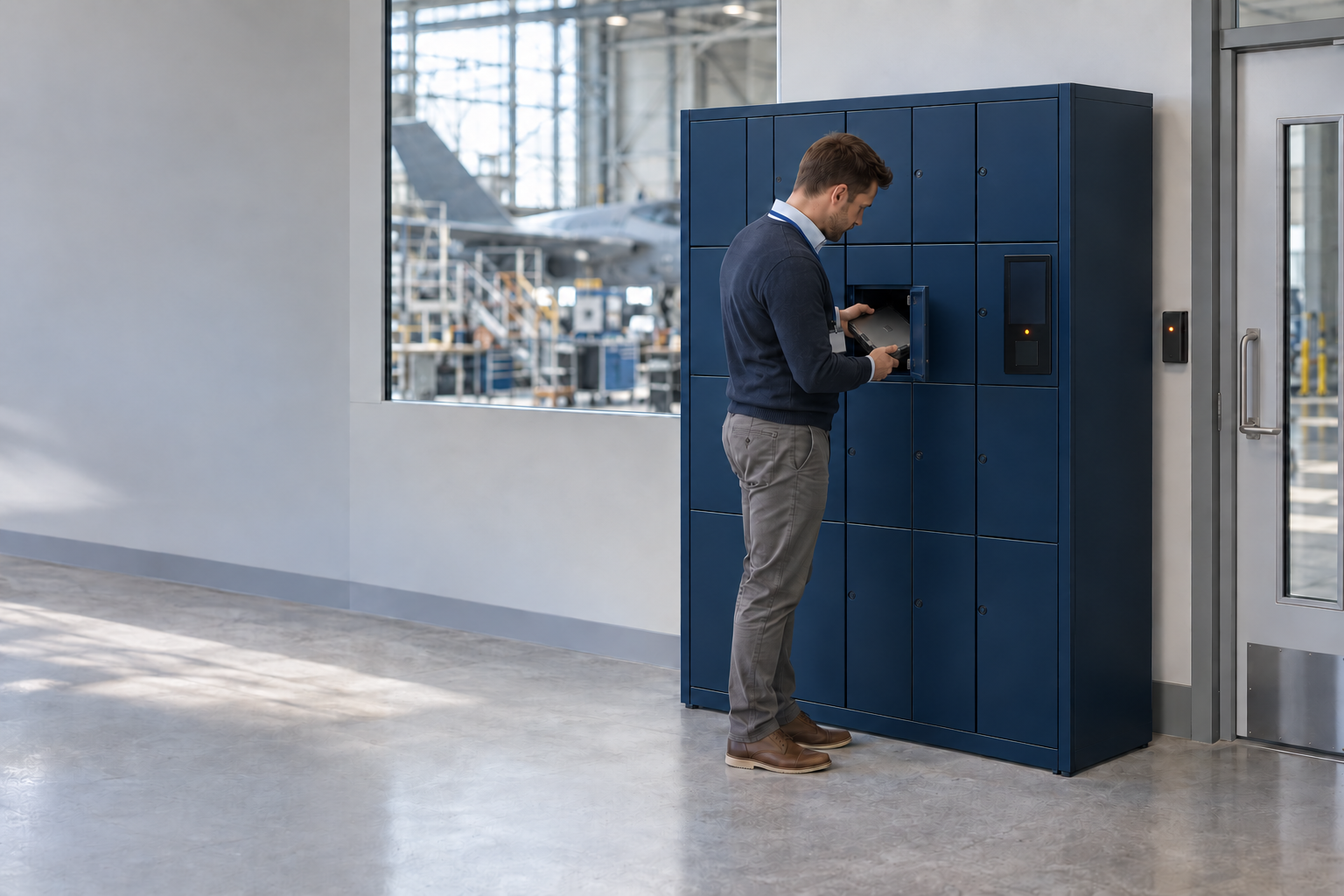
Distributed sites. Critical parts. Defence-grade chain of custody.
Aerospace primes, defence integrators and government contractors run the most distributed enterprise IT estates in the regulated world — and every site needs IT support, parts fulfilment and audit-grade chain of custody. Smart Collect® is the ServiceNow-native platform built to handle that estate without sending an engineer to every site.
A defence prime moved critical parts and IT fulfilment to Smart Collect-orchestrated lockers across its distributed engineering and manufacturing estate — eliminating routine engineer travel while maintaining 100% audit chain compliance.
Engineer travel is the dominant operating cost. The audit chain is the constraint.
Defence primes and aerospace integrators run two parallel estates — the engineering HQ where the rules are normal enterprise IT, and the distributed manufacturing, test and field sites where every IT-asset movement has to be tracked against ITAR, EAR, CMMC and the customer's own programme-level audit.
Enterprise IT, at programme scale.
Engineering offices, design centres, software development teams. Standard enterprise hardware, normal volume, but with the added layer that every laptop, dongle and headset may end up touching a programme that's export-controlled.
- Self-service swap, lend, return and replacement across HQ
- Every transaction bound to a named user and a ServiceNow record
- Programme-level allocation built into the ticket model
- Reduced engineer dispatch for routine fulfilment
Manufacturing, test, field, supplier.
Manufacturing floors, test ranges, supplier-network locations, government-contractor sites. Engineer travel here is the largest line item in IT operating cost — and the slowest route to fixing a critical part shortage on the production line.
- Critical parts pipeline straight to the production line, 24/7
- Defence-grade audit chain on every IT and parts movement
- Cleared-personnel onboarding without an IT engineer dispatch
- Estate-wide visibility from one ServiceNow management plane
The audit chain isn't added on. It's built in.
Smart Collect runs as a certified application inside your existing ServiceNow platform. Which means the chain of custody for every IT asset and every critical part is written as the transaction happens — against your existing programme-level reporting, not a third-party vendor database.
Built for distributed estates
Defence primes don't have one site — they have dozens, sometimes hundreds, often across multiple countries with different export-control rules. Smart Collect deploys uniformly across the estate, with site-specific access controls and a single management plane inside ServiceNow.
Export-control chain of custody
Every dispense, return, swap and lend is bound to a named user, a named asset and a ServiceNow ticket. ITAR, EAR and CMMC chain-of-custody requirements are answered inside the system the auditor already inspects — not reconstructed at audit time from paper handover sheets.
Parts pipeline to the line
Production-line stoppages cost in the thousands per minute. Smart Collect's vending and locker platform moves critical parts directly to operators 24/7, without engineer dispatch, while keeping the chain of custody intact. The line keeps running. The audit trail keeps writing.
US defence prime. 34+ sites. 35% travel reduction.
One of the largest US defence primes moved critical parts and IT fulfilment to Smart Collect-orchestrated lockers across its distributed engineering, manufacturing and supplier-network estate. Here's what changed.
"We removed the engineer dispatch from routine fulfilment without losing the audit chain."
Before Smart Collect, every routine IT and critical-parts fulfilment at a remote site meant either an engineer dispatch or a paper-based handover. After Smart Collect, the same workflow runs through ServiceNow-orchestrated lockers at the site — with 170+ parts per month flowing through the system, 35% less engineer travel across 34+ sites, and full ITAR-grade chain of custody on every movement.
Four workflows where defence IT recovers the most hours.
Every use case Smart Collect supports applies to aerospace and defence — but four matter disproportionately. They're the ones where engineer travel, programme-level audit and cleared-personnel constraints turn into IT-fulfilment delay.
New starter kit-out for cleared personnel.
An engineer starting on Monday at a manufacturing site or supplier location needs the same Day-1 productivity as a HQ hire — without an IT engineer flying out to hand over equipment in person.
Break-fix swap at remote sites.
When a laptop fails at a test range or manufacturing facility, the cost isn't the laptop — it's the engineer travel hours and the lost programme time. Smart Collect's swap workflow drops fulfilment to minutes inside the same ServiceNow ticket.
Critical parts pipeline to the production line.
Test equipment, calibration kit, programme-specific tooling. Smart Vending and locker workflows put critical parts directly into operators' hands 24/7 with the full ITAR-grade audit chain attached to every transaction.
Peripheral fulfilment across distributed estate.
Headsets, dongles, mice, monitors. Low value individually, high volume across dozens of sites, and almost always the work that turns engineer travel into porter work. Smart Vending removes the trip entirely.
Designed for the regulators your programme already answers to.
Smart Collect doesn't generate regulatory compliance by itself — that always sits with your security, compliance and programme teams. But because it runs as a certified application inside ServiceNow, the regulatory posture you already have extends to it natively.
ITAR & EAR EXPORT CONTROLS
International Traffic in Arms Regulations and Export Administration Regulations require traceable chain of custody on every controlled-technology movement. Smart Collect transactions inherit your ServiceNow record integrity, access controls and audit trail — with every movement bound to a named, cleared user.
CMMC & NIST 800-171 DEFENCE CONTRACTOR
Cybersecurity Maturity Model Certification and NIST controls for defence contractors. Smart Collect on ServiceNow inherits your existing CUI handling, access control, audit logging and accountability postures — rather than introducing a separate system to certify.
UK MOD JSP requirements JSP 440 / 604
UK MOD security and information management policies for contractors. Smart Collect supports the asset-handling and audit-trail expectations of MOD-facing programmes by keeping all transactional records inside your ServiceNow instance — under your own data classification and retention rules.
ISO 27001 alignment INFOSEC
Velocity Smart Technology is ISO 27001 and ISO 9001 certified. Smart Collect's architecture — ServiceNow-native, no external database, no third-party data plane — is designed to extend rather than complicate your existing information security and asset management posture.
Why most smart-locker platforms struggle in defence.
The smart-locker market is mostly built for retail click-and-collect or generic enterprise hardware drop-off. Almost none of it is built for export-controlled, security-cleared, programme-audited environments. Here's how Smart Collect compares on the axes that actually matter for defence.
How a defence rollout actually goes.
Smart Collect's ServiceNow-native architecture means defence deployments don't take the year that most standalone secure-system rollouts take. Here's the typical shape of the first ninety days.
Security & compliance scoping.
We work alongside your IT security, compliance and programme teams to map Smart Collect against your existing ITAR/EAR controls, CMMC posture and ServiceNow accreditation. The data plane doesn't move — usually less work than teams expect.
Pilot site install.
Locker, vending or kiosk units land at the pilot site — usually a single engineering campus or manufacturing facility. Smart Collect application installs into your ServiceNow instance during a standard change window. Pilot users start using it the same week.
Estate rollout planning & sign-off.
With pilot evidence and security sign-off in hand, your team rolls the same configuration across additional sites. Most defence customers go from pilot to multi-site rollout within a quarter — orders of magnitude faster than introducing a new standalone certified system.
Common questions from defence IT and security teams.
Every Smart Collect transaction is bound to a named user, a named asset and a ServiceNow ticket. That binding is written at the moment the transaction happens — not reconstructed at audit time.
For ITAR and EAR compliance specifically, this means the export-control record exists in the same authoritative system your auditor already inspects (ServiceNow), under your existing data classification, with your existing access controls. There is no separate vendor-held log to reconcile.
All transactional data lives inside your ServiceNow instance. Every dispense, return, swap and lend is a ServiceNow record under your data residency, your retention policy and your access controls.
For defence programmes with strict data-residency rules, this is the single biggest architectural difference between Smart Collect and any other locker vendor — there is no vendor cloud holding defence transactional records.
Smart Collect supports authentication patterns appropriate for cleared environments, including badge integration with existing access control systems, PIN-code retrieval that doesn't require shared touchscreens, and pre-allocated codes for sensitive workflows.
For genuinely air-gapped sites, the deployment model is different and we'd discuss it as a specific configuration during the workshop. The general principle — that the audit chain lives inside ServiceNow, not in a vendor cloud — still applies.
The reference customer is running Smart Collect across 34+ sites today, with a uniform configuration managed from one ServiceNow plane. Site-specific controls (access, working hours, programme allocation) are layered on top of a common base.
Multi-site rollouts typically run as a phased programme — pilot at one or two sites first, then a wave-based rollout once the configuration is validated for your programme. We'd map this during the workshop.
Yes. Because every transaction is a ServiceNow record, you can attach programme allocation, cost-centre tagging and contract-line-item references at the ticket level. The cost-recovery reporting that defence primes typically run quarterly becomes a ServiceNow report rather than a spreadsheet reconciliation.
This is typically one of the early-win outcomes our defence customers point to — the audit and cost-recovery work that used to consume programme-management hours becomes routine reporting.
Smart Collect can be deployed at supplier sites under your programme — either as part of your own estate (with the supplier as a managed user) or as a federated deployment depending on the contract structure.
For programmes where supplier compliance is part of your own compliance posture, having Smart Collect at supplier sites means the same audit chain extends across the full supply network — rather than ending at your own perimeter.
Three ways to take this further.
US aerospace case study, in full.
The complete write-up of how a US defence prime deployed Smart Collect across 34+ engineering and manufacturing sites, removing 35% of engineer travel and moving 170+ critical parts a month while maintaining defence-grade chain of custody.
Read the full case studyTake the ROI Challenge.
Use our interactive ROI calculator to model what Smart Collect could deliver across your defence estate. Get a directional view in 30 seconds, or book the workshop for a bespoke business case calibrated to your programme.
Open the calculatorHow Smart Collect® actually works.
The full technical breakdown of the only ServiceNow-certified locker and vending application — architecture, features, integration model, and the reasons it's built differently to every other vendor in the category.
See the platform pageA 60-minute workshop, scoped to your defence estate.
We work through your programme, your distributed estate, your export-control posture and the specific use cases that move your numbers. You leave with a sector-anonymised view of what we'd build, what it'd cost, what it'd save and when it'd pay back. No slideware. No sales pitch. Just the maths and the model.