<img src="https://secure.intelligence52.com/795135.png" style="display:none;">

Asset vending as-a-service: automate IT support

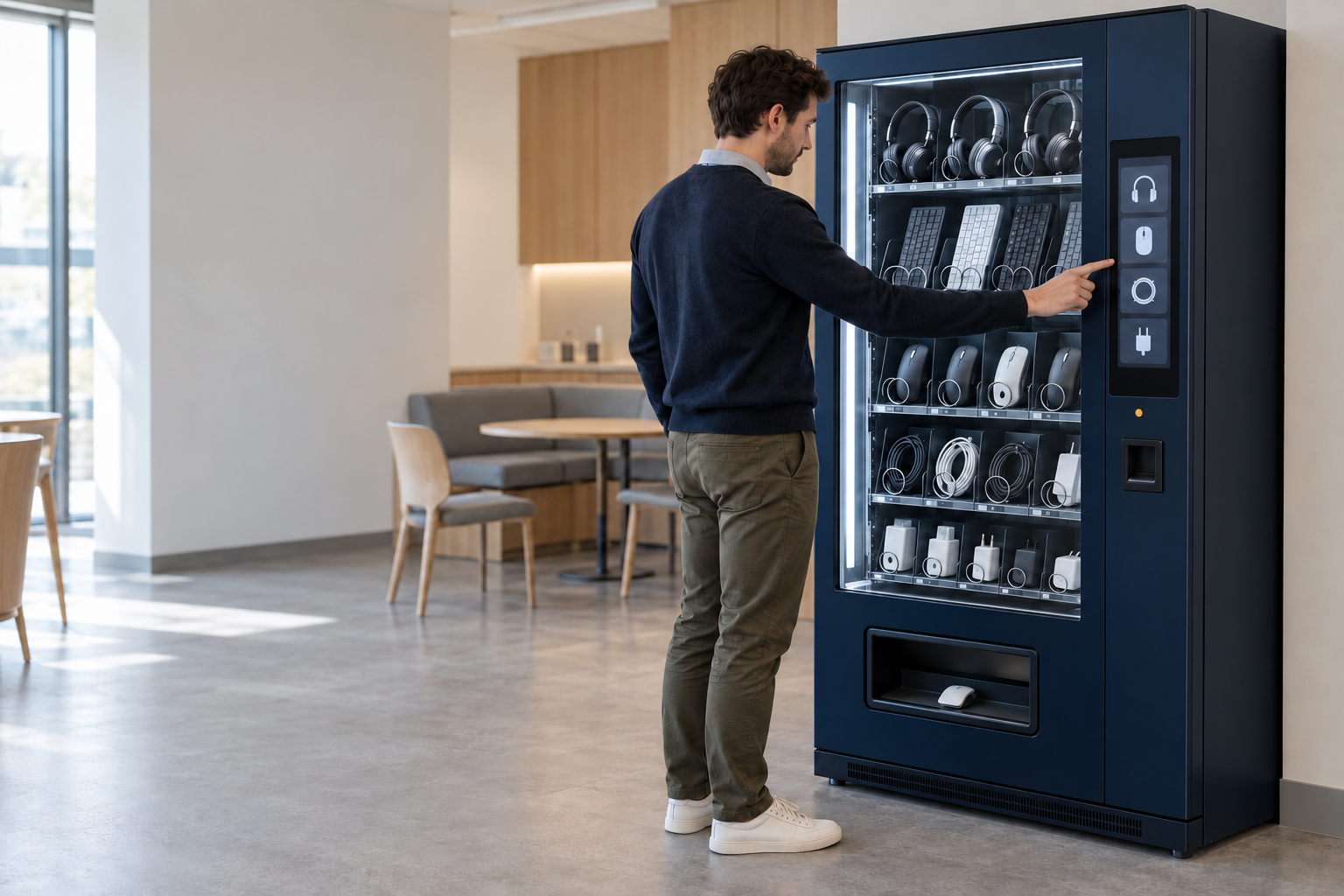
IT technician stocking smart vending machine


TL;DR:

  • Asset vending as-a-service automates hardware distribution, management, and support through subscription models.
  • Integration with ServiceNow streamlines asset requests, fulfillment, and lifecycle updates automatically.
  • AVaaS reduces costs, manual efforts, and device downtime while shifting accountability to service providers.

Most IT operations leaders assume that device distribution and support will always require significant manual effort: a storeroom, a helpdesk queue, and a technician physically handing over hardware. That assumption is increasingly costly. As workforces spread across multiple sites and employee expectations shift, the traditional model creates friction, delays, and hidden overheads that compound at scale. Asset vending as-a-service (AVaaS) offers a fundamentally different approach, combining automated hardware dispensing, integrated management software, and ongoing support under a single subscription model that works directly inside your existing ServiceNow environment.

Table of Contents

Key Takeaways

Point Details
AVaaS explained clearly Asset vending as-a-service means automating device provision and support as a managed subscription, not just a product.
ServiceNow integration advantage Connecting asset vending with ServiceNow unlocks true workflow automation for IT teams.
Reduces cost and complexity Shifting from capex to opex, AVaaS cuts up-front costs and operational headaches for large enterprises.
Practical use cases Break/fix, remote worker support, and onboarding are key scenarios for AVaaS in enterprise IT.

Understanding asset vending as-a-service

The term “asset vending as-a-service” is still emerging in enterprise IT circles, but its foundations are well established in adjacent markets. In unattended retail and facilities management, Vending-as-a-Service (VaaS) already refers to a subscription model that bundles vending hardware, management software, maintenance, remote monitoring, and restocking into a predictable monthly fee, eliminating the need for operators to own and manage the underlying infrastructure.

Translated into the IT context, AVaaS applies the same logic to enterprise device management. Instead of procuring, deploying, and maintaining a fleet of smart lockers or vending systems as capital assets, IT teams consume the full capability as a managed service. Hardware, firmware updates, break/fix support, and platform integrations are all included. The organisation accesses the technology without carrying the ownership burden.

Understanding what AVaaS actually covers helps clarify why it is attracting attention among IT operations leaders:

  • Automated hardware dispensing: Smart lockers and vending machines that issue and receive devices without human intervention
  • Integrated management software: A platform that connects dispensing events directly to your IT service management (ITSM) system
  • Ongoing maintenance and support: Physical hardware servicing, software updates, and monitoring included in the subscription
  • Asset tracking and lifecycle management: Real-time visibility over every device issued, returned, or flagged for repair
  • Scalable deployment: The ability to add or relocate units across sites without triggering fresh procurement cycles

It is worth distinguishing AVaaS from simply buying smart hardware. If you purchase a locker system outright and bolt a software licence on top, you still own the problem when the hardware fails, the software needs updating, or your estate grows. Understanding the differences between smart vending and lockers is a useful starting point, but the bigger question is whether you want to own that infrastructure at all.

“The shift towards subscription-based asset dispensing represents a genuine operational model change for IT, not merely a procurement preference. Organisations that treat it as a simple technology purchase often underestimate the ongoing operational value.”

The emerging niche for fully managed IT asset dispensers contrasts directly with the traditional buy and own approach, where IT teams carry the full lifecycle burden from day one. AVaaS removes that burden and replaces it with a predictable, accountable service relationship.

How ServiceNow integration powers automated asset workflows

Now that we have defined asset vending as-a-service, let us look at how ServiceNow integration brings this model to life within enterprise IT support.

ServiceNow is already the operational backbone for the majority of large enterprise IT teams. It manages incidents, requests, asset records, and change workflows. The natural question is: what happens when your physical device dispensing is natively connected to that same system?

The answer is that the entire asset lifecycle becomes automated. When a user raises a request for a replacement laptop, ServiceNow can trigger a locker to pre-load and reserve the correct device, notify the user via automated message, and update the asset record at the moment of collection. No manual intervention. No helpdesk queue. No technician hand-off.

Here is how a typical ServiceNow-driven AVaaS workflow operates in practice:

  1. Request initiation: An employee raises a service request or reports a fault through the ServiceNow self-service portal
  2. Automatic fulfilment trigger: ServiceNow identifies the nearest stocked dispenser unit and reserves the appropriate device
  3. User notification: The employee receives automated instructions with their collection reference
  4. Secure dispensing: The smart locker or vending unit releases the device after verifying the user’s identity
  5. Asset record update: The asset record, assignment status, and location data are updated in ServiceNow in real time
  6. Return and repair: When a faulty device is returned, the locker triggers a repair ticket automatically, with no manual logging required

According to the ServiceNow-certified Velocity Smart Collect app, this model enables automated asset requests, fulfilment from stock, loaner issuance for break/fix scenarios, and device returns that trigger repair workflows without any manual step in the chain.

For IT operations leaders, the practical benefit is significant. Your team stops acting as a distribution function and starts focusing on higher-value work. The ServiceNow integration guide outlines the technical setup in more detail, and the approach to integrating smart lockers within existing workflows demonstrates how quickly this can be operational.

Woman entering IT device workflow request

The data flow matters too. Because the dispensing system runs natively inside your ServiceNow instance rather than as a separate platform, there is no API translation layer, no duplicate data entry, and no GDPR risk from exporting asset or user data to a third-party system. Every transaction is recorded within your existing governance framework.

Pro Tip: Before deploying AVaaS across multiple sites, map your highest-volume device request categories first. Automating the top three request types alone can eliminate the majority of manual helpdesk touchpoints for asset provisioning.

“For IT ops leaders in large enterprises, asset vending integrated with ServiceNow optimises device workflows by automating distribution and support, cutting costs and downtime at scale.”

Comparing AVaaS subscription to traditional models

With workflows automated by ServiceNow, it is vital to understand how AVaaS stacks up against familiar acquisition models.

Most large enterprises approach IT asset provision through one of two routes: direct capex procurement of hardware and software, or longer-term leasing arrangements. Both models place the operational management burden squarely with the IT team. AVaaS changes that calculation entirely.

Factor Traditional capex model AVaaS subscription
Up-front cost High capital outlay Low or zero capex
Maintenance Managed in-house Included in subscription
Software updates Manual or contract-dependent Automatic and continuous
Scalability Requires fresh procurement Add or relocate units flexibly
Forecasting Manual, often reactive AI-driven, data-informed
ITSM integration Custom or third-party Native ServiceNow integration
Risk Owned by the organisation Shared or transferred

The shift from capex to opex is one of the most significant financial advantages of the VaaS model, and it applies directly to IT asset vending. Finance teams benefit from predictable monthly costs rather than lumpy capital cycles. IT teams benefit from removing the overhead of hardware lifecycle management.

Beyond cost structure, the operational differences are material:

  • Restocking and inventory management are handled as part of the service, not added to an IT team’s task list
  • Firmware and software updates are applied continuously rather than queued behind change windows
  • Hardware failures are resolved by the service provider, not escalated internally
  • Usage data and analytics are available automatically, enabling smarter decisions about asset deployment

The business case for improved IT service delivery is often easier to construct under an AVaaS model because costs are transparent and measurable outcomes are built into the service terms. When a CIO or finance director asks for a return on investment figure, you can point directly to reduced helpdesk calls, faster device provisioning times, and lower asset write-offs. These are concrete, trackable numbers.

For teams currently managing smart vending for IT support under a traditional ownership model, the transition to AVaaS also resolves the maintenance dilemma that grows more acute as hardware ages and estates expand.

A note on scale: The advantage of AVaaS grows proportionally with organisational size. For a 500-person office, manual processes might feel manageable. For a 15,000-person estate spread across 30 sites, the manual model becomes genuinely unworkable. That is where AVaaS delivers its sharpest value.

Infographic comparing AVaaS and traditional IT asset models

Key use cases and implementation tips for IT leaders

Understanding the comparison, let us turn to real-world examples and practical guidance for IT leaders considering AVaaS.

The most common deployment scenarios we see across enterprise clients fall into three broad categories. Each has distinct characteristics and implementation considerations.

Use case Challenge solved Key ServiceNow trigger
Break/fix device replacement Long wait times for faulty device swaps Incident raised, loaner auto-assigned
New starter onboarding Manual device allocation, delay on first day HR workflow triggers device reservation
Field worker hardware provision No onsite IT at remote locations Request portal triggers nearest dispenser
Loaner device management Lost visibility over loaner fleet Return event triggers audit and reassignment

For each of these scenarios, the implementation path follows a consistent sequence. IT leaders considering AVaaS deployment with ServiceNow should approach it in the following order:

  1. Audit your current request volume by category. Identify which device request types are highest frequency and lowest complexity. These are your first automation candidates.
  2. Map existing ServiceNow workflows that touch those request types. Understand where manual steps currently occur and which of those can be replaced by dispenser events.
  3. Define locker placement strategy based on user density and request origin data. Putting dispensers in low-traffic locations reduces their value immediately.
  4. Configure ServiceNow workflows to trigger on dispenser events, covering both issuance and return. Ensure asset records, assignment tables, and incident queues are all updated automatically.
  5. Run a pilot on a single site before scaling. Choose a site with measurable baseline data so you can quantify improvement clearly.
  6. Establish KPIs before go-live. Mean time to device provision, helpdesk call volume for asset requests, and asset loss rates are all strong starting metrics.

The improvement in IT support efficiency that organisations achieve through this approach is well documented, and the enterprise asset access model enabled by electronic lockers gives IT teams the control and auditability they need without the manual overhead.

One often overlooked implementation consideration is change management. The technology itself deploys quickly. Changing user behaviour takes longer. Employees who have always walked to a helpdesk for a new device need clear communication about the new process, supported by an intuitive self-service experience that makes the change feel like an upgrade, not a disruption.

For IT ops leaders, automating device workflows at scale depends on clean asset data in ServiceNow from day one. If your asset records are patchy or out of date, the dispenser system will surface those gaps immediately. Treat data quality as a pre-deployment requirement, not an afterthought.

Pro Tip: Measure helpdesk call volume for device requests before and after AVaaS deployment. In most large enterprise deployments, automated dispensing reduces asset-related helpdesk contacts by 40% or more within the first three months. Use that data to build the case for further automation investment.

Why asset vending as-a-service will redefine IT asset management

Most conversations about AVaaS focus on efficiency. That framing, while accurate, understates what is actually happening. This is not merely a faster way to distribute laptops. It is a fundamental change in how IT organisations relate to physical assets.

The conventional view holds that owning your assets means controlling them. In practice, ownership often means being consumed by them. Procurement cycles, maintenance schedules, asset audits, loaner tracking, and end-of-life disposal all generate work that has nothing to do with delivering IT value to the organisation.

AVaaS challenges that assumption directly. When hardware, software, and support are consumed as a service and managed through a native ServiceNow-embedded smart locker system, the IT team regains focus. The estate becomes a managed capability rather than a management liability.

There is also a deeper shift in accountability. Under traditional ownership, if a device takes four days to provision, the problem is somewhere inside IT. Under AVaaS with contractual service levels, slow provisioning is a service failure with measurable consequences. That accountability drives a higher standard of performance for everyone involved.

The IT leaders who resist AVaaS most strongly often cite concerns about losing control. Our experience across financial services, pharmaceuticals, and government deployments is consistently the opposite. You gain control because you gain data, automation, and accountability that manual processes simply cannot provide.

Next steps: explore smart IT vending and automation

If the AVaaS model resonates with the operational challenges your team faces today, the practical next step is to see how the technology actually works in an enterprise environment.

https://velocity-smart.com

Velocity Smart Technology offers a full suite of workplace automation solutions built natively on ServiceNow. Whether you need a Smart IT Support Kiosk for real-time remote support and device exchange, or the ServiceNow Smart Locker software that powers automated asset distribution and returns, we can help you move from manual processes to fully integrated, measurable automation. For a broader look at how automation is transforming IT operations, explore Automation Unboxed to find practical insights, case studies, and guidance tailored to large enterprise IT teams.

Frequently asked questions

How is asset vending as-a-service different from just buying smart lockers?

Asset vending as-a-service bundles device dispensing hardware, management software, maintenance, and ongoing support into a single subscription, removing the up-front costs and operational burdens that come with traditional hardware ownership. Buying smart lockers outright means your team carries the full lifecycle management responsibility, including repairs, updates, and eventual replacement.

Can AVaaS reduce device downtime in large offices?

Yes. When integrated asset vending connects to ServiceNow, workflows such as break/fix loaner issuance and device return processing are automated end-to-end, cutting the time employees spend waiting for replacement hardware and reducing the manual workload on IT teams significantly.

Is asset vending as-a-service only for IT equipment or can it be adapted for other business assets?

While AVaaS is primarily designed around IT devices, the underlying managed dispenser model is adaptable to other physical assets where secure, automated distribution and accurate tracking are operationally important, such as safety equipment, facilities tools, or shared peripherals.

How does ServiceNow integration actually work with AVaaS solutions?

ServiceNow-certified AVaaS solutions enable automated workflows for asset requests, fulfilment, and returns, updating asset records and triggering downstream actions in real time without any manual data entry, because the dispensing system runs natively inside the organisation’s own ServiceNow instance.

You may also like

7-Step Checklist for Secure IT Vending in Enterprises_BLG
13 January, 2026

7-Step Checklist for Secure IT Vending in Enterprises Physical security remains a top concern for IT Operations Director...

How to Automate Equipment Issue in ServiceNow Easily
17 April, 2026

How to Automate Equipment Issue in ServiceNow Easily More than 60 percent of Fortune 500 organisations report that manua...

PPE Vending Machines: Transforming Enterprise Safety
1 May, 2026

PPE Vending Machines: Transforming Enterprise Safety More than 60 percent of british and American enterprises struggle t...