
Optimise IT Asset Collection Workflow in ServiceNow
Nearly 60 percent of British and American Fortune 500 firms report costly errors in IT asset records before streamlining their ServiceNow workflows. For IT Operations Directors, these lapses threaten regulatory compliance and operational efficiency across global offices. This guide breaks down proven steps to refine asset collection procedures in ServiceNow, uncovering practical strategies to close gaps, automate critical tasks, and improve audit accuracy for your entire organisation.
Table of Contents
- Step 1: Assess Existing Asset Collection Procedures
- Step 2: Configure ServiceNow Integration For Asset Workflows
- Step 3: Automate Asset Assignment And Notifications
- Step 4: Monitor Asset Movements And Ensure Real-Time Tracking
- Step 5: Verify Compliance And Audit Asset Records
Quick Summary
| Key Message | Explanation |
|---|---|
| 1. Assess Existing Procedures | Critically evaluate current IT asset collection workflows to identify inefficiencies and improvement opportunities. |
| 2. Configure ServiceNow Integration | Develop a tailored integration strategy for synchronising data and automating asset management processes. |
| 3. Automate Asset Assignment | Implement automated workflows to minimise manual tasks and enhance asset tracking accuracy. |
| 4. Monitor Asset Movements | Establish robust tracking mechanisms for comprehensive visibility of asset locations and status changes. |
| 5. Verify Compliance and Audits | Ensure compliance by maintaining accurate records and conducting regular comprehensive audits of assets. |
Step 1: Assess existing asset collection procedures
Assessing your current IT asset collection procedures is a critical first step in optimising your ServiceNow workflow. This process will help you identify gaps, inefficiencies, and opportunities for strategic improvement across your organisation’s asset management practices.
Begin by mapping out your current asset collection workflow, documenting each step from initial asset identification to final tracking and disposal. Asset tracking procedures require systematic documentation according to national cybersecurity guidelines. Focus on understanding how assets are currently entered into your system, who has responsibility for data entry, what verification processes exist, and how comprehensive your current tracking mechanisms are. Engage key stakeholders from IT, procurement, finance, and operations to gain comprehensive insights into existing practices.
Create a detailed inventory that captures the current state of your asset collection process. Review documentation, interview team members, and analyse historical data to understand workflow bottlenecks, manual intervention points, and potential automation opportunities. The goal is not just to document current procedures but to critically evaluate their effectiveness and alignment with best practices.
Insider Tip: Conduct a gap analysis by comparing your current asset collection procedures against recognised standards like ISO/IEC 19770-1 to identify precise improvement areas.
Here’s a summary of typical asset collection gaps and their business implications:
| Identified Gap | Business Impact | Opportunity for Optimisation |
|---|---|---|
| Incomplete documentation | Asset loss and disruption | Introduce systematic logging |
| Manual data entry | Increased error rates | Implement automated input |
| Poor verification | Compliance failures | Add multi-level checks |
| Limited stakeholder input | Misaligned processes | Broaden stakeholder review |
Step 2: Configure ServiceNow integration for asset workflows
Configuring ServiceNow integration for asset workflows enables seamless data synchronisation and automates critical IT asset management processes across your organisation. This step transforms how you track, manage, and optimise your technology infrastructure.

Start by establishing a comprehensive integration strategy that aligns with your organisation’s specific requirements. Bidirectional data workflows require careful configuration to ensure accurate asset record management. Begin by identifying the primary data sources, mapping asset attributes, and defining synchronisation rules. Determine which systems will serve as the authoritative source for different asset types and establish clear protocols for data updates, conflict resolution, and record ownership.
Implement integration through ServiceNow’s native connectors or third party integration platforms, focusing on creating standardised data exchange mechanisms. Configure automated workflows that capture asset lifecycle events, track changes, and maintain real time visibility across procurement, deployment, maintenance, and retirement stages. Ensure your integration supports detailed audit trails, enables comprehensive reporting, and provides granular access controls to maintain data integrity and security.
Professional Advice: Conduct thorough testing of your integration configuration using representative datasets to validate data accuracy, synchronisation speed, and workflow performance before full production deployment.
Step 3: Automate asset assignment and notifications
Automating asset assignment and notifications is a pivotal strategy for streamlining IT asset management workflows in ServiceNow, reducing manual administrative overhead and ensuring precise asset tracking across your organisation.
Workflow orchestration strategies can significantly reduce manual touchpoints in asset management processes. Begin by designing business rules within ServiceNow that automatically route assets based on predefined criteria such as department, location, cost centre, or asset type. Configure intelligent assignment matrices that dynamically allocate assets to specific teams or individuals, eliminating the need for manual intervention. Establish notification triggers that generate automatic alerts for critical events like asset procurement, deployment, maintenance schedules, and imminent replacements.
Utilise ServiceNow’s advanced configuration options to create granular automation workflows. Implement script includes and scheduled jobs that can automatically update asset records, trigger notifications to relevant stakeholders, and maintain comprehensive audit trails. Design escalation mechanisms that notify backup personnel if primary assignees do not respond within specified timeframes. Integrate machine learning capabilities to progressively refine and optimise your asset assignment logic based on historical data and organisational patterns.
Professional Insight: Regularly review and calibrate your automated workflows to ensure they remain aligned with evolving organisational requirements and technological landscapes.
Below is a quick reference for automating asset assignments and notifications:
| Automation Feature | Business Value | Example Use Case |
|---|---|---|
| Intelligent routing | Faster asset allocation | Assign laptops by department |
| Event notifications | Proactive issue alerts | Notify scheduled maintenance |
| Escalation triggers | Improved accountability | Alert backup staff on delays |
| Machine learning | Adaptive process tuning | Refine assignment logic over time |
Step 4: Monitor asset movements and ensure real-time tracking
Monitoring asset movements in ServiceNow requires a strategic approach to maintaining comprehensive visibility and accountability across your organisation’s technology infrastructure. By implementing robust tracking mechanisms, you can transform how your organisation manages and understands its technological resources.
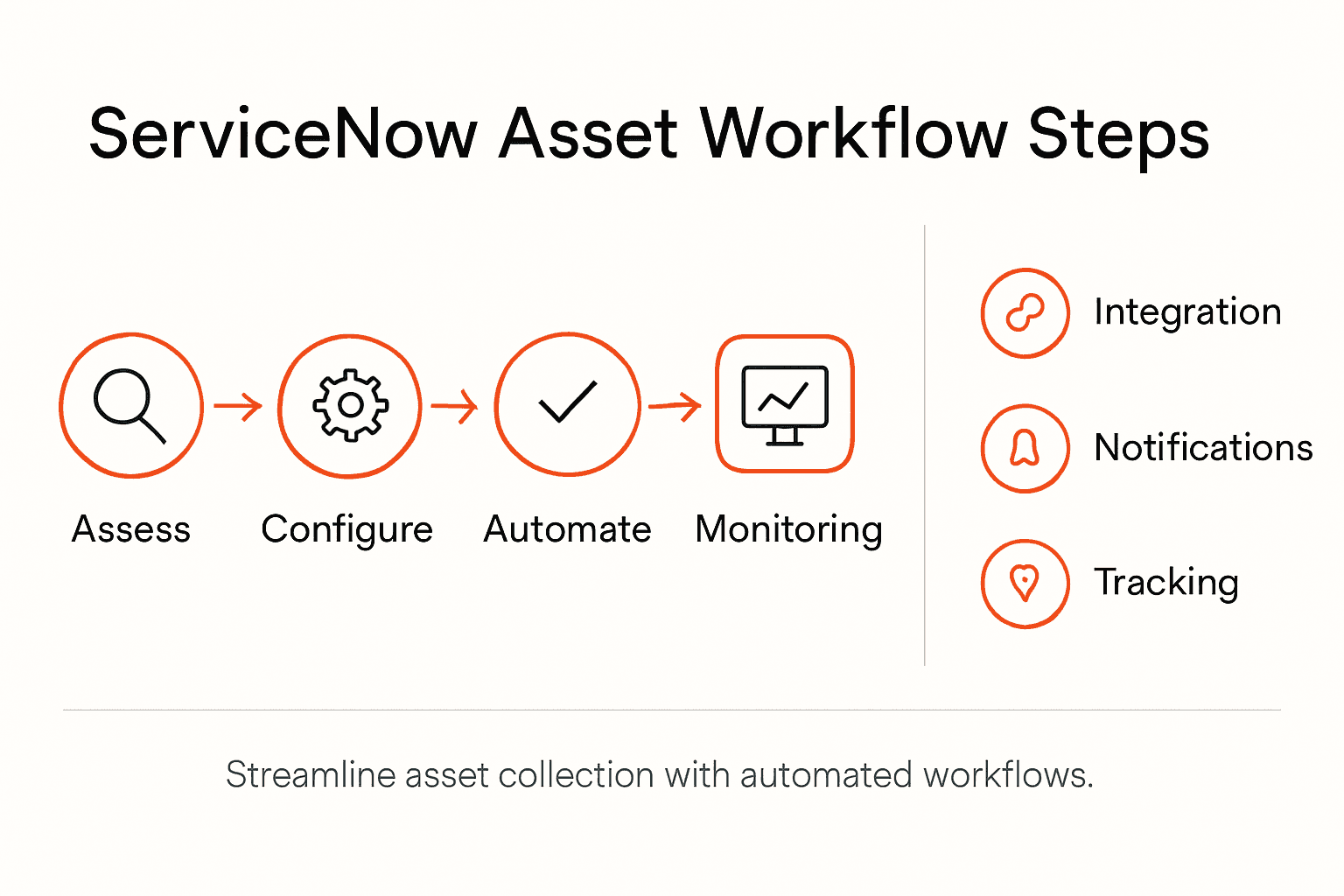
Implementing the Chain of Custody principle enables precise hardware asset lifecycle management and creates a transparent record of asset transitions. Configure ServiceNow to capture critical movement data including timestamp, location, responsible personnel, and reason for transfer. Utilise built-in discovery tools and integration capabilities to automatically update asset records whenever physical relocations or ownership changes occur. Develop custom dashboards that provide real-time visualisations of asset locations, status changes, and potential discrepancies, enabling proactive management and rapid response to unexpected movements.
Leverage ServiceNow’s advanced tracking capabilities by implementing geolocation services, QR code scanning, and integration with physical access management systems. Create comprehensive audit trails that document every asset interaction, from initial procurement through eventual retirement. Establish automated alerts that trigger notifications for unauthorised movements, approaching maintenance windows, or potential security risks associated with asset transfers.
Professional Insight: Regularly cross-reference physical asset inventories with digital tracking records to maintain data accuracy and identify potential tracking inconsistencies.
Step 5: Verify compliance and audit asset records
Ensuring comprehensive compliance and maintaining accurate asset records represents a critical final stage in optimising your ServiceNow IT asset management workflow. This process transforms your asset tracking from a basic administrative task into a strategic governance mechanism.
Lifecycle documentation and automated audit evidence gathering are fundamental to creating robust compliance frameworks. Configure your ServiceNow Configuration Management Database (CMDB) to enforce stringent record integrity protocols, establishing clear validation rules that prevent incomplete or inaccurate asset entries. Implement systematic verification processes that cross reference physical asset inventories with digital records, highlighting any discrepancies and triggering immediate investigation workflows. Develop comprehensive audit trails that capture every significant asset interaction including procurement, transfer, maintenance, and retirement events.
Leverage ServiceNow’s advanced reporting capabilities to generate detailed compliance documentation. Create customised dashboards that provide real-time insights into asset status, potential risks, and regulatory adherence. Set up automated alerts that notify key stakeholders about impending compliance deadlines, expired certifications, or assets requiring immediate attention. Integrate external compliance standards and regulatory requirements directly into your asset management workflows, ensuring your organisation maintains a proactive approach to technological governance.
Professional Insight: Conduct quarterly comprehensive audits that go beyond surface level checks, diving deep into asset metadata and historical tracking to uncover potential systemic vulnerabilities.
Transform Your IT Asset Collection Workflow with Velocity Smart Technology
Optimising your IT asset collection workflow in ServiceNow requires more than just identifying gaps and automating notifications. Addressing challenges like incomplete documentation, manual data entry, and poor verification can feel overwhelming without the right tools. Velocity Smart Technology offers a seamless solution that integrates natively within your ServiceNow instance, eliminating data silos and empowering you to automate asset issuance, tracking, and lifecycle management with confidence.
Unlock the full potential of ServiceNow with Velocity Smart Collect, the only ServiceNow-certified smart locker and vending solution designed to modernise how enterprises manage equipment and consumables. By embedding smart asset workflows directly into your platform, you reduce errors, ensure compliance, and gain real-time visibility into asset movements—all while improving user experience and reducing operational costs. Discover how your organisation can achieve strategic IT asset optimisation today by visiting Velocity Smart Technology and exploring the future of asset management.
Frequently Asked Questions
How do I assess my current IT asset collection procedures in ServiceNow?
Assess your existing procedures by mapping out your current asset collection workflow. Document each step from asset identification to disposal, and engage stakeholders from IT, procurement, finance, and operations to gather insights into their practices.
What strategies can I use to configure ServiceNow integration for asset workflows?
Establish a comprehensive integration strategy by identifying primary data sources and defining synchronisation rules for asset attributes. Focus on using native connectors or third-party integration platforms for seamless data exchange.
How can I automate asset assignment and notifications in ServiceNow?
Create business rules within ServiceNow to automatically route assets based on criteria such as department or location. Configure notification triggers for critical events like maintenance schedules to keep all stakeholders informed of asset changes.
What steps should I take to monitor asset movements and ensure real-time tracking in ServiceNow?
Implement robust tracking mechanisms by capturing critical movement data, such as timestamps and locations. Create custom dashboards for real-time visibility of asset status and develop automated alerts for unauthorised movements or security risks associated with asset transfers.
How do I verify compliance and audit asset records in ServiceNow?
Ensure compliance by configuring your ServiceNow Configuration Management Database (CMDB) with stringent record integrity protocols. Regularly cross-reference physical inventories with digital records to identify discrepancies and perform comprehensive audits to uncover potential vulnerabilities.
Recommended
See what Smart Collect® could save you
Model your savings in two minutes, or book a 60-minute workshop to pressure-test the numbers against your estate.