The role of automation in ITSM: 2026 guide
TL;DR:
- Automation has evolved beyond scripted tasks to encompass AI-driven incident triage, asset management, and full workflow automation. It enables organizations to scale support, improve consistency, and reduce resolution times while shifting human focus to strategic processes. Effective governance, data accuracy, and phased implementation are essential for realizing automation’s full benefits in IT service management.
Automation has been reshaping IT service management for years, yet many IT leaders still think of it as little more than scripted task execution. The role of automation in ITSM has moved far beyond that. Today, organisations are deploying governance-bound AI specialists that handle incident triage, asset management, and service fulfilment end-to-end, without a human touching the keyboard. If your mental model of ITSM automation is a few if-then rules and a chatbot that escalates everything, this guide will update it. You will find out what modern automation actually does, what it changes about your operating model, and how to adopt it without creating new risks.
Table of Contents
- Key takeaways
- The role of automation in ITSM
- Core automation capabilities in ITSM workflows
- Benefits and measurable impact for enterprises
- Governance and implementation considerations
- Emerging trends and the future of ITSM automation
- My perspective on where this is actually heading
- How Velocity-smart supports enterprise ITSM automation
- FAQ
Key takeaways
| Point | Details |
|---|---|
| Automation redefines ITSM roles | Teams shift from manual execution to oversight and strategic process design as automation handles repetitive tasks. |
| Governance must come first | Defining autonomous boundaries, escalation protocols, and rollback procedures is the foundation of safe ITSM automation. |
| Measurable results are already here | Organisations using AI in ITSM report reduced resolution times and significantly higher customer satisfaction. |
| Closed-loop automation is the standard | Effective automation covers the full workflow cycle, from triage through fulfilment, verification, and closure. |
| Data readiness determines success | CMDB accuracy and integration quality directly influence how far automation can operate without human correction. |
The role of automation in ITSM
IT service management covers the full set of processes and capabilities an organisation uses to design, deliver, manage, and improve IT services for its users. That scope is enormous. Incident management, change control, service requests, problem management, asset tracking, and knowledge management all sit under the ITSM umbrella. In a large enterprise, these processes touch thousands of users, hundreds of systems, and multiple sites every single day.
Manual execution of these workflows at scale is simply not viable. Errors accumulate. Tickets pile up. Users wait too long for resolution, and IT staff spend most of their time on repetitive, low-value tasks instead of work that genuinely requires human judgement. The operational shift enabled by automation moves teams away from manual task execution towards roles focused on process design, oversight, and continuous improvement.
The case for automation in ITSM is not about replacing people. It is about applying human expertise where it genuinely matters. When automation handles the routine, your senior engineers can focus on complex incidents, root cause analysis, and architectural decisions that actually move the organisation forward. Understanding why automating support workflows matters is the starting point for any serious ITSM modernisation effort.
- Scale without headcount growth: Automation handles volume increases without requiring proportional increases in staff.
- Consistency at every interaction: Automated processes follow the same logic every time, reducing the variability that leads to user dissatisfaction.
- Reduced mean time to resolution: Routing, triage, and fulfilment happen in seconds rather than minutes or hours.
- Fewer manual errors: Removing human touchpoints from repetitive tasks eliminates the transcription mistakes and missed steps that degrade service quality.
Core automation capabilities in ITSM workflows
Modern ITSM automation operates across several distinct functional areas, and understanding each one is necessary before you can make intelligent decisions about where to invest.
Ticket routing and AI-driven triage
AI-driven triage uses large language models to read incoming tickets, classify them by category and priority, and route them to the correct team or automated resolver without a human making that decision. Enterprises processing hundreds of tickets per day have deployed this successfully, cutting the time between ticket creation and first action from hours to seconds.
Role-based AI specialists
This is where the operating model shifts most dramatically. Role-based AI specialists operate within defined workflows, respect existing permissions structures, and produce full audit trails for every action they take. They are not bots that execute a single task. They are digital workers that handle diagnosis, remediation, and communication across an entire workflow lifecycle.
Closed-loop automation
Most early ITSM automation projects failed because they only automated the front end of the process. A ticket gets routed correctly, and then a human still has to do everything else. Closed-loop automation covers fulfilment, verification, system updates, and ticket closure. Nothing is left as a manual afterthought.
CMDB lifecycle management
Automated CMDB maintenance applies policies such as retiring configuration items not updated within a defined discovery window, typically 90 days, to keep data accurate without relying on manual audits. Poor CMDB data is one of the most common reasons automation projects underdeliver. If the underlying data is wrong, automated decisions based on that data will also be wrong.
Pro Tip: Before deploying any autonomous resolution workflows, run a CMDB health check. Automation amplifies your data quality in both directions. Good data produces good outcomes. Inaccurate data produces confidently wrong outcomes at scale.
The layered architecture approach to IT support automation combines three elements: an experience layer for self-service interactions, an orchestration layer that executes workflows across multiple systems, and a governance layer that controls access, approvals, and audit trails. All three layers must function together. Organisations that implement orchestration without governance create automation that is fast but unaccountable.
Benefits and measurable impact for enterprises
The business case for ITSM automation is no longer theoretical. Research from 2026 shows that 82% of organisations using AI in ITSM report ticket deflection, 71% report reduced resolution times, and 76% report improved customer satisfaction. Those numbers reflect genuine operational change, not pilot programme results.

| Benefit area | Reported impact |
|---|---|
| Ticket deflection | Up to 82% of organisations see measurable deflection rates |
| Resolution time | 71% report faster mean time to resolution |
| Customer satisfaction | 76% report improved satisfaction scores |
| Staff focus | Teams shift to oversight, design, and complex problem-solving |
| Data accuracy | Automated CMDB policies reduce stale or incorrect records |
The qualitative shifts matter just as much as the quantitative ones. When IT teams stop spending their days processing routine requests, the culture changes. Engineers engage more deeply with complex work. Service design improves because the people responsible for it now have time to think about it.
“Automation changes not only speed but the ITSM operating model, enabling teams to focus on strategic process design and scale service quality.” — Red Hat ITSM overview, 2026
Organisations using efficient IT support automation also report that integration depth is the primary differentiator between modest and transformative results. Automation that touches one system produces limited gains. Automation that connects identity management, the CMDB, service catalogue, monitoring tools, and communication platforms produces compound efficiency across every workflow it touches.
Governance and implementation considerations
Governance is not a constraint on automation. It is the mechanism that makes autonomous execution trustworthy. Without it, AI-driven ITSM produces fast decisions that nobody can explain, audit, or safely reverse.
ITIL 5 guidance on AI in incident management is direct about this. Accountability concerns emerge quickly when AI executes remediation actions. You must know what the system did, why it did it, and how to undo it if the decision was wrong. That requires explicit design before you go anywhere near production.
Here is a practical approach to implementing governance for ITSM automation:
- Define autonomous boundaries explicitly. Document which actions the automation can take without human approval, and which require escalation. Be specific. “Low priority password resets” is acceptable. “Network configuration changes” almost certainly requires human sign-off.
- Set confidence thresholds. AI classifiers and resolution engines should only act autonomously when their confidence in the decision exceeds a defined threshold. Below that threshold, the ticket routes to a human.
- Build rollback procedures before you go live. Every automated action that modifies a system or record should have a tested rollback path. This is not optional.
- Establish audit trail requirements. Compliance frameworks and security teams need full traceability. Every automated action should be logged with enough context to reconstruct the decision chain.
- Grant autonomy incrementally. Start with low-risk, high-volume, well-understood processes. Expand autonomy as you build confidence in the system’s behaviour and validate its accuracy against your environment.
Pro Tip: Treat your first autonomous ITSM workflows as a trust-building exercise, not a cost-cutting project. The goal of early rollouts is to demonstrate reliable, explainable behaviour. Cost reduction follows trust. Teams that rush to autonomy without establishing that trust create incidents that set the programme back by months.
Incremental autonomy granting by process maturity level is a practical governance approach that balances operational risk against the efficiency gains available at each stage of adoption. The organisations that implement automation most successfully treat governance design as an engineering discipline, not a compliance checkbox.
Emerging trends and the future of ITSM automation
The shift from recommendation-based AI to genuinely autonomous AI specialists represents the most significant change in how IT service management will operate over the next three to five years. The question is no longer whether AI can classify a ticket. It is whether an AI specialist can own an entire service domain, operating as a digital workforce member rather than a single-function bot.
| Capability | Previous generation | Current direction |
|---|---|---|
| Ticket handling | Rule-based routing | AI classification with autonomous resolution |
| Knowledge management | Manual article creation | AI-generated, continuously updated knowledge bases |
| Monitoring and alerting | Threshold-based alerts | Predictive anomaly detection with auto-remediation |
| Security and compliance | Periodic manual review | Continuous automated review with policy enforcement |
| Workforce model | Human agents with AI assist | AI specialists with human oversight |
Multi-LLM architectures improve reliability by breaking complex tasks into components and comparing outputs across models before committing to an action. This is particularly relevant for high-stakes workflows such as security reviews and compliance checks, where a single model’s error could have material consequences.
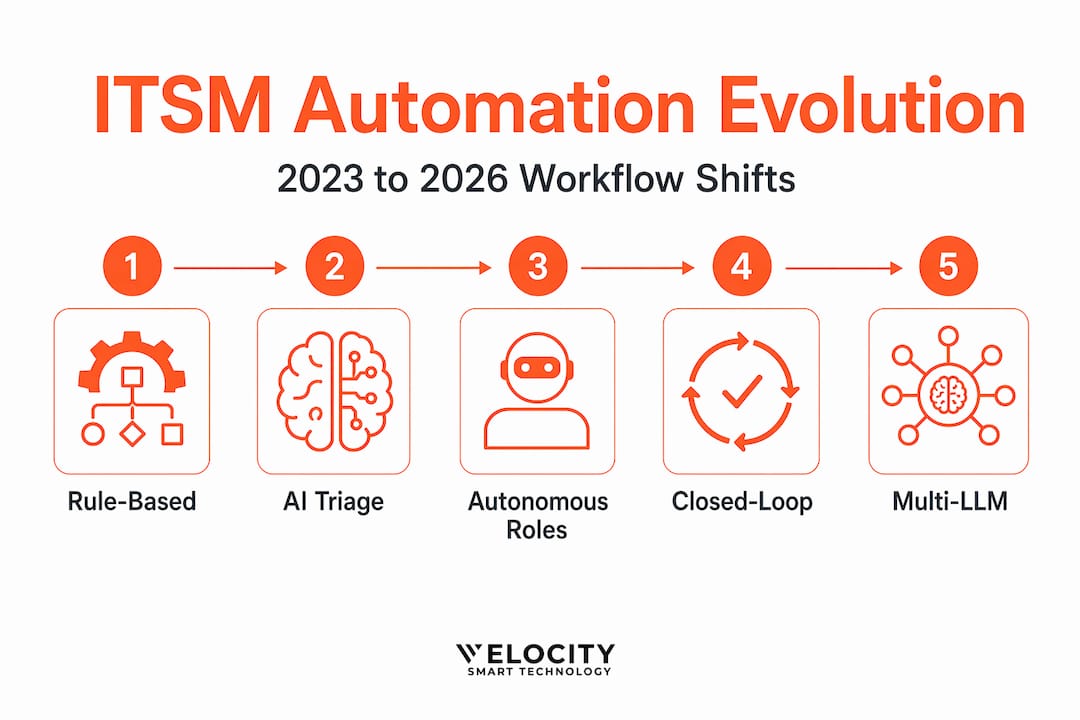
ServiceNow’s Autonomous Workforce model illustrates where the market is heading. The proactive IT support model that emerges from this architecture does not wait for users to raise tickets. It detects conditions, resolves them autonomously within governance bounds, and notifies the user that the issue has been addressed. That is a fundamentally different user experience from anything achievable through traditional ITSM.
Data readiness remains the limiting factor for most enterprises. Automation can only be as reliable as the data it operates on. Organisations that invest in CMDB accuracy, integration quality, and continuous data validation before deploying autonomous workflows will see materially better outcomes than those that treat data hygiene as a follow-on activity.
My perspective on where this is actually heading
I have seen too many IT automation programmes start with the wrong ambition. The goal gets framed as “automate as much as possible,” and the governance conversation gets deferred until something goes wrong. That sequence is reliably expensive.
What I have found actually works is inverting that order entirely. The organisations that get the best results from ITSM automation are the ones that design their governance model first, choose their first automated processes based on risk profile rather than volume alone, and treat the first six months as a controlled experiment rather than a production deployment.
The other thing that surprises people is how much the human role improves rather than diminishes. When automation handles the repetitive tier-one work reliably, the engineers who were doing that work become owners of process quality instead. They spend their time making the automation better, handling genuinely complex incidents, and doing the kind of strategic work that actually develops their careers. That is a different conversation from the “automation will replace jobs” narrative, and it is a more honest one.
The future of ITSM automation is not a fleet of bots running scripts. It is a structured workforce of AI specialists operating under clear governance, alongside human colleagues who focus their attention where it genuinely matters. The organisations that build that model thoughtfully, starting with process maturity and data quality, will find that automation becomes a genuine competitive capability rather than a perpetual proof-of-concept.
— Anthony
How Velocity-smart supports enterprise ITSM automation
At Velocity-smart, we build automation into the physical layer of IT service delivery, not just the digital one. Our Smart IT Support Kiosks give employees access to real-time remote support, secure device diagnostics, and equipment exchange at workplace locations without requiring an onsite technician. That means the automation your ITSM workflows trigger can extend all the way to the moment an employee collects a replacement device.
Our platform runs natively inside your ServiceNow instance, which means every transaction, every asset movement, and every support interaction feeds directly into your existing workflows, CMDB, and reporting without introducing additional data platforms or compliance risk. If you are building an automation strategy that needs to scale across multiple sites and reduce manual IT support touchpoints, explore our automation resource hub or speak to our team about where smart workplace automation fits your environment.
FAQ
What is the role of automation in ITSM?
Automation in ITSM handles repetitive, rule-based processes such as ticket triage, routing, fulfilment, and CMDB maintenance, freeing IT teams to focus on complex work and strategic oversight. Modern implementations use AI specialists that operate end-to-end within governance frameworks rather than executing isolated tasks.
What are the key benefits of automation in ITSM?
Research shows that 82% of organisations using AI in ITSM report ticket deflection, with 71% seeing faster resolution times and 76% reporting improved customer satisfaction. Operational benefits include greater consistency, fewer manual errors, and the ability to scale support without proportional headcount growth.
What is the role of AI in IT service management?
AI in IT service management powers autonomous ticket classification, natural language self-service, predictive incident detection, and governance-bound remediation. The most advanced implementations use role-based AI specialists that operate as digital workforce members within defined permission boundaries.
What governance controls are needed for ITSM automation?
Effective governance requires clearly defined autonomous action boundaries, confidence thresholds that trigger human escalation, tested rollback procedures, and full audit trails for every automated action. ITIL 5 guidance reinforces that accountability must be designed into the system before autonomous execution begins.
How does automation improve ITSM efficiency?
Automation reduces the manual touchpoints across incident management, request fulfilment, and asset lifecycle workflows, cutting resolution times and freeing engineers for higher-value work. Closed-loop automation that covers triage, fulfilment, verification, and closure produces consistently better results than partial implementations.
Recommended
See what Smart Collect® could save you
Model your savings in two minutes, or book a 60-minute workshop to pressure-test the numbers against your estate.