
The role of automation in stock control explained
TL;DR:
- Automation enhances stock control by enabling real-time visibility, AI forecasting, and integrated workflows to support strategic decision-making. Critical to success are data quality, phased implementation, and change management, which collectively prevent process failures and maximize benefits. By 2030, warehouse operations will increasingly rely on robotics and software-driven environments, reducing human involvement to oversight and exception handling.
For most supply chain managers, the role of automation in stock control sounds straightforward: replace manual counting with technology and watch accuracy improve. The reality is considerably more complex, and considerably more rewarding. Automation is not simply a labour substitute. When implemented with the right data foundations and integrated workflows, it becomes the engine behind strategic decision-making, real-time inventory visibility, and warehouses that scale without proportional headcount growth. This article unpacks how automation genuinely changes stock control at an operational and strategic level.
Table of Contents
- Key takeaways
- Why manual stock control fails at scale
- Core technologies driving stock control automation
- Benefits of automating stock control workflows
- How to implement automation effectively
- Future trends shaping warehouse automation
- My perspective on automation as a strategic imperative
- How Velocity-smart connects to your automation goals
- FAQ
Key takeaways
| Point | Details |
|---|---|
| Automation is a strategic enabler | The true value of automated inventory management lies in better decisions, not just reduced manual effort. |
| Data quality comes first | Clean, governed data is the non-negotiable foundation before any automation technology can deliver reliable results. |
| Phased implementation works best | Moving from barcode scanning to AI-driven forecasting in stages avoids the chaos of automating flawed processes. |
| Real-time visibility transforms outcomes | A 100% scan-based workflow replaces delayed reconciliation and gives you genuine inventory truth at every moment. |
| Human-optional warehouses are close | By 2030, robot-centric facilities will be a commercial reality, making now the critical moment to build automation maturity. |
Why manual stock control fails at scale
Large organisations carry complexity that manual processes simply cannot absorb. When your operation spans multiple sites, hundreds of suppliers, and tens of thousands of SKUs, the compounding effect of small errors becomes a serious operational liability.
The most common failure modes are familiar to any experienced supply chain manager:
- Stockouts and overstock occurring simultaneously across different product lines because data from separate systems never reconciles in real time
- Inaccurate physical counts driven by human fatigue, inconsistent processes, and time pressure during cycle counts
- Siloed data spread across ERP, warehouse management systems, and spreadsheets that gives no single source of truth
- Delayed visibility where a manager only learns about a stock discrepancy after a fulfilment failure has already damaged customer trust
- Spreadsheet-based forecasting that cannot account for seasonal variation, supplier lead time volatility, or demand spikes across hundreds of locations at once
The financial consequences reach further than most organisations model. Overstock ties up working capital and generates write-off risk. Stockouts erode customer satisfaction and often trigger emergency procurement at higher cost. A manual forecasting team working with stale data is not making strategic decisions. They are perpetually firefighting.
This is the environment that automated inventory management was built to address. Not as a replacement for thinking, but as the data infrastructure that makes good thinking possible.
Core technologies driving stock control automation
Understanding which technologies to deploy, and in what combination, is where supply chain managers often get lost. The tools are not interchangeable. Each addresses a different point of failure in the stock control process.
AI and ensemble forecasting models are the most visible advancement in recent years. Rather than extrapolating from a single trend line, these systems reconcile conflicting data from ERP, WMS, and sales channels simultaneously, producing a real-time inventory position that genuinely reflects what is on the shelf. The downstream effect is significant: safety stock requirements drop because you are no longer padding buffers to compensate for data uncertainty.
Barcode scanning and RFID address accuracy at the point of physical movement. Barcode systems have an inherent 1 in 300 scan error rate, which sounds minor until you multiply it across 10,000 daily transactions. RFID-enabled warehouses can achieve up to 99.8% accuracy through automated fixed portal scanning, and the ROI case for RFID becomes compelling precisely at that transaction volume threshold.
- Barcode scanning: cost-effective entry point, ideal for operations under 10,000 daily transactions, immediate accuracy gains on inbound receiving
- RFID: higher upfront investment, transformative accuracy above high-volume thresholds, fully automated scanning without staff intervention
- Robotic picking and replenishment systems: reduce physical handling errors and enable continuous operation without shift constraints
- Integrated software platforms: WMS, ERP, and procurement systems connected via APIs to orchestrate data flow and trigger automated reorder events
Pro Tip: Never deploy RFID across an entire warehouse in one phase. Pilot it on your highest-velocity SKU category first. That is where accuracy errors cost the most and where the ROI calculation becomes undeniable within weeks.
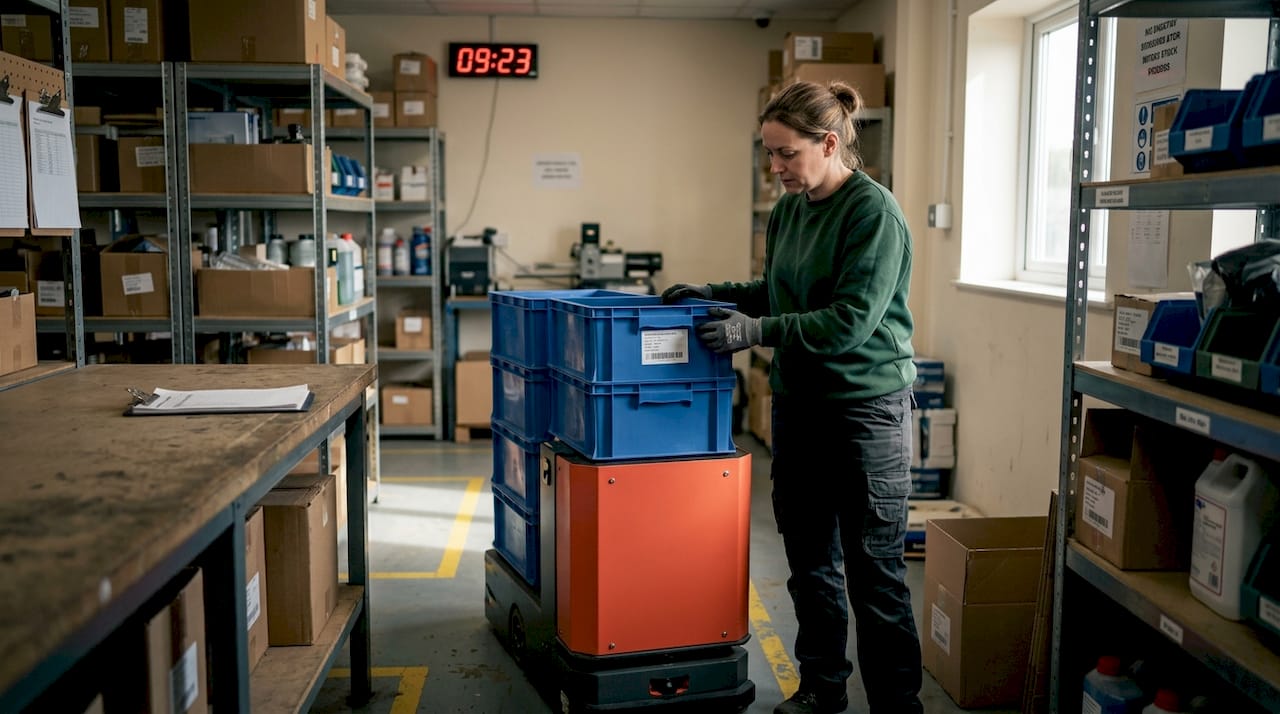
Robotics deserves particular attention because it changes the labour model entirely. Automated guided vehicles and robotic picking arms do not replace warehouse workers in a headline-grabbing way. They remove the most error-prone and physically demanding tasks, freeing people to handle exceptions and quality control. That is a meaningful operational distinction.
Benefits of automating stock control workflows
The gap between what automation promises and what it actually delivers depends almost entirely on implementation quality. When done well, the numbers are striking.
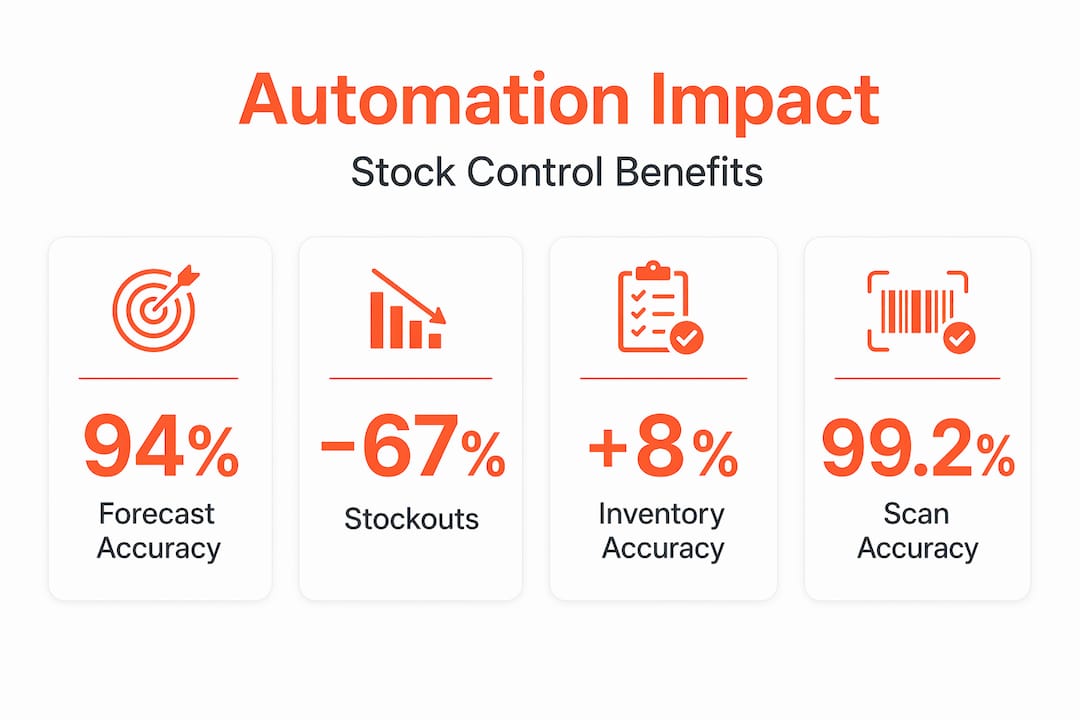
An AI-driven platform deployed in a large retail operation achieved 94% forecast accuracy and reduced stockouts by 67% within six months, while cutting manual planning effort by 85%. The system handled over 250,000 SKUs with 3,000 to 6,000 daily forecasting cycles. That is not a marginal gain. It is a structural change in how the operation functions.
| Metric | Before automation | After automation |
|---|---|---|
| Forecast accuracy | 70-75% typical | 94% demonstrated |
| Stockout rate | Baseline | Reduced by 67% |
| Manual planning effort | High (full team allocation) | Reduced by 85% |
| Inventory accuracy | 91% typical manual | 99.2% with scanning |
Introducing handheld barcode scanners for inbound receiving raised accuracy from 91% to 99.2% at a cost of £330 per scanner. That is one of the sharpest ROI calculations available to a supply chain team. A single prevented fulfilment failure or avoided write-off typically covers the device cost many times over.
The accuracy gains compound over time. Reaching inventory accuracy above 99% requires a phased approach, but each phase builds on the last. Dynamic safety stock algorithms replace static buffer rules. Automated reorder flows trigger at the right moment rather than when someone remembers to check. Planners stop spending their days correcting data and start spending them on supplier negotiations and demand planning strategy.
Pro Tip: Track your “inventory truth rate” as a KPI: the percentage of SKU locations where the system record matches physical reality on any given day. This single metric surfaces every process gap that automation needs to address.
How to implement automation effectively
The most common mistake supply chain leaders make is automating a broken process. Technology does not fix bad workflow design. It amplifies the outputs, good or bad, and does so at higher speed and volume.
A practical implementation sequence that works across large organisations looks like this:
-
Audit your data quality first. Map every system that holds inventory data. Identify where records diverge and why. Clean data is the foundation. Nothing built on inaccurate records will deliver reliable results regardless of the technology layered on top.
-
Start with inbound receiving accuracy. This is where most stock discrepancies originate. Implementing a 100% scan-based workflow for every inbound and outbound movement establishes real inventory truth before you build anything more complex on top of it.
-
Integrate your core systems before adding AI. WMS, ERP, and procurement platforms must share data cleanly. AI forecasting is only as good as the inputs it receives. A disconnected tech stack produces conflicting signals that no algorithm can resolve reliably.
-
Introduce AI forecasting for your highest-impact SKU categories. Start where accuracy failures cost the most. Demonstrate measurable improvement there before expanding scope.
-
Add robotics where workflow is already disciplined. Robotics adoption alone is insufficient without mature workflow sequencing. Simply adding robots to a chaotic warehouse environment creates a different kind of operational chaos, faster and more expensive.
-
Invest in change management in parallel with technology. Planners who have spent years managing by instinct and manual adjustment will resist systems that surface every exception and demand process compliance. Framing automation as a tool that gives them strategic capacity rather than a system that monitors them makes adoption significantly faster.
The organisations that extract the most value from stock control technology are those that treat it as a continuous improvement process, not a project with a completion date.
Future trends shaping warehouse automation
The direction of travel is clear, and the timeline is shorter than many supply chain leaders expect. By 2030, 50% of new warehouses in developed markets will be human-optional, robot-centric facilities according to Gartner. The shift moves human roles toward orchestration, exception handling, and strategic oversight rather than physical execution.
Several developments will define this transition:
Digital twins are becoming a standard tool for facility design. Before a warehouse is reconfigured, a virtual simulation tests throughput scenarios, identifies bottlenecks, and validates automation sequencing without any physical disruption.
Multi-agent orchestration platforms will coordinate heterogeneous robot fleets where different autonomous systems from different vendors work in concert. The software layer managing that coordination is where the competitive advantage lives, not the robots themselves.
Software-defined automation decouples capability from physical infrastructure. Facilities can scale throughput by updating software configurations rather than deploying new hardware, which changes both capital planning and operational resilience calculations.
| Factor | Current state | Direction by 2030 |
|---|---|---|
| Human involvement | Core operational role | Exception handling and oversight |
| Scalability mechanism | Headcount increase | Software configuration updates |
| Warehouse design | Human-dependent layout | Robot-optimised environments |
| Data orchestration | Siloed systems with integrations | AI-driven real-time truth |
The organisations building automation maturity now will have a significant structural cost advantage over those who defer. Clean data governance and disciplined workflow automation are the critical differentiators for the decade ahead.
My perspective on automation as a strategic imperative
I have seen enough automation projects succeed and fail to know that the technology is rarely the limiting factor. What separates the operations that genuinely transform from those that buy expensive tools and see modest returns is almost always the same thing: data governance decisions made before any procurement conversation began.
In my experience, the organisations that rush to AI forecasting without first fixing their inbound receiving accuracy are building on sand. The algorithm produces confident-sounding recommendations based on records that do not reflect physical reality. Planners lose trust in the system within weeks and revert to spreadsheets. The investment fails, and the cultural damage is worse than if they had never started.
What I have found actually works is a mindset shift among senior leaders. When a supply chain director stops measuring automation success by how many staff positions were eliminated and starts measuring it by how many fewer exceptions their planners have to chase manually, the entire implementation approach changes. The goal is strategic capacity, not headcount reduction.
I also think the robotics narrative needs recalibrating. We are not heading toward fully robot-operated warehouses in any near-term scenario I find credible for most large organisations. We are heading toward environments where robotics handles the predictable, high-volume, physically demanding work while human expertise concentrates on supplier relationships, demand shaping, and genuine exceptions. That is a more interesting and more sustainable destination than the replacement narrative suggests.
— Anthony
How Velocity-smart connects to your automation goals
If you are building automation maturity across a large organisation, the device and equipment distribution layer is an area where manual processes often persist long after warehouse operations have been modernised. Velocity-smart’s platform automates how employees collect, return, and replace workplace devices and IT equipment through smart lockers and vending solutions built natively on ServiceNow. For supply chain and IT operations teams managing distributed workplaces, the Smart IT Support Kiosk removes the need for on-site technicians while maintaining real-time asset visibility. It is a practical extension of the same principles that make warehouse automation work: remove manual steps, capture every movement as data, and let your people focus on decisions that require judgement.
FAQ
What is the role of automation in stock control?
Automation in stock control replaces manual counting, spreadsheet forecasting, and siloed data management with real-time tracking, AI-driven forecasting, and integrated workflows. The result is higher accuracy, fewer stockouts, and planners who focus on strategy rather than data correction.
How does automation improve inventory accuracy?
Introducing barcode scanning for all inbound and outbound movements can raise inventory accuracy from around 91% to over 99%, as demonstrated in documented operational case studies. RFID systems push accuracy even further, reaching up to 99.8% in high-volume environments.
What are the biggest risks when automating stock control?
The most significant risk is automating a process that is already flawed. Technology amplifies existing process failures rather than correcting them. Starting with data quality and workflow discipline before layering in AI or robotics is the only reliable path to sustainable returns.
Why automate consumables management specifically?
Consumables are high-frequency, low-visibility items that generate disproportionate stockout risk when managed manually. Automated reorder triggers and real-time tracking remove the reliance on individual staff members noticing when replenishment is needed, which is where most consumables failures originate.
What does a human-optional warehouse actually mean?
According to Gartner, 50% of new warehouses in developed markets will be human-optional by 2030. This means robotic systems handle standard fulfilment tasks while humans manage orchestration, exceptions, and strategic oversight rather than physical execution.
Recommended
See what Smart Collect® could save you
Model your savings in two minutes, or book a 60-minute workshop to pressure-test the numbers against your estate.