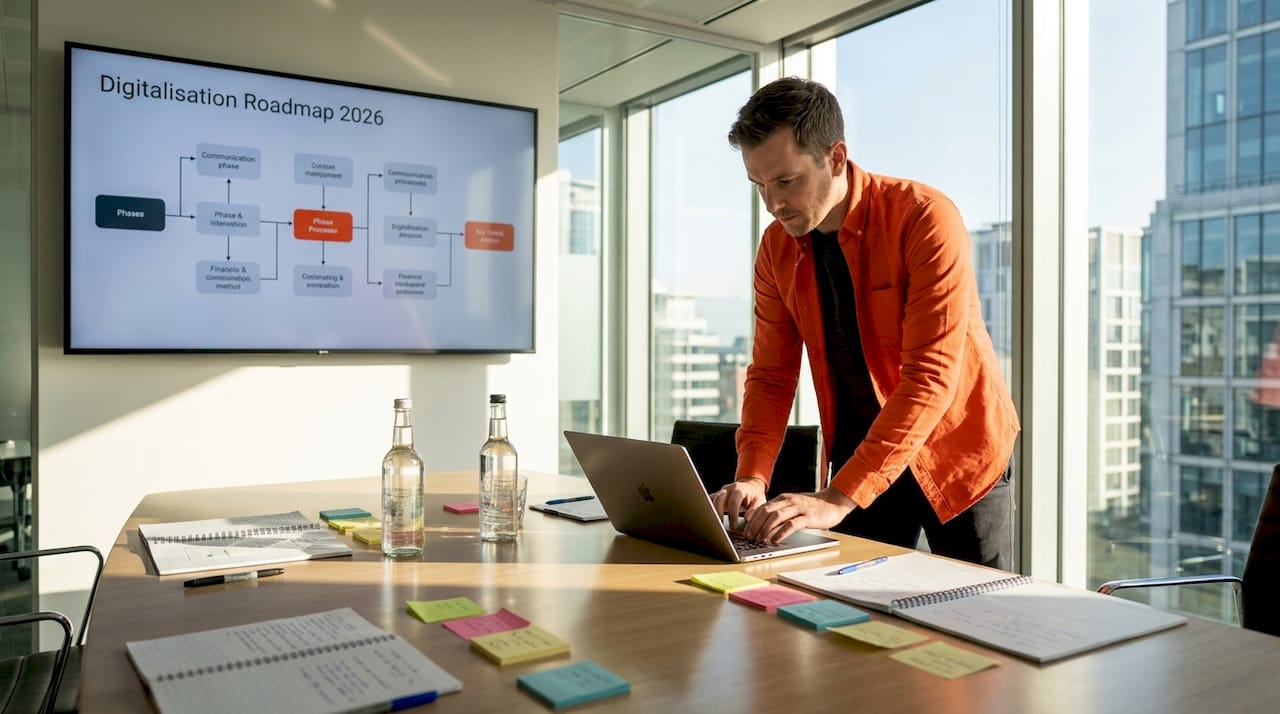
Workplace digitalisation trends boosting efficiency in 2026
TL;DR:
- Choosing strategic digitalisation initiatives aligned with business goals is crucial amid evolving AI, budget constraints, and workforce diversity.
- Prioritise human-centric outcomes, scalable integration, cost efficiency, privacy, and vendor maturity when evaluating solutions for modern workplaces.
Selecting the right workplace digitalisation initiatives has never been more consequential. With AI capabilities evolving at pace, IT budgets under persistent pressure, and the workforce now split between desk-based knowledge workers and frontline employees who may never touch a corporate laptop, the decisions IT leaders make today will define operational efficiency for years. The problem is not a shortage of options. It is knowing which trends deserve serious investment, which are overhyped, and which criteria separate a sound business case from an expensive experiment.
Table of Contents
- Key criteria for evaluating digitalisation trends
- Top digitalisation trends redefining the workplace
- Comparing leading digitalisation solutions
- Choosing the right trend for your enterprise scenario
- Why privacy-first analytics—not just tool adoption—should drive your digital workplace strategy
- Accelerate your digital workplace with automation
- Frequently asked questions
Key Takeaways
| Point | Details |
|---|---|
| Human-centric approach | Placing digital dexterity and employee experience at the centre leads to smarter, more sustainable adoption. |
| AI-driven personalisation | Personalised algorithms and GenAI are key to adaptive, efficient workplaces as AI matures. |
| Privacy in measurement | Balancing workplace analytics with privacy protection ensures both productivity and trust. |
| Frontline enablement | Modern platforms should address the unique digital needs of deskless workers and compliance-heavy sectors. |
Key criteria for evaluating digitalisation trends
Before you can compare specific tools or platforms, you need a clear evaluation framework. Without one, vendor demonstrations and analyst reports can create noise rather than clarity.
Strategic alignment is the starting point. Any digitalisation investment must connect directly to business objectives, whether that means reducing service desk costs, enabling hybrid working, or accelerating onboarding for a growing workforce. Gartner’s guidance on digital workplace strategy consistently emphasises strategic roadmaps and human-centric digital dexterity as the foundation for addressing digital workplace challenges. Solutions that cannot demonstrate a clear line to business outcomes should be deprioritised, regardless of how impressive the feature set looks in a demo.
Human-centric outcomes matter just as much as technical capability. Digital dexterity, the ability of employees to confidently use digital tools to achieve business goals, is a critical metric that many IT leaders overlook. Understanding workforce technology essentials helps ensure that new investments genuinely support the people using them, rather than adding friction under the banner of modernisation.
When evaluating any solution, the following criteria should form your checklist:
- Scalability and integration: Can it grow across multiple sites and integrate cleanly with existing infrastructure, including legacy systems that are unlikely to be replaced soon?
- Cost efficiency and ROI: Does it deliver measurable returns within a realistic timeframe, particularly when headcount and budgets are constrained?
- Privacy and ethical analytics: Does it measure adoption and usage in ways that respect employee privacy and comply with GDPR? Surveillance disguised as analytics erodes trust quickly.
- Flexibility for hybrid and frontline use cases: Reviewing flexible working technologies highlights how critical it is to support both office-based and deskless workers within a single strategy.
- Vendor maturity and ecosystem: Is the vendor’s roadmap credible, and does the platform participate in a broader technology ecosystem rather than creating yet another silo?
A sound digital transformation strategy also requires that organisations resist the temptation to chase every emerging trend. Technology stacks become unmanageable when each business unit adopts its own preferred toolset.
Pro Tip: Prioritise solutions that optimise and extend the value of tools you already own before committing budget to net-new platforms. Most enterprises are underutilising existing investments by a significant margin.
Top digitalisation trends redefining the workplace
With a firm evaluation framework in place, it becomes much easier to assess which of the current generation of trends genuinely warrants attention. Here are the five most impactful digitalisation trends shaping enterprise workplaces in 2026.
-
AI-driven personalisation: Adaptive work experiences are moving from concept to mainstream deployment. By 2028, over 20% of workplace apps will use AI-driven personalisation algorithms to tailor interfaces, content, and workflows to individual roles. For IT leaders, this means selecting platforms with machine learning capabilities built into the core product, not bolted on as an afterthought.
-
Generative AI beyond the chatbot: GenAI is reshaping digital workplace programmes well beyond simple question-and-answer interactions. Workflow design, code generation, policy drafting, and analytics summarisation are all now within reach of enterprise-grade GenAI tools. The key challenge is governance: who controls the prompts, the outputs, and the data that feeds these systems?
-
Employee experience analytics: Measuring the actual impact of digital tools, rather than counting licences or logins, is becoming a strategic priority. Privacy-protected analytics platforms give IT and HR leaders the data they need to understand what is working, what is creating friction, and where investment should be redirected. This trend pairs closely with the broader future of work models that organisations are still refining.
-
Cloud-based communication and collaboration: Unifying hybrid and deskless workers remains one of the most persistent challenges for large organisations. Cloud platforms that combine messaging, video, task management, and document collaboration in a single interface continue to see strong adoption. Refer to AI productivity strategies for practical approaches to making these platforms genuinely productive rather than just present.
-
Frontline enablement: Shift coordination, task automation, and real-time communication tools built specifically for frontline employees are a rapidly growing category. Traditional intranet and collaboration tools were designed for desk-based knowledge workers. The benefits of touchless solutions extend this concept further, removing physical friction from device collection, IT support, and equipment management for employees who cannot afford downtime.
“The digital workplace is no longer just about enabling remote work. It is about creating adaptive, personalised, and equitable experiences for every employee, regardless of where or how they work.” This perspective increasingly shapes how leading enterprises evaluate technology investments.
Pro Tip: Leverage natural language analytics within your intranet or collaboration platform to surface the content employees are searching for but not finding. This turns your intranet from a passive repository into a proactive knowledge resource.
Comparing leading digitalisation solutions
Understanding individual trends is useful, but a side-by-side comparison of leading solutions helps clarify which options actually align with your strategic priorities. The table below evaluates four major platform categories against the criteria established earlier.
| Solution category | AI and automation | Privacy protection | Frontline support | System integration | Analytics strength |
|---|---|---|---|---|---|
| AI personalisation platforms | Very strong | Moderate | Limited | Moderate | Strong |
| Microsoft Viva and Copilot | Strong | Very strong | Growing | Very strong | Very strong |
| Modern intranet platforms | Moderate | Strong | Strong | Strong | Strong |
| Frontline enablement tools | Moderate | Moderate | Very strong | Moderate | Moderate |
Viva Insights and Copilot Analytics stand out for providing privacy-protected, data-driven insight into adoption and productivity without exposing individual employee data. This makes them particularly compelling for regulated industries where employee monitoring carries significant legal and reputational risk.

Intranet platforms are rapidly expanding their AI-based analytics, frontline integrations, and data-driven dashboards, according to recent Forrester analysis. The gap between basic intranet tools and modern enterprise experience platforms has widened considerably. Leading vendors now offer AI-generated content recommendations, automated governance workflows, and purpose-built modules for shift workers and field-based employees.
A few additional considerations when comparing solutions:
- Integration depth matters more than breadth: A platform that integrates deeply with your ITSM, HR system, and identity provider will deliver more value than one with dozens of shallow connectors.
- Frontline and deskless worker support is now a differentiator: Platforms that only serve desk-based employees leave a significant portion of your workforce underserved.
- Privacy analytics separate leading solutions from the rest: The ability to measure productivity and wellbeing without individual-level surveillance is no longer optional in most European enterprises.
For IT teams supporting distributed workforces, smart locker solutions represent a practical hardware complement to these software platforms, ensuring physical device access is as seamless as digital access. Explore digital team communication platforms for further context on how leading organisations are unifying their collaboration toolsets.
Choosing the right trend for your enterprise scenario
No two organisations have identical needs, and the most effective digitalisation strategy matches specific trends to specific organisational contexts. Here is a scenario-driven approach to guide your decision-making.
Large remote or hybrid workforce: AI-driven personalisation and cloud-based collaboration platforms deliver the most immediate value. Employees working across time zones and locations need tools that adapt to their context without requiring manual configuration. DEX (Digital Employee Experience) and adaptive algorithms have been shown to contribute meaningfully to higher engagement and job satisfaction, particularly in distributed teams.
High compliance or regulated sectors: Privacy-first analytics and robust governance frameworks are non-negotiable. Financial services, healthcare, and government organisations should prioritise platforms with demonstrable GDPR compliance, audit trails, and role-based data access controls.
High-volume frontline operations: Manufacturing, logistics, retail, and healthcare delivery organisations should lead with frontline enablement tools combined with automated IT support infrastructure. Automating proactive IT deskside support reduces the burden on central IT teams while giving frontline employees faster access to the help they need.
Organisations seeking quick wins: Employee experience analytics and intranet optimisation typically offer faster time-to-value than large AI platform deployments. They surface actionable insights from existing behaviour rather than requiring a wholesale technology change.
Use this step-by-step process to pilot, measure, and scale any new digitalisation trend:
- Define success metrics before you start: Agree on what good looks like, whether that is a reduction in service desk tickets, faster device provisioning, or improved employee satisfaction scores.
- Select a representative pilot group: Choose a cohort that reflects the diversity of your workforce, including frontline and remote employees, not just office-based knowledge workers.
- Measure baseline performance: Capture current data on the metrics you care about before the pilot begins. Without a baseline, you cannot demonstrate improvement.
- Run the pilot for at least eight weeks: Shorter pilots rarely surface adoption barriers or the second-order effects that determine long-term success.
- Analyse with privacy-protected tools: Use analytics that protect individual privacy while giving you aggregated insight into where the solution is creating value or friction.
- Scale with governance in place: Before rolling out organisation-wide, establish clear ownership, training pathways, and a feedback mechanism for continuous improvement.
Potential risks to manage carefully include overpromising with GenAI, particularly when the underlying data quality or governance framework is not mature enough to support it, and underinvesting in privacy measurement, which creates compliance exposure and erodes employee trust over time. Review digital signage options for offices as one example of how physical and digital workplace layers can be coordinated thoughtfully.
Why privacy-first analytics—not just tool adoption—should drive your digital workplace strategy
Here is the uncomfortable truth that many enterprise digitalisation programmes avoid confronting. The majority of organisations still measure the success of their digital workplace investments by counting seats, licences, and login frequency. These metrics are easy to report but almost entirely meaningless as indicators of business value.
The real question is not whether employees are logging in. It is whether the tools are making work better, reducing friction, enabling faster decision-making, and supporting employee wellbeing at scale. That requires a fundamentally different measurement approach.
Measurement frameworks are shifting towards privacy-protected analytics that capture wellbeing signals, collaboration patterns, and productivity trends without exposing individual behaviour to managerial scrutiny. This is not just a compliance consideration. It is a strategic one. Employees who trust that their organisation measures outcomes rather than monitors activity are more likely to adopt new tools fully and provide honest feedback about what is and is not working.
We have seen enterprises deploy sophisticated AI platforms only to find adoption stalling at 30 to 40 percent, because no one measured the experience of the employees who were not using the tools. Privacy-safe analytics reveal precisely these gaps. They show which teams are thriving with new technology and which are struggling, without creating a culture of surveillance.
The organisations that will lead in digital workplace maturity by 2027 and beyond are those that treat employee experience measurement as a core competency, not an afterthought. DEX measurement, human-centric analytics, and wellbeing-aware reporting will become the genuine differentiators, not the size of the AI budget or the number of SaaS subscriptions active in the environment. It is not about adopting more tools. It is about understanding whether the tools you have are creating meaningful work outcomes.
Accelerate your digital workplace with automation
The trends and frameworks in this article point in a consistent direction: effective digitalisation requires both intelligent software and reliable physical infrastructure to support employees wherever they work.
Velocity Smart Technology helps enterprise IT teams put this into practice. Our enterprise automation solutions enable organisations to automate device distribution, equipment management, and IT support workflows across distributed sites, without creating new data platforms or GDPR risks. For organisations ready to move beyond manual IT support processes, our Smart IT Support Kiosks deliver real-time remote diagnostics, device exchange, and technical assistance at the point of need, reducing pressure on central IT teams while improving the employee experience at every site.
Frequently asked questions
What is workplace digitalisation?
Workplace digitalisation refers to integrating digital technology into all workplace processes to improve efficiency, agility, and employee experience. It encompasses both software platforms and physical infrastructure that together reduce manual effort and enable smarter working.
Which digitalisation trend offers the fastest ROI for large organisations?
AI-driven personalisation and automation typically offer rapid ROI by streamlining workflows and reducing manual intervention. Over 20% of workplace apps are forecast to use AI-driven personalisation for adaptive experiences by 2028, reflecting strong expected business value.
How can IT leaders balance privacy and productivity in digitalisation?
Adopting privacy-protected analytics, such as those available in Viva Insights, enables productivity measurement and wellbeing monitoring without compromising individual employee trust or creating compliance risk.
What are the key features to look for in modern workplace platforms?
Look for AI-driven automation, robust privacy controls, frontline enablement, and deep integration with existing ITSM and HR systems. Leading intranet platforms now offer AI analytics, frontline task management, and data-driven dashboards as standard capabilities.
How can frontline employees benefit from workplace digitalisation?
Digitalisation gives frontline staff access to task automation, shift management tools, and real-time communication, capabilities that go well beyond basic mobile apps. Modern intranet platforms now include purpose-built AI tools and frontline task management designed specifically for deskless workers.
Recommended
See what Smart Collect® could save you
Model your savings in two minutes, or book a 60-minute workshop to pressure-test the numbers against your estate.