
AI agents in enterprise IT: a practical 2026 guide
TL;DR:
- Enterprise AI agents are autonomous systems that detect and resolve IT issues without human intervention. They reduce incidents by up to 50% and automate over 90% of service requests, cutting operational costs significantly. Proper governance, context engineering, and integration of physical support workflows are essential for effective deployment.
Enterprise AI agents are autonomous software systems that detect IT incidents, resolve service requests, and execute workflows without waiting for human instruction. They represent the most consequential shift in IT operations since the introduction of ITSM platforms. 23% of organisations are already scaling AI agents across at least one business function, and high performers are three times as likely to deploy them enterprise-wide. For IT leaders in large organisations, the question is no longer whether to adopt AI agents in enterprise IT, but how to deploy them in a way that is governed, auditable, and operationally sound.
What are AI agents in enterprise IT?
AI agents in enterprise IT are software entities that perceive their environment, reason over available data, and take action to achieve defined objectives. The industry term for the broader category is “agentic AI,” which distinguishes these systems from earlier, narrower automation tools that followed fixed scripts. Agentic AI systems plan, adapt, and execute across multi-step workflows without requiring a human to approve each step.
The core capabilities that define enterprise-grade agents are proactive detection, autonomous resolution, and deep workflow integration. Proactive detection means the agent monitors telemetry, logs, and configuration data continuously, identifying anomalies before they become incidents. Autonomous resolution means the agent acts on that intelligence, not just reports it. Workflow integration means the agent operates inside the systems your organisation already uses, including ITSM platforms, configuration management databases, and collaboration tools.
These capabilities combine to produce a fundamentally different support model. Traditional IT support is reactive: a user raises a ticket, a technician investigates, a fix is applied. Agentic IT support is predictive and self-correcting. The agent closes the loop before the user notices a problem exists.
How do AI agents reduce IT incidents and operational costs?
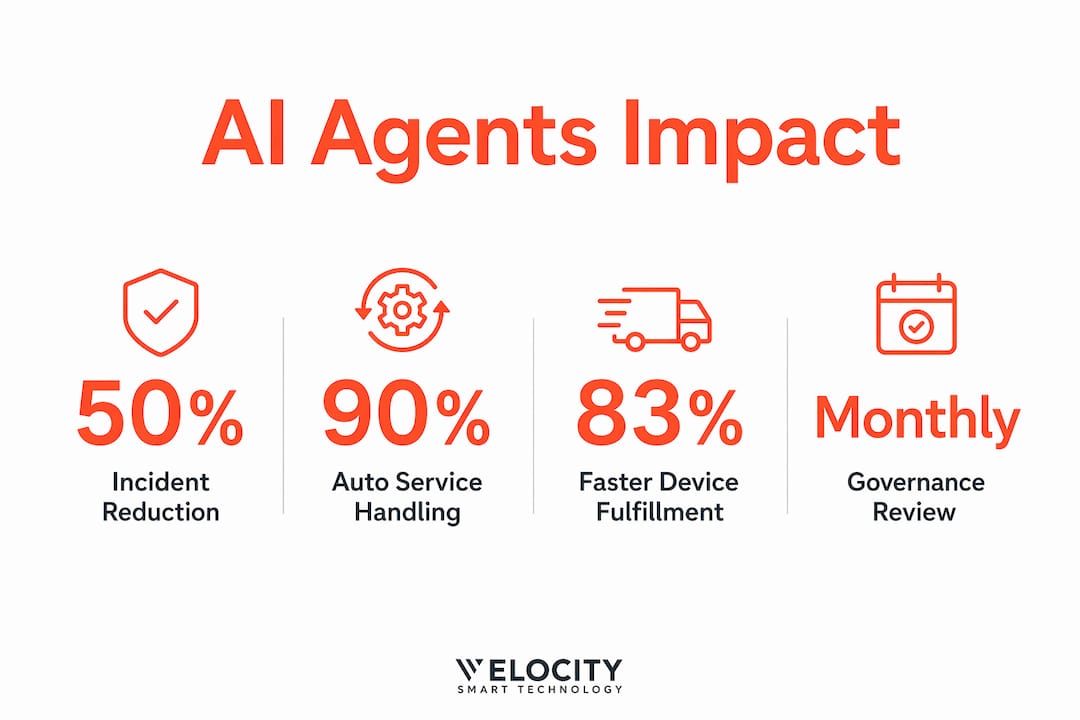
The evidence for incident reduction is concrete. AI-agent assisted root cause analysis on Kyndryl Bridge reduces IT incidents by up to 50% and delivers $3 billion in annual customer savings. That platform operates across 200,000+ customer devices, generating millions of AI insights every month. The implication is direct: at enterprise scale, proactive AI analysis does not just speed up resolution. It prevents the incident from occurring in the first place.
On the service request side, autonomous IT support agents handle over 90% of Level 1 to 3 service requests without human intervention. These agents integrate natively with ITSM tools and collaboration platforms such as Slack and Microsoft Teams, resolving issues conversationally. That means a user can report a problem in a Teams message and receive a confirmed resolution, with the ticket closed in the ITSM system, without a technician ever becoming involved.
The cost mechanics follow directly from the resolution rate. When agents handle the majority of service requests autonomously, the cost per ticket falls sharply. IT teams redirect their capacity from repetitive ticket handling to higher-value work: architecture, security, and continuous improvement. The automation of IT support at this level also reduces the organisational cost of employee downtime, which is often the largest hidden cost in enterprise IT operations.
Pro Tip: Measure your current Level 1 ticket volume before deploying AI agents. That baseline figure becomes your primary ROI metric. Without it, you cannot demonstrate the financial case to the CFO six months after go-live.
Key mechanisms driving cost reduction include:
- Proactive anomaly detection across device fleets, reducing unplanned outages before they affect productivity.
- Conversational self-service embedded in tools employees already use, removing friction from the support process.
- Automated ticket classification and routing, which eliminates manual triage and accelerates resolution times.
- Continuous learning loops, where each resolved incident improves the agent’s future decision accuracy.
What architecture and governance do enterprise AI agents require?
The architecture question is where most enterprise AI deployments succeed or fail. The success of enterprise AI depends more on its supporting system than on the AI model itself. Effective contextualisation, governance, and continuous human oversight are the variables that determine whether an agent delivers value or creates risk. Choosing a capable model is necessary but not sufficient.

The architecture that works at enterprise scale separates two distinct layers. The agentic layer handles reasoning: it interprets intent, plans actions, and selects the appropriate workflow. The execution layer handles action: it triggers pre-defined, auditable workflow APIs rather than making direct changes to infrastructure. Successful autonomous agents bind these two layers so that all agent actions trigger governed workflows, ensuring compliance and traceability without granting the agent direct infrastructure access. This separation is not a limitation. It is the mechanism that makes enterprise deployment safe.
Governance controls sit across both layers. Human-in-the-loop oversight ensures that autonomous agent actions are traceable, auditable, and reversible, which is essential in regulated industries. For sensitive operations, such as account deprovisioning or security policy changes, the agent proposes the action and a human approves it before execution. For routine operations, the agent acts autonomously within pre-defined boundaries. The boundary between these two categories is a governance decision, not a technical one.
| Governance control | Purpose | When to apply |
|---|---|---|
| Human approval gates | Prevent irreversible or high-risk actions | Account changes, security policy updates |
| Auditable workflow APIs | Ensure every action is logged and traceable | All agent-initiated actions |
| RBAC inheritance | Restrict agent permissions to defined scope | At deployment and on each workflow |
| Continuous feedback loops | Improve agent decisions over time | Ongoing, post-deployment |
Pro Tip: Treat your governance framework as a living document. Review agent action logs monthly for the first six months. Patterns in near-misses reveal where your permission boundaries need tightening before an error reaches production.
Deterministic rules versus probabilistic AI reasoning in enterprise agents
Enterprise AI agents do not operate on pure machine learning. Enterprise AI combines deterministic rule-based systems with probabilistic AI reasoning, linked by context engineering, to meet both compliance and adaptability requirements. This hybrid approach is not a compromise. It is the architecture that makes agents trustworthy in high-stakes environments.
Deterministic components handle actions where the correct response is fixed and known. If a device falls outside its approved configuration baseline, the rule fires and the remediation runs. There is no ambiguity and no model inference required. Probabilistic components handle situations where context determines the correct action. Diagnosing an intermittent network fault across a distributed estate requires pattern recognition across thousands of variables, which is where AI reasoning adds value that rules cannot provide.
Context engineering is the mechanism that connects these two modalities. Enterprise AI deployment relies on context engineering to ensure agents make decisions aligned with proprietary operational logic. This means feeding agents with CMDB records, incident histories, RBAC policies, and service desk taxonomies specific to your organisation. A general-purpose agent operating without this context will produce generic or incorrect responses. Domain-specific grounding on proprietary service desk taxonomies and operational schemas is essential to avoid critical errors in high-stakes IT actions.
The compliance implications are significant. Deterministic rules provide the predictability that regulators and auditors require. Probabilistic reasoning provides the adaptability that complex, distributed IT environments demand. Neither alone is adequate. The Microsoft Copilot deployment model for enterprise IT illustrates this balance in practice, combining governed policy enforcement with adaptive AI assistance across the Microsoft 365 estate.
Key design principles for the hybrid model:
- Ground all probabilistic reasoning in organisation-specific data, not generic training sets.
- Define explicit boundaries between rule-governed and AI-governed decision domains before deployment.
- Audit probabilistic decisions at higher frequency than deterministic ones, as they carry greater variance.
- Use ITSM automation guides to map which existing workflows are candidates for deterministic automation before introducing AI reasoning.
How do AI agents improve physical IT support and device lifecycle management?
The most underserved application of intelligent automation for IT is physical support. AI agents excel at digital resolution, but the moment a workflow requires a device to physically change hands, a different capability is required. This is the gap that most enterprise AI deployments leave open, and it is the gap that carries the highest cost per ticket.
Proactive AI agents address part of this problem by preventing device failures before they require physical intervention. Continuous telemetry analysis across a laptop fleet can identify a failing storage drive weeks before it causes data loss or user downtime. The agent raises a replacement request automatically, routes it through the ITSM system, and schedules the swap. The physical handover still needs to happen, but the agent has compressed the resolution timeline and removed the diagnostic labour.
For the physical handover itself, the future of IT support lies in intelligent service points: smart lockers, smart vending units, and AI-powered kiosks that execute the physical transaction without requiring a technician to be present. Velocity-smart’s Smart Collect platform integrates directly with ServiceNow, so when an AI agent closes a ticket that requires a hardware handover, the locker or vending unit fulfils the request autonomously. The agent closes the ticket end-to-end, including the physical layer.
The operational impact across Velocity-smart’s customer base illustrates what this model delivers at scale:
- A global pharmaceutical customer achieved 500%+ uplift in IT service throughput and 83% faster fulfilment after deploying smart locker automation within ServiceNow workflows.
- A US nuclear energy operator cut on-site support tickets by 60% and reclaimed 31–42% of IT staff time previously spent on physical handovers.
- A US aerospace and defence customer reduced IT staff travel by 35% across 34+ sites by enabling self-service device collection at intelligent service points.
- A UK utility reduced shared-equipment loss and damage by 90% through automated custody tracking within the CMDB.
| Use case | Outcome | Mechanism |
|---|---|---|
| New-starter device delivery | 83% faster fulfilment | Smart locker automated by ServiceNow workflow |
| Broken device swap | 60% reduction in on-site tickets | Self-service collection at intelligent service point |
| Peripheral dispensing | 24/7 availability, no technician required | Smart vending integrated with ITSM |
| Equipment loan tracking | 90% reduction in loss and damage | CMDB custody records updated at each transaction |
Workplace self-service automation at this level does not just reduce cost. It changes the employee experience of IT support from a friction point into a background service that simply works.
Key takeaways
Enterprise AI agents deliver measurable incident reduction and cost savings only when deployed within a governed architecture that combines deterministic rules, probabilistic AI reasoning, and context engineering grounded in proprietary operational data.
| Point | Details |
|---|---|
| Incident reduction is proven | AI-agent root cause analysis reduces IT incidents by up to 50% at enterprise scale. |
| Governance architecture is non-negotiable | Separate the agentic reasoning layer from the execution layer to maintain auditability and compliance. |
| Context engineering determines accuracy | Feed agents with CMDB records, incident histories, and RBAC policies to prevent generic or incorrect responses. |
| Physical IT support is the remaining gap | AI agents cannot close physical-handover tickets without a hardware endpoint integrated into the ITSM workflow. |
| Human oversight improves agent performance | Continuous feedback from human operators turns agent actions into learning signals, reducing errors over time. |
The governance-first case I keep making to IT leaders
Every IT leader I speak with wants to know which AI agent platform to choose. That is the wrong question to start with. The right question is: what does your system of record look like, and how will the agent be governed within it?
I have seen deployments where the AI model was genuinely impressive and the outcomes were poor, because the agent had no reliable context to reason over. CMDB data was stale. Incident taxonomies were inconsistent. RBAC policies had not been reviewed in two years. The agent made decisions based on incomplete information and produced results that eroded trust in the entire programme. The technology was not the problem. The surrounding system was.
The organisations that get this right treat context engineering as a first-class project, not a configuration task. They audit their CMDB before they deploy an agent. They define their governance boundaries in writing before they write a single workflow. They instrument every agent action from day one, so that the feedback loop starts generating learning signals immediately. SAP’s AI-native architecture treats agents as principals with scoped permissions embedded at the platform layer. That is the right mental model. The agent is not a tool you point at a problem. It is a principal operating within a governed system, and the system design is your responsibility.
The physical layer deserves equal attention. Most enterprise AI programmes treat physical IT support as out of scope, because it feels like a logistics problem rather than a software problem. That framing is expensive. Physical handovers are the highest-cost tickets in the estate, and they are the ones AI agents cannot close without a hardware endpoint. Closing that gap is not optional if you are serious about the cost reduction targets your CFO is expecting.
— Anthony
Velocity-smart: closing the physical gap in enterprise IT automation
Velocity-smart builds the only ServiceNow-native platform that lets AI agents close physical-handover tickets without dispatching an engineer. Smart Collect runs natively inside your ServiceNow tenant, inheriting your existing RBAC, audit trail, and CMDB. When an AI agent resolves a ticket that requires a device handover, Smart Collect fulfils it through smart lockers, smart vending units, or the Smart Kiosk virtual tech-bar, with every transaction recorded as a native CMDB record.
For IT leaders looking to reduce hardware support tickets and extend AI-driven automation into the physical layer of their estate, Velocity-smart’s Smart Collect platform provides the hardware endpoint that makes end-to-end autonomous resolution possible. Deployments span regulated industries across Europe, North America, and Asia-Pacific, with outcomes that include 500%+ throughput uplift and 60% reductions in on-site ticket volume.
FAQ
What are AI agents in enterprise IT?
AI agents in enterprise IT are autonomous software systems that detect incidents, resolve service requests, and execute workflows without human instruction at each step. They operate within governed architectures that include ITSM platforms, CMDBs, and collaboration tools.
How much can AI agents reduce IT operational costs?
AI-agent assisted root cause analysis reduces IT incidents by up to 50%, and autonomous agents handle over 90% of Level 1 to 3 service requests without human intervention, both of which directly reduce the cost per ticket across the IT estate.
What governance controls do enterprise AI agents need?
Enterprise AI agents require auditable workflow APIs, human approval gates for sensitive actions, RBAC-scoped permissions, and continuous feedback loops. Human-in-the-loop oversight ensures agent actions remain traceable, auditable, and reversible in regulated environments.
Why does context engineering matter for enterprise AI agents?
Context engineering grounds agent decisions in organisation-specific data such as CMDB records, incident histories, and RBAC policies. Without it, agents produce generic or incorrect responses that erode trust and create operational risk.
Can AI agents handle physical IT support tasks?
AI agents can automate the detection, ticketing, and routing of physical support requests, but closing the ticket end-to-end requires a hardware endpoint. Platforms such as Velocity-smart’s Smart Collect integrate smart lockers and vending units with ServiceNow so that agents can fulfil physical handovers without engineer dispatch.
Recommended
See what Smart Collect® could save you
Model your savings in two minutes, or book a 60-minute workshop to pressure-test the numbers against your estate.