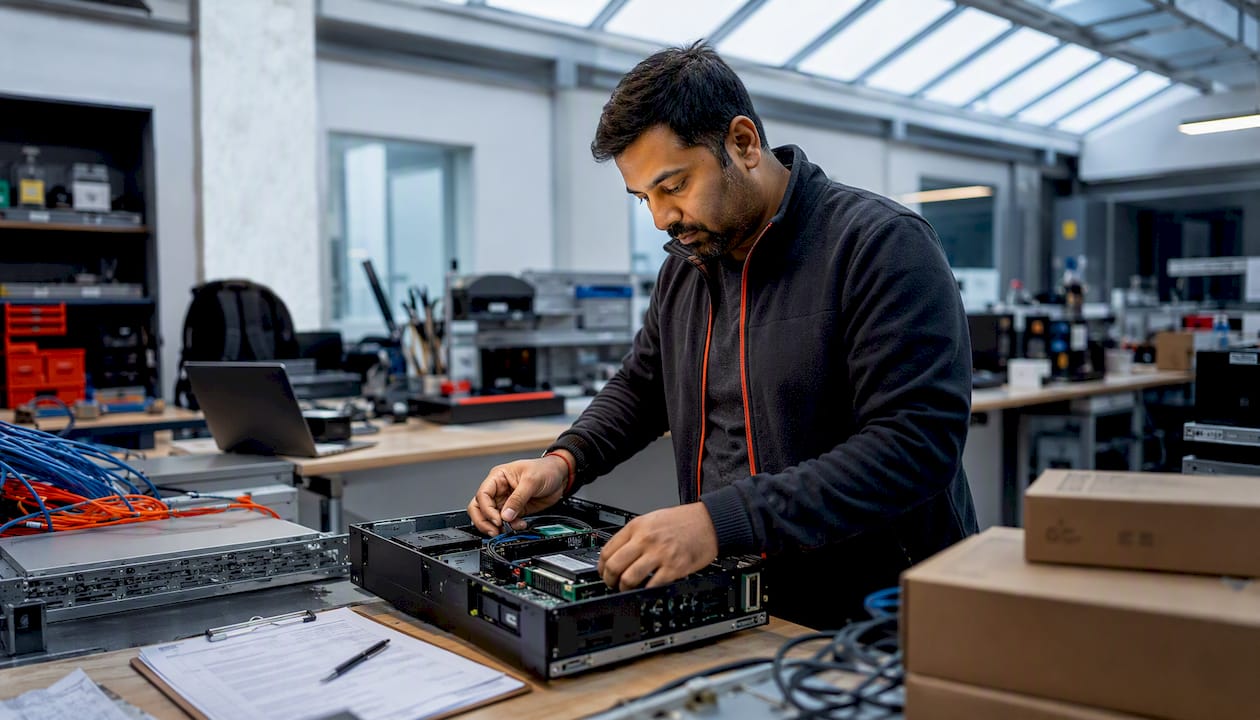
Automated onboarding software for enterprise IT teams
TL;DR:
- ServiceNow-native device onboarding software enhances device readiness, CMDB accuracy, and audit trail integrity for UK enterprises. It enables real-time CMDB updates, inherits tenant RBAC, and improves operational throughput while reducing asset loss and helpdesk tickets. Proper preparation and clear KPIs are essential for pilot success and demonstrating measurable ROI.
ServiceNow-native automated device onboarding software is the right choice for any UK distributed enterprise where day-one device readiness, CMDB accuracy, and audit-trail integrity are non-negotiable. The single next step: schedule a pilot scoping call with your ITSM, security, and procurement leads before the next budget cycle closes.
The case is straightforward. A ServiceNow-native platform inherits your existing RBAC, writes asset records directly to your CMDB, and keeps every handover event inside your tenant’s audit trail. No parallel database, no fresh vendor security review, no integration tax. Organisations that have deployed this model report 500%+ IT service throughput uplift and 83% faster fulfilment in regulated environments. These improvements were observed before agentic AI entered the workflow.
Table of Contents
- What does ‘automated onboarding software’ actually mean for IT teams?
- Why UK distributed enterprises need this now
- How does a ServiceNow-native provisioning platform actually work?
- What outcomes do enterprises actually achieve?
- What must you prepare before procurement or pilot?
- Which KPIs should you measure, and how do you model ROI?
- What does a realistic pilot-to-scale roadmap look like?
- What are the key risks and how do you mitigate them?
- How do you evaluate and choose the right vendor?
- Key takeaways
- The physical layer is the last mile AI cannot close alone
- Smart Collect® by Velocity-smart: from pilot to production
- Useful sources for procurement and technical teams
What does ‘automated onboarding software’ actually mean for IT teams?
Most search results for this phrase return HR tools: new-hire paperwork, induction portals, learning management systems. That is not what this article covers, and it is not what enterprise IT leaders need.
Here, automated onboarding software means ServiceNow-native device onboarding and provisioning platforms that orchestrate the physical handover of IT equipment through smart lockers, vending units, and kiosks. The scope includes:
- Device enrolment and compliance baseline checks at the point of handover
- Automated CMDB record creation and reconciliation
- RBAC inheritance from the customer’s ServiceNow tenant
- Full audit trail of every handover event, return, and wipe
- Hardware form factor orchestration: lockers, vending, and kiosks
Explicitly excluded: HR new-hire paperwork, LMS platforms, people-ops workflows, and any tool whose primary function is managing the employee experience rather than the device lifecycle. If your procurement brief conflates the two, correct it before issuing an RFP.
Why UK distributed enterprises need this now
Managing hardware across a hybrid and remote estate exposes a cluster of operational failures that manual processes cannot contain: late returns, incorrect configurations, security gaps, and helpdesk queues that grow faster than headcount. For UK organisations with sites across multiple regions, the cost compounds at every node.

Three drivers are converging to make automated device provisioning urgent rather than aspirational.
Distributed estate complexity. A device fleet spread across 10 or 30 sites cannot be managed by courier logistics and spreadsheet tracking. Configuration drift, missed patches, and unrecorded loans are structural outcomes of manual processes, not edge cases.
Security and compliance pressure. ISO 27001 and Cyber Essentials both require demonstrable controls over device state at handover. Automated enrolment and compliance checks, embedded in the handover workflow rather than appended as a gating step, produce the audit evidence those frameworks demand. A ServiceNow-native app inherits tenant RBAC and audit trails without additional configuration.
Operational cost. Device lifecycle management best practice includes imaging and security baseline before dispatch, zero or minimum-touch provisioning, and continuous monitoring. When those steps are automated inside your ITSM platform, the staff time reclaimed is measurable from week one.
How does a ServiceNow-native provisioning platform actually work?
The architecture is simpler than most IT leaders expect, because the platform lives inside the tenant rather than alongside it.
Core architecture: Smart Collect® runs as a ServiceNow-certified native application inside the customer’s tenant. It writes asset records directly to the CMDB, inherits existing RBAC and audit configuration, and tracks ServiceNow’s release schedule. There is no middleware layer, no API sync, and no separate vendor database to secure.
Typical workflow:
- Procurement raises a device request; the ITSM workflow triggers automatically
- Device is imaged and baseline-configured before dispatch (zero or minimum-touch staging)
- Device is loaded into a smart locker, vending unit, or kiosk at the target site
- User authenticates and collects; the handover event writes to the CMDB in real time
- Automated enrolment and compliance checks run at collection, not after
- CMDB record closes with ownership, location, and configuration state confirmed
Hardware form factors serve distinct operational needs. Smart lockers handle full-device handovers: new-starter kits, broken-laptop swaps, loans, and returns. Smart vending units dispense peripherals, consumables, and accessories on demand, 24/7, with no IT staff present. Smart Kiosk™ is a virtual tech-bar with an AI-powered video resolver group, replacing the traditional walk-up help desk.
Site readiness matters. Lockers and kiosks require stable power, a secure wired or dedicated wireless network (never guest Wi-Fi for locker traffic), and adequate transit space. These are the physical prerequisites that most pilots underestimate.
Pro Tip: Treat provisioning as an operating model across Day 0 to Day 30 and beyond, not a single deployment event. Measure stability through patch cycles and user experience, not just initial enrolment success.
What outcomes do enterprises actually achieve?
The metrics below come from Smart Collect® deployments in regulated sectors, delivered using traditional ITSM workflows before agentic AI entered the picture.
| Organisation type | Key metric | Outcome |
|---|---|---|
| Global pharma | IT service throughput | Significant uplift |
| Global pharma | Fulfilment speed | Much faster |
| Global pharma | Employee downtime | Large reduction |
| US nuclear energy operator | On-site helpdesk tickets | Notable reduction |
| US nuclear energy operator | IT staff time reclaimed | Substantial portion |
| US aerospace and defence | IT staff travel across multiple sites | Considerable reduction |
| UK utility | Shared-equipment loss and damage | Major reduction |
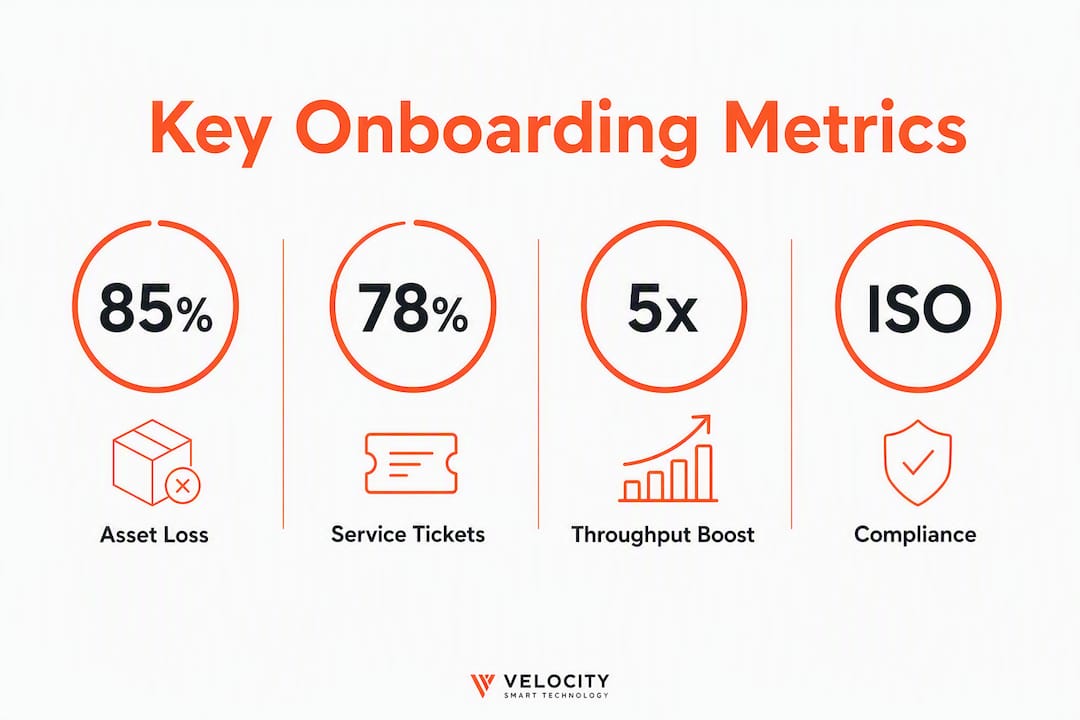
A separate analysis of smart locker and ITSM integration recorded an 85% reduction in asset loss, a 78% reduction in IT staff time on asset tasks, and 62% fewer helpdesk tickets. These figures align with the Smart Collect® case data and provide a useful cross-reference for procurement teams building conservative ROI models.
What must you prepare before procurement or pilot?
A pilot that stalls at week three usually failed in the preparation phase, not the technology. Work through this checklist before issuing an RFP or scheduling a vendor POC.
- Identity integration: — Confirm that your identity provider (Active Directory, Entra ID, or equivalent) integrates with the ServiceNow tenant and the locker authentication layer.
Pro Tip: Remote device management pilots that validate operational impact at one or two sites before full rollout consistently outperform big-bang deployments on both speed and stakeholder confidence.
Which KPIs should you measure, and how do you model ROI?
Measure these KPIs from day one of the pilot. Without a baseline, the business case for scale is anecdotal.
| KPI | Baseline measure | Target benchmark |
|---|---|---|
| Fulfilment time (device collection) | Current average hours | Sub-30 minutes at locker |
| IT service throughput | Transactions per day | 500%+ uplift (pharma benchmark) |
| Helpdesk tickets (hardware) | Tickets per week | Notable reduction as per energy benchmark |
| Asset loss rate | Devices unaccounted per quarter | Major reduction as per utility benchmark |
| IT staff time on asset tasks | Hours per week | Substantial portion reclaimed as per energy benchmark |
Sample ROI model inputs (conservative scenario):
- Courier cost per device dispatch: use your current average
- Helpdesk FTE cost attributable to hardware tickets: apply the 62% ticket reduction benchmark
- Asset write-off cost: apply the 85% loss reduction benchmark
- Staff time reclaimed: apply 78% of current IT asset-task hours at fully loaded cost
Most enterprises reach payback within the first operational quarter when courier, helpdesk, and asset-loss savings are combined. The manual distribution cost analysis provides a structured framework for populating these inputs with your own figures.
Measurement windows: Day 0–30 establishes the baseline and surfaces site-readiness gaps. Day 30–180 is where throughput, ticket, and loss metrics stabilise and become defensible for a board-level business case.
What does a realistic pilot-to-scale roadmap look like?
- Pilot deployment (weeks 5–12): — Install hardware at pilot sites, configure ServiceNow workflows, load initial device stock, and run user communications. Validate CMDB write behaviour and RBAC inheritance before go-live.
The global device provisioning model confirms that staged rollouts, with explicit validation gates between phases, consistently outperform single-wave deployments on both CMDB accuracy and user adoption.
What are the key risks and how do you mitigate them?
CMDB drift is the most common operational failure. Validate that the native app creates new records matched to existing serial numbers, and schedule monthly reconciliation runs. A ServiceNow-native app that writes records as configuration items rather than shadow assets makes this straightforward.
Unauthorised physical access to locker banks requires MFA at collection, tamper-evident hardware, and CCTV coverage at each installation point. Fail-safe decisions (locker locks on network loss) must be agreed with security before go-live.
Data residency. Confirm that all asset and audit data remains within your ServiceNow tenant and that no handover data transits to a third-party vendor database. A native app with no parallel database eliminates this risk by design.
Network outages at locker sites. Define fail-open versus fail-safe behaviour for each site. Lockers with local gateway capability can queue transactions and sync on reconnection; sites without this require a manual exception process.
Shared and loaner devices require separate CMDB record types and return-deadline automation. Without these, the audit trail breaks and asset loss rates rise.
How do you evaluate and choose the right vendor?
Use this checklist during RFP and POC stages.
| Criterion | What to verify |
|---|---|
| ServiceNow-native certification | Published on ServiceNow Store; not an API wrapper |
| CMDB write behaviour | Records created as native CIs, matched to existing serials |
| RBAC and audit inheritance | No additional configuration; inherited from tenant |
| Hardware form factors | Lockers, vending, and kiosks all supported from one platform |
| ISO 27001 and ISO 9001 | Current certificates, not self-declared |
| Data residency | All data stays within customer tenant; no vendor database |
| Regulated-sector references | Named case studies in pharma, energy, defence, or financial services |
| Channel and partner delivery | Availability through your existing systems integrator |
| Failure and exception SLAs | Documented response times for hardware faults and enrolment failures |
| MDM/RMM integration | Validated integrations with Microsoft Intune, JAMF, or equivalent |
Ask every vendor to demonstrate CMDB write behaviour in a sandbox environment during POC. Vendors who cannot show this in a live tenant are not natively integrated, regardless of marketing claims.
Key takeaways
ServiceNow-native automated device onboarding software delivers measurable throughput, fulfilment, and compliance gains that non-native integrations cannot replicate, because the data and workflows stay inside your existing tenant.
| Point | Details |
|---|---|
| Native integration is the deciding criterion | Only a ServiceNow-certified native app inherits RBAC, audit trails, and CMDB without additional configuration. |
| Outcomes are already proven | 500%+ throughput uplift and 83% faster fulfilment are documented in regulated-sector deployments. |
| Preparation determines pilot speed | Site readiness, asset tagging, and identity integration must be confirmed before hardware is ordered. |
| Measure from day one | Establish fulfilment time, ticket volume, and asset loss baselines in the first 30 days or the ROI case is undefendable. |
| Velocity-smart Smart Collect® | The only ServiceNow-native platform with ISO 9001, ISO 27001, and verified case studies across pharma, energy, and defence. |
The physical layer is the last mile AI cannot close alone
The enterprise IT community has spent three years debating which AI tools will reshape the service desk. The honest answer is that most of the gains are already visible in digital workflows: ticket triage, knowledge retrieval, change advisory. What has not moved is the physical layer. A laptop still needs a human to hand it over, unless the infrastructure exists to do it without one.
ServiceNow-native device onboarding is not a peripheral investment. It is the prerequisite for any enterprise that wants AI agents to close physical-handover tickets end-to-end. The organisations that have already deployed this model in pharma, energy, and defence did so before agentic AI was part of the conversation. Their throughput and fulfilment numbers are the floor. As Now Assist matures and drives workflows from request to physical handover without human intervention, those benchmarks will look conservative.
The procurement argument is straightforward: pilot at constrained scope, protect CMDB integrity, measure against the KPIs in this article, and present the validated numbers to finance. The risk of waiting is not abstract. Every quarter of manual distribution is a quarter of courier costs, helpdesk load, and asset losses that a deployed system would have eliminated.
Smart Collect® by Velocity-smart: from pilot to production
Velocity-smart’s Smart Collect® is the only ServiceNow-certified native application that orchestrates device handovers through smart lockers, vending units, and kiosks, all managed from inside your existing ServiceNow tenant. There is no middleware, no parallel database, and no additional security review. RBAC, audit trails, and CMDB records are inherited from your tenant on day one.
Trust signals for procurement and security teams: ISO 9001 and ISO 27001 certified, with documented outcomes including 500%+ IT service throughput uplift, 83% faster fulfilment, and 62% fewer on-site tickets across regulated sectors including pharma, energy, defence, and financial services. Approximately 55% of deployments are channel-led through global systems integrators, so your existing partner relationship likely already covers the route to market.
To see the pharma case study metrics in detail, or to request a pilot scoping conversation, visit velocity-smart.com.
Useful sources for procurement and technical teams
The references below underpin the claims in this article. Procurement and security teams can use them to validate benchmarks, populate RFP evidence packs, and brief audit teams.
- Global Pharma & Biotech — 500% IT Service Throughput | Velocity-smart case study — primary evidence for throughput and fulfilment benchmarks
- Velocity Smart Technology — Smart Collect® product and certification information — ServiceNow-native app architecture, CMDB behaviour, and hardware form factors
- Smart IT Support Kiosk for Enterprise IT Teams | Velocity-smart — kiosk form factor, supported integrations, and operational model
- Hardware Asset Management — ServiceNow — ServiceNow HAM product documentation and CMDB-as-source-of-truth architecture
- Zero Touch Refresh — ServiceNow documentation — zero-touch asset refresh workflow reference
How to use these in an RFP or security pack: attach the case study and product certification links as supporting evidence for the business case; use the ServiceNow documentation links to validate native app behaviour claims during POC; and reference the lifecycle management guides when briefing audit teams on provisioning controls.
Recommended
See what Smart Collect® could save you
Model your savings in two minutes, or book a 60-minute workshop to pressure-test the numbers against your estate.