 Automated replacement benefits: boost efficiency in enterprise IT">
Automated replacement benefits: boost efficiency in enterprise IT
TL;DR:
- Automated device replacement enhances speed, security, and employee experience in enterprise IT.
- Smart lockers and vending machines enable quick, secure, and scalable asset handovers.
- Successful implementation requires careful planning, stakeholder engagement, and phased change management.
Automated device replacement is too often reduced to a single talking point: cost savings. But for IT leaders managing hundreds or thousands of employees across distributed sites, the real story is far more compelling. Smart automation transforms how your organisation responds to device failures, onboards new starters, and keeps people productive without burdening your support teams. This article examines the evidence-backed, strategic benefits of automated replacement, from operational resilience and employee experience to security and compliance, and shows why forward-thinking enterprises are treating it as a cornerstone of modern IT.
Table of Contents
- Understanding automated replacement in enterprise IT
- Key benefits: why automate device replacement?
- How automated replacement works: tools and real-world examples
- Building the business case for automation
- Overcoming challenges when shifting to automation
- Why automation drives truly modern IT support
- Take the next step towards smart support
- Frequently asked questions
Key Takeaways
| Point | Details |
|---|---|
| Efficiency gains | Automated replacement transforms device management, reducing manual work and speeding up issue resolution. |
| Employee satisfaction | Rapid, streamlined device exchanges boost end-user experience and productivity in any workplace. |
| Operational resilience | Automation ensures consistent, secure device support for distributed and remote teams. |
| Overcoming hurdles | Strategic planning and communication help enterprises navigate common automation challenges. |
Understanding automated replacement in enterprise IT
Automated replacement, in the context of enterprise IT, refers to using technology to trigger, process, and fulfil device swaps or equipment handovers without requiring manual intervention at each step. When a device fails, a workflow fires. A replacement is reserved, located in a smart locker or vending unit nearby, and the employee collects it using secure credentials. No waiting for a technician. No phone call to the help desk. No delay.
Contrast that with traditional approaches. A fault is logged, a ticket is raised, someone reviews it, a replacement is sourced from a storeroom, and a technician schedules a visit. Labour-intensive and prone to delays, these manual workflows are difficult to scale across multiple sites or remote locations.
The triggers for adopting intelligent automation in IT tend to be consistent across large organisations:
- Rapid growth in headcount across dispersed locations
- Increasing pressure on help desk teams to manage asset logistics
- Rising expectations from employees for instant, self-service support
- Compliance demands that require auditable asset records
Here is a quick comparison of the two approaches:
| Factor | Manual replacement | Automated replacement |
|---|---|---|
| Speed of resolution | Hours to days | Minutes |
| Staff involvement | High | Minimal |
| Audit trail | Inconsistent | Automatic |
| Scalability | Limited | High |
| Employee experience | Disruptive | Seamless |
The help desk efficiency strategies that consistently deliver results share a common thread: removing friction from the asset handover process.
Pro Tip: Begin your automation journey with high-turnover assets such as laptops and headsets. These generate the most tickets and offer the fastest, most visible return on investment.
Key benefits: why automate device replacement?
Once you understand what automated replacement involves, the operational benefits become hard to ignore. The gains extend well beyond cost reduction.
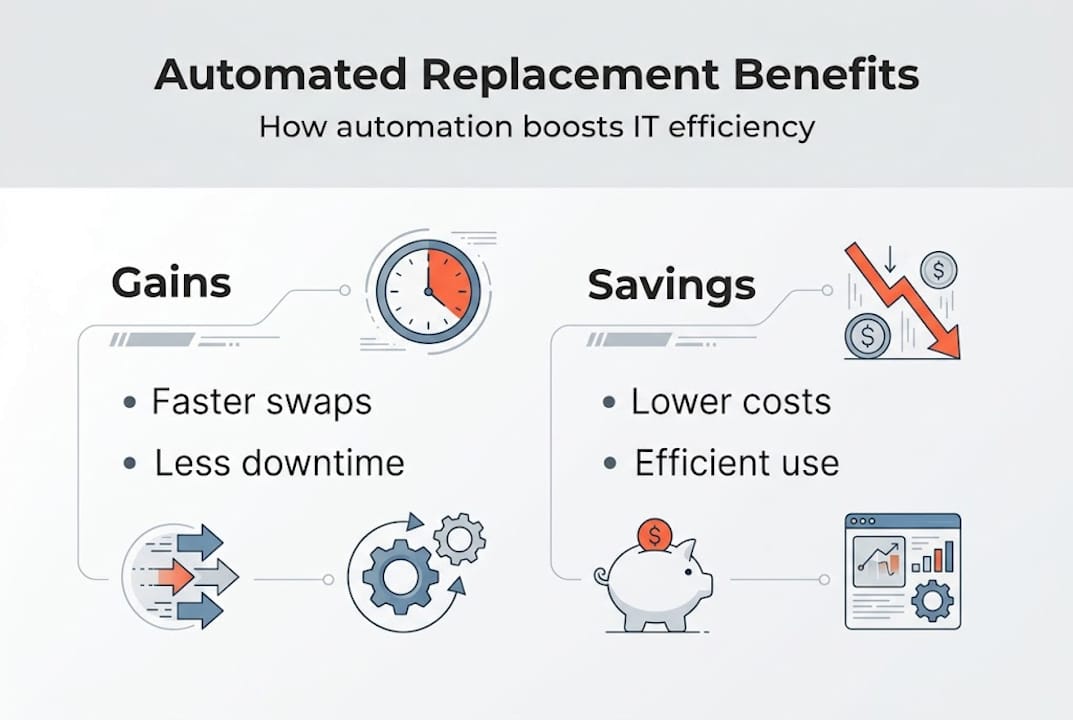
Speed and efficiency are the most immediate wins. Device handovers that previously took days now take minutes. Employees are not left waiting for a technician, and IT teams are not buried in logistics. Automated device replacement can reduce downtime and costs significantly, which has a direct knock-on effect on productivity across the workforce.

The costs of IT inefficiency accumulate quickly in large enterprises. A single day of reduced productivity per employee, multiplied across hundreds of workers, represents a substantial financial impact.
Employee experience is the benefit most organisations underestimate. When a new starter receives their laptop via a secure smart locker on day one, without queuing or waiting, that sets the tone for their entire employment experience. The same applies to device failures mid-project. Rapid resolution signals that the organisation values people’s time.
Security and compliance benefit enormously from automation. Every transaction is logged automatically, creating an unbroken audit trail. There is no risk of unrecorded handovers or missing asset information. For regulated industries such as financial services, healthcare, or government, this is not just convenient. It is essential.
- Faster device handover reduces mean time to resolution (MTTR)
- Automated audit trails support compliance and security reviews
- Reduced manual touchpoints lower the risk of human error
- Self-service access improves satisfaction scores across distributed teams
- Scalable workflows support steps to efficient IT automation without adding headcount
“The organisations that see the greatest ROI from automation are those that connect it directly to employee experience metrics, not just ticket volumes.”
The Reduce support costs guide reinforces this: reducing cost without sacrificing service quality requires systemic change, not just headcount decisions.
How automated replacement works: tools and real-world examples
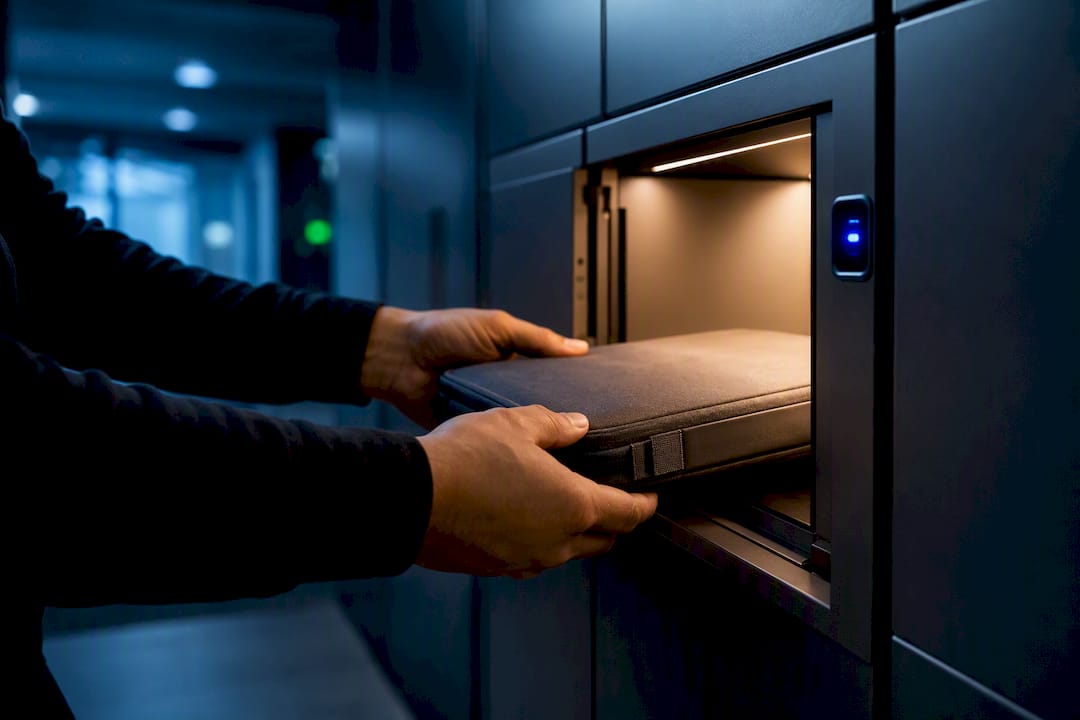
The mechanics are more straightforward than many IT leaders expect. Smart lockers and vending machines are deployed at workplace locations, stocked with pre-configured devices and accessories. Employees access them using single sign-on credentials, employee ID cards, or PIN codes. The transaction is recorded automatically in the connected ITSM platform.
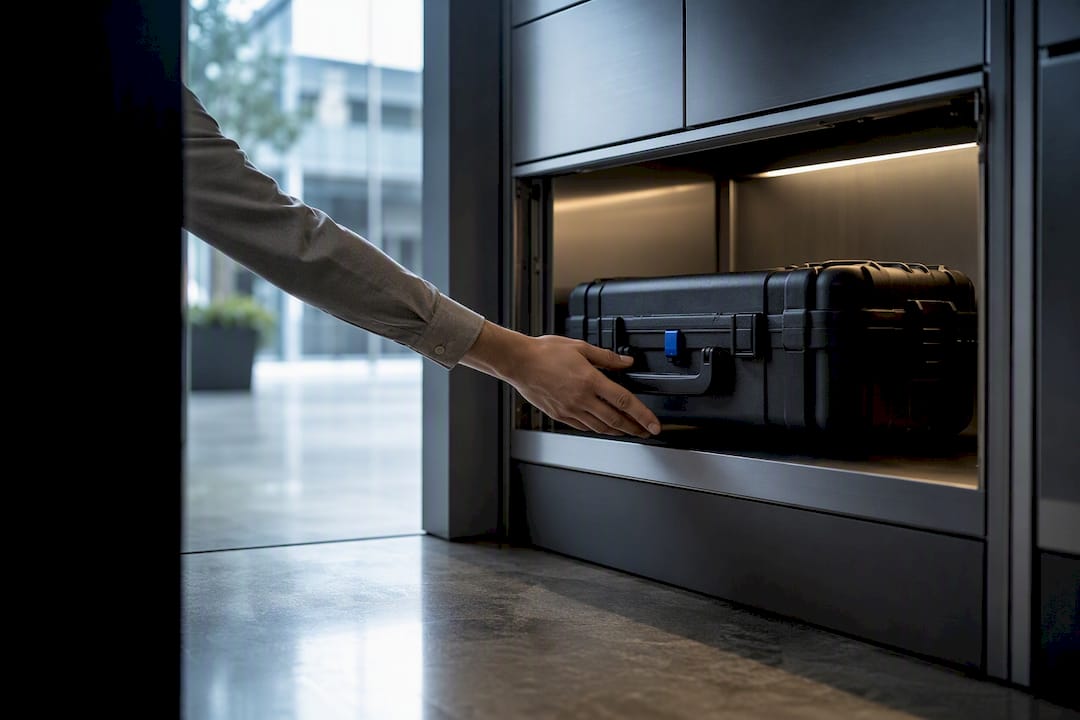
Smart lockers for remote IT enable 24/7 secure device access and streamlined replacements, meaning employees at a regional office or a manufacturing site can resolve a device issue outside of business hours without escalating to central IT.
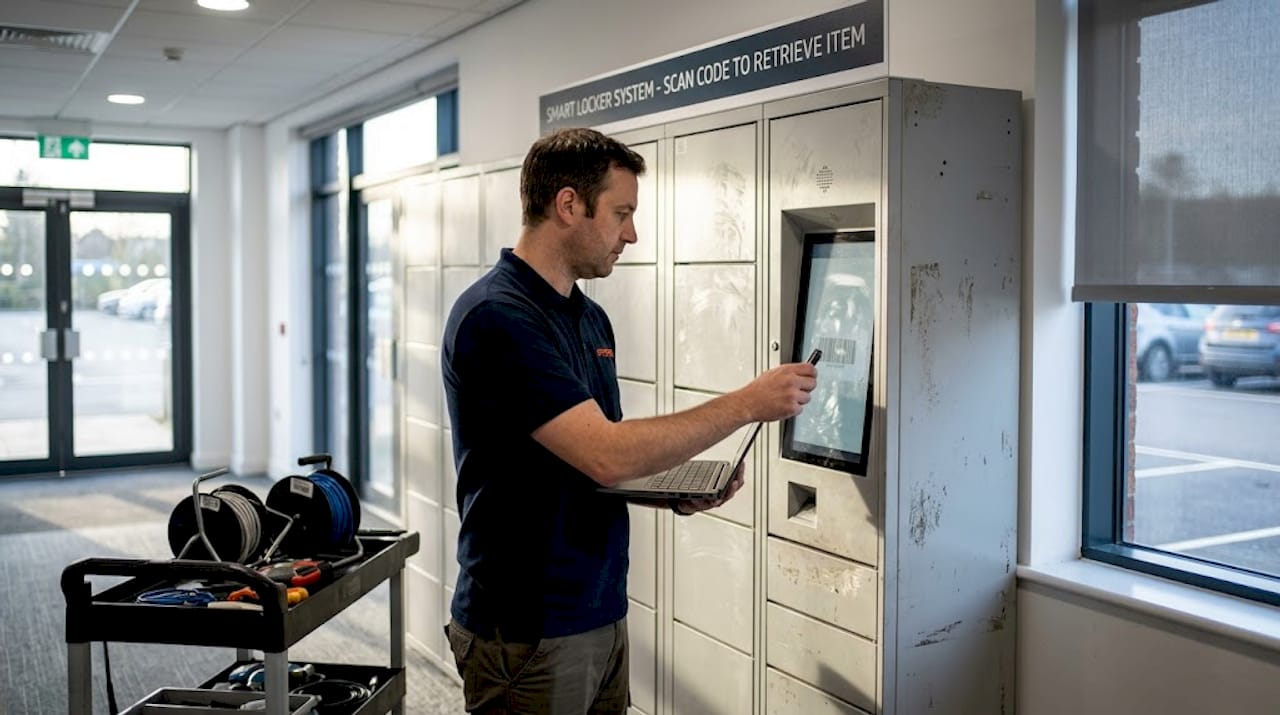
Consider a practical scenario. An employee at a satellite office reports a failed laptop at 7am. The automated workflow triggers, reserves a replacement unit in the on-site smart locker, and sends the employee a collection code. They retrieve the device in under three minutes. The failed unit is placed back in a designated return slot for collection by IT. No technician needed on-site.
Here is how manual and automated interventions compare across a typical replacement event:
| Stage | Manual process | Automated process |
|---|---|---|
| Fault reported | Ticket raised by user | Auto-detected or user logs via app |
| Replacement sourced | IT locates unit manually | Workflow selects nearest stocked unit |
| Employee collects device | Technician delivers or user travels to IT desk | User collects from smart locker |
| Asset record updated | Manual data entry | Automatic, real-time |
| Return of faulty device | Arranged separately | Same locker unit, same visit |
Integration with platforms such as ServiceNow makes this seamless. Solutions that run natively inside the customer’s instance eliminate the need for additional data platforms and remove GDPR risk entirely.
- Transform IT asset support by deploying vending machines stocked with peripherals and accessories
- Use enhancing IT asset automation approaches to accommodate larger devices as your estate grows
Pro Tip: Map your peak usage scenarios before deployment. If your site hosts shift workers, ensure lockers are stocked and accessible across all shift patterns, not just core business hours.
Building the business case for automation
Securing stakeholder buy-in for automation requires more than enthusiasm. It requires evidence. Fortunately, the numbers are increasingly on your side.
Automating IT asset management leads to measurable efficiency gains in enterprise environments, including reductions in ticket volumes, faster resolution times, and improved SLA (service level agreement) compliance. These are the metrics that resonate with finance teams and board-level sponsors.
Here is a stepwise approach to building your internal case:
- Baseline your current costs. Document the number of manual device replacements per month, average resolution time, and associated staff hours.
- Model the automation impact. Use vendor data and enterprise IT asset management benchmarks to project time savings and cost reductions.
- Connect to employee productivity. Quantify the cost of downtime per employee per day and show how faster resolution reduces this.
- Address risk and compliance. Highlight the audit trail and asset tracking benefits for your legal and security teams.
- Pilot and measure. Propose a single-site pilot to generate internal evidence before scaling.
One common objection is that automation requires significant upfront investment. The response is straightforward: compare that investment against the ongoing cost of manual processes, which rarely appears as a single budget line but accumulates across every team that touches device logistics.
Exploring automating device returns as part of the case can also demonstrate a full-circle approach to asset management, reducing loss and improving stock visibility.
The global support efficiency strategies adopted by leading enterprises consistently show that organisations that invest in systemic automation outperform those relying on reactive, manual support models.
Overcoming challenges when shifting to automation
No transformation is without friction. IT leaders who approach automation with a clear-eyed view of the challenges are far better positioned to succeed.
The most common hurdles include:
- Integration complexity: Connecting smart hardware to existing ITSM platforms can be technically demanding. Choose solutions designed to run natively within your existing environment rather than bolting on external systems.
- Stakeholder resistance: Finance and operations teams may question the business case initially. Use pilot data and automating proactive IT support evidence to address concerns.
- End-user adoption: Employees accustomed to calling the help desk may be sceptical of self-service tools. A structured communication and training plan removes much of this friction.
- Change management: IT teams themselves sometimes worry that automation threatens their roles. Frame it accurately: automation handles repetitive logistics, freeing staff for higher-value work.
Automation can face initial resistance but delivers long-term value when implemented thoughtfully. A tiered rollout, beginning with a single location or asset type, generates early wins and builds confidence across the organisation.
Before you begin your rollout, prepare the following:
- A clear scope document defining which assets and locations are in scope for phase one
- A communication plan for employees at the pilot site
- A training brief for IT staff managing the hardware and workflows
- A measurement framework to track resolution times and satisfaction scores
The future of IT support points firmly towards intelligent, distributed service points that reduce the need for centralised, manual intervention. The contact centre best practices literature echoes this: proactive, technology-led service consistently outperforms reactive, people-only models.
Why automation drives truly modern IT support
Most enterprises that explore automation focus almost entirely on the operational metrics: fewer tickets, faster resolution, lower cost per device swap. These matter. But the organisations that see transformative results are those that treat automation as an enabler of a fundamentally better employee experience, not simply a way to reduce headcount or cut budgets.
The uncomfortable truth is that most IT support models were designed for a world where employees were concentrated in a single building, close to a central IT desk. That world is gone. Distributed teams, flexible working, and multi-site operations have made the old model structurally inadequate. Automation does not just make that old model more efficient. It replaces it with something fit for purpose.
The IT support evolution insights coming from progressive enterprises share a clear message: the technology is rarely the barrier. The barrier is the willingness to reimagine what support looks like when it is built around the employee rather than the IT team’s convenience. That shift in thinking is where the real value lives.
Take the next step towards smart support
If the case for automated device replacement is clear, the next question is practical: what does implementation actually look like for an organisation at your scale?
Velocity Smart Technology works with large enterprises across financial services, healthcare, government, and beyond to operationalise exactly this kind of automation. From smart lockers and vending machines to the smart IT support kiosk, our solutions run natively within ServiceNow, eliminating data risk and enabling seamless workflow automation. Whether you are exploring your first pilot or scaling across dozens of sites, the Automation Unboxed resource is a practical starting point for enterprise IT leaders ready to act.
Frequently asked questions
What is automated replacement in IT support?
Smart vending machines and smart lockers automate IT asset replacement by allowing employees to collect and return devices securely without involving a technician, reducing the manual effort required at every stage.
How does automation improve device replacement efficiency?
Automation speeds up device exchanges and cuts downtime by giving employees instant access to working equipment, with reduced device downtime translating directly into improved productivity and support outcomes.
Are automated replacement solutions secure?
Yes. Every transaction is logged automatically, creating a full audit trail. Automation enhances security by eliminating unrecorded handovers and ensuring asset records remain accurate and compliant.
What challenges might I face when automating device replacement?
Integration, end-user training, and change management are the most common hurdles, but automation brings long-term value when introduced through a structured, phased rollout with clear communication from the outset.
Recommended
See what Smart Collect® could save you
Model your savings in two minutes, or book a 60-minute workshop to pressure-test the numbers against your estate.