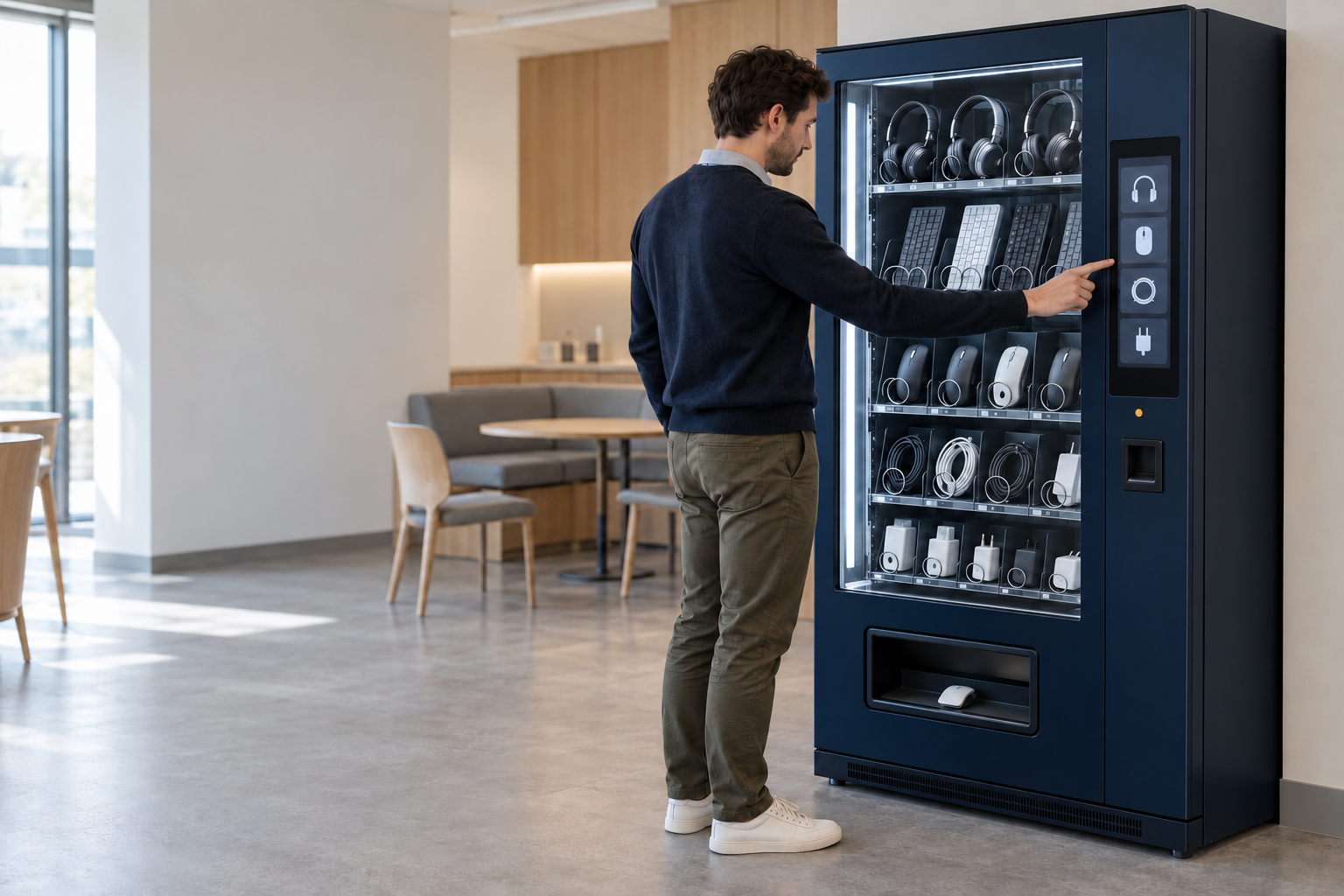
A smart vending machine hands your people the IT equipment they need, and closes the ServiceNow ticket automatically.
Every headset, cable, adapter, keyboard and charger your people ask for today arrives as a ticket in a queue and an engineer's afternoon. A Velocity smart vending machine turns that queue into 24/7 self-service that writes each transaction straight into your ServiceNow workflows, updates the CMDB, and closes the ticket without anyone lifting a finger.
What is a smart vending machine for IT equipment?
A smart vending machine for IT equipment is a secure, automated dispensing unit that gives your people instant, 24/7 access to peripherals, accessories, consumables and, in larger configurations, full laptops and tablets, without raising a ticket or waiting for an engineer.
Velocity Smart Vending is fully native to your ServiceNow tenant, so every transaction runs inside your own service workflows. Whether your team calls it a tech vending machine, an IT vending machine or an IT equipment vending machine, the outcome is the same. Every collection updates your CMDB, every restock is automated, and every pound of spend is auditable.
- Automated dispensing — 25+ products per unit, secured behind glass or solid front
- Self-service 24/7 — peripherals and consumables collected on demand, no ticket required
- ServiceNow-native — every collection updates CMDB, every restock is automated
One smart vending machine covers peripherals, consumables and laptops.
Velocity smart vending machines are purpose-built for high-volume IT fulfilment: keyboards, mice, headsets, charging cables, USB drives, laptop chargers, adapters and PPE. Configured as a laptop vending machine, the larger IDEA units dispense full laptops and tablets from conveyor lifts, so a single estate covers everything from a cable on a spiral to a business laptop.
Unlike a traditional snack machine, a Velocity smart vending machine connects directly to your CMDB. Every dispensed item is logged against the employee's identity, every restock is triggered automatically, and your IT team keeps complete visibility of accessory inventory without a single manual stock-take.
Smart Collect® runs your entire smart vending machine estate from inside ServiceNow.
Velocity Smart Collect® is the world's only Built On Now certified, ServiceNow-native platform for smart vending machines and smart lockers. It runs your whole estate from one dashboard inside your own tenant: real-time stock levels, automated restock alerts when a bay drops below threshold, a complete transaction history per employee, and full audit trails.
Because Smart Collect® uses the same workflows for lockers, vending and, from Q3 2026, kiosks, your team manages one platform whichever form factor sits in whichever site. Most customers reach payback inside year one as onsite IT spend and ticket volumes fall, and the platform scales across multi-site deployments and eight hardware manufacturers.
What can a Velocity smart vending machine do?
Four use cases template across the Velocity customer base, from global pharma to nuclear energy. Each one closes a workflow that used to need a ticket.
Peripheral fulfilment
The dominant use case — on demand, ticket-free.
Headsets, cables, adapters, charging blocks, mice, keyboards — dispensed automatically against pre-authorised employee allocations. No tickets, no engineer dispatch.
New-starter accessory pack
Day-1 accessories alongside the laptop locker.
Headset, mouse, charging cable, ID lanyard pack — dispensed to the new starter on arrival, paired with the laptop locker collection in the same workflow.
Consumables refresh
Recurring restocks, zero IT-team admin.
Cables, batteries, charging blocks and other consumables tracked against per-employee policy. Auto-restock when thresholds hit. Spend reportable against cost-centre.
Employee experience programmes
Branded merchandise, recognition gifts, wellness items.
Smart Vending isn't just IT — HR-issued items (branded swag, wellness products, recognition tokens) can run on the same Smart Collect® workflow, with their own authorisation rules.
Your smart vending machines are not tied to one vendor, and neither is your platform.
Velocity is not tied to a single vending hardware vendor. We deploy and support smart vending machines from three manufacturers, chosen for the use case, the product mix and the site environment — part of eight distinct hardware manufacturers across the whole Smart Collect® estate. Whatever the underlying hardware, Smart Collect® unifies it inside a single ServiceNow workflow.


Your people authenticate two ways, and every collection lands on one audit chain.
A Velocity smart vending machine supports two complementary authentication models, chosen per use case or per machine. Both tie every transaction to a ServiceNow record, giving you different starting points with the same audit integrity.
The employee raises a request in ServiceNow. Once approved, the system generates a single-use QR code, barcode or PIN and emails it to the employee's ServiceNow-registered work address. The employee collects from the machine.
The ticket exists before the collection. The collection closes the ticket. Same one-ticket-one-item integrity as Velocity Smart Lockers.
The employee taps their existing staff ID badge at the machine. The system reads role, team or department, applies the configured spend or item allowance for that profile, and presents only the items they're entitled to collect. On selection, the system auto-creates a ServiceNow request for the item — and closes it in the same workflow.
The ticket is created at the moment of collection. Spend is reportable against cost-centre. Allowances are configurable by role, team or department.
Why both? Some workflows benefit from the ticket existing before the collection — controlled assets, GxP-validated peripherals, anything requiring approval. Others — like everyday peripheral fulfilment — benefit from removing the request-raising step entirely. Velocity Smart Collect® supports both, and every transaction lands as a first-class ServiceNow record either way.
Every collection is a trip somebody no longer makes.
Peripheral fulfilment looks cheap per ticket, which is exactly why it never gets challenged. Multiply it by a year of cables, headsets, chargers, keyboards and docks across every site you support, and it stops looking cheap. Most IT teams have never counted it, because deskside support does not appear as its own line in anyone's budget.
Two ways to put a number on it. Start with whichever matches what you already know.
The Deskside Support Cost Benchmark
Twelve questions about how your team runs device support today. No spreadsheet, no digging through ticket exports, nothing to prepare.
- Twelve questions, every one multiple choice
- Around three minutes, start to finish
- Your annual deskside support cost, calculated from your answers
- How your handover times, wait times and kit recovery rates compare with other enterprise IT teams
The Smart Collect® ROI Calculator
If you already know your ticket volumes, your sites and what an engineer costs you, skip the diagnosis and go straight to modelling the saving.
- Savings modelled against your own volumes, not an industry average
- Payback period and multi-year return
- A written breakdown you can take into a budget conversation
Both are free. The benchmark sends your result by email, so you will need a work email address.
IT leaders ask us these questions about smart vending machines.
Ready to put a smart vending machine inside your ServiceNow?
A 60-minute discovery workshop with a Velocity ServiceNow architect maps your fulfilment volumes, sizes a pilot, and identifies the right smart vending machine ranges for your environment.