
How to modernise device returns for faster IT processes
TL;DR:
- Automating device returns reduces costs, enhances compliance, and improves employee experience.
- Implementing a structured 5-stage process with smart lockers and API integrations streamlines workflows.
- Ongoing monitoring and communication are essential for optimizing the automated return program.
Every time an employee leaves your organisation, changes role, or returns from a project, a device needs to come back. In large enterprises, this happens hundreds or thousands of times a year, and the process is rarely as clean as it should be. Legacy device return workflows create IT backlogs, expose organisations to data security risks, and leave employees frustrated with clunky, manual hand-back procedures. Modernising this process through automation is not simply an efficiency play. It directly improves compliance, reduces costs, and transforms the employee experience at a moment that genuinely matters.
Table of Contents
- Why modernise device returns?
- Preparing for device return automation
- Step-by-step: Modernising your device return process
- Verifying and optimising device returns
- What most guides miss about device returns
- Take the next step with automated device returns
- Frequently asked questions
Key Takeaways
| Point | Details |
|---|---|
| Automate for efficiency | Device return automation reduces costs, admin work, and turnaround times in IT operations. |
| Smart lockers boost security | Deploying smart lockers enables audited, secure, 24/7 device returns for both IT teams and employees. |
| Track with ITAM | Centralised IT asset management ensures traceability, compliance, and easy reporting in modernised processes. |
| Employee experience matters | Modern device returns deliver flexible options and reduce user frustration for enterprise teams. |
| Continuous improvement | Regularly review metrics and user feedback to optimise your device return strategy over time. |
Why modernise device returns?
Legacy device return processes share a familiar set of problems. IT teams chase employees for hardware. Asset records go unupdated for weeks. Devices sit in drawers, unwiped and untracked, creating real data security exposure. The cumulative cost of these inefficiencies is significant, not just in IT staff time but in the risk of unaccounted assets and delayed device redeployment.
The most common pain points include:
- Manual asset tracking that relies on spreadsheets or disconnected systems, leading to errors and gaps in audit trails
- No clear handoff process, meaning devices are left on desks, posted without tracking, or handed to line managers who forget to escalate them
- Delayed device wipe and re-enrolment, which extends the window of data security risk and slows redeployment to new starters
- Poor employee experience, particularly during offboarding, when friction in the return process leaves a lasting negative impression
- Compliance exposure, especially in regulated industries where device accountability is subject to audit
The business case for change is strong. ROI of smart locker investment analysis consistently shows that automating device returns reduces per-return costs and frees IT staff to focus on higher-value work. The business case for smart lockers is increasingly straightforward when you factor in reduced manual labour, faster asset redeployment, and improved compliance.
“Key methodologies include zero-touch unenrollment, API integrations for instant revocation, smart lockers for on-site returns, prepaid shipping for remote, and centralised ITAM tracking.”
Organisations investing in enhancing global mobility strategies are already embedding device return automation into their broader workforce management frameworks. The shift from reactive, manual returns to proactive, automated processes is not a future ambition. It is happening now, and enterprises that delay risk falling further behind on both cost and compliance.
Automation also changes the dynamic for IT teams. Rather than chasing devices, your team receives automated alerts, updated asset records, and clean handoff data without lifting a finger. That is a meaningful shift in how IT capacity is spent.
Preparing for device return automation
With the rationale clear, preparation is the next step. Rolling out device return automation without proper groundwork is one of the most common reasons implementations stall. Start with a thorough audit of your existing return workflows, mapping every touchpoint from the moment a return is triggered to the point the device is wiped and redeployed.
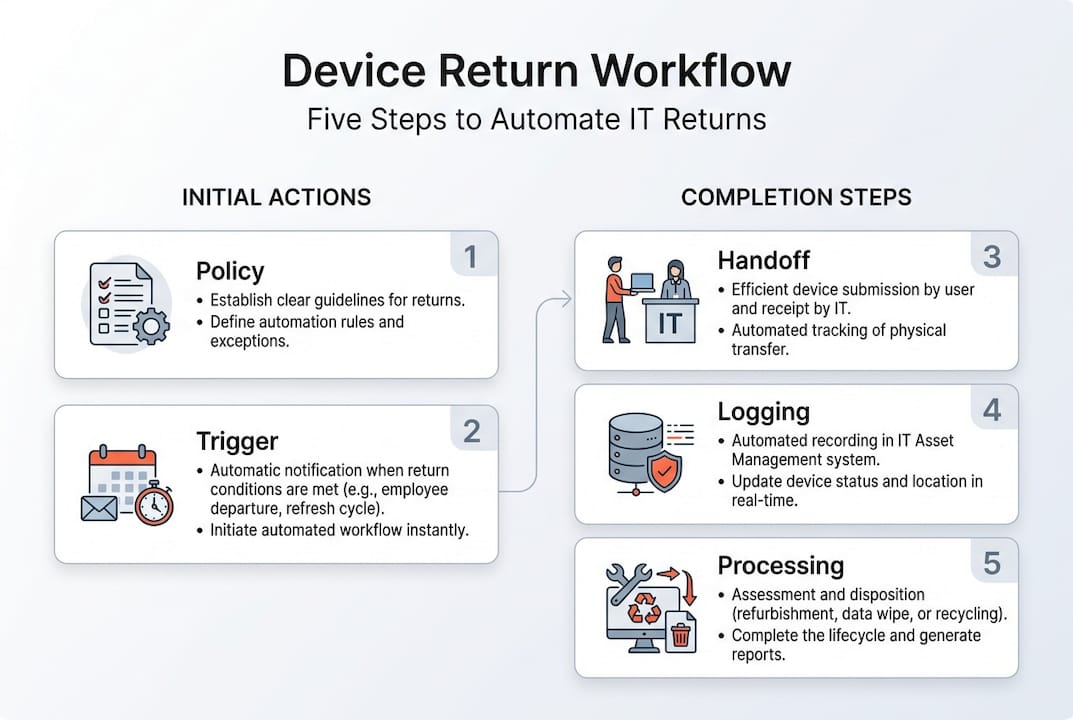
A well-structured device return programme follows a 5-stage process: Policy, Trigger, Handoff, Logging, and Processing. Each stage needs a defined owner, a clear method, and ideally an automated action.
| Stage | Manual approach | Automated approach |
|---|---|---|
| Policy | Documented but inconsistently applied | Enforced via ITSM workflows |
| Trigger | HR emails IT manually | System event auto-triggers return request |
| Handoff | Employee posts device or drops to IT desk | Smart locker or prepaid tracked shipping |
| Logging | IT manually updates asset record | Auto-logged on device receipt |
| Processing | IT team wipes and re-enrols manually | Zero-touch unenrolment via MDM |
Key requirements for a successful rollout include:
- Zero-touch unenrolment capability within your mobile device management (MDM) platform
- API integration between your ITSM, HR, and ITAM systems to ensure return triggers fire automatically
- Centralised IT asset management (ITAM) to provide a single source of truth for device status
- Smart locker infrastructure for on-site employees, enabling secure, self-service device drop-off
Understanding how smart lockers help IT support teams is important at this stage. Lockers remove the need for a staffed collection point and provide tamper-evident, auditable handoff records. For transforming IT asset management, this kind of physical-digital integration is a genuine step change.

Employee communication is often underestimated. People need to know what to return, when, and how. Clear instructions, sent at the right moment in the offboarding or transition workflow, dramatically reduce errors and delays.
Pro Tip: Pilot your automation with a single site or department before rolling out enterprise-wide. This surfaces integration gaps and employee experience issues before they become large-scale problems.
Step-by-step: Modernising your device return process
Now that you have prepared, follow this process to bring device returns into the modern era.
- Define and publish your return policy. Set clear rules: what must be returned, within what timeframe, and via which method. Embed this policy into your ITSM platform so it can be enforced automatically.
- Configure automated triggers. Connect your HR system to your ITSM so that a leaver record, role change, or project closure automatically generates a return request and notifies the employee.
- Set up handoff options. For on-site staff, smart lockers for on-site returns provide 24/7 secure drop-off. For remote employees, prepaid tracked shipping labels issued automatically remove the logistical burden from both sides.
- Automate logging. When a device is placed in a smart locker or scanned at a shipping point, your ITAM system should update automatically. No manual re-keying, no delays.
- Process and redeploy. Zero-touch unenrolment wipes and re-enrols devices without IT intervention. The device moves straight back into your available inventory.
| Method | Speed | Cost | Employee effort | Auditability |
|---|---|---|---|---|
| Manual desk drop-off | Slow | High (staff time) | Medium | Low |
| Smart locker | Fast | Low (automated) | Low | High |
| Prepaid shipping | Medium | Medium | Low | Medium |
The future of remote IT support is built on exactly this kind of frictionless, automated workflow. Organisations exploring the business case for improved IT service delivery will find that device return automation is one of the fastest ways to demonstrate measurable ROI.
Automation in global mobility programmes shows that organisations reducing manual touchpoints in device logistics see faster asset turnaround and lower operational costs at scale.
Pro Tip: Use your ITSM platform to send automated reminders at 48 hours and 24 hours before a return deadline. This alone can cut late returns by a significant margin without any additional staff effort.
Verifying and optimising device returns
Once the system is in motion, ensuring consistent results and ongoing improvement is essential. Automation does not mean set-and-forget. You need visibility into how the process is performing and a clear method for identifying where it breaks down.
Start by tracking these key metrics:
- Return turnaround time: how long from trigger to device being available for redeployment
- Compliance rate: percentage of returns completed within the defined policy window
- Cost per return: total operational cost divided by volume, tracked over time
- Employee satisfaction score: gathered via a short post-return survey embedded in the workflow
- Asset discrepancy rate: the gap between expected and actual returns, which flags process failures
Centralised ITAM tracking for auditability and reporting is what makes this visibility possible. Without a single system of record, you are relying on manual reconciliation, which defeats the purpose of automation.
Common problems to watch for include user errors at the smart locker (wrong compartment, wrong device), delayed handoff due to unclear instructions, and integration failures between HR and ITSM that prevent triggers from firing. Each of these has a straightforward fix once you can see it in your data.
Gathering feedback from both employees and IT staff is valuable. Employees will tell you where the process felt confusing. IT staff will highlight where manual intervention is still required, pointing to gaps in your automation coverage. Use this feedback to refine instructions, adjust triggers, and close integration gaps.
Learning how to improve IT support efficiency through data-led optimisation is what separates organisations that sustain the benefits of automation from those that see initial gains erode over time.
What most guides miss about device returns
Most how-to guides treat device return modernisation as a purely technical problem. Configure the API, install the lockers, update the policy. Done. In practice, the hardest part is almost always change management, and it is rarely discussed with the seriousness it deserves.
Employees do not resist returning devices because they are difficult. They resist because the process has historically been unclear, inconvenient, or disconnected from anything that felt important. Changing that perception requires deliberate communication, not just better technology.
There is also a regulatory dimension that generic guides overlook entirely. In sectors such as financial services, healthcare, and government, device return processes must satisfy specific audit and data handling requirements that vary by jurisdiction. Automation helps, but only if it is configured with those requirements in mind from the outset.
The unexpected benefit that IT leaders consistently report is improved asset visibility across the entire estate, not just at the point of return. When your return process is automated and integrated, you gain a live picture of where every device is in its lifecycle. That intelligence feeds better procurement decisions, more accurate budgeting, and stronger risk management. For organisations transforming finance IT and other regulated functions, this visibility is genuinely transformative. Device return automation is a gateway to broader IT maturity, not just a cost-saving exercise.
Take the next step with automated device returns
If the process outlined in this guide resonates, the next question is which technology will actually deliver it at enterprise scale.
Velocity Smart Technology provides the infrastructure and platform integration to make device return automation real. Our Smart IT Support Kiosk enables secure, self-service device exchange and diagnostics without requiring onsite technicians. Our Smart Locker and Vending Software is the leading ServiceNow-certified solution, built natively on the platform trusted by 85% of the Fortune 500. Explore practical use cases and implementation insights through Automation Unboxed, or speak with our team to see how we can accelerate your device return modernisation programme.
Frequently asked questions
What are the core steps for automating device returns in large enterprises?
The main steps follow a 5-stage process: defining policy, setting up automated triggers, handing off devices via smart lockers or tracked shipping, logging returns automatically, and centrally processing and redeploying assets.
How do smart lockers simplify device returns?
Smart lockers for on-site returns provide 24/7 secure drop-off with automated asset logging, removing the need for staffed collection points and giving IT teams a complete, tamper-evident audit trail.
What are the key metrics for measuring a device return programme?
Track turnaround time, compliance rates, cost per return, and employee satisfaction scores. Centralised ITAM tracking provides the auditability and reporting needed to monitor all of these consistently.
Does automation increase security in device returns?
Yes. API integrations for instant revocation and centralised ITAM tracking ensure devices are locked out and accounted for immediately, closing the data security window that manual processes leave open.
How can device returns improve employee experience?
Automated returns using smart lockers and prepaid shipping give employees flexible, low-effort options for handing back devices, reducing friction during offboarding and leaving a more positive final impression of the organisation.
Recommended
See what Smart Collect® could save you
Model your savings in two minutes, or book a 60-minute workshop to pressure-test the numbers against your estate.