 IT consumable dispensers: 4 types driving enterprise efficiency">
IT consumable dispensers: 4 types driving enterprise efficiency
TL;DR:
- Automated dispensers improve asset management, security, and reduce manual workload across enterprises.
- Smart lockers are ideal for high-value or larger assets, offering secure, traceable check-in and check-out.
- Most large organizations benefit from deploying a mix of vending machines and lockers tailored to their needs.
IT consumable dispensers: 4 types driving enterprise efficiency
Managing IT consumables across a large enterprise is far more complex than most senior leaders anticipate. When you have hundreds or thousands of employees spread across multiple sites, keeping everyone equipped with cables, peripherals, replacement devices, and everyday IT essentials becomes a logistical challenge that eats into your team’s time and your organisation’s budget. Manual distribution processes create queues, shadow IT stockpiles, and blind spots in your asset data. Automated dispensers offer a structured, data-driven alternative — and understanding which types suit which scenarios is the first step toward making a genuinely sound investment.
Table of Contents
- Key criteria for selecting IT consumable dispensers
- Smart vending machines: Automated convenience for common IT consumables
- Smart lockers: Secure and flexible storage for high-value equipment
- Comparison of dispenser types: Which fits your organisation?
- Case studies: Real-world deployment of IT consumable dispensers
- Our take: Why the right dispenser mix can make or break IT automation
- Explore automated IT dispensing with Velocity Smart
- Frequently asked questions
Key Takeaways
| Point | Details |
|---|---|
| Smart vending machines | Ideal for distributing low-cost, high-volume IT consumables securely and efficiently. |
| Smart lockers | Designed for high-value or bulky assets, supporting flexible workflows and added security. |
| Hybrid approach | Many enterprises achieve superior results by combining vending and locker solutions. |
| Data-driven decisions | Both dispenser types provide actionable usage data to inform IT support and inventory management. |
Key criteria for selecting IT consumable dispensers
To choose the right dispenser, it is essential to begin with clear criteria. Jumping straight to a product catalogue without first mapping your requirements is one of the most common and costly mistakes enterprises make. Before comparing any specific solution, run through the following evaluation framework.
Volume and item range. Consider how many items you need to dispense per day or per week, and how varied those items are. A single warehouse might need only charging cables and mice, while a multi-floor corporate campus might require everything from USB hubs to temporary laptop loans.
Security and access control. Some assets demand stricter authentication than others. Think carefully about who should access what, and whether you need individual user-level tracking rather than just departmental logs.
Integration with existing IT systems. A dispenser that cannot connect to your ITSM (IT service management) platform or asset management database will create more work, not less. Look for native integrations, not bolt-on connectors.
Physical footprint. Space is often constrained in IT storerooms, server rooms, and open-plan offices. Measure available floor and wall space before shortlisting any hardware.
Restocking and maintenance ease. Who will replenish stock, and how often? Systems that require specialist technician visits for routine restocking will quickly frustrate your facilities or IT ops teams.
Total cost of ownership. Purchase price is only part of the picture. Factor in software licensing, installation, training, maintenance contracts, and integration costs over a three to five year horizon.
Real-time usage data. The most valuable dispensers do not just distribute items — they generate actionable data about consumption patterns, low-stock alerts, and user behaviour. That data feeds smarter procurement decisions and tighter budget control.
Pro Tip: Build a cross-functional working group that includes IT, facilities, finance, and HR before finalising your criteria. The requirements that each team surfaces are often very different, and missing any one perspective leads to gaps in your deployment.
Smart vending machines: Automated convenience for common IT consumables
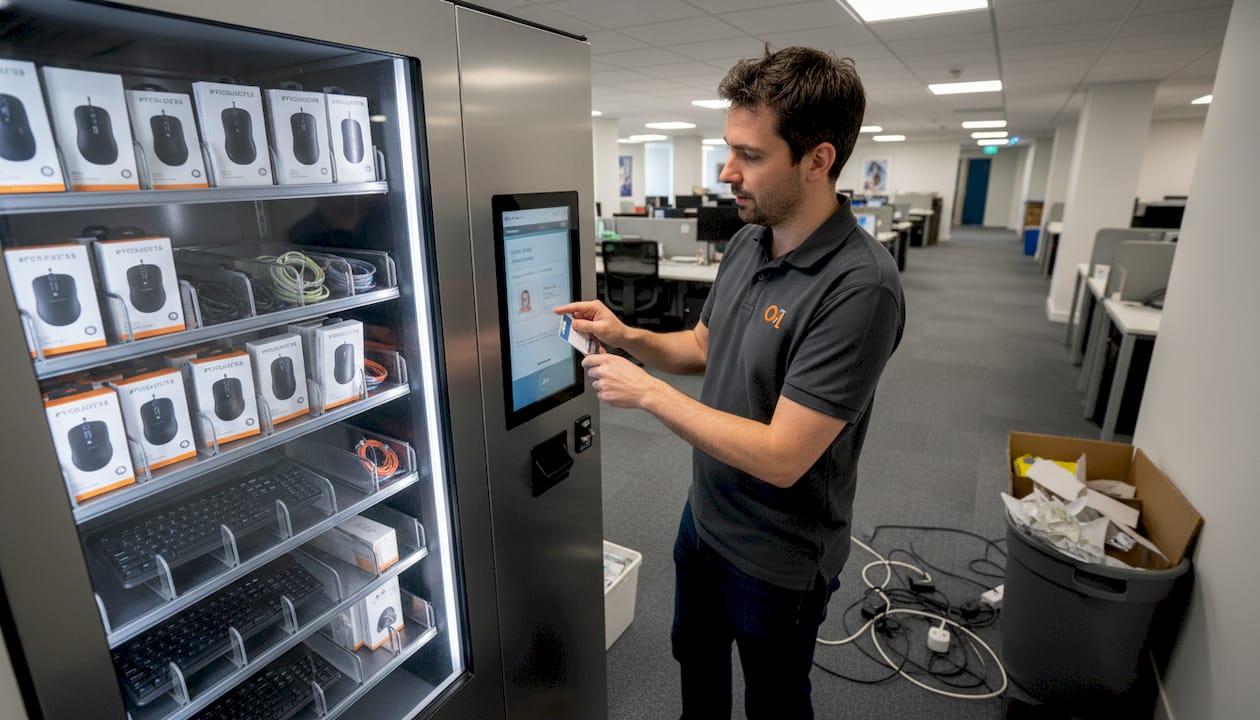
With evaluation criteria in place, we can explore the main dispenser types, starting with smart vending machines. These units look similar to the food and drink vending machines you find in office break rooms, but they are purpose-built for IT asset management. They automate the distribution of small, frequently needed items such as USB cables, mice, keyboards, headsets, and phone chargers.
Access is typically controlled through staff credentials or employee badges swiped at the machine’s interface, which means every transaction is logged against a named individual. That single feature eliminates the “missing stock” problem that plagues open-shelf IT storerooms almost overnight. Inventory levels are tracked in real time, and many systems send automated alerts when stock falls below a defined threshold.
Where smart vending machines deliver the most value:
- High-throughput environments where many employees need common consumables quickly
- 24/7 access scenarios where an IT helpdesk may not be staffed around the clock
- Locations where reducing walk-up requests to IT staff is a priority
- Sites where standardising item distribution and preventing waste are key goals
However, vending machines do have a ceiling. They are not well suited to large, irregularly shaped items or high-value assets that require more robust chain-of-custody documentation. As Amazon Business Restock notes, its vending service added lockers specifically to provide secure distribution of high-dollar or larger items that may not fit inside vending machines, with items checked in and out via employee badging.
Understanding the precise boundary between what belongs in a vending unit and what warrants a locker is critical. The vending machines vs smart lockers comparison covers this distinction in practical detail for IT environments.
Smart vending machines shine brightest when item size, value, and access frequency all align. Push outside those parameters and you will find the format fighting against you.
Pro Tip: Use vending machines strategically at high-traffic points such as building entrances, canteen areas, or major floor hubs. Positioning matters as much as the machine itself. Review the business case for smart vending to make sure your placement strategy maps to measurable outcomes.
Smart lockers: Secure and flexible storage for high-value equipment
Not all IT consumables are small. Let us consider how smart lockers provide a different value proposition, particularly for larger or more sensitive assets.
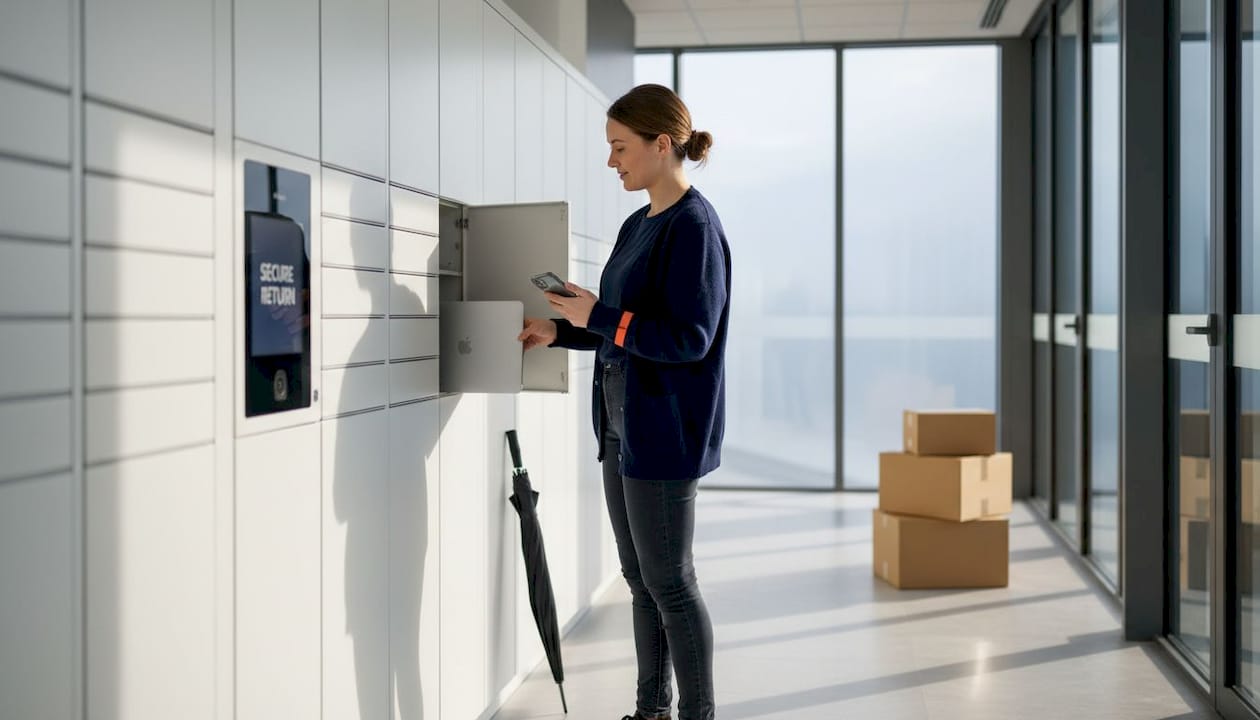
Smart lockers consist of individually secured compartments that employees access using secure authentication methods such as PIN codes, employee badges, mobile apps, or biometric verification. Unlike a vending machine that dispenses an item and records the transaction, a locker holds an item in a locked compartment assigned to a specific user or workflow. This makes them ideal for assets where accountability needs to be airtight.
Typical use cases where smart lockers excel:
- Laptop and device loan programmes, including next-business-day replacements
- Secure returns for equipment that needs to go through a checking process before reissue
- On-site device swap workflows where an employee drops off a faulty device and collects a replacement
- Sensitive IT assets that require a documented chain of custody
- Overnight or extended-loan scenarios where a vending machine’s continuous dispensing model does not apply
Smart lockers also support bidirectional workflows. An employee can drop off a faulty keyboard in a locker before leaving at the end of the day, and the IT team can collect it, assess it, and place a replacement in the same or another locker ready for collection the following morning. That kind of frictionless exchange removes a significant volume of face-to-face helpdesk interactions.
As Amazon Business Restock reinforces, the locker format was specifically developed to handle high-dollar or larger-in-size items that sit outside the practical range of vending machines. This is not a minor edge case — it represents a substantial portion of enterprise IT assets.
It is also worth considering total cost carefully. The true costs of IT dispensing are not always obvious from headline pricing, and smart lockers typically offer a stronger return when deployed for assets whose value justifies the enhanced security and workflow capability.
The strongest locker deployments we have seen treat the locker not as a storage box but as an active node in a broader IT service workflow.
Pro Tip: Map your locker compartment sizes to your actual asset dimensions before procurement. A mismatch between compartment size and asset range is a surprisingly common deployment error that is both expensive and disruptive to correct after installation. Also consider the smart lockers versus vending breakdown to ensure you allocate each format to the right use case from the outset.
Comparison of dispenser types: Which fits your organisation?
Both types have clear strengths, so how do you choose? Here is a direct comparison to help you map requirements to the right format.
| Criteria | Smart vending machine | Smart locker |
|---|---|---|
| Item size | Small to medium | Medium to large |
| Asset value | Low to medium | Medium to high |
| Workflow type | Dispense only | Check-in and check-out |
| Authentication | Badge or PIN | Badge, PIN, mobile, or biometric |
| Inventory visibility | Real-time | Real-time |
| Best for | Cables, peripherals, headsets | Laptops, devices, returns |
| Throughput | High volume | Lower volume, higher value |
| Restocking effort | Moderate | Low to moderate |
Once you have that framework in front of you, use these questions to sharpen your decision:
- What is the average value of the items you need to distribute?
- Do employees need to return items as well as collect them?
- How often do items need to be replenished, and by whom?
- Do you need to support device loan programmes or just consumable top-ups?
- Is your primary goal speed of access or security of custody?
For most large enterprises, the honest answer is that both formats are needed. As Amazon Business Restock demonstrates, even a single deployment quickly evolves to require both vending and locker capability, because the range of assets involved rarely fits neatly into one format.
Hybrid deployment tips for large environments:
- Place vending machines in high-footfall areas for everyday consumables
- Position smart lockers near IT support points or reception areas for managed asset exchanges
- Integrate both formats into a single ITSM platform to maintain unified asset visibility
- Use consumption data from vending to inform procurement cycles for locker-based stock
Pro Tip: Reviewing the building a dispenser business case resource before finalising your hybrid plan will help you build the financial justification your leadership team will need before approving capital expenditure.
Case studies: Real-world deployment of IT consumable dispensers
Theory is powerful, but real outcomes tell the true story. Across utilities, campuses, and manufacturing environments, organisations are deploying smart dispensers and recording tangible improvements in IT support speed, asset accountability, and employee satisfaction.
Utilities sector. A major utilities organisation deployed smart lockers across multiple operational sites to manage the distribution of ruggedised tablets and safety-critical communication devices. Before automation, field workers frequently experienced delays of several hours waiting for IT support staff to manually issue replacement equipment. After deployment, device exchanges dropped from hours to minutes, and asset loss rates fell significantly because every transaction was attributed to a named individual. Explore how the utilities sector is applying this approach at scale.
University campuses. Higher education institutions managing large, distributed estates face a particular challenge: their “workforce” changes entirely every academic year. Smart vending machines deployed in library and computing centre locations gave students and staff 24/7 access to cables, adaptors, and peripherals without requiring helpdesk staffing outside business hours. Satisfaction scores for IT support services improved measurably, and the volume of routine helpdesk calls fell. See how campuses IT automation is reshaping this sector.
Manufacturing. On factory floors where shift patterns mean IT support is rarely available at the point of need, smart vending machines positioned near production lines have dramatically reduced downtime caused by missing or failed peripherals. Managers can view real-time stock data and pre-authorise access for specific employee groups, giving them granular control without manual intervention. Discover how manufacturing smart lockers are addressing these shift-pattern challenges.
| Sector | Dispenser type used | Key outcome |
|---|---|---|
| Utilities | Smart lockers | Device exchange time reduced from hours to minutes |
| Higher education | Smart vending | 24/7 access without extra helpdesk staffing |
| Manufacturing | Smart vending plus lockers | Reduced production downtime from missing peripherals |
Across all three settings, one finding is consistent: the Amazon Business Restock principle holds true in practice. Organisations that start with vending almost always discover they also need lockers once high-value or larger assets enter the distribution mix.
Our take: Why the right dispenser mix can make or break IT automation
After working with large enterprises across multiple sectors, we have found that the organisations which struggle most with IT dispenser deployments are the ones that frame the decision as a binary choice. They ask “vending or locker?” when the more productive question is “where does each format serve our people best?”
Mistakes in this space are rarely about the technology itself. They stem from underestimating change management, failing to involve the people who will actually use the machines, and making decisions based solely on current pain points rather than where the organisation is heading in two or three years.
The cost dimension is particularly easy to get wrong. Choosing the cheapest unit on the market often costs considerably more over a three-year lifecycle than a more capable system that integrates cleanly with your ITSM platform and generates the usage data you need. The dispensing cost lessons we have gathered from deployments across industries are instructive here. A tailored mix, implemented with realistic expectations and proper onboarding, consistently outperforms a single-format deployment that was cheaper to procure but harder to scale. The right approach anticipates future needs, not just the problems you are trying to solve today.
Explore automated IT dispensing with Velocity Smart
Ready to implement smart IT consumable dispensers across your enterprise? Velocity Smart Technology builds intelligent dispensing solutions designed specifically for large organisations managing distributed IT assets.
Our ServiceNow smart locker solution runs natively inside your existing ServiceNow instance, eliminating data silos and GDPR complexity while automating equipment distribution workflows end to end. For organisations that also need real-time remote IT support at unmanned locations, our enterprise IT support kiosk extends your IT team’s reach without adding headcount. If you are at the early stages of building your automation strategy, the Automation Unboxed overview is an ideal starting point for understanding the full scope of what intelligent dispensing can do for your organisation.
Frequently asked questions
What are the main benefits of using IT consumable dispensers in large enterprises?
These dispensers streamline asset tracking, enforce access controls, and generate real-time usage data, removing the manual burden from IT teams. As Amazon Business Restock demonstrates, secure dispensing with employee badging also significantly reduces loss and improves accountability across distributed sites.
Are smart lockers or vending machines better for securing high-value IT equipment?
Smart lockers are the stronger choice for high-value or large items because they offer compartment-level authentication and bidirectional workflows. The Amazon Business Restock experience confirms that high-dollar items are specifically routed to lockers rather than vending machines.
How do IT staff access items from these automated dispensers?
Employees typically use employee badges, PIN codes, or mobile authentication to securely collect or return items. Both vending machines and lockers support employee badging as a standard access method, with audit trails generated automatically for every transaction.
Can smart dispensers help reduce IT support bottlenecks for remote or hybrid teams?
Yes. By enabling 24/7 secure access to consumables and replacement equipment, smart dispensers remove the dependency on staffed helpdesk hours, reducing downtime for distributed workforces. The locker-backed expansion model shows how organisations scale this access as asset complexity grows.
Recommended
See what Smart Collect® could save you
Model your savings in two minutes, or book a 60-minute workshop to pressure-test the numbers against your estate.