
IT support cost trajectory: 2026 guide for CIOs
TL;DR:
- The cost of managed IT services is increasing due to expanding service scope, compliance demands, and AI integration. Active governance and regular contract reviews help control expenses, especially as hidden fees and physical support costs rise. AI adoption raises baseline costs but can reduce downtime and incident resolution times, justifying the investment.
The IT support cost trajectory is defined as the directional movement of IT service expenditure over time, driven by expanding service scope, compliance obligations, and the adoption of AI-powered automation. As of mid-2026, national average managed IT services cost $150–$200 per user per month, with compliance-heavy environments reaching $400 per user monthly. For CIOs and IT Directors managing global enterprise budgets, this trajectory is no longer a background variable. It is a primary line item demanding active governance, contract discipline, and a clear understanding of what is actually driving costs upward.
What are the primary factors driving the IT support cost trajectory?
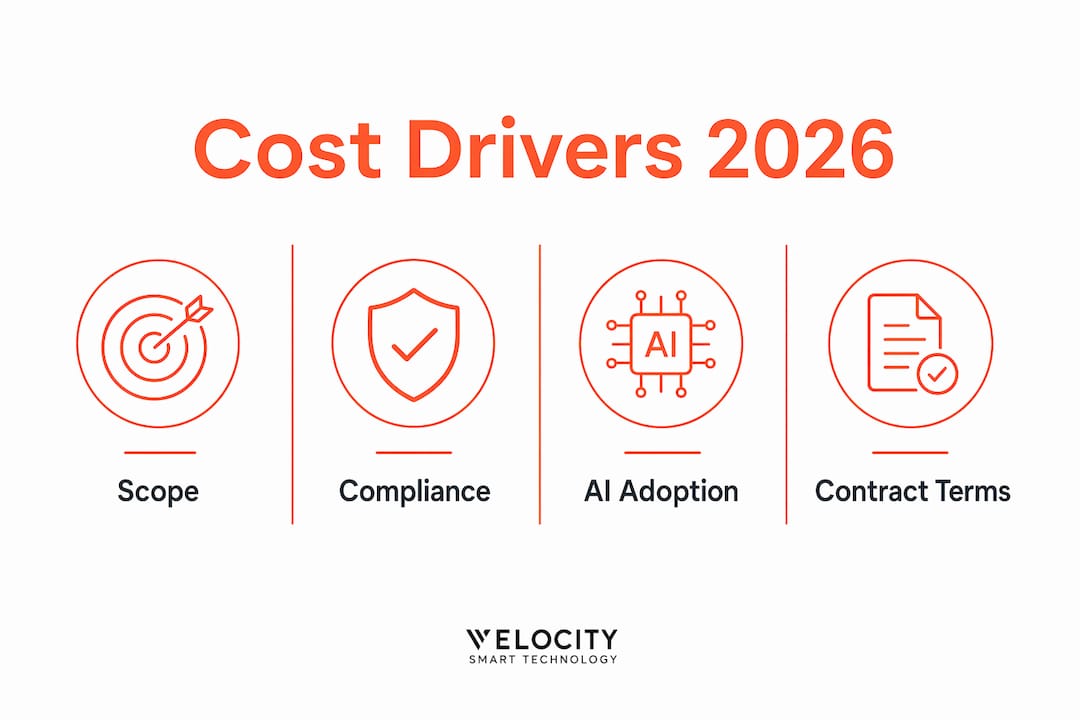
Price variance in managed IT services reflects scope, not markup. Premium tiers include vCIO, 24/7 security operations, and compliance management, which is why two enterprises with similar headcounts can face vastly different invoices. Understanding this distinction is the first step in controlling IT support expenses analysis at the enterprise level.
Compliance requirements represent one of the most significant cost drivers. HIPAA, SOC 2, and CMMC compliance premiums add a 12–25% uplift, equivalent to $20–$80 per user per month, due to audit preparation, documentation, and continuous monitoring obligations. Regulated industries such as pharmaceuticals, defence, and financial services routinely sit at the upper end of that range. Failing to specify compliance scope in an RFP causes mid-contract price increases that are difficult to challenge.
AI integration is raising baseline costs while simultaneously improving efficiency. Over 60% of top managed IT providers now bundle AI tools that reduce mean time to resolution by 40%, adding $30–$75 per user monthly to costs. That is a meaningful uplift, but the reduction in incident volume and resolution time typically justifies it at scale.

The table below summarises the primary cost drivers and their financial impact on enterprise IT support budgets.
| Cost driver | Typical financial impact |
|---|---|
| Basic monitoring only | $75–$125 per user per month |
| Full managed services (vCIO, 24/7 SOC) | $150–$400 per user per month |
| Compliance uplift (HIPAA, SOC 2, CMMC) | +12–25% or $20–$80 per user per month |
| AI and automation tooling | +$30–$75 per user per month |
| Hidden fees (after-hours, hardware markups) | +30–50% on annual spend |
Pro Tip: When reviewing IT support proposals, request a line-item breakdown separating base service, compliance, and AI tooling costs. Bundled pricing obscures where your budget is actually going.
How have AI and automation reshaped IT support pricing?
AI is no longer an optional add-on in managed IT services. It is becoming the default delivery model. The role of automation in ITSM has shifted from incident response acceleration to proactive failure prevention, fundamentally changing how providers price their services.
The core AI functionalities now embedded in enterprise-grade managed services include anomaly detection, auto-ticketing, predictive failure analysis, and self-healing workflows. These capabilities reduce the labour cost of tier-1 and tier-2 support, but they require significant platform investment from providers, which flows through to per-user pricing. The AI and automation embedding trend generates efficiency gains while incrementally raising base costs.
For CIOs evaluating IT support budget projections, the key question is not whether AI increases costs. It does, in the short term. The question is whether the reduction in downtime, incident volume, and engineer dispatch justifies the uplift. Physical support tickets, for example, cost approximately three times more than digital ones to resolve. Automating the physical layer, through solutions such as smart lockers and automated IT kiosks, directly addresses the highest-cost support category.
The benefits and challenges of AI integration in IT support are worth examining clearly:
- Reduced mean time to resolution: AI-driven auto-ticketing and anomaly detection cut resolution times by up to 40%, reducing labour hours per incident.
- Proactive incident prevention: Predictive failure tools identify hardware and software issues before they cause downtime, lowering the frequency of high-cost emergency responses.
- Higher baseline per-user costs: AI tooling adds $30–$75 per user per month, which compounds significantly across large enterprise headcounts.
- Dependency on data quality: AI tools perform poorly on incomplete or inconsistent CMDB data, making data governance a prerequisite for realising efficiency gains.
- Skill shift in IT teams: Automation displaces tier-1 tasks but increases demand for engineers who can manage AI workflows and exception handling.
Pro Tip: Before committing to an AI-enhanced managed services tier, audit your CMDB completeness. Poor asset data is the single most common reason AI tooling underperforms against its projected ROI.
What hidden costs affect total IT support expenditure?
Hidden costs are the most reliable way for IT support expenses to exceed budget projections. After-hours support, hardware markups of 20–40%, and project-based fees can add 30–50% to annual IT support costs. Most enterprises discover these charges only when reviewing invoices against contract terms, by which point the cost has already been incurred.
Onboarding remediation is a particularly underestimated line item. Onboarding fees can exceed £30,000 for complex enterprise environments requiring infrastructure stabilisation before managed services can begin. This cost rarely appears prominently in sales proposals. Scope creep compounds the problem in regulated environments, where compliance extensions trigger additional audit and documentation charges mid-contract.
Annual price escalators typically run 3–5%, tied to CPI, but are negotiable when linked to performance benchmarks rather than inflation alone. A contract that escalates at CPI regardless of service quality effectively rewards underperformance. Linking escalators to metrics such as mean time to resolution, first-call resolution rate, or uptime percentage gives enterprises a meaningful lever.
The following audit checklist helps CIOs identify hidden costs before signing or renewing a managed IT contract:
- Request a full fee schedule. Ask for every billable event, including after-hours callouts, project work, and emergency response charges, in writing.
- Clarify hardware procurement terms. Confirm whether hardware is supplied at cost or with a markup, and request the markup percentage explicitly.
- Define compliance scope in the RFP. Specify which regulatory frameworks apply and require the provider to price compliance management as a separate line item.
- Review escalator clauses. Identify whether annual increases are CPI-linked or performance-linked, and negotiate the latter where possible.
- Audit onboarding and remediation terms. Establish a fixed-price or capped onboarding fee before contract signature.
- Check project surcharge thresholds. Determine at what point routine support tasks become billable project work, as this boundary is frequently disputed.
The true costs of IT inefficiency extend beyond contract line items. Unplanned downtime, delayed hardware provisioning, and manual ticket handling all carry costs that never appear on a managed services invoice but directly affect enterprise productivity.
Managed services vs in-house IT: how do the costs compare?
The break-even point between managed IT services and fully staffed in-house support sits at 75–100 employees. Below 75 employees, managed IT services typically cost 25–45% less than fully loaded in-house support. Above 100 employees, the economics shift, and internal staffing becomes increasingly competitive on a per-user basis.
Fully loaded in-house IT technician costs include salary, employer national insurance contributions, pension, training, tooling licences, and management overhead. These costs reach $8,000–$12,000 per technician per month at current market rates. A single technician covers a limited skill range. A managed services provider delivers access to security specialists, network engineers, compliance consultants, and vCIO-level advisory within the same per-user fee.
The comparison table below illustrates total cost of ownership across different organisational scales.
| Model | Sub-75 employees | 75–100 employees | 100+ employees |
|---|---|---|---|
| Managed IT services | Lower cost, broader skills | Break-even zone | Higher per-user cost at scale |
| In-house IT support | Higher fully loaded cost | Comparable cost | More cost-competitive |
| Hybrid model | Rarely justified | Viable for specialist needs | Often optimal for global enterprises |
For global enterprises above the break-even threshold, hybrid models frequently offer the best balance. Core infrastructure and security functions are retained in-house, while specialist services such as compliance management, 24/7 monitoring, and physical device support are outsourced. The enterprise success strategies for distributed IT support increasingly favour this hybrid approach, particularly where physical device distribution spans multiple geographies.
37% of SMBs pay above the 75th percentile for their service tier due to long-term vendor inertia and failure to renegotiate contracts as market rates fall. The same dynamic affects large enterprises, particularly those on multi-year agreements signed before AI tooling became standard. Periodic contract reviews, conducted at least every 18 months, are the most direct mechanism for controlling the IT support cost trajectory.
Pro Tip: When benchmarking your managed IT contract, request proposals from at least two alternative providers before entering renewal negotiations. Market pricing data is the strongest negotiating tool available to IT Directors.
Key takeaways
The IT support cost trajectory is determined by service scope, compliance obligations, AI tooling adoption, and contract discipline, not by headline per-user pricing alone.
| Point | Details |
|---|---|
| Scope drives price variance | Premium tiers include vCIO, 24/7 SOC, and compliance management, not just helpdesk coverage. |
| Compliance adds 12–25% uplift | HIPAA, SOC 2, and CMMC requirements add $20–$80 per user per month to managed IT costs. |
| AI raises costs but reduces downtime | AI tooling adds $30–$75 per user monthly while cutting mean time to resolution by up to 40%. |
| Hidden fees add 30–50% annually | After-hours support, hardware markups, and project surcharges routinely exceed initial contract estimates. |
| Contract reviews control trajectory | 37% of enterprises overpay due to inertia; renegotiating every 18 months realigns costs with market rates. |
The cost conversation CIOs are not having often enough
From my perspective, the most persistent mistake I see in enterprise IT budget planning is treating managed IT pricing as a commodity comparison. CIOs request proposals, compare headline per-user figures, and select the lowest number. The hidden costs, compliance uplifts, and AI tooling surcharges then arrive mid-contract, and the budget overrun is attributed to scope creep rather than inadequate due diligence at procurement.
The more productive conversation is about what the service scope actually covers and what it does not. A contract priced at $150 per user per month with no compliance management is not comparable to one at $200 per user per month that includes SOC 2 audit support. The $50 difference is not a premium. It is a different product.
The physical layer of IT support deserves particular attention in this analysis. Digital ticket costs are falling as AI automation matures. Physical support tickets, device handovers, peripheral replacements, and equipment loans remain expensive because they require human dispatch. Solutions such as Velocity-smart’s Smart Collect platform, which automates physical device handovers natively within ServiceNow, directly address the highest-cost category in the IT support cost breakdown. The enterprises I observe controlling their cost trajectory most effectively are those investing in automating physical support, not just digital workflows.
The final point I would make is on contract governance. Annual escalators tied to CPI are a structural cost increase that compounds over multi-year agreements. Linking escalators to performance metrics is not an aggressive negotiating position. It is a reasonable expectation that cost increases should reflect service improvement.
— Anthony
How Velocity-smart reduces the cost of physical IT support
Physical device support is the fastest-growing cost category in enterprise IT, and it is the one that AI alone cannot resolve without a hardware endpoint.
Velocity-smart’s smart locker support services automate device handovers, peripheral distribution, and equipment loans directly within ServiceNow, without dispatching an engineer. Customers including Roche, BAE Systems, and Entergy have used Smart Collect to cut on-site tickets by 60%, recover 31–42% of IT staff time, and achieve 83% faster fulfilment. For CIOs managing IT support budget projections across distributed enterprise sites, Velocity-smart’s IT self-service hardware platform offers a measurable reduction in the physical support cost line.
FAQ
What is the average cost of managed IT services per user in 2026?
National averages sit at $150–$200 per user per month for standard managed IT services. Compliance-heavy environments such as those subject to HIPAA or CMMC reach $250–$400 per user monthly.
What factors affect the IT support cost trajectory most significantly?
Service scope breadth, compliance requirements, AI tooling adoption, and contract escalator terms are the four primary drivers. Compliance uplifts alone add 12–25% to base managed IT costs.
When does in-house IT support become more cost-effective than managed services?
The break-even point is typically 75–100 employees. Below 75 employees, managed IT services cost 25–45% less than fully loaded in-house staffing.
How do hidden costs affect annual IT support expenditure?
After-hours support charges, hardware markups of 20–40%, and project-based fees can add 30–50% to annual IT support costs beyond the contracted per-user rate.
How often should enterprises renegotiate their managed IT contracts?
Contract reviews every 18 months are advisable. Research shows 37% of enterprises pay above-market rates due to long-term vendor inertia and failure to renegotiate as market pricing falls.
Recommended
See what Smart Collect® could save you
Model your savings in two minutes, or book a 60-minute workshop to pressure-test the numbers against your estate.