
NYCHHC employee self service: an enterprise IT briefing
The NYCHHC Employee Self Service portal is the centralised workforce hub for NYC Health + Hospitals staff, covering pay, benefits, performance and internal career applications through a single Employee Resources Centre. For enterprise IT leaders, the system’s design signals matter as much as its feature list: Duo MFA on every remote session, delegated authority models for payroll, autogenerated time records, and an architecture that keeps workforce identities strictly separate from patient-facing systems.
Key operational signals to register immediately:
- Payroll and timekeeping: Web Time Entry, delegated authority dashboards, autogenerated time records (Group 11 pattern), centralised payroll inboxes
- Benefits management: enrolment, dependent updates, healthcare waiver status, direct deposit
- Performance and careers: evaluation records, internal job postings, role-change workflows
- Security controls: Duo MFA mandatory for remote access, IT Acceptable Use Policy, session monitoring
- Integration architecture: ServiceNow-compatible ITSM ticketing; workforce ESS identities are kept separate from patient-facing MyChart identities
Table of Contents
- What a large-scale employee self-service system actually does
- How MFA, Duo and acceptable use policy shape your automation design
- Payroll and timekeeping at scale: Web Time Entry and delegated authority
- Centralising the Employee Resources Centre: governance and common pitfalls
- How to keep device handovers auditable inside ServiceNow
- What to require from platforms and vendors when modernising your ESS
- Key takeaways
- Device handovers are where ESS automation earns its keep
- Velocity Smart Collect® as a ServiceNow-native device-handling layer
- Useful sources and further reading
What a large-scale employee self-service system actually does
A mature ESS covers far more than a payslip viewer. The NYCHHC ESS page lists benefits updates, pay information, performance evaluations and career applications as core capabilities. Mapped to user journeys, those functions break into four operational layers.
Core feature catalogue:
- New starter: identity provisioning, benefits enrolment, direct deposit setup, device allocation trigger
- Pay query: view and print pay stubs, W-2 and tax forms, salary verification letters
- Leave and absence: view leave balances, submit requests, manager approval queue
- Role change or termination: update personal data, reclaim device, close delegated authority tokens
Operational boundaries every IT leader must enforce:
- ESS is workforce-only. Patient-facing identities live in MyChart; mixing the two creates privacy and operational risk that no automation layer should introduce.
- ESS events (new starter, role change, termination) are natural triggers for device fulfilment workflows. A new-starter record appearing in the ESS should fire a ServiceNow task to allocate a locker slot or dispatch a device kit.
- CMDB records must reflect ESS lifecycle state. If the ESS shows a termination and the CMDB still shows an active device assignment, you have an audit gap.
The IT self-service hardware automation pattern addresses exactly this: mapping HR lifecycle events to physical device workflows so that asset state and workforce state stay synchronised.
How MFA, Duo and acceptable use policy shape your automation design
MFA and an explicit Acceptable Use Policy define every remote session in the NYCHHC environment, and your automation must align with both. The connect-idp portal states that all remote access requires Duo MFA and that sessions may be recorded and reviewed without notice under the IT Acceptable Use Policy.
That is not boilerplate. It means three concrete things for automation design:
- No workflow can bypass MFA. Any device-handover or ESS-triggered task that skips the identity-proofing step will violate the policy and likely fail a security audit.
- Session logging is expected. Automation that does not produce a log entry is architecturally inconsistent with the environment’s monitoring posture.
- Consent for monitoring is embedded at login. Employees acknowledge this at the identity provider; your automation inherits that consent boundary.
Practical vendor requirements that follow:
- SSO compatibility with the existing identity provider (Imprivata or equivalent)
- MFA-friendly flows that do not create parallel authentication paths
- Session and transaction logging exportable to SIEM or ServiceNow audit tables
- ISO 27001 certification as baseline evidence of security governance
Pro Tip: When evaluating vendors, ask specifically whether their integration creates a new authentication path or inherits the existing one. A new path means a new attack surface and a new policy review.
The Acceptable Use Policy is more than compliance text. For IT leaders, it sets the cultural and operational boundary that defines what the remote employee experience is permitted to look like. Automation that feels intrusive or opaque will generate friction and policy challenges even if it is technically compliant.
Payroll and timekeeping at scale: Web Time Entry and delegated authority
Payroll accuracy depends on structured workflows. NYCHHC’s payroll and timekeeping infrastructure uses Web Time Entry, delegated authority models, automated dashboards for timesheet status, and centralised payroll contacts for corrections. The autogenerated time records pattern (Group 11) is particularly instructive: the system generates time entries automatically for certain employee groups, rather than requiring manual submission.
For IT leaders designing automation on top of this architecture, the operational requirements are specific:
- Read-only access by default. Automation should read timesheet state, not write to it, unless an explicit approval gate is in place.
- Delegated authority tokens must be preserved. When a manager delegates payroll authority, that delegation must be visible in any downstream automation log.
- Exception handling, not record replacement. Autogenerated records are the source of truth; automation surfaces exceptions for human review.
- Centralised payroll inboxes as a reconciliation hook. Corrections flow through defined channels; automation should route exceptions there, not create parallel correction paths.
Centralising the Employee Resources Centre: governance and common pitfalls
A single Employee Resources Centre reduces manual handoffs and improves consistency across HR, payroll and benefits. NYCHHC centralised its Employee Resources Centre explicitly to consolidate HR and payroll systems into one digital entry point. That design choice has governance implications that extend well beyond the portal itself.
Governance pillars for a centralised ESS:
- Role-based access with clearly scoped read/write permissions per function
- Delegation records that are auditable and time-bounded
- Change control for any modification to payroll or benefits data
- Vendor assurance: ISO 9001 for operational quality, ISO 27001 for information security
Common pitfalls at scale:
- Siloed identity stores that cause the portal to show stale data for transferred employees
- Unclear delegated authority, where multiple managers believe they hold approval rights for the same timesheet
- Insufficient auditability for device handovers, leaving asset state disconnected from HR state
- Poor exception workflows that push corrections into email rather than structured ticketing
Aligning vendor SLAs to internal governance means requiring that any third-party integration writes audit records to the same system of record your internal teams already query. Anything else creates a reconciliation burden.
How to keep device handovers auditable inside ServiceNow
Attach device workflows to ESS lifecycle events and keep every action inside ServiceNow for a single audit trail. That is the architecture pattern that survives an operational audit. Automation that bypasses ServiceNow ticketing will be rejected by operational teams, regardless of its technical merit.

The recommended architecture pattern:
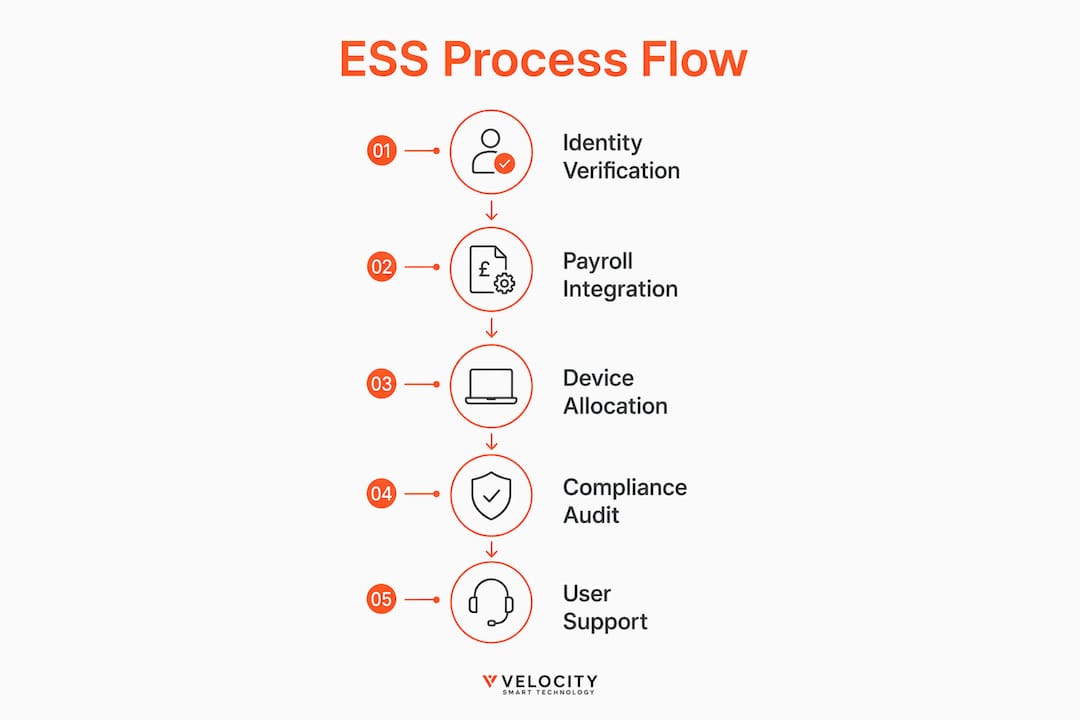
ESS lifecycle event (new starter / role change / termination) → ServiceNow task creation → Smart Collect® locker allocation or device dispatch → CMDB record updated with asset state and identity → task closure with payroll and asset reconciliation confirmation.
Integration options and their auditability trade-offs:
- API-driven push from ESS to ServiceNow: highest auditability, real-time, requires ESS API access and change control governance
- Inbound webhooks: near-real-time, lower coupling, but webhook failures need dead-letter handling to avoid silent gaps
- Scheduled sync: simplest to implement, lowest operational risk during rollout, but introduces latency that can cause CMDB drift between ESS state and asset state
Smart Collect® runs natively inside the ServiceNow tenant, which means device handover records sit in the CMDB as native configuration items. There is no parallel database, no data sync, and no separate vendor security review to manage. A global pharma customer using this pattern saw a significant uplift in IT service throughput and notably faster fulfilment.
Pro Tip: When configuring ServiceNow tasks for device handovers, add a mandatory field for the delegated authority token active at the time of the transaction. This single field closes the most common audit gap in physical IT workflows.
What to require from platforms and vendors when modernising your ESS
- SSO and MFA compatibility. The vendor must integrate with your existing identity provider without creating a parallel authentication path. Duo compatibility is non-negotiable in environments modelled on the NYCHHC pattern.
- ServiceNow-native or certified integration. Prefer applications that run inside your ServiceNow tenant over API integrations that require a separate middleware layer and a separate security review.
- Granular audit logging. Every transaction, approval, and delegation must produce a log entry queryable from your existing audit tooling.
- Role-based delegation support. The platform must model delegated authority explicitly, not treat all approvers as equivalent.
- ISO 27001 and ISO 9001 certification. These are baseline evidence of security governance and operational quality management, not differentiators.
- CMDB and asset lifecycle hooks. Device state must update in the CMDB at each handover event, not in a separate asset database.
- Read/write scoping for payroll data. Automation should read timesheet state and route exceptions; write access to payroll records requires explicit approval gating.
- Support for autogenerated time records. Vendors must understand the Group 11 pattern and design exception workflows accordingly, not overwrite system-generated entries.
Vendor questions for procurement:
- What is your data residency model, and can records be kept within UK/EU boundaries?
- Provide reference use cases in regulated industries (healthcare, pharma, defence).
- How does your integration handle delegated authority tokens across role changes?
- What is your SLA for ServiceNow release compatibility?
Key takeaways
The most operationally sound ESS design keeps workforce identity, payroll workflows, device state, and audit records inside a single ServiceNow-native architecture, with Duo MFA enforced at every access point.
| Point | Details |
|---|---|
| Mandate Duo MFA compatibility | Every remote session and device handover must preserve MFA flows; no automation path should bypass identity proofing. |
| Map ESS events to device workflows | New-starter, role-change, and termination events should automatically trigger ServiceNow tasks for device allocation or reclaim. |
| Require ServiceNow-native integration | Prefer platforms that run inside your tenant and write to the CMDB natively, eliminating data sync and parallel security reviews. |
| Enforce delegated authority records | Delegation tokens must be logged at every payroll and device-handover transaction to close the most common audit gap. |
| Velocity-smart Smart Collect® | Runs natively in the ServiceNow tenant; a global pharma deployment delivered 500%+ throughput uplift and 83% faster fulfilment. |
Device handovers are where ESS automation earns its keep
Most ESS modernisation programmes stop at the digital layer. They consolidate payroll, benefits and performance into a single portal, deploy SSO, mandate MFA, and declare the project complete. The physical layer, where a new starter needs a laptop or a departing employee needs to return one, remains a manual process handled by a desk visit, an email chain, or a spreadsheet.
That gap is where the real operational cost lives. When digital workflows are automated and physical ones are not, the physical step becomes the bottleneck. It is also where audit trails break down: the ServiceNow task closes, but nobody recorded which device was handed over, to whom, under which delegated authority, and when.
ServiceNow-native approaches close that gap without introducing new complexity. When the handover platform runs inside the tenant, the audit record is a native CMDB entry, the approval chain is the same one used for every other ITSM task, and the identity used for the transaction is the same identity the ESS already knows. The workforce digitalisation trends driving ESS investment in 2026 are pointing in exactly this direction: physical and digital workflows converging inside a single orchestration layer. The organisations that recognise this now will carry a measurable throughput advantage into the next cycle of AI-driven service automation.
Velocity Smart Collect® as a ServiceNow-native device-handling layer
When your ESS modernisation reaches the physical handover problem, Smart Collect® is the option that does not require a separate integration project. It runs natively inside your ServiceNow tenant, inherits your existing RBAC, audit trail, and CMDB, and tracks ServiceNow’s release schedule without a middleware layer between them. Device state, ownership history, and handover records sit as native configuration items, queryable alongside every other asset in your environment.
The outcomes from existing deployments were achieved before agentic AI was driving the workflows. A global pharma customer recorded a 500%+ throughput uplift and 83% faster fulfilment. A UK utility reduced shared-equipment loss and damage by 90%. As Now Assist matures, those figures represent the floor.
A practical proof-of-concept scope: integrate Smart Collect® with one ESS-triggered workflow (new-starter device allocation) inside your existing ServiceNow tenant, and measure CMDB accuracy and fulfilment time against your current baseline. Visit Velocity-smart to scope a pilot.
Useful sources and further reading
- NYCHHC Employee Self Service — the primary ESS page listing core portal capabilities: pay, benefits, performance, and careers.
- NYCHHC Employee Resources Centre — the centralised hub page, backing the single-entry-point strategy discussed in the governance section.
- NYCHHC Payroll and Timekeeping — source for Web Time Entry, delegated authority models, and the autogenerated time records pattern.
- connect-idp.nychhc.org — the identity provider portal that mandates Duo MFA and references the IT Acceptable Use Policy; backs the security section claims.
- Velocity Smart Collect® peripheral fulfilment use case — product detail for the ServiceNow-native handover layer discussed in the integration pattern section.
- IT self-service hardware automation — further reading on mapping ESS lifecycle events to physical device workflows.
Recommended
See what Smart Collect® could save you
Model your savings in two minutes, or book a 60-minute workshop to pressure-test the numbers against your estate.