
How to minimize ticket volume: the enterprise IT playbook
TL;DR:
- Combining self-service, AI chat, and physical device orchestration can reduce on-site IT tickets by up to 60% within three months. Success depends on narrow scope, root-cause analysis, and integrating workflows directly into ServiceNow. Measuring deflection rates and AI resolution progress ensures sustained efficiency and cost reduction in regulated industries.
The fastest route to fewer on-site IT tickets is to stop them entering the queue in the first place. Combine self-service deflection, AI conversational agents, and a ServiceNow-native physical device orchestration layer — specifically Smart Collect® — and a well-scoped programme can cut human-handled on-site tickets by 40–60% within 60–90 days.
Three actions to take to your programme owner now:
- Run a 90-day ticket audit, cluster by root cause, and identify the top five deflectable intent categories.
- Scope an AI conversational agent to those intents and connect it to your ServiceNow knowledge base.
- Deploy one Smart Locker or Smart Kiosk endpoint to remove device-handover tickets from the queue entirely.
Material deflection is achievable within 60–90 days, but only if scope discipline holds: start with two or three high-frequency, high-KB-completeness intents, not the entire catalogue.
Table of Contents
- Why do on-site physical IT tickets keep recurring?
- The four highest-leverage levers to reduce on-site ticket volume
- How does the ServiceNow-native architecture actually fit together?
- Which KPIs actually measure progress, and which are vanity?
- A 90–180 day pilot-to-scale roadmap for UK enterprises
- What pitfalls and governance checks should UK enterprises anticipate?
- What is the recommended approach for this quarter?
- Key takeaways
- Why this matters now for UK CIOs
- Evaluate Smart Collect® as your pilot this quarter
- Useful sources for a procurement or board pack
Why do on-site physical IT tickets keep recurring?
Recurring ticket clusters are not a technician skill problem. They are a signal that something upstream — a process, a knowledge gap, or a device lifecycle step — is broken and generating the same request repeatedly.
The five failure modes that drive most on-site volume are: fragile or unfindable self-service; a shallow knowledge base that cannot answer common device queries; a brittle manual device lifecycle (no locker, no vending, no automated swap); slow scheduling and engineer travel to distributed sites; and stale CMDB device-state records that force manual reconciliation. Each of these is a structural defect, not a workload problem. Hiring more technicians treats the symptom while the cause keeps producing contacts.
Layered deflection patterns — knowledge base, in-product help, AI chat, and proactive notifications working together — consistently produce substantial reductions in total ticket volume within a few months. The organisations that achieve the upper end of that range treat every recurring ticket cluster as evidence of an upstream UX or process failure, then fix the source rather than absorbing the demand.
Diagnostic signal: examine the ten-minute window of user activity before each ticket is created. The same feature, the same error state, or the same empty page appearing repeatedly across tickets identifies your highest-return intervention targets before you write a single KB article.
The four highest-leverage levers to reduce on-site ticket volume
The table below maps each lever to its expected impact and the timeline to see results.
| Lever | Primary mechanism | Expected impact | Timeline |
|---|---|---|---|
| Self-service and KB optimisation | Deflects common queries before ticket creation | 20–40% of Tier-1 volume | Weeks 1–4 |
| AI conversational agents | Autonomous Tier-1 resolution and smart routing | Significant share of repetitive tickets | Weeks 4–12 |
| Physical device orchestration | Removes handover tickets entirely | Up to 60% of on-site tickets | Weeks 5–12 |
| Root-cause elimination | Retires ticket categories permanently | Compounding, long-term | Ongoing |
Self-service and KB optimisation is the fastest win. Audit your knowledge base for the top ten ticket categories, rewrite articles in user language rather than internal jargon, and embed contextual help at the points where users stall. Self-service, automation, and prevention are the three categories that sustainably reduce ticket load — scripted Tier-1 automation alone often clears 20–40% of that queue.
AI conversational agents handle the repetitive base reliably. The correct architecture is: intent parsing, retrieval-augmented generation against your KB, confidence scoring, then auto-resolve, agent-assist, or escalation. Integration depth — connecting the agent to your CMDB, asset records, and fulfilment workflows — adds materially to deflection quality. Scope the agent to two or three high-frequency intents first; this narrow focus is what consistently delivers the highest deflection rates on targeted categories before you scale.

Physical device orchestration is the lever most IT programmes leave untouched. Smart Lockers handle full-device handovers — new-starter kit delivery, broken-laptop swaps, equipment loans. Smart Vending dispenses peripherals and consumables on demand, 24/7, without a technician present. Smart Kiosk provides a walk-up virtual tech-bar experience, replacing the traditional in-office help desk. A US nuclear energy operator using Smart Collect® cut on-site tickets by 60% and reclaimed 31% of IT staff time — using traditional ITSM workflows, before agentic AI entered the picture.
Root-cause elimination is the most durable lever. Cluster tickets by underlying cause, not by agent-applied tag, and trace each cluster to a specific product, documentation, or onboarding failure. Fix the source and the ticket category disappears permanently.
Pro Tip: Before deploying any AI agent, run it against 90 days of historical tickets in simulation mode. You will see exactly which intents it handles confidently and where it would escalate — before a single employee encounters it.
How does the ServiceNow-native architecture actually fit together?
The architecture that prevents tickets rather than just routing them has five components working in sequence.
The critical architectural principle: every component must write state back to the same CMDB. When device location, ownership, and condition live as native ServiceNow records, the manual reconciliation tickets caused by lost equipment, access disputes, and stale asset data simply stop generating.
The five components are:
- ServiceNow tenant application: Smart Collect® runs natively inside your tenant, inheriting your existing RBAC, audit trail, and security posture. No parallel database, no data sync, no additional vendor security review.
- CMDB device state: asset location, ownership history, and condition are queryable as native configuration items, eliminating the reconciliation work that drives a significant share of device-related tickets.
- AI agent layer: Now Assist or an equivalent agentic workflow handles intent parsing, KB retrieval, confidence scoring, and routing — closing Tier-1 tickets autonomously or escalating with full context.
- Device orchestration API: Smart Collect® connects the AI agent to physical endpoints, so a workflow that needs a laptop handed over does not require a human to schedule and travel.
- Hardware endpoints: Smart Lockers for full-device handovers, Smart Vending for peripherals and consumables, Smart Kiosk for walk-up virtual support. All three are managed from one platform inside ServiceNow.
This architecture means a ServiceNow-native self-service workflow can track device state and ownership history inside the CMDB, removing the manual reconciliation tickets that accumulate when asset records drift from physical reality. Workflows live where the rest of your ITSM workflows live — and that is the governance advantage that matters most in regulated industries.
Which KPIs actually measure progress, and which are vanity?
Total ticket count is a vanity metric in any growing organisation. As headcount rises, raw volume rises with it — even when your programme is working. The metrics that reveal genuine efficiency gains are relative ones.
| Metric | Calculation | Target range | Cadence |
|---|---|---|---|
| Deflection rate | Self-served contacts ÷ total contacts | 40–60% | Weekly |
| AI auto-resolution rate | AI-closed tickets ÷ tickets reaching AI agent | Track trend | Weekly |
| Tickets per employee | Total tickets ÷ headcount | Declining quarter-on-quarter | Monthly |
| Re-contact rate | Tickets reopened or followed up ÷ total closed | — | Monthly |
| Agent time reclaimed | Hours on Tier-1 before vs. after automation | Track absolute hours | Monthly |
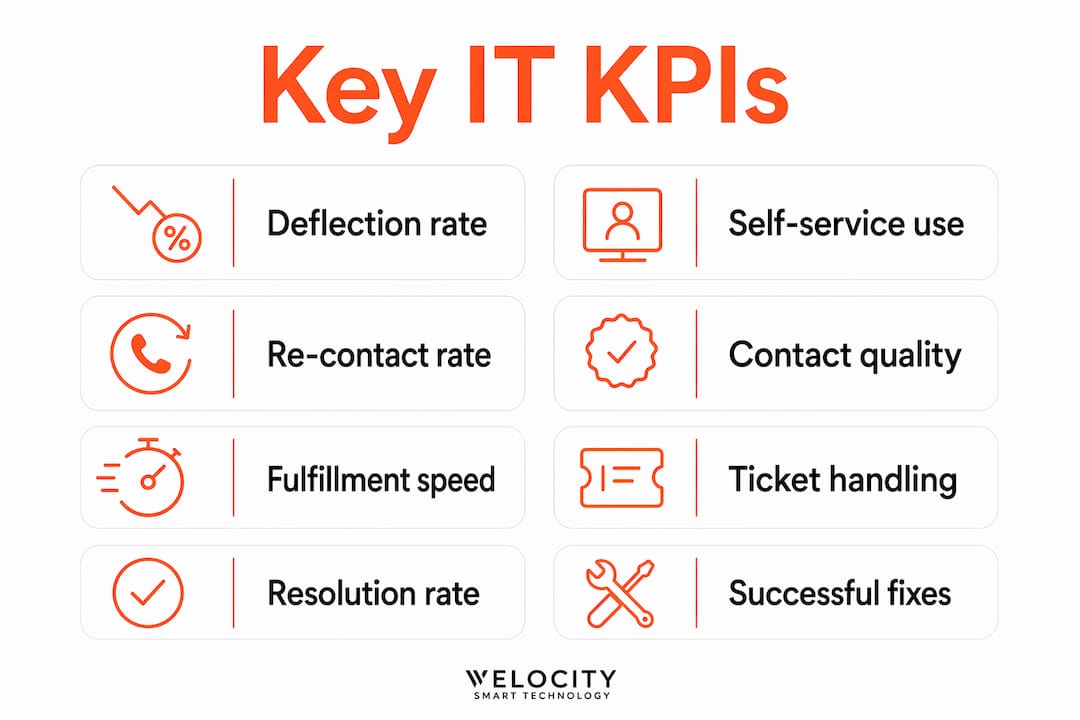
Re-contact rate is the metric most programmes ignore and most regret. A deflection that sends an employee to a knowledge base article they cannot follow, or a locker workflow that fails silently, shows up as a re-contact within 48 hours. Tracking deflection rate before and after each change is the minimum instrumentation needed to know whether an intervention worked.
A 90–180 day pilot-to-scale roadmap for UK enterprises
- Weeks 1–4 (pilot scoping): Pull 90 days of ticket data. Cluster by root cause. Identify the top three deflectable intent categories. Audit KB coverage for those intents and close gaps. Deploy one Smart Locker or Smart Kiosk at your highest-volume site. Establish baseline metrics for deflection rate and tickets per employee.
- Weeks 5–12 (integration and calibration): Connect the AI agent to your ServiceNow KB and CMDB. Run confidence-routing calibration — set escalation thresholds conservatively. Graduate from copilot-assist to autonomous resolution on intents where confidence is consistently high. Establish a weekly escalation review cadence with IT ops and the product team.
- Weeks 13–26 (scale and governance): Apply the scale rules from your pilot: only expand to additional sites or intents when deflection rate on existing scope holds above target. Complete your UK data residency and ISO 27001 alignment checks. Extend Smart Locker and Smart Vending endpoints to additional sites. Assign a responsibility matrix across IT ops, security, product, and vendor.
For a detailed step-by-step automation playbook, Velocity-smart’s IT support automation guide covers Tier-1 integration and KB preparation in depth.
What pitfalls and governance checks should UK enterprises anticipate?
The most common failure mode is over-scope at launch. Programmes that try to automate fifteen intent categories in the first sprint deliver poor deflection quality across all of them. Narrow scope, high KB completeness, and a working human-escape path are the three conditions that determine whether a pilot succeeds.
Pro Tip: Always instrument a “talk to a person” escape route in every AI and self-service flow. Programmes that remove this option to inflate deflection numbers see CSAT collapse within six weeks — and the re-contact rate tells the story.
UK-specific governance checks to complete before scaling:
- Data residency: confirm your ServiceNow tenant and any AI processing nodes are hosted within UK or EEA boundaries, or that your data transfer agreements satisfy UK GDPR requirements.
- RBAC and audit trail: Smart Collect® inherits your existing ServiceNow RBAC, so access controls and audit logs require no separate configuration — but verify this during your security review.
- ISO 27001 alignment: Velocity Smart Technology holds ISO 27001 certification; request the certificate and scope statement for your procurement pack.
- VIP and regulated ticket types: define escalation SLAs for executive accounts and any ticket categories subject to regulatory handling requirements before go-live.
Retraining cadence matters as much as initial configuration. Schedule a quarterly KB review tied to your ticket audit cycle — stale knowledge base content is the single most common reason deflection rates plateau after an initially successful pilot.
What is the recommended approach for this quarter?
The recommended architecture is: ServiceNow-native AI agent scoped to two or three high-frequency intents, connected to a CMDB-integrated KB, with at least one physical device orchestration endpoint (Smart Locker, Smart Vending, or Smart Kiosk) removing handover tickets from the queue.
Evaluation checklist for procurement or proof-of-concept review:
- Does the platform run natively inside your ServiceNow tenant, or does it require a separate integration layer?
- Does it inherit your existing RBAC, audit trail, and CMDB without a parallel database?
- Can it demonstrate ISO 9001 and ISO 27001 certification for your security review?
- What quantified outcomes can the vendor evidence from comparable regulated-industry deployments?
- What is the minimum viable pilot scope, and what does the vendor define as proof-of-value criteria?
- What SLAs apply to hardware endpoint uptime and software support?
Smart Collect® satisfies each of these criteria. Request the pharma and nuclear energy case studies as procurement evidence — both include quantified throughput and ticket-reduction figures from pre-AI deployments, which sets a credible floor for what the programme can deliver.
Key takeaways
Combining self-service deflection, AI conversational agents, and ServiceNow-native physical device orchestration via Smart Collect® is the most direct path to cutting on-site IT ticket volume by 40–60% within 60–90 days.
| Point | Details |
|---|---|
| Deflect before automating | Layered deflection patterns achieve significant ticket reduction; start with KB optimisation before deploying AI agents. |
| Narrow pilot scope | Scope the initial AI agent to two or three high-frequency intents; this focus delivers the highest deflection rates before scaling. |
| Physical orchestration removes tickets | Smart Lockers, Smart Vending, and Smart Kiosk eliminate device-handover tickets entirely, delivering substantial on-site reductions. |
| Measure relative metrics | Track deflection rate, AI auto-resolution rate, and tickets per employee; raw ticket count is a vanity metric in growing organisations. |
| Velocity-smart as the evaluation option | Smart Collect® is ServiceNow-native, ISO 27001 certified, and evidenced across regulated industries — the direct option to evaluate this quarter. |
Why this matters now for UK CIOs
The economics of desk-side support are shifting faster than most IT programmes have adjusted for. AI is collapsing the cost-to-serve for digital tickets toward zero, which means physical handover tickets — already costing roughly three times more than digital ones — become the dominant cost line on the IT operations budget within a few years. The CIOs who act now are not just reducing ticket volume; they are repositioning their IT function before the cost gap becomes a board-level conversation.
For regulated UK industries — pharma, defence, financial services, utilities — the case is sharper still. ServiceNow-native device orchestration delivers auditability and CMDB integrity as a byproduct of normal operations, not as a compliance overhead. The 90% reduction in shared-equipment loss achieved by a UK utility using Smart Collect® is a risk-reduction outcome as much as an efficiency one. And the 35% travel reduction evidenced at a US aerospace and defence customer across 34+ sites translates directly into staff productivity and carbon-reduction commitments that UK enterprises are increasingly required to report.
The AI-Physical Bridge is not a future state. The outcomes cited here were delivered using traditional ITSM workflows, before agentic AI entered the picture. As Now Assist matures and closes tickets end-to-end, these figures are the floor.
Evaluate Smart Collect® as your pilot this quarter
Velocity-smart’s Smart Collect® platform gives UK enterprise IT teams a ServiceNow-native way to close physical-handover tickets without dispatching an engineer. Smart Lockers handle full-device exchanges, Smart Vending dispenses peripherals on demand, and Smart Kiosk delivers walk-up virtual support — all orchestrated from inside your existing ServiceNow tenant, inheriting your RBAC and audit trail with no parallel database.
A global pharma customer achieved 500%+ IT service throughput and 83% faster fulfilment. A nuclear energy operator cut on-site tickets by 60%. Both results came from traditional ITSM workflows — the AI layer is still to come. Velocity Smart Technology is ISO 9001 and ISO 27001 certified, UK-headquartered, and active across regulated industries in Europe, North America, and Asia-Pacific.
To request a proof-of-concept scoped to your highest-volume site, contact Velocity-smart directly via velocity-smart.com and ask for the regulated-industry pilot pack, which includes case study evidence and certification documentation ready for your procurement board.
Useful sources for a procurement or board pack
- Ticket deflection playbook (built.ai) — evidence for the 40–60% reduction range; use in the business case section of a board pack.
- AI ticket reduction pipeline (eesel AI) — confidence-routing architecture and integration-depth guidance; use in technical review.
- Reduce ticket volume with AI (Supplo) — implementation steps for connecting channels, writing KB articles, and enabling an AI agent; use for pilot design.
- Root-cause ticket reduction (Corebee) — the three-layer framework (deflect, automate, eliminate) with reduction benchmarks; use in the business case.
- Reduce IT ticket volume without hiring (Syncro) — Tier-1 automation examples and the argument for demand reduction over headcount growth; use for IT ops stakeholders.
- Velocity Smart Technology case studies and certifications — available at velocity-smart.com; ISO 9001 and ISO 27001 certificates, plus pharma, nuclear, and aerospace case studies with quantified outcomes, are the strongest procurement evidence for regulated-industry boards.
Recommended
See what Smart Collect® could save you
Model your savings in two minutes, or book a 60-minute workshop to pressure-test the numbers against your estate.