 Benefits of ServiceNow integration: 2026 enterprise guide">
Benefits of ServiceNow integration: 2026 enterprise guide
TL;DR:
- ServiceNow integration connects the platform to external systems through automated workflows, improving resolution times and reducing costs. Proper governance and architecture are essential for scalability, AI readiness, and long-term ROI, especially with Advanced AI Agents. Enterprises prioritizing strategic, governed integration layers are better positioned for AI adoption and operational resilience.
ServiceNow integration is defined as the practice of connecting ServiceNow’s ITSM platform to external business systems through governed, automated workflows that replace manual data transfer and fragmented processes. The core benefits of ServiceNow integration are measurable and structural: faster resolution times, reduced operational costs, and cross-departmental visibility that manual processes cannot replicate. ServiceNow Integration Hub connects hundreds of enterprise systems in minutes using out-of-the-box spokes, removing the need for specialised integration resources on every project. For IT decision-makers evaluating where to direct automation investment in 2026, the advantages of ServiceNow integration extend well beyond IT into HR, finance, and facilities workflows.
What are the key operational benefits of ServiceNow integration?
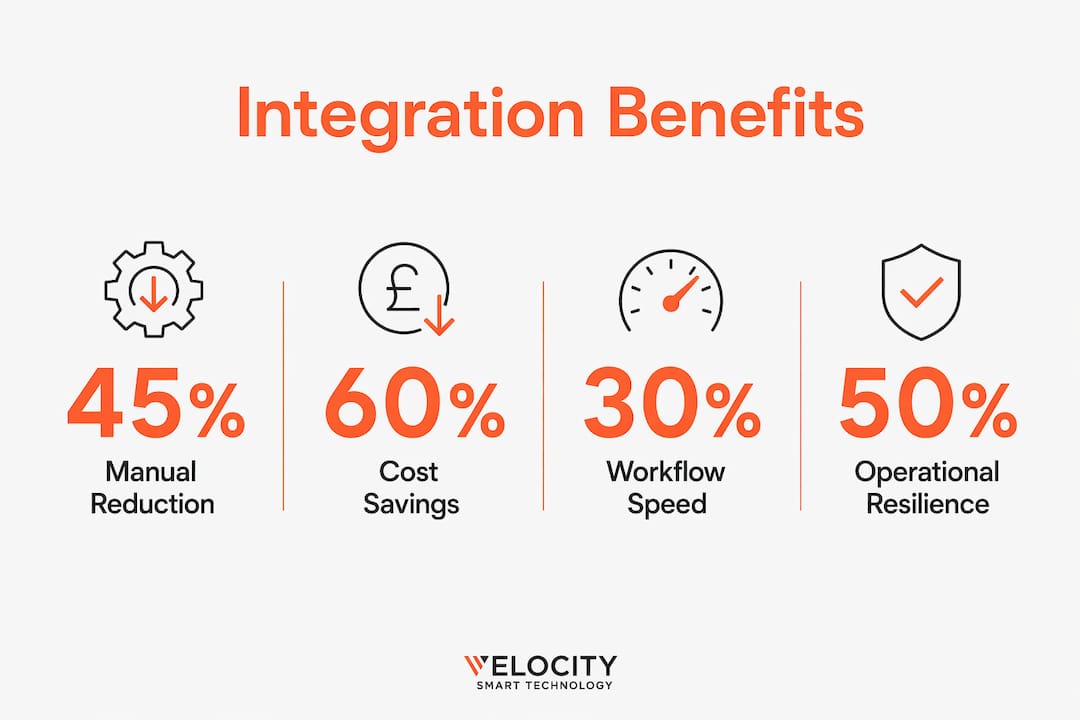
ServiceNow integration delivers measurable operational gains by eliminating the manual handoffs that slow resolution times and introduce errors across IT, HR, finance, and customer service. CGI UK reports that integration delivers faster time to value, greater efficiency, reduced risk, and an improved employee experience. Those outcomes are not aspirational. They reflect what happens when repetitive data re-entry and status-chasing are replaced by automated, auditable workflows.
The operational advantages of ServiceNow integration fall into four distinct categories:
- Workflow unification. Processes that previously required agents to toggle between SAP, Workday, Salesforce, and ServiceNow can execute within a single workflow. Fewer context switches mean fewer errors and faster throughput.
- Elimination of manual re-entry. Integration removes the human step of copying data between systems. This reduces the error rate on routine tasks such as employee onboarding, asset provisioning, and incident escalation.
- Cross-departmental visibility. When HR, IT, and facilities workflows share a common data layer, managers gain a single view of process status. Bottlenecks become visible before they become failures.
- Compliance and audit readiness. Integrated workflows produce audit trails linked directly to service records. This is particularly valuable in regulated industries such as pharmaceuticals, financial services, and defence.
Pro Tip: Before selecting which systems to integrate first, map your highest-volume manual workflows and calculate the staff hours consumed per month. This gives you a defensible ROI figure before a single spoke is configured.
Operational resilience is the less-discussed but equally important benefit. When a workflow fails, an integrated system surfaces the failure immediately within the ServiceNow platform. Without integration, failures often go undetected until an employee raises a ticket. The difference in mean time to resolution between those two scenarios is significant. You can explore how enterprises are reducing manual IT requests to understand the downstream impact on IT staff capacity.
How does integration hub’s architecture reduce complexity and cost?
The architectural difference between traditional point-to-point integrations and ServiceNow Integration Hub is the difference between a web of bilateral dependencies and a governed, centralised workflow layer. Point-to-point approaches become non-scalable and costly as the number of connected systems grows. Each new connection in a point-to-point model requires its own authentication logic, error handling, and retry management. Integration Hub consolidates those concerns into reusable, maintained patterns.

The comparison below illustrates the practical difference for enterprise IT teams:
| Dimension | Point-to-Point Integration | Integration Hub |
|---|---|---|
| Maintenance ownership | Internal development team | ServiceNow-maintained spokes |
| Authentication management | Replicated per connection | Centralised credential store |
| Error handling | Custom-built per integration | Built into Flow Designer patterns |
| Scalability | Degrades with system count | Governed, reusable connections |
| Audit trail | Inconsistent | Native to every workflow execution |
ServiceNow recommends using Integration Hub spokes and Flow Designer patterns specifically to avoid replicating authentication, retry logic, and error management across multiple integrations. This is not a minor convenience. In large enterprises with dozens of connected systems, the cumulative maintenance burden of custom scripting is a significant cost centre.
One architectural consideration that IT managers frequently underestimate is licensing. Integration Hub requires a separate subscription, and this affects total cost of ownership calculations from the outset. Confirming entitlement before moving from pilot to production prevents budget surprises at the worst possible moment in a deployment cycle.
Pro Tip: Treat ServiceNow as your integration control tower, not just a ticketing system. When Integration Hub sits at the centre of your enterprise workflow architecture, every connected system benefits from ServiceNow’s RBAC, audit trail, and CMDB without additional configuration.
The strategic value of this architectural model extends beyond cost. Enterprises that position ServiceNow as the central integration platform gain a governed layer through which all workflow data flows. That data layer becomes the foundation for AI-driven automation, which requires clean, structured, auditable information to function reliably.
What advanced features drive future-ready ServiceNow automation?
The most significant recent development in ServiceNow integration features is the introduction of AI Agents for Integration Hub. Integration Hub now includes over 200 spokes, and AI Agents can dynamically select spokes and actions at runtime rather than following a pre-configured sequence. This changes the nature of workflow automation from static orchestration to adaptive decision-making.
The practical implications for enterprise IT are substantial:
- Reduced manual configuration. Agentic workflows determine the appropriate integration action based on context, removing the need for IT teams to pre-map every possible scenario.
- Real-time failure management. Integrated workflows surface failures within the platform immediately, enabling automated retry or escalation without human intervention.
- Governed AI decision-making. Because AI Agents operate within Integration Hub’s governed framework, every action is logged, auditable, and traceable to a specific workflow execution.
- Operational intelligence at scale. When AI Agents draw on a unified, integrated data layer, the quality of their decisions improves. Fragmented data produces fragmented automation. Governed integration produces reliable AI outputs.
The connection between integration quality and AI performance is direct. Enterprises that have invested in governed Integration Hub architectures are better positioned to adopt Now Assist and agentic workflows because their data is already structured, auditable, and accessible. Those still relying on point-to-point connections or manual data transfer face a more complex remediation before AI can operate reliably. Reviewing current IT process automation trends gives useful context for where this trajectory is heading across global enterprises.
The impact of ServiceNow integration on AI readiness is therefore not a future consideration. It is a present architectural decision with long-term consequences for operational cost and capability.
What steps should IT managers take to maximise integration benefits?
Maximising the key benefits of ServiceNow requires a disciplined approach to planning, governance, and ongoing management. The following sequence reflects best practice for enterprise deployments in 2026.
-
Define business outcomes before selecting technology. Integration projects that start with a technology decision rather than a measurable business outcome tend to overengineer. Identify the specific KPIs you intend to move: resolution time, staff hours recovered, error rate on a given process.
-
Use out-of-the-box spokes before commissioning custom development. Standard Integration Hub patterns handle authentication, retry logic, and error management without custom scripting. Custom development should be a last resort, not a default.
-
Plan transaction capacity before go-live. Integration Hub transactions are counted per Flow or Subflow execution of an action containing integration steps. Underestimating transaction volume against your subscription tier creates cost overruns and potential service interruptions at scale.
-
Establish integration governance with clear ownership. Assign architectural ownership of the integration layer to a named team or individual. Without governance, integration sprawl erodes the ROI that centralised workflows were designed to deliver. ServiceNow security best practices provide a useful governance framework that applies directly to integration architecture.
-
Review integrations regularly for performance and AI readiness. Integrations that were fit for purpose two years ago may not be optimally structured for agentic workflows. Schedule quarterly reviews to assess performance, compliance alignment, and opportunities to introduce AI Agents where manual configuration still exists.
Pro Tip: Map your Integration Hub transaction consumption monthly during the first quarter post-deployment. Early visibility into usage patterns allows you to right-size your subscription before renewal, rather than discovering overage after the fact.
The automation ROI from ServiceNow integration improves consistently when the design is anchored to measurable business outcomes rather than technical completeness. Enterprises that govern their integration architecture as a strategic discipline, rather than a series of one-off projects, sustain that ROI over time and build the data foundation that AI-driven automation requires.
Key takeaways
The benefits of ServiceNow integration are realised through governed, outcome-focused architecture, not through the volume of systems connected.
| Point | Details |
|---|---|
| Operational efficiency gains | Integration eliminates manual re-entry and reduces resolution times across IT, HR, and finance workflows. |
| Architecture over point-to-point | Integration Hub’s governed spokes reduce maintenance cost and prevent the scalability failures of bilateral connections. |
| Licensing must be planned early | Integration Hub requires a separate subscription; confirm entitlement before moving from pilot to production. |
| AI readiness depends on integration quality | Governed, auditable integration data is the prerequisite for reliable AI Agent and Now Assist performance. |
| Governance sustains ROI | Assigning architectural ownership and reviewing integrations regularly prevents sprawl and protects long-term investment value. |
Why integration governance is the decision that matters most
Having worked with enterprise IT teams across regulated industries, the pattern I see most consistently is this: the organisations that extract the greatest value from ServiceNow integration are not those with the most connected systems. They are the ones that treated integration as an architectural discipline from day one.
The temptation to build custom integrations is understandable. A bespoke script can solve a specific problem faster than configuring a spoke and learning Flow Designer patterns. But that decision compounds. Six months later, you have a collection of fragile, undocumented connections that no one wants to touch, each requiring its own maintenance cycle and each invisible to the governance layer that makes audit and compliance possible.
What I find consistently true is that the enterprises with the strongest integration governance are also the ones best positioned for AI adoption. Their data is clean, their workflows are auditable, and their IT teams understand what is connected to what. When Now Assist or an AI Agent needs to act on a workflow, the governed integration layer is already there. The organisations that skipped governance are now facing a remediation project before they can adopt the AI capabilities their boards are asking about.
The practical advice I would offer any IT leader reading this is straightforward. Treat your Integration Hub architecture the way you treat your CMDB: as a strategic asset that requires ownership, documentation, and regular review. The maintenance burden of doing this properly is far lower than the cost of undoing a sprawling, ungoverned integration estate. The efficiency gains from IT support automation are real, but they require the architectural foundation to be solid before the automation layer can perform reliably.
— Anthony
How Velocity-smart extends ServiceNow integration to the physical layer
Velocity-smart builds on the ServiceNow integration advantages described in this article by extending governed workflows to the physical IT support layer. Smart Collect, Velocity-smart’s ServiceNow-native platform, runs entirely within your existing ServiceNow tenant, inheriting your RBAC, CMDB, and audit trail without additional middleware or data synchronisation. For enterprises that have invested in Integration Hub governance, Smart Collect adds the hardware endpoint that completes the workflow: smart lockers, smart vending, and automated kiosks that AI agents can close without dispatching an engineer. Explore Velocity-smart’s ServiceNow-integrated automation solutions or review the full range of smart locker support services to understand how physical IT support fits within your existing integration architecture.
FAQ
What is ServiceNow integration hub?
ServiceNow Integration Hub is a platform capability that connects ServiceNow workflows to external business systems using pre-built spokes and Flow Designer patterns. It provides over 200 out-of-the-box connectors, centralised authentication, and governed error handling without custom scripting.
Does ServiceNow integration hub require a separate licence?
Yes. Integration Hub requires a separate subscription from the core ServiceNow platform. Confirming entitlement before moving from pilot to production is critical to avoid cost overruns and service interruptions.
How are integration hub transactions counted?
Transactions are counted per Flow or Subflow execution of an action that contains integration steps. Enterprises should model expected transaction volumes against their subscription tier before go-live to avoid unexpected overage charges.
What is the difference between point-to-point and integration hub architecture?
Point-to-point integration creates bilateral connections between individual systems, each requiring its own authentication and error handling. Integration Hub centralises these concerns into governed, reusable workflow patterns that scale without proportional increases in maintenance cost.
How does ServiceNow integration support AI adoption?
Governed Integration Hub workflows produce clean, auditable, structured data that AI Agents and Now Assist require to make reliable decisions. Enterprises with strong integration governance are better positioned to adopt agentic automation without a prior remediation of their data architecture.
Recommended
See what Smart Collect® could save you
Model your savings in two minutes, or book a 60-minute workshop to pressure-test the numbers against your estate.