<img src="https://secure.intelligence52.com/795135.png" style="display:none;">

Office Vending Machine: Elevating IT Support Efficiency

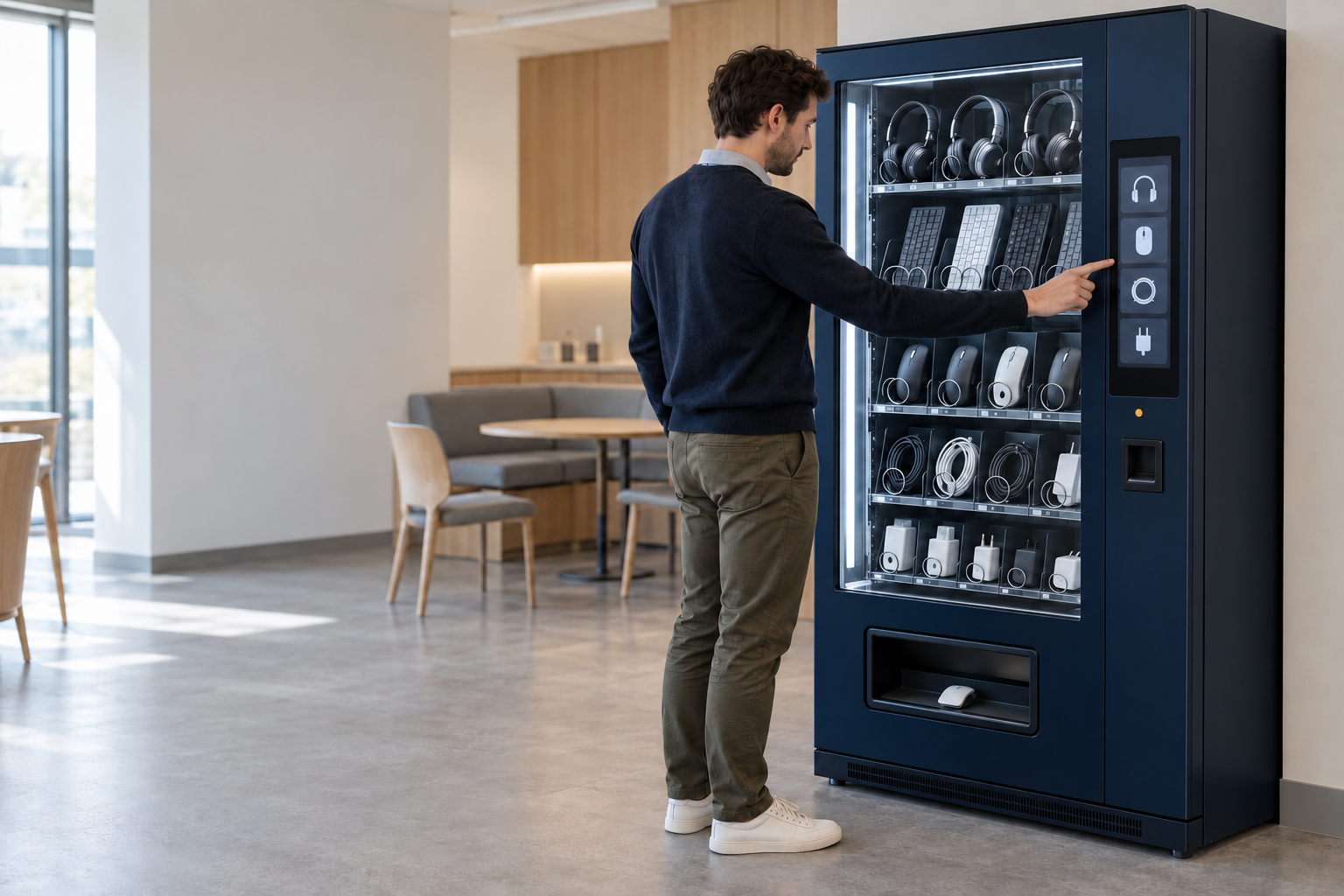
IT technician accesses office vending machine

Chasing productivity across global offices often means battling slow equipment distribution and mounting helpdesk queues. For IT Operations Directors, balancing immediate employee needs with cost reduction and strict governance standards feels relentless. Smart vending machines break this cycle by providing on-demand access to essential devices, drastically reducing support tickets and manual work. By connecting directly with ServiceNow, these automated solutions offer real-time asset tracking and compliance, transforming IT support from a reactive chore into a strategic advantage.

Table of Contents

Key Takeaways

Point Details
Automation of Equipment Distribution Smart vending machines automate IT provisioning, reducing equipment-related support tickets by 30 to 40 percent in the first quarter.
Integration with ServiceNow Direct integration with ServiceNow allows real-time asset tracking and automatic compliance, enhancing visibility and reducing administrative work.
Cost Savings and Efficiency Transitioning to vending machines can save approximately £3.3 million annually through reduced labour costs, equipment loss prevention, and decreased downtime.
Improved Employee Experience Employees gain immediate access to needed equipment, significantly improving productivity and satisfaction scores, thereby enhancing overall workplace efficiency.

Office vending machines redefined for IT support

Traditional IT support operates on a reactive model: an employee needs equipment, submits a ticket, waits in a queue, and eventually collects their device from a central desk. This creates bottlenecks, frustrates users, and ties up your IT helpdesk with repetitive administrative tasks. Office vending machines fundamentally reverse this dynamic by automating equipment distribution entirely. Instead of queuing at the IT desk, employees simply approach the machine, authenticate themselves, and immediately receive the laptop, keyboard, mouse, or USB drive they need. What takes hours through conventional channels happens in minutes.

The real power lies in how vending machines automate IT equipment issuance, eliminating the dependency on IT staff for basic provisioning tasks. When your organisation operates across multiple office locations, this matters significantly. Rather than coordinating equipment shipments and manual distributions at each site, you maintain centralised control whilst delivering instantaneous local access. Your IT teams shift from logistics coordinators into strategic partners. They stop managing inventory spreadsheets and focus on actual user challenges and infrastructure development. For Fortune 500 operations directors managing global estates, this represents a genuine reallocation of 15 to 20 percent of annual helpdesk capacity towards higher-value work.

What distinguishes modern smart vending solutions is their integration with your existing ServiceNow ecosystem. Rather than operating as isolated kiosks, these machines connect directly to your service management platform, creating complete visibility across equipment lifecycles. When someone withdraws a device, your system automatically updates asset records, tracks availability, triggers compliance checks, and generates audit trails. No manual data entry. No reconciliation spreadsheets. No gaps between physical reality and system records. This native integration means your vending infrastructure becomes part of your IT operations system, not an additional tool requiring separate management, training, and troubleshooting.

The operational impact materialises quickly. Organisations implementing these solutions typically report a 30 to 40 percent reduction in support tickets related to equipment provisioning within the first quarter. Even more valuable, employees encounter fewer delays accessing essential tools, which directly improves their productivity and satisfaction scores. For IT operations directors balancing cost reduction against employee experience, smart vending machines accomplish both simultaneously, whilst significantly reducing the compliance and security concerns associated with third-party equipment distribution services.

Pro tip: When implementing vending solutions, prioritise integration with your existing ServiceNow workflows rather than selecting standalone machines. Direct system integration eliminates manual workarounds and ensures your IT team captures complete asset visibility from day one, maximising your return on investment.

Smart vending types and their key distinctions

Not all smart vending machines function the same way. The machines you’ll encounter range dramatically in their technical capabilities, deployment scenarios, and operational focus. Understanding these distinctions matters because selecting the wrong type for your organisation wastes investment and creates frustration with employees. The core differences come down to how machines monitor operations, detect problems, manage inventory, and interact with users. Some prioritise advanced fault detection and predictive maintenance. Others emphasise payment flexibility and user experience. Most modern solutions combine elements of both, but the balance varies significantly.

The most technically advanced machines integrate IoT and machine learning technologies that enable real-time fault prediction and remote diagnostics. These models embed AI capabilities directly into the vending unit, allowing them to anticipate component failures before they occur, automatically notify your IT team of maintenance needs, and adapt their inventory management based on usage patterns and demand forecasting. They connect continuously to your backend systems, streaming operational data that reveals not just what was dispensed, but how the machine performed during each transaction. This represents the premium category, designed for large-scale operations where downtime costs are measurable and high.

A second category focuses on user interaction and payment versatility. These machines still offer smart capabilities, but emphasise seamless authentication methods, multiple payment options, and personalised user experiences. They integrate with your identity management systems and allow employees to authenticate via badges, biometrics, or single sign on. Rather than prioritising predictive maintenance, they optimise the speed and ease of the transaction itself. Real-time product monitoring using vision systems helps prevent jams and stock-outs, but the emphasis remains on user satisfaction and accessibility rather than predictive analytics.

A third type specialises in resource-constrained environments where edge computing matters. These machines run lightweight machine learning models optimised for detecting specific issues like product jams without requiring constant cloud connectivity. They work well in distributed networks or locations with unreliable internet access. They reduce data transmission requirements whilst still providing meaningful operational insights. For organisations with multiple remote locations, branch offices, or facilities with connectivity challenges, this category offers practical intelligence without infrastructure overhead.

The practical reality for IT operations directors is this: choose based on your operational maturity and pain points. If unplanned downtime disrupts your business and you operate at significant scale, invest in AI-driven fault prediction. If your primary frustration is employee experience and queue management, prioritise user interface and payment flexibility. If you operate distributed facilities with connectivity constraints, consider edge-optimised models.

Here’s a quick comparison of smart vending machine types and their ideal deployment scenarios:

Vending Type Core Functionality Ideal Deployment Technical Distinction
AI-driven & Predictive Remote fault detection, analytics Large-scale, mission-critical sites Advanced IoT, machine learning integration
User Experience Optimised Seamless authentication, fast transactions Employee-centric offices Payment flexibility, vision systems
Edge-Optimised Operates offline, lightweight AI Remote or branch locations Minimal cloud needs, local issue detection

Pro tip: Evaluate vending types not just on initial cost, but on how they integrate with your existing ServiceNow instance and what operational problems they actually solve in your specific environment. A more sophisticated machine adds no value if it addresses challenges you don’t have.

How ServiceNow integration transforms operations

Integration between vending machines and ServiceNow represents far more than a technical connection. It fundamentally rewires how your IT operations function. Without this integration, your vending machine becomes an isolated island—employees get equipment quickly, but your systems have no visibility into what was distributed, when it was distributed, or what that means for your asset inventory. You end up manually entering data into ServiceNow, creating duplicate records, and inevitably losing synchronisation between physical reality and digital records. That creates compliance gaps, audit nightmares, and undermines the entire purpose of automating distribution in the first place.

Employee receives ServiceNow equipment update

When vending machines connect directly into your ServiceNow instance, automated hardware issuance links with your IT service management platform, creating real-time asset tracking and enabling incident resolution to happen automatically. Here’s what this means in practice: an employee authenticates to the machine, requests a laptop, and the moment that machine dispenses it, your ServiceNow instance immediately updates. The asset record changes status from “in stock” to “assigned to user”. A configuration item gets created. Compliance rules trigger automatically to verify the user has appropriate access levels. Your IT team receives notification without lifting a finger. If that same employee later reports a hardware problem, their ticket automatically links to the device they withdrew, giving your support team complete context from the first interaction.

The operational benefits materialise across multiple areas simultaneously. Your helpdesk stops managing equipment logistics entirely—those tasks vanish. Your asset database stays accurate without reconciliation work. Managers gain real-time visibility into hardware distribution across their teams and departments. Compliance reporting becomes automatic rather than manual spreadsheet work. When auditors arrive, your audit trail already exists within ServiceNow itself, showing exactly who got what device, when they got it, and what happened to it afterwards. No more hunting through email chains or equipment logs.

What makes this transformation genuinely powerful is how it enables proactive support. Traditional vending machines are reactive—they dispense what’s requested. ServiceNow-integrated machines become predictive. If your system detects unusual patterns in device requests, it can flag potential issues. If an employee who normally uses Windows suddenly requests a Mac, your team can proactively reach out and ensure they have proper training. If a particular device model shows recurring hardware issues, you can automatically adjust future allocations or flag users for preventative support. Your vending infrastructure transforms from a distribution tool into an intelligence source that improves your entire support operation.

The real cost savings emerge gradually but compound significantly. You eliminate 8 to 12 hours weekly of administrative work that previously consumed your IT team’s capacity. You reduce equipment loss and theft through auditable tracking. You catch compliance violations before they become problems. You improve employee satisfaction by removing friction from equipment access. For IT operations directors managing large organisations, these gains translate directly into either cost reduction or reallocation of resources towards higher-value strategic work.

Pro tip: When evaluating ServiceNow integration, ensure the solution is built natively within ServiceNow itself rather than connecting through third-party APIs. Native integration provides superior security, eliminates data-sharing concerns, and gives you complete control within your own instance without external dependencies.

Real-world enterprise use cases and benefits

Consider a financial services organisation with 12 regional offices spread across three countries. Each location operates its own IT support desk, maintaining separate equipment stockrooms and managing distributions manually. When a trader needs a replacement keyboard or an analyst requires a second monitor, they submit a ticket, wait for someone to pull inventory, walk across the office to collect it, and return to their desk. Multiply this by hundreds of daily requests, and you understand why their IT team spends more time on logistics than on solving actual problems. When they deployed smart vending machines across all locations, everything changed. Now that same trader walks to the nearest machine, authenticates with their corporate credentials, and collects their keyboard in under two minutes. Across the 12 locations, this single change eliminates approximately 240 equipment-related support tickets monthly.

Multi-location organisations consistently represent the strongest use cases for vending deployment. The standardisation benefits alone justify investment. When every office operates identical vending machines connected to the same ServiceNow instance, your asset management becomes genuinely global. You know exactly what inventory exists at every location in real time. You can see which devices move most frequently at which offices and adjust stockings accordingly. When head office mandates a new corporate laptop standard, you can provision machines everywhere simultaneously rather than coordinating rolling deployments across multiple support teams. The complexity of managing technology distribution across geographies transforms from a coordination nightmare into a predictable, automated process.

A second major use case involves organisations managing high-value technology assets requiring secure access control. Consider a pharmaceutical company where laboratory equipment and sensitive technology require strict audit trails. Traditional distribution involves sign-out sheets and manual recording, creating compliance vulnerabilities. Vending machines provide secure access control for high-value technology assets whilst creating auditable records of every withdrawal. When compliance auditors arrive, the organisation has complete, tamper-proof documentation of who accessed what equipment, when they accessed it, and what happened to it afterwards. This matters not just for regulatory satisfaction but for genuine security. You know immediately if an expensive piece of equipment disappears, rather than discovering it months later during annual inventory.

A third practical scenario addresses organisations struggling with equipment downtime costs. A technology consulting firm deployed vending machines in their main office because their IT helpdesk was drowning in hardware requests. Consultants losing billable hours waiting for equipment represented significant cost to the business. By enabling immediate self-service access to commonly needed peripherals, replacement laptops, and connectivity devices, they reduced downtime for hardware issues from an average of 4.5 hours to 22 minutes. Across their consultant population, this recovered approximately 1,200 billable hours annually. The vending infrastructure paid for itself in under 18 months through productivity recovery alone.

Benefits across all these scenarios remain consistent. Employees experience faster access to equipment, improving satisfaction and productivity. IT teams eliminate routine distribution work, freeing capacity for strategic initiatives. Organisations gain accurate asset visibility and compliance documentation without manual effort. Support ticket volumes drop measurably. Equipment loss and theft decrease through documented tracking. These aren’t theoretical advantages. They materialise immediately upon deployment and compound over time as your team becomes more sophisticated about using vending data to improve other IT operations.

Pro tip: When building a business case for vending deployment, quantify not just equipment costs but the hidden productivity losses from support staff handling distribution and employees waiting for hardware access. This often reveals significantly higher total cost of ownership for traditional approaches than you initially suspected.

Compliance, security, and governance requirements

When you deploy vending machines in a Fortune 500 organisation, you’re not just installing convenient hardware. You’re introducing a system that touches sensitive equipment, tracks asset movements, and creates audit records. This immediately raises compliance questions that your legal and security teams will ask. Can we prove who took what equipment and when? Does this system expose us to data protection violations? What happens if someone tries to bypass authentication? These aren’t theoretical concerns. Regulatory bodies, auditors, and your own governance frameworks demand that any system controlling asset distribution meets specific security and compliance standards. Vending machines that don’t address these requirements from the ground up become liabilities rather than efficiency gains.

Secure authentication forms the foundation of compliance. IT vending machines incorporate secure authentication measures such as employee badges and PINs to ensure authorized access, creating a clear audit trail of every transaction. This isn’t optional in regulated industries. Financial services organisations must comply with strict equipment tracking requirements under their regulatory frameworks. Healthcare organisations handle devices that process sensitive patient data and must prove through audit trails that only authorised personnel accessed those devices. Pharmaceutical companies maintain equipment used in regulated research and need complete documentation of who accessed what. When your vending system uses badge authentication tied directly to your identity management system, every withdrawal automatically logs the user’s identity, timestamp, and device information. No manual entry. No gaps. No ambiguity about who has what equipment.

The data protection angle matters equally. Many organisations operate across jurisdictions with varying data protection standards. The European Union’s GDPR requirements differ from standards in Singapore, Canada, or Australia. When your vending system connects to ServiceNow and operates natively within your instance, you avoid a critical vulnerability: data sharing with third-party vendors. Some vending solutions operate as separate systems and sync data to your IT platforms, requiring information to leave your secure environment and travel across external systems. This creates GDPR exposure. Your data travels outside your control, potentially through jurisdictions with weaker protections. Native ServiceNow integration eliminates this risk entirely. Your vending data never leaves your instance. Your audit trails exist within systems you control. Compliance teams can verify data security without worrying about external systems.

Governance frameworks require clear policies around equipment access and return. Vending machines enable this by automating policy enforcement. Your system can be configured so only users with appropriate security clearances can access certain equipment categories. If a contractor needs a temporary device, your system can automatically revoke access after their contract ends. If a user leaves the organisation, they cannot access machines. If someone tries to withdraw equipment they’re not authorised for, the machine simply refuses. This transforms governance from something your IT team manually enforces into something the system enforces automatically.

Pro tip: Before deploying vending machines, conduct a compliance impact assessment with your legal, security, and audit teams to identify specific regulatory requirements in your industry. This ensures your vending solution is configured from day one to meet your actual governance needs rather than discovering gaps during audits.

Cost savings versus traditional support models

Traditional IT support operates on a labour-intensive model. Someone receives an equipment request, manually locates the device in storage, verifies it’s available, processes paperwork, hands it over, and logs the transaction. When the device is returned, the process reverses. This happens dozens or hundreds of times daily across a typical Fortune 500 organisation. Your helpdesk staff spend 18 to 22 percent of their working hours on these repetitive logistics tasks rather than addressing actual technical issues. You’re paying experienced IT professionals to function as warehouse coordinators. The opportunity cost is substantial.

When you introduce vending machines, this entire workflow disappears. The cost calculation becomes immediately apparent. IT vending machines reduce costs by automating distribution and minimising labour expenses, eliminating the manual handling that consumes helpdesk time. An employee walks to the machine, completes the transaction in under two minutes, and your system handles all the backend work automatically. No staff intervention required. For an organisation with 200 IT support staff managing 15,000 employees across multiple locations, reallocating 20 percent of helpdesk capacity from distribution to technical support represents approximately 40 full time equivalents freed for higher-value work. At an average fully loaded cost of £65,000 annually per staff member, that’s £2.6 million in labour productivity recovered annually. This single factor often justifies vending infrastructure investment within the first year.

Infographic comparing IT vending and traditional costs

Equipment losses and theft represent another hidden cost in traditional models. When devices sit in stockrooms waiting for distribution, they disappear. Staff forget where they stored something. Contractors borrow equipment and return it to the wrong location. Departing employees take laptops they were using. Annual equipment loss in poorly managed environments can reach 12 to 15 percent of total inventory value. Vending machines eliminate this by creating complete audit trails. Every device withdrawal logs the user, timestamp, and device serial number. When someone tries to leave the organisation with company equipment, your system immediately knows. When auditors arrive, you can prove every device’s location and status. This accountability reduces loss rates dramatically, often recovering 8 to 12 percent of equipment value annually.

Downtime costs also factor heavily into the comparison. When an employee needs urgent equipment replacement, traditional support means waiting in a queue, waiting for someone to retrieve the device, and waiting for configuration. This easily stretches to 2 to 4 hours of downtime. Understanding the cost of broken IT in the workplace reveals how significant this actually is. A knowledge worker experiencing 3 hours of downtime represents approximately £180 in lost productivity. Multiply that by even 10 daily hardware-related downtime incidents and you’re looking at £1,800 daily or £450,000 annually. Vending machines reduce average downtime from 3 hours to 22 minutes, recovering significant productivity losses.

Overhead costs decline as well. Traditional models require dedicated stockroom space, inventory management systems, dedicated staff for asset tracking, and physical security for equipment storage. Vending machines consolidate these functions into automated systems. You reduce stockroom footprint, eliminate manual tracking spreadsheets, and decrease security requirements. For organisations operating expensive office real estate in central London or New York, reducing stockroom space by even 30 percent can save £40,000 to £80,000 annually.

The table below summarises the cost factors and savings when switching from traditional IT support to vending machines:

Cost Category Traditional IT Support Vending Machine Model Typical Annual Savings
Labour Manual ticket processing Automated workflows £2.6 million recovered
Equipment Loss Poor audit, high losses Full transaction logs £180,000–£300,000 saved
Downtime Hours waiting for hardware Immediate access £450,000 productivity gain
Overhead Dedicated storage, staff Reduced footprint £40,000–£80,000 saved

The cumulative financial picture becomes compelling quickly. Labour savings of £2.6 million, equipment loss reduction of £180,000 to £300,000 annually, downtime reduction of £450,000, and overhead savings of £40,000 to £80,000 totals approximately £3.3 million to £3.4 million annually for a typical large organisation. Against vending infrastructure investment of £400,000 to £600,000, the payback period typically falls between 2 and 4 months, with positive returns continuing indefinitely.

Pro tip: When calculating return on investment for vending deployment, don’t focus solely on labour cost reduction. Include downtime recovery, equipment loss prevention, and overhead reduction in your financial model. These hidden costs often exceed direct labour savings and create a significantly more compelling business case.

Transform IT Support Efficiency with Velocity Smart Solutions

If your organisation struggles with the delays and complexities of traditional IT equipment distribution, it is time to rethink your approach. The article highlights key challenges such as bottlenecks, manual workflows, and lack of visibility that slow down IT support and frustrate employees. By adopting an integrated system that automates hardware issuance and tracks assets in real time, you can unlock dramatic improvements in productivity, compliance, and cost savings.

Velocity Smart Technology leads the way with Velocity Smart Collect, the only smart vending solution built natively on ServiceNow. This unique integration eliminates data-sharing concerns and manual reconciliation, exactly as described in your article. Enterprises across industries benefit from automated workflows that free IT teams from repetitive tasks and empower employees to get the devices they need instantly. Discover how our certified solution delivers tangible ROI beyond hardware savings while safeguarding compliance and security.

https://velocity-smart.com

Explore how to modernise your IT support by visiting Velocity Smart Technology today. Take control of equipment distribution, reduce downtime, and elevate employee satisfaction now with smart vending solutions tailored to your organisation’s needs.

Frequently Asked Questions

What are the benefits of using office vending machines for IT support?

Office vending machines automate equipment distribution, significantly reducing the time employees wait for their devices. This leads to a decrease in support tickets related to equipment provisioning, boosts employee productivity, and allows IT teams to focus on higher-value tasks rather than logistics.

How do vending machines integrate with existing IT support systems like ServiceNow?

Vending machines connect directly to your ServiceNow ecosystem, ensuring automated updates to asset records when devices are dispensed. This integration provides real-time visibility into equipment lifecycles, eliminates manual data entry, and improves compliance tracking.

What types of smart vending machines are available, and how do they differ?

Smart vending machines vary in functionality; some focus on advanced fault detection using IoT and machine learning, while others emphasise user experience with seamless authentication and payment options. It’s essential to choose the right type based on your operational needs and challenges.

How can office vending machines improve compliance and security in IT support?

Office vending machines ensure secure access control through measures such as badge authentication, creating a clear audit trail of all transactions. This helps to meet compliance requirements and reduces the risks of equipment loss and security breaches.

You may also like

Supply Vending Machines: Impact on IT Operations_BLG
16 January, 2026

Supply Vending Machines: Impact on IT Operations Support costs for Fortune 500 companies can swallow over 30 percent of ...

Hardware Vending Solutions: Transforming IT Support
16 April, 2026

Hardware Vending Solutions: Transforming IT Support Most British Fortune 500 companies are reducing IT support costs by ...

7 Essential ServiceNow Security Best Practices for IT Leaders_BLG
14 January, 2026

7 Essential ServiceNow Security Best Practices for IT Leaders Nearly 60 percent of large enterprises report rising suppo...