
83% Faster Fulfilment: ServiceNow SAP Automation for CIOs
In a ServiceNow context, SAP automation means orchestrating physical device handovers, from laptop swaps to peripheral pickups, natively inside your ServiceNow tenant rather than through SAP ERP workflows. It runs through smart lockers, smart vending and kiosk endpoints, inheriting your existing CMDB and RBAC controls. This has nothing to do with automating SAP ERP business processes; it is about closing the physical gap in your IT service desk.
TL;DR:
- Hardware endpoint integration is essential to accurately reflect device status, such as dispense, lock, and error states, to prevent ghost assets in the CMDB.
- Fulfillment speed improvements depend on precise state mapping and proper choice of fulfillment model, whether vendor-direct or stockroom-held inventory.
- Cost savings and efficiency gains are primarily driven by reduced manual dispatch, fewer technician site visits, and lower device loss rates, with improvements amplifying as AI automation advances.
- Proper planning of physical infrastructure, including power, security, and network, is crucial before deploying lockers, vending, or kiosks at pilot sites with measurable KPIs.
- Using a native ServiceNow platform for physical asset management ensures consistent RBAC, audit tracking, and easier security compliance compared to deploying separate vendor solutions.
Table of Contents
- What is SAP automation in a ServiceNow environment?
- How zero-touch device handovers work inside ServiceNow
- What outcomes should you expect from device handover automation?
- Rolling out physical asset automation: a practical checklist
- Where lockers, vending and kiosks fit in practice
- Where the physical layer becomes the next cost frontier
- Explore Smart Collect® for your device distribution strategy
- Sources
What is SAP automation in a ServiceNow environment?
Drop the SAP ERP association entirely here. This article uses “SAP automation” the way many IT leaders now search for it, meaning ServiceNow-native automation of the physical side of asset management, and that is a distinct discipline from RPA or workflow bots built for SAP Business Technology Platform. If you landed here looking for SAP ERP process automation, you want a different resource; what follows concerns hardware distribution.
The proper anchor is ServiceNow’s own Hardware Asset Management (HAM) and IT Asset Management (ITAM) capability, where the CMDB acts as the single source of truth for every device your organisation owns. HAM already governs procurement, deployment and retirement through prescriptive workflows. Physical device handover automation extends that discipline to the point where a human would otherwise have to hand someone a laptop.
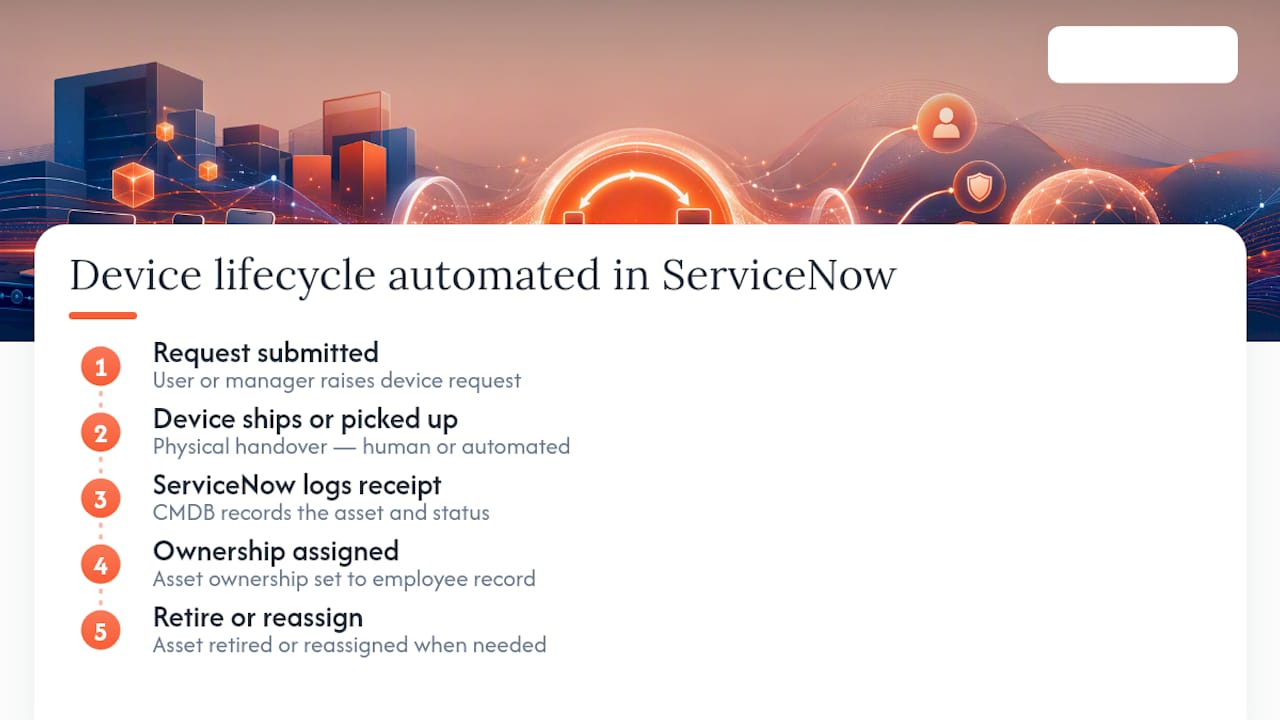
The lifecycle it automates is familiar to any asset manager: a request comes in, the device ships or gets picked up, ServiceNow logs receipt, ownership assigns to the employee, and eventually the asset gets retired or reassigned. What changes is who, or what, performs each step.
How zero-touch device handovers work inside ServiceNow
ServiceNow already documents a zero-touch request flow that automates tasks like “request shipment,” “ready for pickup” and “receive asset,” coordinating provider shipping and stockroom pickup without anyone manually chasing a spreadsheet. Automated tasks track their own progress and update status the moment a step completes. A hardware endpoint, whether that is a smart locker bank or a vending unit, plugs into that same task chain rather than sitting beside it.
A typical zero-touch refresh flow looks like this:
- An employee or manager submits a hardware request through the Service Portal, or a workflow trigger fires automatically from an onboarding or break/fix record.
- ServiceNow checks Stockroom availability against CMDB stock levels and either reserves an on-site unit or routes the order to a provider for direct shipment, exactly the model ServiceNow’s own zero-touch example describes, where laptops ship straight from a VAR to the employee and the asset record creates itself on receipt.
- The hardware endpoint confirms fulfilment: a locker door unlock and collection, a vending dispense, or a courier proof-of-delivery scan.
- That physical event fires back into ServiceNow as a task completion, updating the CI record and asset state in the CMDB.
- Ownership assigns to the employee, and the audit trail closes the loop for compliance reporting.
The part that trips up most first attempts is state mapping. If “In stock,” “Pending pickup,” “In transit” and “Assigned” are not synchronised precisely with what the locker or vending unit physically does, you get ghost assets, records that say a laptop is on a shelf when it left the building three weeks ago. Every hardware endpoint should expose a minimal, audited event set to ServiceNow, covering dispense, lock, serial confirmation and error states, each tied directly to a task completion.
What outcomes should you expect from device handover automation?
The numbers from live regulated-industry deployments give you a realistic ceiling to aim for, not a marketing average. For example, a global pharmaceutical customer running Smart Collect® reported significantly improved IT service throughput, faster fulfilment, and reduced employee downtime.
The metrics that actually move:
- Fulfilment lead time, from request submission to device in hand
- Ticket volume for physical incidents, which drops as self-service replaces desk visits
- Device loss and damage rate, tracked through locker or vending audit logs
- CMDB reconciliation error rate, the clearest signal of whether state mapping is working
- IT staff travel and time reclaimed, particularly across multi-site estates
Cost reduction follows a similar pattern to the throughput gains: fewer manual dispatch tasks, less technician travel between sites, and a lower lost-or-damaged device rate because every locker and vending transaction is logged against a named user. As ServiceNow’s AI agents mature and take on more of the triage and routing work upstream, these outcomes are a floor rather than a ceiling. Today’s throughput gains were achieved on traditional ITSM workflows; agentic orchestration on top of that foundation should widen the gap further.
Rolling out physical asset automation: a practical checklist
A pilot that skips state design fails quietly for months before anyone notices the CMDB is wrong. Work through these in order:
- Map every lifecycle state to a workflow task first. Decide what “In stock,” “Assigned,” “In transit” and “Retired” mean physically before wiring up a single endpoint, since automating updates without precise state definitions is how ghost assets creep into the CMDB.
- Choose your fulfilment model deliberately. Vendor-direct shipping suits distributed workforces; stockroom-held inventory suits sites with volatile break/fix demand; most large enterprises end up running a hybrid of both.
- Design RBAC and audit logging around the physical endpoint, not just the software. A locker’s unlock event needs the same access controls and traceability as any privileged ServiceNow transaction, particularly across regulated environments like pharma or defence.
- Plan the physical site properly. Power, network drops, physical security and a maintenance contract for the hardware itself all need sign-off before install day, not after.
- Pick pilot sites and KPIs before you touch a locker. Choose two or three sites with contrasting profiles (a large headquarters, a distributed regional office), define your test ticket types, and build in a reconciliation check against the CMDB within the first fortnight.
Pro Tip: When a third-party vendor holds your break/fix stock, you will often need to create a new asset record rather than reassign the old one; plan contract linkage and software entitlement transfer into the swap workflow from day one, not as a fix afterwards.
Where lockers, vending and kiosks fit in practice
Each hardware form factor answers a different operational problem, and most large estates end up running all three.
- New-hire provisioning: a zero-touch flow ships a preconfigured laptop directly to a new starter’s home, or reserves it for pickup at a locker on their first day, with the asset record created automatically on receipt.
- Break/fix swaps: an employee with a failed laptop collects a replacement from a smart locker, the old device gets logged into a return slot, and both transactions write straight into the CMDB with a full audit trail.
- Peripheral and consumable access: smart vending covers the unglamorous but constant demand for headsets, cables and docking stations, available around the clock without a desk visit.
- Walk-up resolution: a Smart Kiosk gives employees a video-based tech bar for immediate triage, replacing the traditional physical help desk counter for issues that do not need a locker transaction at all.
Where the physical layer becomes the next cost frontier
Digital ticket costs are heading towards zero as AI agents absorb password resets and access requests. What is left over concentrates in the physical layer, and that is where budgets will get scrutinised hardest over the next few years. Pilot the ticket categories with the highest technician travel time first, typically new-hire kit and break/fix swaps across multi-site estates, and measure fulfilment lead time and CMDB reconciliation error rate from week one.
Choosing a platform that runs natively inside your existing ServiceNow tenant, rather than bolting on a parallel vendor database, changes your governance conversation entirely. You inherit RBAC and audit trails you already trust instead of commissioning a fresh security review for every hardware vendor. That difference in total cost of ownership tends to surface only once you have priced out the alternative.
— Anthony
Explore Smart Collect® for your device distribution strategy
If your estate already runs HAM inside ServiceNow, Smart Collect® extends that same tenant, the same CMDB, the same RBAC, to the physical handover itself, rather than asking you to stand up a separate vendor platform and a fresh security review. It orchestrates smart lockers, smart vending and Smart Kiosk from one place, with every transaction landing as a native ServiceNow record.
Velocity Smart Technology is ISO 9001 and ISO 27001 certified, and its deployments span regulated customers including Roche, BioNTech, Centrica and BAE Systems. The Smart Locker Whitepaper walks through deployment models for teams scoping a pilot, and the IT Asset Lockers product page covers how the platform handles handover, assignment and retirement without middleware. If you want to see the throughput numbers behind a live regulated deployment, the global pharma case study breaks down the 500% throughput and 83% faster fulfilment figures in context. For IT operations leaders ready to scope a pilot, that whitepaper is the natural starting point before a technical evaluation call.
Recommended
See what Smart Collect® could save you
Model your savings in two minutes, or book a 60-minute workshop to pressure-test the numbers against your estate.