Procurement Grade Employee Self Service in ServiceNow for CIOs
Employee self-service for physical IT fulfilment works best when the hardware orchestration runs natively inside ServiceNow and writes asset state to the CMDB. In this context, that’s what “employee self service GCSNC” means: lockers, vending and kiosks that let staff collect, return or exchange devices without middleware or a parallel database. Velocity Smart Collect® is the clearest example of a ServiceNow-certified platform built this way, inheriting your existing RBAC, audit trail and CMDB rather than bolting on a new one.
TL;DR:
- Moving hardware self-service into ServiceNow-native workflows significantly improves throughput and reduces fulfillment cycle times, as shown by a 500% improvement in one case.
- Native asset state and ownership data stay synchronized with existing CMDB records, avoiding security risks and data sprawl associated with bolt-on solutions.
- Successful deployment depends on establishing clear ownership, inventory controls, and stockroom discipline before automation to prevent data pollution.
- A pilot should focus on limited device categories and sites, with measurable goals and parallel manual fallback to contain risk during early testing.
- Velocity Smart Collect runs entirely within ServiceNow, inheriting existing governance and delivering proven operational improvements like 60–90% ticket reduction.
Table of Contents
- Why ServiceNow-native hardware self-service changes the cost equation
- What are the core components inside ServiceNow?
- What maturity stage is your organisation at?
- How should the integration layer be designed?
- What KPIs and cost benchmarks actually matter?
- What does a pilot rollout checklist look like?
- What do enterprise deployments actually teach you?
- How does Velocity Smart Collect® meet these requirements?
- Sources
Why ServiceNow-native hardware self-service changes the cost equation
Digital IT support keeps getting cheaper. Physical support doesn’t move, because a human still has to walk to a locker, hand over a laptop, or restock a shelf. That divergence is becoming the line item CFOs notice first.
Desktop support tickets already cost roughly three times more than digital ones, at $70 versus $22 per ticket according to MetricNet’s 2024 benchmarking. As AI agents push the digital cost-to-serve toward zero, that gap doesn’t narrow. It widens.
There’s a second argument for going ServiceNow-native, and it’s about risk, not cost. A platform that writes directly into your existing CMDB and RBAC avoids the vendor security review, the data sync job, and the parallel database that a bolt-on locker product requires.
- No middleware layer between the hardware and your ITSM workflows.
- Asset state, location and ownership history live as native CMDB records.
- Audit trails inherit your existing governance rather than creating a second one.
Publisher-reported example: a global pharma customer saw a 500%+ uplift in IT service throughput and 83% faster fulfilment after moving hardware handovers into this kind of native workflow. These are results delivered before agentic AI was driving the workflow end-to-end, which is worth sitting with for a moment.
What are the core components inside ServiceNow?
Three hardware form factors cover most enterprise fulfilment needs, and each maps to a different stage of the device lifecycle: request, receive, fulfil, recover.
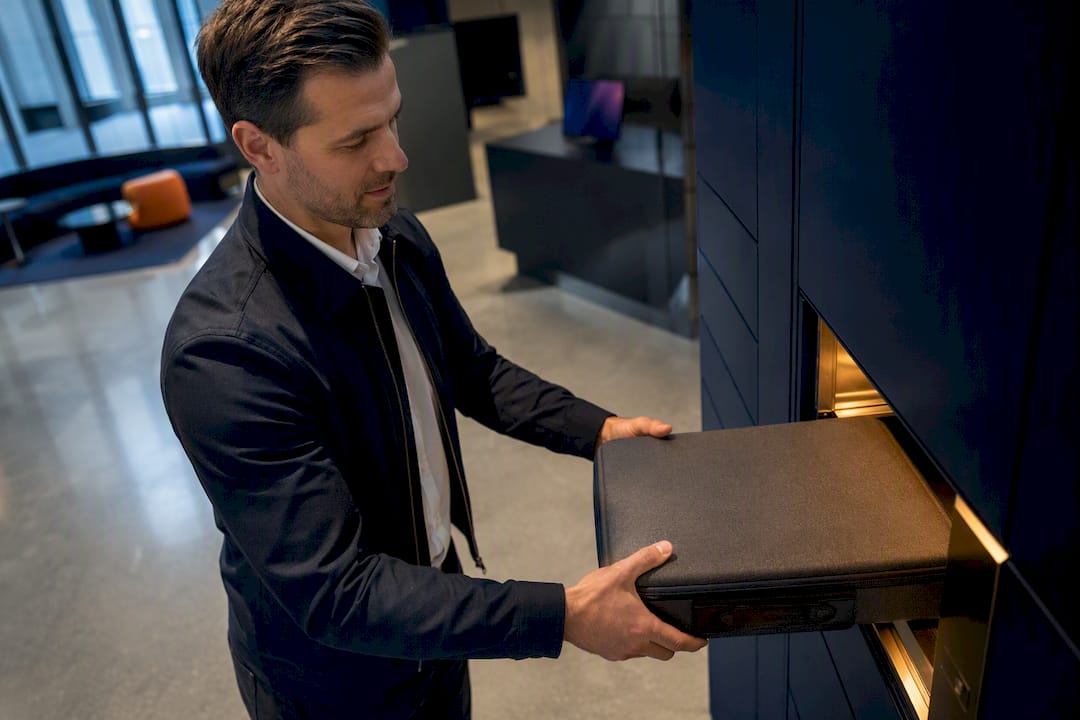
Smart lockers handle full-device handovers. New-starter kit delivery, broken-laptop swaps, loaner returns. An employee requests a device through the catalogue, the locker dispenses it against that ticket, and the transaction writes back to the configuration item the moment the door closes.
Smart vending dispenses peripherals and consumables on demand, around the clock. Cables, headsets, mice, dongles. No stockroom queue, no ticket for a £15 item.
Smart kiosk replaces the walk-up help desk with a virtual tech bar, often paired with an AI-powered video resolver group for guided handovers and quick diagnostics.
- Lockers → device lifecycle: swap, loan, new-starter provisioning.
- Vending → consumables and peripherals, no ticket required.
- Kiosk → walk-up support, guided troubleshooting, human escalation when needed.
Each interaction should update the same CMDB record set your ITSM team already relies on. Well-designed catalogues with “My Devices” style views can deflect 65-70% of routine tickets simply by giving employees a self-service path that already knows what they own.
What maturity stage is your organisation at?
ServiceNow’s hardware asset management maturity model names four stages: Crawl, Walk, Run, Fly. Each depends on stabilising ownership, states and data coverage before you add automation on top.
- Crawl — manual tracking, inconsistent ownership records. Next move: assign a single accountable owner per asset category.
- Walk — basic CMDB discipline, defined states (in stock, assigned, in repair). Next move: pilot one locker or vending site with tight receiving controls.
- Run — automated workflows across multiple sites, reconciled stockrooms. Next move: expand catalogue items and add kiosk-based support.
- Fly — AI-augmented orchestration, predictive stock and proactive device recovery. Next move: layer Now Assist workflows onto a proven physical fulfilment base.
Community best practice reinforces this staged approach, warning that stockroom structure and receiving controls matter more than the hardware itself, because bad receiving data poisons everything downstream.
Pro Tip: Don’t buy lockers before you’ve defined who owns each device state in the CMDB. Hardware automation amplifies whatever data discipline already exists, good or bad.
A short readiness checklist before you automate: named ownership per site, a defined stockroom hierarchy, receiving controls that catch bad data at the door, and a written policy for lost or damaged equipment.
How should the integration layer be designed?
Practitioners are consistent on one point: design Hardware Asset Management and ITSM together. Bolt lockers onto an undefined lifecycle and the CMDB drifts from physical reality within weeks.
A central integration layer, tied to a single source of identity, is the pattern that holds up under scale. IAM integration determines who can open which locker compartment, and that identity check needs to happen against the same source your ServiceNow instance already trusts, not a separate directory.
Locker events should be handled asynchronously. A door opens on local authorisation, and the transaction reconciles into ServiceNow once connectivity returns rather than blocking the employee at the point of use.
Treat every locker event as eventually consistent, not instantaneous. The employee gets their device now; the system of record catches up within seconds, even across a transient network outage.
Design principles worth codifying:
- Keep audit logs for hardware transactions separate from general ITSM logs, so a compliance review doesn’t require untangling the two.
- Apply least-privilege API scopes to every integration endpoint touching the CMDB.
- Harden edge devices physically and on the network, since lockers and kiosks sit outside the typical office perimeter.
- Build local buffering so a locker can still dispense against a cached authorisation during an outage.
What KPIs and cost benchmarks actually matter?
Five metrics tell you whether hardware self-service is working: fulfilment cycle time, ticket deflection rate, IT staff time reclaimed, stranded stock (devices sitting unassigned), and recovery rate on loaned or leaver equipment.
Publisher-reported customer outcomes give a useful, if illustrative, sense of scale. A US aerospace and defence customer reduced IT staff travel by 35% across 34+ sites; a US university processed over 70,000 transactions with 90% of IT staff time recovered on late equipment returns.
| Metric | What it measures | Illustrative benchmark |
|---|---|---|
| Fulfilment cycle time | Request to device in hand | 83% faster (pharma customer) |
| IT staff time reclaimed | Hours no longer spent on manual handover | 60% (nuclear energy operator) |
| On-site ticket volume | Tickets requiring a physical visit | 60% reduction (nuclear energy operator) |
| Shared-equipment loss/damage | Assets lost or damaged in shared pools | 90% reduction (UK utility) |
Total cost of ownership usually blends three components: an annual software licence tied to device or site count, hardware and installation fees for lockers or vending units, and a tiered support contract. Weigh those against the staff hours a manual model consumes before comparing sticker prices.
What does a pilot rollout checklist look like?
A pilot should be small enough to fail safely and large enough to prove the model. Phased integration, starting with identity, then inventory feedback, then reporting, keeps risk contained.
- Pick one or two sites and a narrow device family (laptops or a single peripheral category).
- Define catalogue items and name a stockroom owner accountable for receiving accuracy.
- Set measurable acceptance criteria: target cycle time, a reconciliation tolerance for stock discrepancies, and a maximum acceptable rate of failed dispenses.
- Run a parallel manual fallback during the first weeks so no employee is stranded by an edge case.
- Expand to additional sites once reconciliation stays inside tolerance for a full reporting cycle, then introduce AI-driven request routing once the physical layer is proven.
What do enterprise deployments actually teach you?
Three lessons recur across deployments of this kind. First, scope creep kills pilots: teams that try to automate every device category on day one lose the receiving discipline that makes the data trustworthy. Second, governance has to precede hardware, not follow it. Third, integration quality determines whether a locker feels like magic or like a second system to babysit.
If there’s one thing worth insisting on during procurement, it’s genuine ServiceNow-native behaviour. Ask a vendor to show the CMDB record their locker writes to, live, in your own tenant. If they can’t, you’re buying middleware with a nicer front end, whatever the sales deck calls it.
— Anthony
How does Velocity Smart Collect® meet these requirements?
Velocity Smart Collect® runs inside your ServiceNow tenant as a certified application, not an API bolt-on. Asset state, location and ownership history sit as native CMDB records, queryable like any other configuration item, inheriting the RBAC and audit trail you’ve already built rather than asking for a new one.
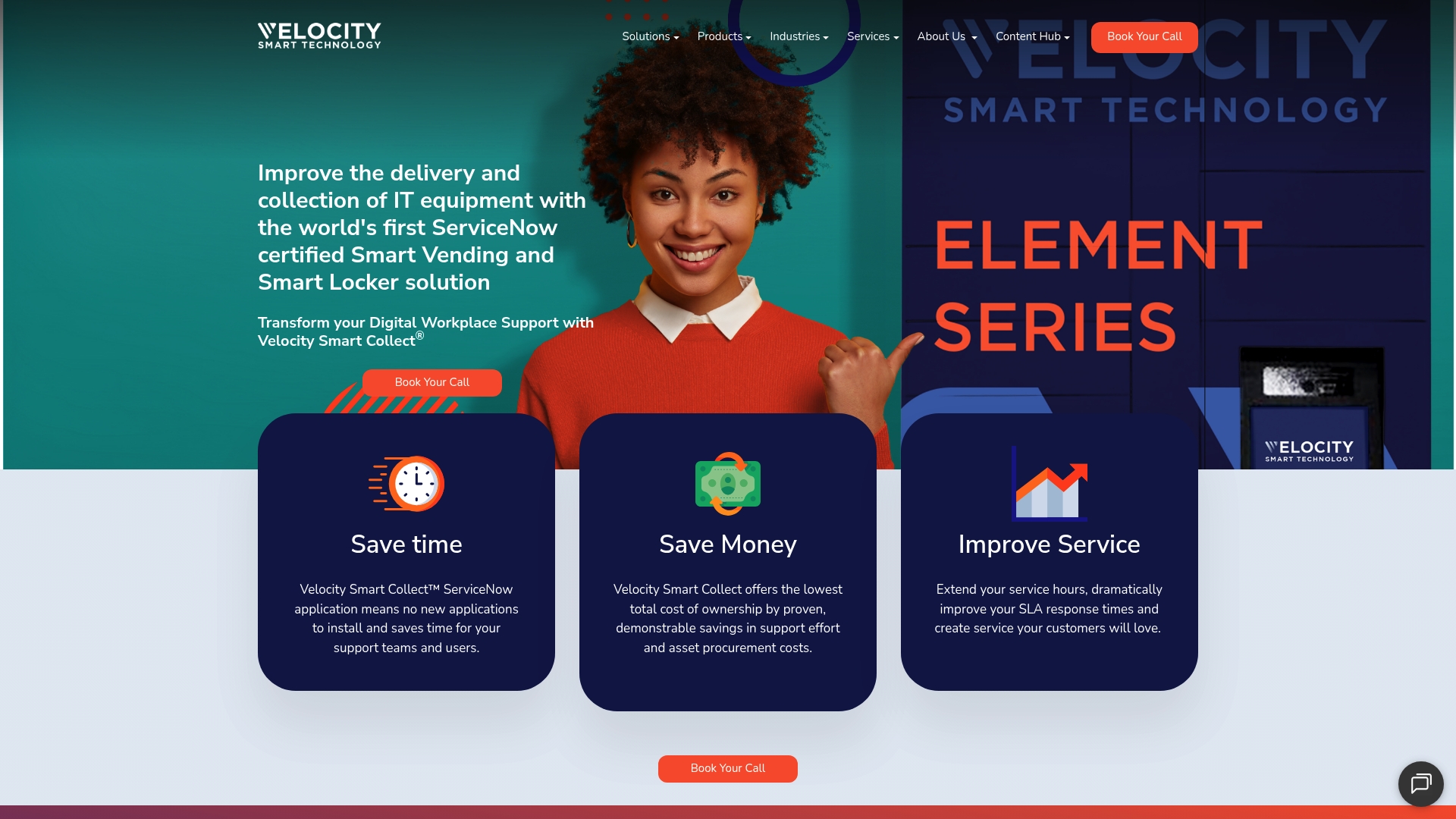
That in-tenant design is exactly why the publisher-reported outcomes hold up under scrutiny: a global pharma customer’s 500%+ throughput uplift and a US nuclear operator’s 60% cut in on-site tickets both came from workflows that never left ServiceNow. Smart Collect® orchestrates smart lockers, smart vending and Smart Kiosk™ from one platform, which means the pilot checklist above maps directly onto a system you can stand up without a parallel database.
If you’re evaluating vendors against the ServiceNow-native bar this article sets out, start with the Smart Locker whitepaper for the technical and ROI detail your procurement team will ask for, or review the company’s positioning and certifications directly.
Sources
For technical validation beyond this article, ServiceNow’s own maturity-stage documentation sets out the Crawl to Fly framework in full. The RSM Technology blog on hardware lifecycle management is worth reading for the lifecycle-first argument. ServiceNow’s community best-practice thread covers stockroom design in more depth than any vendor page will. For a look at the ServiceNow-native locker category itself, see the Smart Locker product page.
- ServiceNow: Hardware asset management maturity stages
- Collection locker system: ERP, IAM and logistics (Net‑Base)
Recommended
See what Smart Collect® could save you
Model your savings in two minutes, or book a 60-minute workshop to pressure-test the numbers against your estate.