
Why asset accountability drives IT efficiency and control
TL;DR:
- Asset accountability involves continuous, real-time tracking of ownership, location, and status of IT assets.
- Strong asset accountability reduces costs, security risks, and improves operational efficiency through automation.
- Implementing centralized records, automated processes, and ongoing reconciliation transforms IT management into a strategic advantage.
Asset accountability is one of those disciplines that quietly determines whether your IT operation runs smoothly or haemorrhages budget. Many IT leaders treat it as a compliance formality, a spreadsheet exercise carried out before an audit and then forgotten. That approach is costly. Across large, distributed enterprises, poor asset accountability leads directly to wasted spend on devices no one can locate, security vulnerabilities caused by untracked hardware, and productivity losses when employees cannot access the tools they need. This article examines what genuine asset accountability looks like, what it costs to ignore it, and how you can build it into the foundation of a more efficient, automated IT operation.
Table of Contents
- What does asset accountability really mean?
- The business impact of weak asset accountability
- How asset accountability powers automation and efficiency
- Practical steps to strengthen asset accountability today
- Perspective: Why asset accountability is a strategic advantage, not just a compliance box
- How Velocity Smart can drive your asset accountability initiatives
- Frequently asked questions
Key Takeaways
| Point | Details |
|---|---|
| Drives operational efficiency | Effective asset accountability reduces waste, loss, and manual tracking effort for IT leaders. |
| Enables automation | Automation and digital workflows require real-time, accurate asset data to function optimally. |
| Mitigates risk | Proactive asset management lowers compliance, security, and financial risk for organisations. |
| Supports change | Strong accountability systems lay the groundwork for scalable, agile IT processes. |
What does asset accountability really mean?
Asset accountability is often confused with basic inventory management. Knowing you purchased 500 laptops last quarter is inventory. Knowing which employee has laptop number 312, in which office, running which software version, and when it is due for refresh — that is asset accountability.
Asset accountability is foundational to effective IT management and operational efficiency. It encompasses custody, lifecycle management, and full traceability from procurement to disposal. Where inventory management is a snapshot, asset accountability is a continuous, living record.
For IT leaders in large enterprises, true asset accountability means being able to answer four questions at any given moment:
- What assets does the organisation own or lease?
- Who has custody of each asset right now?
- Where is each asset physically located?
- What is the status of each asset: deployed, available, under repair, or end of life?
When you can answer all four questions reliably and in real time, you have genuine asset accountability. When even one answer is unclear or outdated, operational risk grows quietly in the background.
“If you cannot account for an asset, you cannot manage it. And if you cannot manage it, it is managing you — through lost budget, security gaps, and frustrated employees.”
The distinction also matters for regulatory and audit purposes. Many sectors, including financial services, healthcare, and government, require demonstrable chains of custody for IT assets. Accountability provides that chain. Simple inventory management does not.
Pro Tip: Create a single source of truth for asset data across your organisation. Even before automating anything, consolidating records into one system with clear ownership fields dramatically reduces ambiguity and speeds up audits.
Understanding asset tracking fundamentals is the first step towards building that kind of structured, traceable environment. Without it, even well-resourced IT teams spend time chasing information that should already be at their fingertips.
The business impact of weak asset accountability
Once you understand what asset accountability requires, the consequences of neglecting it become sharper. The costs are both direct and indirect, and they compound over time in ways that catch many IT leaders off guard.
IT asset mismanagement leads to increased support costs, security vulnerabilities, and compliance issues. These are not theoretical risks. They are recurring operational drains that affect every large enterprise managing devices across multiple sites.
Direct costs are the most visible. Devices that go untracked get lost, stolen, or sit idle in a storage room while the IT team raises a purchase order for a replacement. In large organisations with thousands of endpoints, even a 2 to 3 per cent unaccounted device rate translates into significant unnecessary spend. Hardware that could be redeployed to a new starter instead gets replaced with a new purchase — purely because no one could locate the available asset.
Indirect costs are subtler but often larger. Consider what happens when an untracked device leaves the building. Without a clear custody record, you cannot confirm whether sensitive data was stored on it, whether it was encrypted, or whether a particular employee was responsible for it. That is not just a data protection concern. It is a regulatory exposure that can trigger costly investigations or fines under data protection legislation.
The following table illustrates how the same operational scenario plays out differently depending on the level of asset accountability in place:
| Scenario | Low accountability environment | High accountability environment |
|---|---|---|
| New employee onboarding | Device sourced manually, delays of 1 to 3 days | Device pre-assigned and available at smart locker on day one |
| Device reported lost | No audit trail, device written off | Custody record reviewed, last user identified, device located |
| Security incident response | Unclear which devices were at risk | Immediate identification of affected assets and users |
| IT budget planning | Purchasing decisions based on estimates | Data-driven decisions based on real utilisation rates |
| Compliance audit | Manual collation of records, high effort | Automated reporting from centralised system |
The table makes the operational gap plain. Low accountability environments create friction at every stage of the asset lifecycle. High accountability environments convert the same processes into smooth, data-informed workflows.
It is also worth noting the IT asset visibility challenge that many organisations underestimate: assets move between sites, change hands informally, and accumulate in ways that no static record can capture without active tracking. The result is a growing shadow inventory of devices that are neither actively managed nor formally decommissioned.
For large enterprises managing enterprise IT asset management across distributed locations, the accountability gap between what is recorded and what actually exists on the network is frequently wider than IT leaders realise — and that gap represents real, recoverable cost.
How asset accountability powers automation and efficiency
Here is where the conversation shifts from risk management to genuine competitive advantage. Robust asset accountability is not just about protecting what you have. It is the prerequisite for the kind of automation that transforms IT delivery in distributed workplaces.

Automation and digital lockers enhance asset traceability and accountability in ways that manual processes simply cannot match. When every check-in and check-out is logged automatically, and when that data flows directly into your ITSM platform, you create the conditions for intelligent, self-managing workflows.
Consider how this plays out in practice. When a new employee is onboarded, a fully accountable system can automatically identify the nearest available device matching their role profile, assign it in the asset management system, notify the employee of its location, and log collection when they retrieve it from a smart locker. No ticket to raise, no technician to involve, no delay.
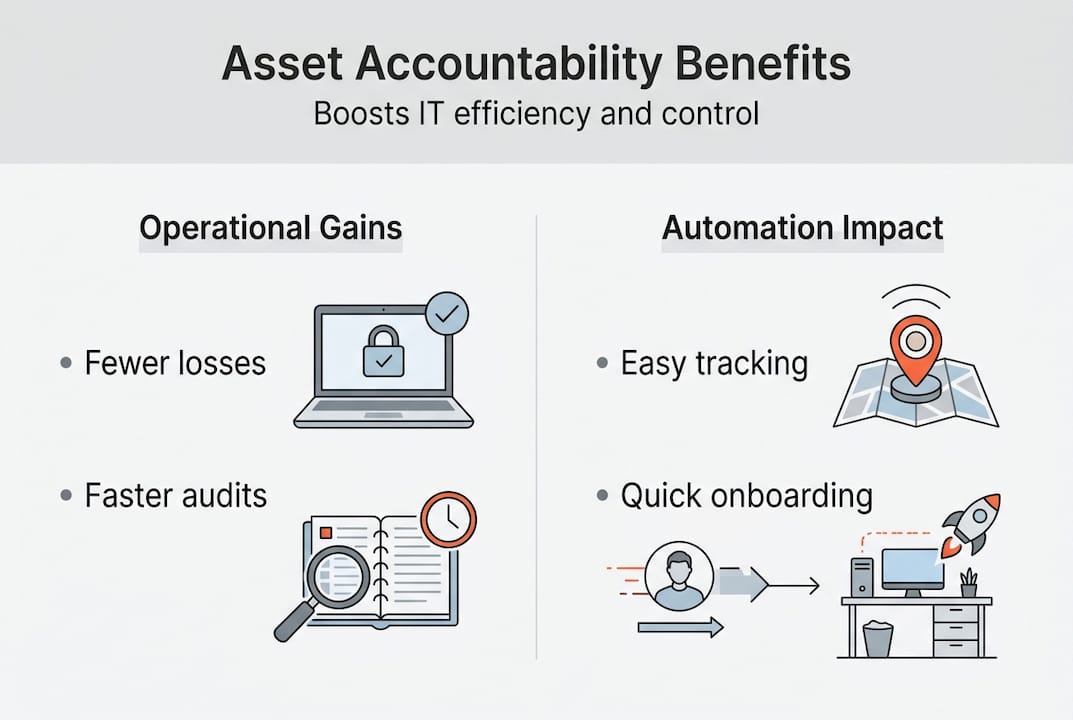
The sequence only works because each step depends on accurate, real-time asset data. Remove accountability from any point in that chain and the automation breaks down. The system cannot assign an asset it does not know is available. It cannot notify a user about a device it cannot locate.
Here is how asset accountability enables specific automation outcomes:
- Automated provisioning. Accurate stock data allows the system to fulfil device requests without manual intervention, matching available assets to user needs instantly.
- Triggered maintenance workflows. When a device reaches a defined usage threshold or fault state, accountability records trigger automated repair or replacement processes.
- Automated returns. Employees can return devices to smart lockers without involving IT, with the system logging the return, updating the asset record, and scheduling inspection or redeployment.
- Audit trail generation. Every transaction is recorded without manual effort, producing a complete custody history for compliance reporting.
- Real-time utilisation reporting. Decision-makers can see which device types are under pressure and which are sitting idle, enabling proactive procurement and redeployment decisions.
Pro Tip: Before deploying automation, audit your current asset records for accuracy. Automation amplifies whatever data quality exists. Accurate records produce efficient automation. Inaccurate records produce efficient errors.
The table below illustrates the measurable workflow improvements that come with accountable asset management:
| Workflow | Without accountability | With accountability and automation |
|---|---|---|
| Device provisioning time | 1 to 3 days | Under 30 minutes |
| Return processing | Manual, often delayed | Automated, immediate |
| Audit preparation | Days of manual effort | On-demand reporting |
| Lost device resolution | Weeks, often unresolved | Hours, with custody trail |
| IT staff involvement per transaction | High | Minimal |
Exploring how transforming asset management through digital infrastructure delivers these results is increasingly a priority for enterprise IT leaders facing pressure to do more with the same headcount. Similarly, automating device returns removes one of the most consistently time-consuming manual processes in distributed IT operations.
Practical steps to strengthen asset accountability today
Acknowledging the importance of accountability is the easy part. Building it into your operations requires deliberate, sequenced action. The good news is that meaningful improvements are achievable quickly, even in large, complex environments.
Centralised tracking and smart systems improve asset visibility and accountability across sites and teams. Here is a practical sequence to move from weak to strong accountability:
-
Consolidate your asset records into a single system of record. Multiple spreadsheets and siloed databases are the enemy of accountability. Choose your ITSM platform as the authoritative source and migrate all asset data into it. Duplicate or conflicting records should be resolved before automation is introduced.
-
Define ownership clearly at every stage of the lifecycle. Every asset should have a named custodian at all times, from procurement through to disposal. If an asset moves between users, the transfer should be logged. Informal handoffs are where accountability breaks down most frequently.
-
Automate check-in and check-out processes using smart hardware. Smart lockers and vending solutions remove the reliance on manual processes that are inconsistently followed. When collection and return are automated, accountability becomes structural rather than dependent on individual behaviour.
-
Introduce regular, automated reconciliation. Rather than waiting for an annual audit, set up automated reconciliation cycles that flag discrepancies between recorded and actual asset states. Catching gaps early prevents them from compounding into larger problems.
-
Build reporting dashboards that surface accountability metrics. Visibility drives behaviour. When IT managers can see real-time utilisation rates, unresolved discrepancies, and overdue returns, they have the information needed to act proactively rather than reactively.
-
Invest in change management alongside the technology. New systems only deliver value when people use them correctly. Train teams on why accountability matters, not just how to use the new tools. When employees understand that the locker system protects them from being held responsible for a device they no longer have, adoption increases significantly.
Addressing reducing the impact of asset loss requires this kind of structural approach. Relying on individuals to remember to log assets or return devices on time is a fragile model that fails at scale. Structuring the environment so that accountability happens automatically is the only sustainable solution for large enterprises.
Pro Tip: Start with your highest-value and highest-risk device categories, such as laptops and mobile devices, before rolling out accountability improvements across all asset types. Quick wins in these categories build organisational confidence and demonstrate ROI early.
For organisations looking at enhancing asset automation as part of a broader workplace technology strategy, the practical steps above provide the data foundation that automation depends on. Getting the basics right first means every subsequent automation initiative delivers faster, cleaner results.
Perspective: Why asset accountability is a strategic advantage, not just a compliance box
Here is the view that most asset management conversations miss entirely. Asset accountability is not fundamentally about compliance. Compliance is a welcome by-product. The real value of strong asset accountability is strategic agility.
Think about what accountability actually gives you: a real-time, accurate picture of every tool your organisation has deployed. That is an operational intelligence capability. And operational intelligence is what allows IT leaders to respond to change faster than their competitors and faster than their own leadership expects.
When a new office opens, you know exactly which devices can be redeployed without new procurement. When a security vulnerability is announced, you can identify every affected asset within minutes rather than days. When the business needs to scale headcount quickly, you can provision devices without bottlenecks. None of this is possible when accountability is an afterthought.
The enterprises that treat why accountability matters as a strategic priority tend to have something that others lack: a culture of IT confidence. Their business stakeholders trust IT to deliver. Their leadership teams trust IT data to make decisions. And their IT teams feel empowered rather than overwhelmed, because they are working from a foundation of accurate information rather than guesswork.
The uncomfortable truth is that many IT teams are operating with a false sense of control. The systems look structured. The spreadsheets exist. But the data is stale, incomplete, or siloed in ways that make it functionally useless when it matters most. Genuine accountability requires investment in both technology and discipline. But the returns, in cost savings, risk reduction, and operational speed, are not marginal. They are transformational.
How Velocity Smart can drive your asset accountability initiatives
Implementing the accountability practices outlined in this article is significantly easier when your infrastructure is designed to support them from the ground up.

Velocity Smart Technology provides intelligent workplace automation solutions purpose-built for large enterprises managing devices across multiple sites. Our Smart IT Support Kiosk enables real-time remote IT support, secure device diagnostics, and equipment exchange without requiring onsite technicians, so accountability is maintained even in distributed and unmanned locations. Our Smart Collect solutions automate device collection and return with full audit trail logging, running natively inside your ServiceNow instance to eliminate data silos and GDPR risk. If you want a broader view of what intelligent automation looks like in practice, our Automation Unboxed resource is a good starting point.
Frequently asked questions
How does asset accountability reduce IT costs?
Better asset accountability minimises device loss, reduces unnecessary purchases, and enables cost-effective redeployment of resources. Proper accountability reduces overspending and waste within IT budgets by making every available asset visible and actionable.
What technologies improve IT asset accountability in large enterprises?
Digital lockers, automated tracking, and centralised asset management systems provide IT teams with greater control and visibility. Digital solutions are transforming asset management by improving traceability at every stage of the device lifecycle.
Which key processes should be automated to enhance asset control?
Automating check-in and check-out, returns, and audit trails strengthens accountability and operational efficiency across distributed sites. Automation streamlines and secures asset management tasks that are too inconsistent and time-consuming to rely on manual effort.
Is asset accountability relevant for remote and hybrid workforces?
Yes, it is essential for tracking, securing, and supporting devices in distributed environments where informal handoffs and unmonitored movements create the greatest risk. Centralised systems offer visibility and control even in distributed workplaces where physical oversight is limited.
Recommended
See what Smart Collect® could save you
Model your savings in two minutes, or book a 60-minute workshop to pressure-test the numbers against your estate.