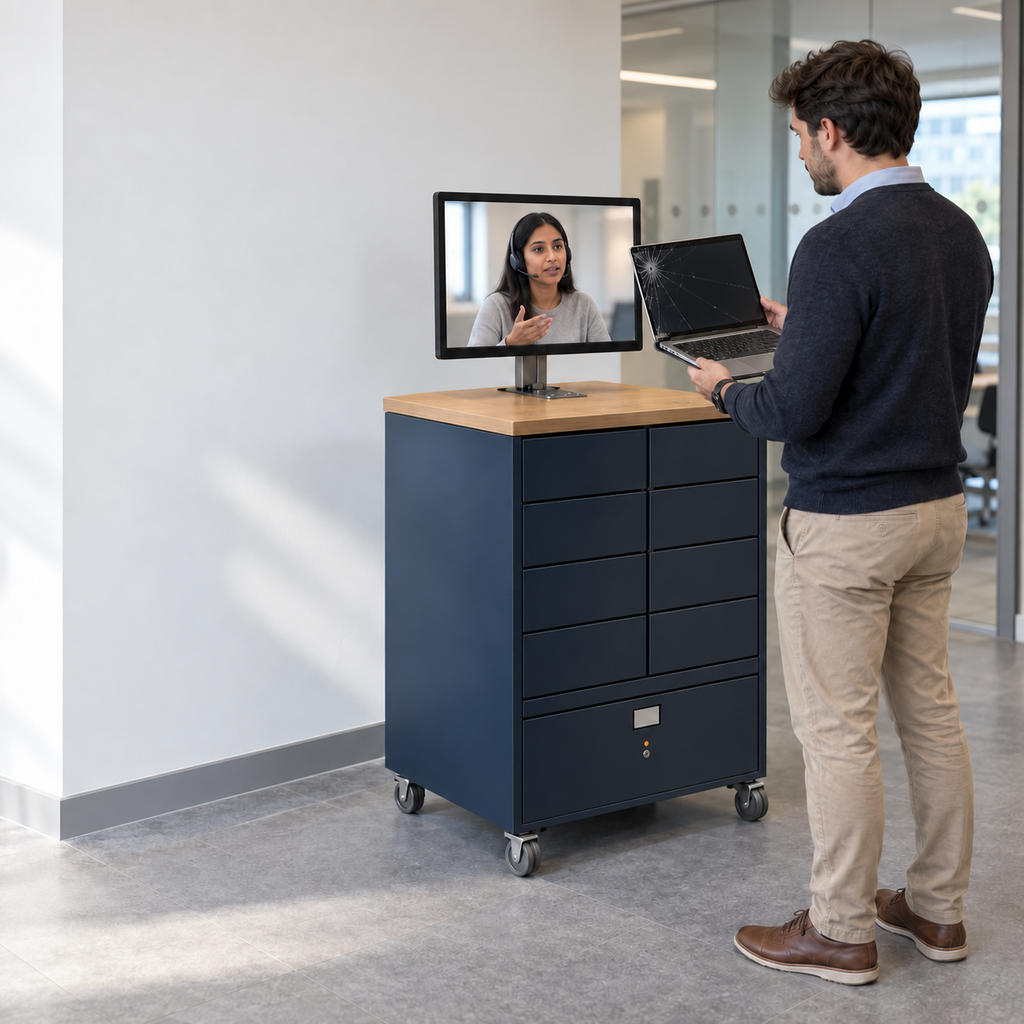
The kiosk with a face.
A talking avatar triages, escalates to a live agent when needed, and drives a swap at the kiosk.

Tools you may already run, plus the one that hands the device over.
From the first signal to a device in hand.
Someone talks to an avatar on the Smart Kiosk screen.
Otto or Flow does the thinking behind the avatar and decides: resolve it, swap the device, or bring in a live agent.
It is resolved on screen, swapped at the kiosk, or passed to a video agent with the conversation intact.
The full sequence
- Someone walks up to the kiosk and the avatar greets them.
- They describe the problem out loud. The AI behind the avatar triages it.
- Simple issues are resolved on screen, from knowledge.
- If a device has failed, the avatar releases a replacement from the kiosk compartment.
- If a person is needed, a live agent joins by video with the conversation so far.
- The conversation is stored in ServiceNow, so it can continue on a desktop or phone later.
What you need in place
- A Smart Kiosk on site
- ServiceNow Otto, or Flow, as the AI behind the avatar
- A talking avatar service, such as D-ID, connected to that AI
- A contact centre linked to ServiceNow for live video, such as Amazon Connect
How the pieces connect
- Talking avatar
- Gives the AI a face and voice on the kiosk screen. It does not make decisions itself.
- ServiceNow Otto or Flow
- Does the thinking: triage, knowledge and the decision on what happens next.
- Amazon Connect
- Brings in a live agent by video when needed, with the conversation attached.
- Smart Kiosk
- Provides the screen, KVM diagnostics and swap compartments, recorded in ServiceNow.
The physical steps stay the same, whichever system makes the decision.
This recipe starts with AI. The physical steps stay the same whichever AI you choose.
One record of what was decided, and what physically happened.
A reference design for your technical team.
The Blueprint shows how this recipe would work in your ServiceNow instance and what a build would involve. It is a design, not a step-by-step installation guide.
- What you need in place. A Smart Kiosk on site · ServiceNow Otto, or Flow, as the AI behind the avatar · A talking avatar service, such as D-ID, connected to that AI · A contact centre linked to ServiceNow for live video, such as Amazon Connect
- How the pieces connect. The role of D-ID avatar, ServiceNow Otto, Flow by ServiceNow and Amazon Connect and Smart Collect®, and what stays in your instance
- Step by step. All 6 steps, from the first signal to the returned device
- Approval and policy. The avatar speaks only from approved knowledge and policy.
- Handover rules and exceptions. Reservations, codes, expiry, returns, and what happens when stock runs out or nobody collects
- What to measure. Share of visits resolved without a person · User satisfaction with the avatar · Time to a live agent when needed
- What a build involves. The questions to settle first, the roles involved, and how we would scope a six to eight week pilot
Request the Blueprint
A four-page reference design for your technical team. Tell us who you are and the Blueprint downloads straight away.
Before you ask
Is the avatar a separate AI?
No. The avatar is the face and voice. Your chosen AI, such as Otto or Flow, does the thinking, and every conversation is recorded in ServiceNow.
Is this an off-the-shelf integration?
No. It is a recipe concept that shows what becomes possible when these tools are combined with Smart Collect®. We build it with you, and where needed with the vendor, when it fits your estate.
Where does the data live?
In your own ServiceNow instance. Smart Collect® does not keep a separate database of your users or devices.
Which AI does this need?
Whichever fits your estate. Otto suits companies on the ServiceNow platform, Flow suits teams not on it yet, and the physical steps are the same either way.