
Agentic AI in IT services: a 2026 CIO guide
TL;DR:
- Agentic AI in IT services automates multi-step workflows independently and adapts in real time without human intervention. It differs from traditional AI and RPA by operating goal-oriented processes across entire service chains with minimal oversight. Proper governance, data quality, and process redesign are essential for successful, compliant enterprise deployment.
Agentic AI in IT services is defined as autonomous AI systems that independently plan, execute, monitor, and adapt multi-step IT workflows without requiring human intervention at each step. Unlike conventional AI tools that generate recommendations or automate single tasks, agentic systems pursue defined goals across entire service chains. Enterprise platforms now deploy 45+ specialised AI agents supporting over 70 IT tasks across functions including ITSM, CloudOps, Security Operations, and FinOps. Analysts at IDC report that transitioning from labour-based to platform-led delivery can reduce operational costs by 30–60%. For CIOs in large enterprises, the question is no longer whether to adopt autonomous AI in IT solutions, but how to do so with the governance and operational rigour that regulated environments demand.
How does agentic AI differ from traditional AI and RPA?
Agentic AI occupies a fundamentally different position in the IT automation stack compared to robotic process automation (RPA) or conventional machine learning tools. Traditional RPA executes fixed, rule-based scripts. It breaks when processes change and requires constant maintenance. Conventional AI tools, such as chatbots or recommendation engines, generate outputs but do not act on them. Agentic AI plans and adapts end-to-end, closing the loop between detection, decision, and resolution without waiting for a human to approve each step.

The practical difference shows up clearly in incident management. A traditional chatbot identifies a likely cause and surfaces it to a technician. An agentic system identifies the cause, queries the CMDB, initiates a remediation script, validates the outcome, and closes the ticket. The entire sequence runs autonomously, with human oversight reserved for exceptions that fall outside defined guardrails.
| Capability | Traditional RPA / AI tools | Agentic AI |
|---|---|---|
| Task scope | Single, predefined steps | Multi-step, goal-oriented workflows |
| Adaptability | Breaks on process change | Adapts in real time |
| Decision-making | Rule-based or generative output | Autonomous reasoning with guardrails |
| Human involvement | Required at each handover | Exception-based supervision only |
| IT use cases | Data entry, ticket logging | Incident resolution, device fulfilment, CloudOps |
Pro Tip: Map your current IT workflows before selecting an agentic platform. Agents perform best on processes with clear goals and measurable outcomes. Vague or undocumented workflows produce unreliable automation regardless of the AI’s capability.
The shift from task assistance to goal-oriented autonomy is what makes AI-driven IT service management genuinely different from previous automation waves. CIOs who treat agentic AI as a faster version of RPA will underinvest in the process redesign and governance infrastructure that actually determines success.
What governance and security controls does agentic AI require?
Governance is the primary barrier to enterprise adoption of agentic AI, not the technology itself. IDC’s analysis confirms that governance must be operationalised within the client environment through controls that provide traceability, explainability, and compliance for every autonomous agent action. Writing a governance policy is insufficient. The controls must be embedded in the execution layer where agents operate.
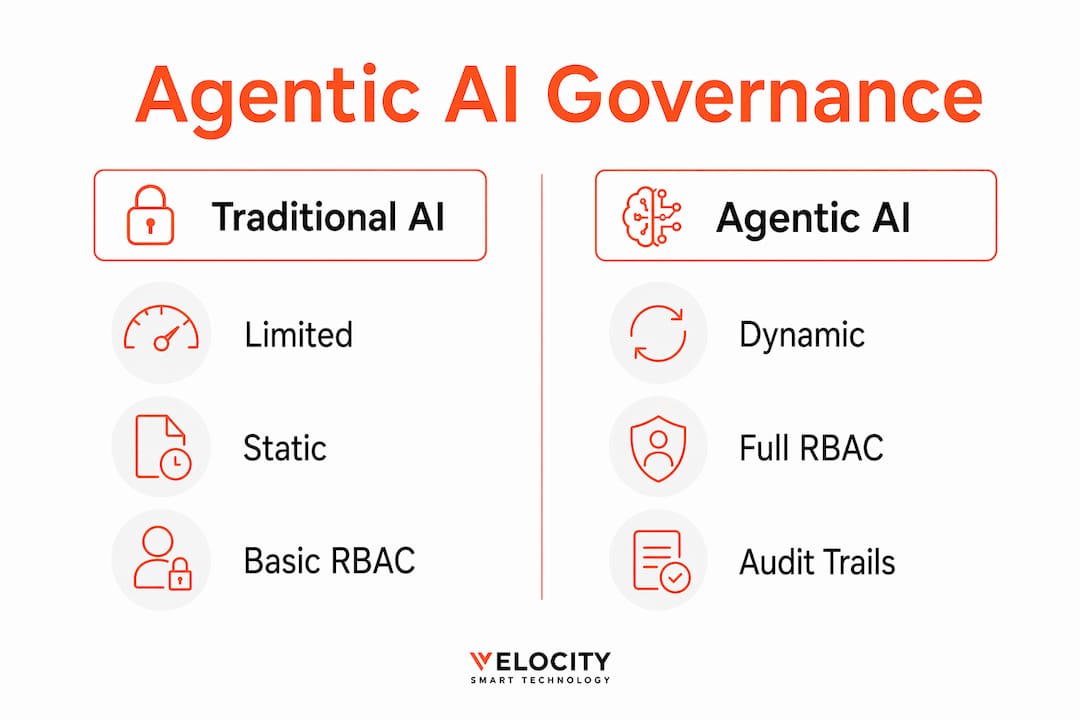
The most reliable architecture treats AI agents as RBAC users routed through ITSM platforms, enforcing role-based access controls and audit trails without granting agents direct system access. This approach prevents agents from taking actions outside their authorised scope and produces a complete audit record that satisfies compliance requirements in regulated industries such as pharmaceuticals, financial services, and defence. Every agent action becomes traceable to a specific workflow, a specific trigger, and a specific outcome.
Data quality is equally non-negotiable. A unified IT Knowledge Graph provides agents with accurate, real-time views of the environment. Without it, agents act on stale or incomplete asset and dependency data, producing failed automation and costly rework. Enterprises that skip data hygiene before deploying agents consistently report higher error rates and lower resolution accuracy.
Best governance practices for enterprise agentic AI deployments include:
- Define agent scope explicitly. Each agent should have a documented set of permitted actions, systems it can access, and conditions under which it must escalate.
- Enforce RBAC at the execution layer. Agents must inherit the same access controls as human technicians, not operate with elevated or undefined permissions.
- Build approval gates for high-risk actions. Device wipes, configuration changes, and access modifications should require human confirmation before execution.
- Maintain a complete audit trail. Every agent action must be logged with timestamp, trigger, decision rationale, and outcome for compliance and post-incident review.
- Establish data quality standards before deployment. CMDB accuracy, asset records, and dependency maps must be validated before agents rely on them for autonomous decisions.
Pro Tip: Start with a human-in-the-loop configuration for the first 90 days of any agentic deployment. Review agent decisions against human decisions on the same ticket types. Use the comparison to calibrate guardrails before moving to fully autonomous operation.
For CIOs in regulated sectors, the audit-ready agent design is not optional. It is the condition under which the board and the regulator will permit autonomous operations to scale.
How to integrate agentic AI into physical IT service delivery
Physical IT service delivery is the layer that most agentic AI deployments have not yet reached. Ticket routing, incident triage, and CloudOps are well-served by current platforms. Hardware fulfilment, device swaps, peripheral distribution, and walk-up support still depend on engineers showing up in person. Integrating intelligent automation in IT at the physical layer requires a different approach to both process design and technology selection.
The integration follows four phases:
-
Redesign workflows for goal-oriented autonomy. ITIL processes built around linear, manual steps do not translate directly into agentic workflows. Redesigning for governed autonomy means defining the goal (a device is in the hands of the right employee, configured and ready), then letting agents manage the steps and handle exceptions independently within defined guardrails.
-
Start with high-volume, well-documented sub-functions. Incident management, ticket routing, and targeted high-volume functions are the right entry points. They generate enough data to train and calibrate agents quickly, and the cost savings justify the investment within a single quarter.
-
Connect agents to physical fulfilment endpoints. An AI agent that can close a software ticket but cannot trigger a hardware handover is only solving half the problem. Platforms such as Velocity-smart’s Smart Collect integrate natively within ServiceNow, allowing agents to initiate locker assignments, vending transactions, and device returns without dispatching an engineer. The agent closes the ticket end-to-end, including the physical handover.
-
Align financial planning with automation coverage. The operational model shifts from headcount planning to automation coverage planning. CFO and CIO collaboration on this transition is essential from the outset. Cost models built around engineer hours do not capture the economics of platform-led delivery, and budget cycles that lag the automation rollout create funding gaps at the worst possible moment.
For enterprises with distributed workforces across multiple sites, the physical layer is where the cost differential is most visible. Velocity-smart’s deployments show that a US nuclear energy operator cut on-site tickets by 60% and reclaimed 31–42% of IT staff time before agentic AI was driving the workflow. Adding autonomous orchestration to that foundation compounds the return significantly. Reviewing service automation use cases across ITSM functions helps identify where the physical and digital layers intersect most productively.
What business impact can enterprises expect from agentic AI?
The financial case for autonomous AI in IT solutions is well-established at the platform level. The 30–60% operational cost reduction cited by IDC reflects the shift from labour arbitrage to platform-led outcomes. That range is wide because the actual figure depends on the proportion of tickets that can be fully automated, the quality of the underlying data, and the maturity of the governance framework.
Mean time to resolution (MTTR) is the metric that moves first and fastest. Agentic AI reduces MTTR in incident response by orchestrating complex, multi-step workflows in real time without waiting for human handovers between teams. Enterprises that previously measured resolution in hours begin measuring it in minutes. That improvement compounds across thousands of tickets per month, producing measurable gains in employee productivity and service reliability.
Workforce transformation is the longer-term impact. Agentic platforms shift technical teams from manual task execution to exception supervision and governance oversight. Engineers who previously spent the majority of their time on L1 and L2 ticket resolution redirect that capacity to infrastructure improvement, security hardening, and service design. The headcount does not necessarily shrink, but the value generated per engineer rises substantially.
The trajectory points toward continuous improvement as a structural feature of agentic deployments. Agents learn from operational data, refining their decision models with each resolved ticket. Enterprises that deploy early accumulate a compounding advantage in agent accuracy and coverage that later adopters cannot replicate quickly. The governance frameworks built now also become the institutional knowledge that regulators and auditors will expect to see as autonomous operations become standard practice across the industry.
Key takeaways
Agentic AI in IT services delivers the greatest return when governance is operationalised at the execution layer, workflows are redesigned for goal-oriented autonomy, and physical fulfilment endpoints are connected to the same orchestration platform as digital tickets.
| Point | Details |
|---|---|
| Define agentic AI correctly | Agentic AI plans, executes, and adapts multi-step workflows autonomously; it is not faster RPA. |
| Operationalise governance first | Embed RBAC, audit trails, and approval gates at the execution layer before scaling agent autonomy. |
| Start with high-volume sub-functions | Incident management and ticket routing generate the data and savings needed to justify broader rollout. |
| Connect physical and digital layers | Agents must trigger hardware fulfilment, not just close software tickets, to deliver full cost reduction. |
| Shift to automation coverage planning | Replace headcount-based budgeting with coverage-based models; involve the CFO from the outset. |
The physical layer is where the real test begins
My view, having worked closely with enterprise IT leaders navigating this transition, is that the governance conversation is necessary but often used as a reason to delay rather than a framework for action. The organisations that are moving fastest are not the ones that have solved every governance question in advance. They are the ones that have defined a minimum viable governance framework, deployed in a contained environment, and iterated from real operational data.
The part that genuinely surprises most CIOs is the physical layer. They expect the digital automation to be hard and the physical fulfilment to be straightforward. The reality is the opposite. Autonomous ticket routing and incident triage are well-supported by current platforms. Getting an AI agent to close a hardware fulfilment ticket end-to-end, without a human touching it, requires a physical endpoint that is natively integrated into the same ITSM workflow. That is the gap that most enterprise IT stacks have not closed.
The mindset shift I advocate is designing for autonomy from the start, not retrofitting it onto existing processes. That means asking, at the point of process design, what the agent needs to resolve this ticket without escalation. It means building the data quality, the access controls, and the physical infrastructure before the agent goes live, not after the first failure. Organisations that treat agentic AI as a plug-and-play addition to existing ITIL processes consistently underperform against those that reengineer the process around the agent’s capabilities. The strategic guide for CIOs on AI-driven IT operations sets out that reengineering approach in practical terms.
— Anthony
Velocity-smart: closing the loop on physical IT automation
Velocity-smart builds the connection between agentic AI orchestration and physical IT service delivery. Its Smart Collect platform runs natively inside ServiceNow, inheriting existing RBAC, audit trails, and CMDB records without a separate integration layer. AI agents can initiate locker assignments, peripheral vending, and device returns as part of a single end-to-end workflow, closing tickets that previously required an engineer on site.
For enterprises already investing in autonomous AI in IT solutions, Velocity-smart provides the physical endpoint that completes the automation chain. Customers in pharma, defence, energy, and financial services have recorded measurable reductions in on-site tickets, IT staff travel, and device loss before agentic orchestration was added to the workflow. The Automation Unboxed resource centre covers the full scope of physical IT automation, from smart lockers and vending to AI-driven service kiosks, with case studies and deployment guidance relevant to enterprise IT leaders planning their next phase of service modernisation.
FAQ
What is agentic AI in IT services?
Agentic AI in IT services refers to autonomous AI systems that independently plan, execute, and adapt multi-step IT workflows, from incident triage to device fulfilment, without requiring human approval at each step. Unlike conventional AI tools, agentic systems pursue defined goals across entire service chains and handle exceptions within governed guardrails.
How does agentic AI differ from RPA?
RPA executes fixed, rule-based scripts and breaks when processes change. Agentic AI reasons across multi-step workflows, adapts to changing conditions in real time, and closes tickets end-to-end rather than automating a single step within a larger manual process.
What governance controls are required for agentic AI?
Successful deployments enforce RBAC at the execution layer, maintain complete audit trails for every agent action, and build approval gates for high-risk operations. IDC confirms that governance must be operationalised within the live IT environment, not documented as policy alone.
How should enterprises start integrating agentic AI?
Start with high-volume, well-documented sub-functions such as incident management and ticket routing. These generate sufficient data to calibrate agent behaviour quickly and produce cost savings that justify broader rollout across ITSM, CloudOps, and physical fulfilment functions.
What cost reductions can enterprises realistically expect?
IDC analysis indicates that platform-led IT service delivery can reduce operational costs by 30–60% compared to labour-based models. The actual figure depends on the proportion of tickets that can be fully automated, data quality, and the maturity of the governance framework in place.
Recommended
See what Smart Collect® could save you
Model your savings in two minutes, or book a 60-minute workshop to pressure-test the numbers against your estate.