
AI driven IT operations: a strategic guide for CIOs
TL;DR:
- AI-driven IT operations use artificial intelligence and automation to manage enterprise IT at scale and enhance business value. Integrating shared data, policy-based automation, and human oversight improves efficiency, reduces costs, and speeds resolution. Physical infrastructure must be included in AI strategies to fully automate service delivery and asset management.
AI driven IT operations, formally known as AIOps, is defined as the integrated application of artificial intelligence, automation, and data analytics to manage, optimise, and secure enterprise IT service delivery at scale. For CIOs and IT Directors at large enterprises, AIOps is no longer a future consideration. Integrated AI-driven ITSM delivers reported customer outcomes of $3.2M net present value and 204% ROI. That figure signals a structural shift in how enterprise IT creates measurable business value, not merely operational convenience.
How do AI driven IT operations improve efficiency and reduce costs?
AI driven IT operations deliver measurable efficiency gains through three primary mechanisms: autonomous ticket resolution, unified asset lifecycle management, and continuous learning from operational data.
Autonomous AI agents are the most visible mechanism. AI-driven ITSM platforms achieve up to 80% ticket deflection and a 75% reduction in average handling time for human analysts. That means the majority of routine service requests, password resets, software provisioning, and access queries, resolve without analyst involvement. IT teams redirect that recovered capacity toward higher-value work.
Asset management is the second major cost lever. AI-driven asset management reduces overall hardware and software inventory costs by approximately 30%. Unified AI engines track the full asset lifecycle without requiring separate databases or manual reconciliation. The practical result is fewer ghost assets, less over-provisioning, and tighter control over refresh cycles.
The third mechanism is continuous learning. AI platforms trained on historical incident data, CMDB records, and telemetry improve their own resolution accuracy over time. This compounds the efficiency gains: the longer the platform operates, the more precisely it routes, resolves, and predicts.
- Ticket deflection: autonomous resolution of routine requests frees analyst capacity for complex incidents
- Asset cost reduction: unified lifecycle management eliminates redundant inventory and manual tracking
- Faster resolution: AI-assisted triage reduces mean time to resolution across the service desk
- Predictive maintenance: pattern recognition in telemetry data surfaces issues before they become incidents
- Compliance adherence: automated policy checks reduce configuration drift and audit preparation time
Pro Tip: When evaluating AI platforms for intelligent IT management, prioritise those with a unified data architecture. Platforms that share a single data foundation across service management, asset management, and observability outperform those that bolt AI onto existing siloed tools.
What technologies and architectures underpin effective AI driven IT operations?
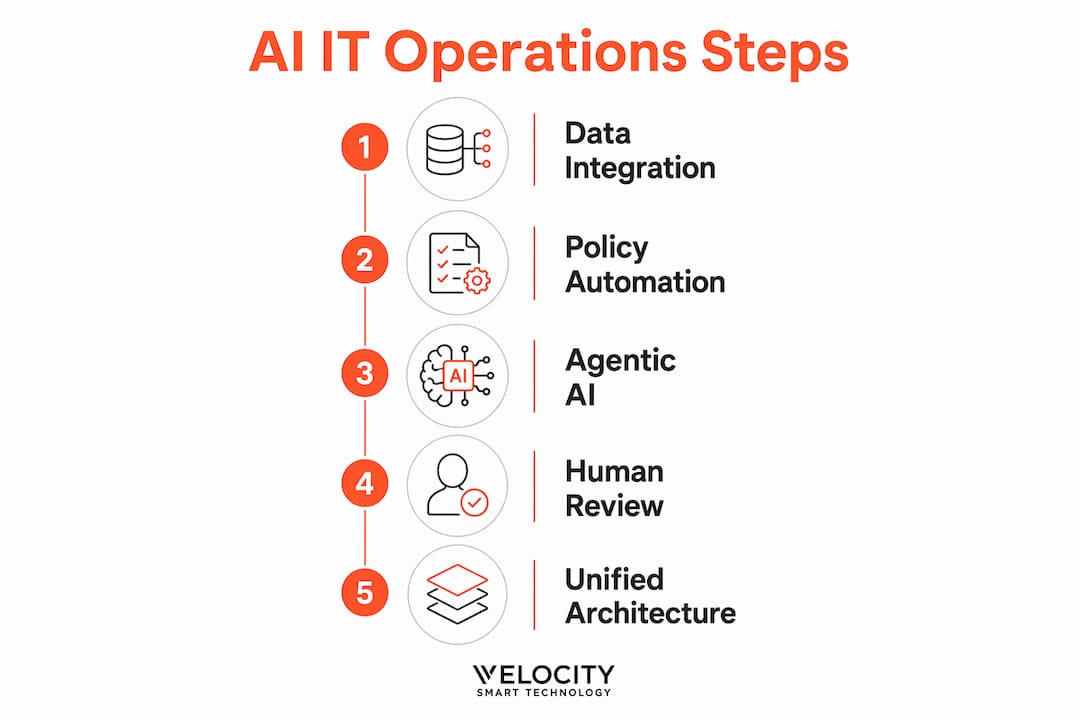
Effective AI driven IT operations rest on four architectural pillars: agentic automation, policy-based decision-making, shared context data, and human-in-the-loop governance. Understanding each pillar helps CIOs make informed technology selections rather than purchasing AI capability in name only.

Agentic IT operations
Agentic IT operations combine observability, automation, and AI to proactively detect and remediate issues before they escalate into incidents. The model replaces fragmented toolsets with a continuous deploy-observe-act loop. Rather than waiting for a ticket to arrive, agentic systems monitor infrastructure in real time, identify anomalies, and execute corrective actions autonomously. This is a fundamental departure from reactive IT support.
Policy-based automation
Policy-based automation automates decision-making using pre-established rules, which enhances compliance and governance in dynamic IT environments. It reduces configuration drift and supports faster incident response with better auditability. The distinction from traditional task automation matters: task automation executes a fixed sequence of steps, while policy-based automation applies conditional logic to variable situations. Successful CIOs are moving to policy-based automation to maintain security and compliance across distributed environments. This is particularly relevant for regulated industries where configuration deviations carry legal and financial consequences.
Shared context and unified data foundations
Shared context data, combining telemetry, CMDB records, and historical logs, is essential for AI-driven IT operations to function accurately. Isolating AI tools in data silos slows operations and increases error rates. A unified data foundation allows AI models to correlate signals across infrastructure layers, producing decisions that reflect the full operational picture rather than a partial view. AI tools in isolated silos increase noise and reduce operational efficiency. Integration is not a nice-to-have feature; it is the condition that determines whether AI delivers value or creates additional complexity.
Human-in-the-loop design
Successful AI agents are designed with human-in-the-loop frameworks that require explicit approval before execution in high-risk scenarios. This promotes traceability, auditability, and risk-managed automation. The AI explains its proposed action and reasoning before acting. IT teams retain control over consequential decisions while benefiting from AI-assisted analysis. This design also addresses the AI “black box” problem directly. Evaluating AI explainability is key to building trust in AI-driven decisions, and operational safety nets that surface reasoning before execution reduce risk materially.
Pro Tip: When assessing AI platforms, request a demonstration of explainability features. Ask the vendor to show how the system presents its reasoning before executing an automated action. Platforms that cannot demonstrate this clearly are not ready for enterprise deployment in regulated environments. Consider engaging AI automation consulting to assess your architecture before committing to a platform.
How do integrated AI platforms unify IT service management and asset management?
Fragmented IT toolsets are the primary obstacle to AI for operational efficiency at enterprise scale. When service management, asset management, and observability run on separate platforms with separate data stores, AI cannot correlate signals across them. The result is slower resolution, duplicated effort, and higher total cost of ownership.
Integrated AI platforms unify IT service management and asset management into one intelligent fabric, enabling faster resolution and improved cost control. The architecture shares intelligence across capabilities rather than passing data between disconnected systems. A service ticket automatically surfaces the asset’s full lifecycle history, warranty status, and configuration record. Resolution decisions are better informed and faster to execute.
The contrast between siloed and unified approaches is significant in practice:
| Dimension | Siloed tools | Unified AI platform |
|---|---|---|
| Data consistency | Duplicate records, manual reconciliation | Single source of truth across ITSM and ITAM |
| Resolution speed | Analyst must query multiple systems | AI correlates data automatically at point of triage |
| Compliance risk | Configuration drift harder to detect | Policy checks run continuously across unified data |
| Cost visibility | Inventory costs spread across systems | Full lifecycle cost visible in one view |
| AI effectiveness | Models trained on partial data | Models trained on complete operational context |
Unified discovery and lifecycle management also reduce the administrative overhead that consumes IT analyst time. When asset records update automatically as devices move through their lifecycle, the CMDB remains accurate without manual intervention. Accurate CMDB data, in turn, improves the quality of every AI-driven decision downstream.
For enterprises managing IT asset management at scale, the platform architecture decision is the most consequential one. Choosing a unified platform at the outset avoids the tool sprawl that undermines AI effectiveness later. The role of automation in ITSM is most fully realised when automation, AI, and data share the same foundation.
What are best practices for implementing AI driven IT operations?
Implementing intelligent IT management at enterprise scale requires discipline in sequencing, measurement, and governance. The most common failure mode is attempting to automate everything simultaneously, which produces complexity without proportionate value.
Enterprises should start AI-driven IT operations in focused, high-impact areas and scale gradually to manage risk and build momentum. Patch management, cloud cost controls, and asset lifecycle management are proven starting points. Each delivers measurable outcomes quickly and generates the operational data that improves AI performance over time.
Practical implementation guidance for CIOs and IT Directors:
- Define KPIs before deployment. Mean time to resolution, ticket deflection rate, compliance adherence, and cost savings per resolved incident are the metrics that matter. Establish baselines before AI goes live.
- Invest in data quality first. AI performance is directly proportional to the quality of the CMDB, telemetry, and historical log data it consumes. Clean data before training models.
- Use domain-specific AI, not general-purpose models. Domain-specific AI agents pre-trained on operational workflows and edge cases deliver better reliability than general-purpose large language models applied to IT contexts. The operational nuance matters.
- Build escalation paths into every automated workflow. Human oversight is not optional. Define clear thresholds at which AI hands off to an analyst, and test those thresholds regularly.
- Align AI initiatives with existing governance frameworks. Cybersecurity and compliance considerations must be embedded in AI deployment from day one, not retrofitted after incidents occur.
- Plan for the physical layer. AI-enhanced IT infrastructure handles digital workflows effectively. Physical handovers, device swaps, and hardware distribution require a hardware endpoint that AI can orchestrate. Velocity-smart’s Smart Collect platform addresses this gap directly within ServiceNow, closing physical-handover tickets without dispatching an engineer.
Pro Tip: Treat your first AI deployment as a learning exercise, not a production commitment. Run it in parallel with existing processes for 60–90 days. The gap between AI recommendations and analyst decisions in that period is your most valuable training data.
Automating proactive IT support requires the same discipline. The organisations that scale AI-driven IT operations successfully are those that measure continuously, adjust based on evidence, and resist the temptation to declare victory before the data supports it.
Key takeaways
AI driven IT operations deliver the greatest enterprise value when integrated platforms, shared data foundations, and human-in-the-loop governance operate together as a single system.
| Point | Details |
|---|---|
| Define AIOps clearly | AI driven IT operations integrate AI, automation, and analytics to manage enterprise IT at scale. |
| Quantify the business case | Reported outcomes include 80% ticket deflection, 30% inventory cost reduction, and 204% ROI. |
| Prioritise unified architecture | Shared data across ITSM, ITAM, and observability is the condition for effective AI performance. |
| Adopt policy-based automation | Policy-driven rules automate complex decisions while maintaining compliance and auditability. |
| Close the physical gap | Digital AI workflows require a hardware endpoint to resolve physical-handover tickets autonomously. |
The physical layer is where AI strategy meets reality
The conversation about AI driven IT operations in enterprise circles tends to focus on the digital stack: ticket deflection rates, CMDB accuracy, agentic workflows. Those metrics are real and the progress is genuine. But after fifteen years of watching enterprise IT transformations, I have observed a consistent blind spot: the physical layer.
Every CIO I speak with has invested in AI-enhanced IT infrastructure for digital service delivery. Very few have a credible answer to the question of what happens when an AI agent closes a ticket that requires a physical device to change hands. The workflow stalls. A human is dispatched. The cost model that AI was supposed to fix reasserts itself at exactly the point where it is most visible to the CFO.
The organisations that get this right treat the physical layer as part of the AI architecture, not an exception to it. They ask whether their AI platform can orchestrate a locker, a vending unit, or a kiosk in the same workflow that resolves a digital ticket. That question separates genuine AI-enhanced IT infrastructure from AI applied only to the easy parts.
The cultural dimension matters equally. IT teams that have spent years resolving tickets manually do not automatically trust AI recommendations. Building that trust requires transparency in AI reasoning, clear escalation paths, and early wins that demonstrate value without creating new risks. The technology is ready. The governance frameworks are maturing. The limiting factor in most enterprises is the willingness to commit to the architecture decisions that make AI work at scale, including the physical ones.
— Anthony
Velocity-smart’s automation solutions for AI-driven IT teams
Velocity-smart builds the physical layer that enterprise AI platforms cannot reach alone. Smart Collect, the only ServiceNow-native platform of its kind, lets AI agents close physical-handover tickets through Smart Lockers, Smart Vending machines, and Smart Kiosk units, without dispatching an engineer. For CIOs already investing in agentic AI and intelligent IT management, Velocity-smart provides the hardware endpoint that completes the workflow. Explore the full range of enterprise automation solutions to see how physical and digital IT operations can operate as one integrated system. For teams evaluating self-service hardware automation, Velocity-smart’s deployments across Fortune 500 enterprises in pharma, defence, energy, and financial services demonstrate what end-to-end automation looks like in practice.
FAQ
What is AIOps and how does it differ from traditional IT automation?
AIOps is the integrated use of artificial intelligence, machine learning, and data analytics to manage enterprise IT operations. Traditional automation executes fixed task sequences; AIOps applies conditional intelligence to variable situations, enabling autonomous decision-making and continuous learning.
How much can AI driven IT operations reduce costs?
Reported outcomes include a 30% reduction in hardware and software inventory costs and a 204% ROI from integrated AI-driven ITSM platforms. Cost savings compound over time as AI models improve through continuous learning on operational data.
What is human-in-the-loop automation in IT operations?
Human-in-the-loop automation requires AI agents to present their proposed actions and reasoning for explicit human approval before execution in high-risk scenarios. This design ensures auditability, reduces risk, and builds IT team trust in AI-driven decisions.
Why does shared context data matter for AI driven IT operations?
Shared context, combining telemetry, CMDB records, and historical logs, gives AI models the complete operational picture needed for accurate decisions. AI tools operating on isolated data produce more noise, slower resolution, and higher error rates than those with a unified data foundation.
How should CIOs measure the success of AI driven IT operations?
The primary KPIs are mean time to resolution, ticket deflection rate, compliance adherence, and cost savings per resolved incident. Establish baselines before deployment and measure against them continuously to identify where AI performance needs adjustment.
Recommended
See what Smart Collect® could save you
Model your savings in two minutes, or book a 60-minute workshop to pressure-test the numbers against your estate.