 Why Automate Request Workflows for Enterprise IT">
Why Automate Request Workflows for Enterprise IT
Most British companies now rely on automated request workflows to cut manual tasks and lower operational costs. With nearly 40 percent of British IT teams adopting workflow automation, the need for accurate, secure, and compliant digital solutions has never been clearer. This guide explores how automated workflows redefine daily operations, drive productivity, and help British organizations stay competitive while managing complex compliance challenges.
Table of Contents
- Defining Automated Request Workflows In IT
- Core Features Of Workflow Automation Solutions
- Key Benefits For IT Teams And MSPs
- Compliance, Data Security, And GDPR Considerations
- Calculating ROI Versus Manual Processes
Key Takeaways
| Point | Details |
|---|---|
| Automated Request Workflows Enhance Efficiency | Implementing automated workflows allows organisations to significantly reduce manual processing times and errors, accelerating service delivery. |
| Critical Features of Automation Solutions | Key features like intelligent routing, real-time monitoring, and process modelling transform traditional processes into agile, scalable systems. |
| Operational Advantages for IT Teams and MSPs | Workflow automation enables better resource allocation and improved service consistency, providing a competitive edge in service delivery. |
| Compliance and Data Security Mechanisms | Automated systems facilitate rigorous data governance, ensuring adherence to regulations and minimising risks associated with data handling. |
Defining Automated Request Workflows in IT
In enterprise information technology, automated request workflows represent a strategic approach to streamlining operational processes by leveraging technology to minimise human intervention. These workflows fundamentally transform how organisations manage repetitive tasks, enabling teams to reduce manual efforts through intelligent automation.
Workflow automation essentially involves deploying technological solutions that systematically execute predefined tasks with minimal human interaction. As research from IBM indicates, this approach allows organisations to perform critical operational functions with unprecedented efficiency, reducing potential human error and accelerating overall service delivery. By implementing sophisticated digital mechanisms, IT departments can automatically route, process, and resolve requests across complex technological ecosystems.
The core components of an effective automated request workflow typically include standardised request capture, intelligent routing, automatic validation, and seamless tracking mechanisms. These integrated systems enable IT teams to transform traditionally time-consuming manual processes into rapid, precise digital interactions. Through intelligent workflow design, enterprises can dramatically reduce processing times, enhance accuracy, and redirect valuable human resources towards more strategic, high-value technological initiatives that drive organisational innovation and growth.
Key benefits of implementing automated request workflows include:
- Significant reduction in manual processing time
- Enhanced accuracy and consistency of task execution
- Improved visibility and transparent tracking of requests
- Scalable processes that adapt to organisational growth
- Freed human resources for complex problem-solving tasks
Core Features of Workflow Automation Solutions
Workflow automation solutions represent a sophisticated technological approach to streamlining enterprise operations, offering a comprehensive suite of features designed to transform traditional manual processes. These solutions are engineered to optimise proactive IT desk support services, enabling organisations to achieve unprecedented levels of operational efficiency.
According to research from IBM, modern workflow automation platforms incorporate critical features such as process modeling, real-time monitoring, and advanced analytics capabilities. These integrated tools allow organisations to map complex workflows, track performance metrics, and continuously refine operational processes. The ability to create dynamic, adaptable workflow structures means enterprises can respond rapidly to changing technological and business requirements, ensuring maximum agility and responsiveness.

The core architecture of workflow automation solutions typically encompasses several fundamental features that distinguish them from traditional management systems. Scalability emerges as a paramount characteristic, enabling organisations to expand and modify workflow processes without significant infrastructural redesign. Key functional elements include intelligent request routing, automatic validation mechanisms, comprehensive audit trails, and seamless system integrations that connect disparate technological platforms.
Primary features of enterprise-grade workflow automation solutions include:
- Intelligent process mapping and design capabilities
- Automated task execution and routing
- Real-time performance tracking and analytics
- Comprehensive compliance and security protocols
- Flexible integration with existing technological ecosystems
- Customisable workflow rules and decision-making parameters
Key Benefits for IT Teams and MSPs
Workflow automation represents a transformative approach for IT teams and Managed Service Providers, offering substantial operational advantages that extend far beyond traditional support models. By uncovering the true costs of IT inefficiency, organisations can strategically realign their technological resources towards more impactful initiatives.
Research indicates that workflow automation enables IT professionals to dramatically improve productivity and operational efficiency. By automating routine tasks, teams can redirect their expertise towards strategic problem-solving and innovation. The fundamental benefits include significant reductions in manual workload, enhanced service delivery precision, and the ability to allocate human resources more intelligently across complex technological ecosystems.
For Managed Service Providers, workflow automation presents a compelling value proposition that directly addresses critical operational challenges. The ability to standardise processes, reduce human error, and provide predictable, scalable support mechanisms transforms traditional service delivery models. Advanced automation tools enable MSPs to offer more consistent, reliable services while simultaneously reducing operational overhead and improving overall client satisfaction.
Key benefits of workflow automation for IT teams and MSPs include:
- Substantial reduction in manual administrative tasks
- Enhanced service delivery consistency and reliability
- Improved resource allocation and strategic focus
- Measurable operational cost reductions
- Increased capacity for innovation and complex problem-solving
- Predictable and standardised support processes
Compliance, Data Security, and GDPR Considerations
Enterprise organisations face increasingly complex regulatory landscapes, where data protection and privacy have become paramount concerns for technological infrastructure. By implementing robust security compliance strategies, organisations can mitigate potential legal and operational risks associated with data management.
Workflow automation provides a sophisticated mechanism for maintaining rigorous data governance standards. Research indicates that automated systems significantly reduce human error and create consistent, auditable processes that align with stringent regulatory requirements. These intelligent systems ensure that sensitive information is handled according to predefined compliance protocols, generating comprehensive tracking mechanisms that demonstrate adherence to complex regulatory frameworks like GDPR.
The intricate nature of modern data protection regulations demands a proactive approach to security and compliance. Automated workflow solutions offer granular control mechanisms that enable organisations to implement precise access controls, detailed audit trails, and systematic data handling procedures. By embedding compliance directly into technological workflows, enterprises can create self-regulating systems that automatically enforce security protocols, minimise potential breaches, and provide transparent documentation of every data interaction.
Key compliance and security considerations in workflow automation include:
- Automated access control and permission management
- Real-time monitoring and comprehensive audit logging
- Systematic data encryption and protection protocols
- Consistent application of regulatory compliance rules
- Minimisation of human error in sensitive data processing
- Transparent and traceable data handling mechanisms
Calculating ROI Versus Manual Processes
Calculating the return on investment for workflow automation requires a comprehensive analysis of both tangible and intangible benefits that extend far beyond simple cost comparisons. By understanding the true costs of IT inefficiency, organisations can develop a nuanced approach to measuring technological investments.
Research indicates that ROI calculation involves multiple sophisticated metrics beyond traditional financial analysis. Automated workflow systems generate substantial value through reduced processing times, minimised human error, and enhanced operational efficiency. Enterprises typically observe significant improvements in productivity, with some organisations reporting up to 40% reduction in administrative overhead and dramatically improved resource allocation.
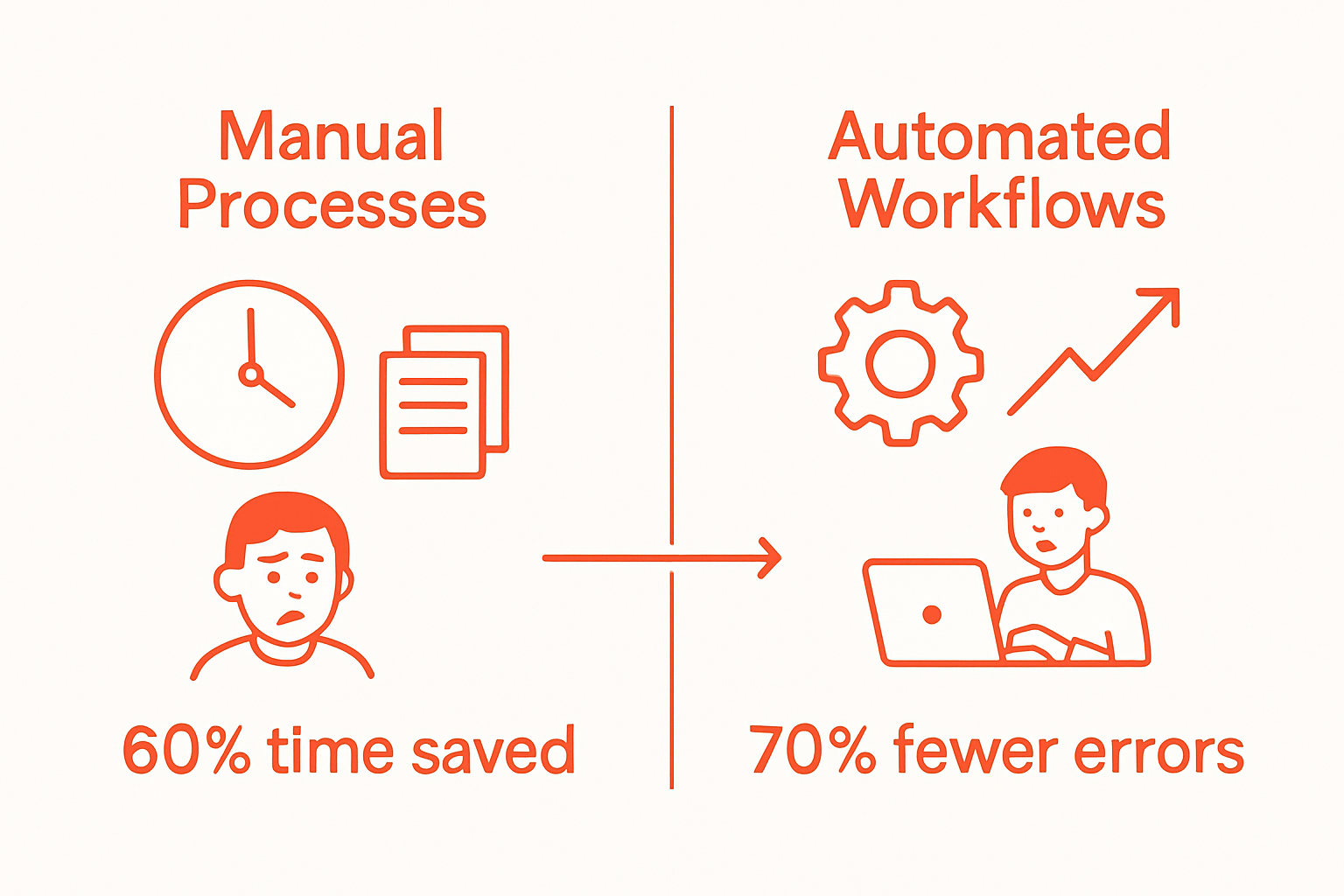
The quantitative assessment of workflow automation ROI encompasses several critical dimensions. Direct cost savings emerge from reduced labour hours, decreased error rates, and streamlined operational processes. Indirect benefits include improved employee satisfaction, enhanced compliance mechanisms, and the capacity to redirect human expertise towards more strategic organisational initiatives. By transforming repetitive manual tasks into intelligent, automated workflows, companies can unlock substantial economic value and competitive advantages.
Key components for calculating workflow automation ROI include:
- Labour hour reduction and cost savings
- Error rate minimisation and associated financial impacts
- Improved service delivery speed and consistency
- Enhanced compliance and risk mitigation
- Increased employee productivity and strategic focus
- Scalability and long-term operational efficiency gains
Streamline Your Enterprise IT Workflows with Velocity Smart Technology
Managing manual request workflows can hold back your IT team and increase the risk of errors and inefficiencies. As highlighted in the article, automating request workflows reduces manual workloads and improves accuracy while enhancing compliance and security. If your goal is to redirect valuable human resources towards high-value tasks and improve operational efficiency Velocity Smart Collect offers a proven solution to modernise how equipment and consumables are issued and tracked.
Discover how our ServiceNow-certified smart locker and vending solutions fit seamlessly inside your existing IT ecosystem. By removing data-sharing concerns and unlocking the full potential of workflow automation, Velocity Smart Technology helps organisations like yours reduce support costs improve employee experience and deliver true ROI beyond simple hardware savings. Visit our website to learn more about this innovative approach and take the next step towards transforming your IT support processes today. Explore how to reduce manual efforts through intelligent automation with Velocity Smart Collect and see why leading enterprises trust our solutions.
Frequently Asked Questions
What are automated request workflows in enterprise IT?
Automated request workflows in enterprise IT refer to the use of technology to streamline operational processes with minimal human intervention, enhancing efficiency and reducing errors during repetitive tasks.
What are the key benefits of implementing workflow automation in IT teams?
The key benefits include significant reductions in manual processing time, enhanced accuracy, improved visibility of requests, scalable processes, and allowing human resources to focus on high-value tasks.
How do workflow automation solutions improve service delivery?
Workflow automation solutions optimise service delivery by standardising processes, minimising human error, delivering consistent support, and enabling real-time performance tracking, which leads to a more efficient and reliable service for users.
How can organisations calculate the ROI of automating request workflows?
To calculate the ROI, organisations should assess labour hour reductions, cost savings from decreased errors, speed of service delivery, enhanced compliance, and the overall impact on employee productivity and strategic focus.
Recommended
See what Smart Collect® could save you
Model your savings in two minutes, or book a 60-minute workshop to pressure-test the numbers against your estate.