 Boost workplace efficiency with service automation">
Boost workplace efficiency with service automation
TL;DR:
- Service automation shifts IT from reactive firefighting to proactive, intelligent support.
- Foundations like structured data, clear workflows, and ownership are essential for reliable automation.
- Human oversight remains crucial in complex, regulated, or emotional support scenarios for safety and trust.
Most IT leaders assume service automation is primarily about cutting headcount or eliminating manual tasks. That assumption misses the bigger opportunity. The genuine value of service automation lies in shifting IT from reactive firefighting to proactive, intelligent support. When you automate incident routing, device provisioning, and support triage, your team stops spending every Monday morning clearing a backlog and starts preventing problems before they reach employees. Forrester notes that service automation streamlines repetitive IT tasks and enables proactive resolution. This article covers what that shift looks like in practice, what it delivers, and where the genuine risks lie.
Table of Contents
- What is service automation in enterprise IT?
- Core benefits of service automation for IT leaders
- Foundations for successful service automation
- Notable limitations and best practices
- A fresh perspective: Why the smartest IT teams blend automation with human expertise
- Next steps: Efficient automation solutions for your enterprise
- Frequently asked questions
Key Takeaways
| Point | Details |
|---|---|
| Maximise efficiency | Service automation drastically reduces manual work for IT teams and accelerates device management. |
| Build foundations first | Structured data, ownership, and workflows are essential for scalable and reliable automation. |
| Balance automation and oversight | Human-in-loop is critical for edge cases, governing the limits of agentic AI. |
| Enable quick ROI | Empirical evidence shows service automation delivers substantial returns within months. |
| Start with augmentation | Augmentation builds trust and prepares IT teams for expanded automation in the future. |
What is service automation in enterprise IT?
Service automation in enterprise IT refers to the use of software, rules-based logic, and increasingly agentic AI to handle IT processes with minimal or no human intervention. Think of it as building an intelligent layer on top of your existing IT infrastructure. That layer intercepts requests, makes decisions, executes actions, and updates records automatically.
The scope is broader than most people realise. Service automation streamlines repetitive IT tasks like incident management, device provisioning, and ticket routing. But modern platforms go further, supporting self-healing workflows, predictive issue detection, and agentic AI that can reason across multiple steps to complete complex support sequences without a technician in the loop.
The key areas where service automation creates the most immediate impact include:
- Incident management: Automated triage categorises, prioritises, and routes incidents to the right team without a first-line analyst reviewing each one manually.
- Device provisioning: New starters can collect pre-configured devices from smart lockers or vending units without IT presence, triggered automatically by an onboarding workflow.
- Support ticket routing: Intelligent classification reduces misrouted tickets, cutting resolution times and improving first-contact resolution rates.
- Asset tracking: Automated check-in and check-out processes keep asset registers accurate without manual re-keying.
Learning the automation steps for IT support in a structured sequence matters enormously here. Jumping straight to agentic AI without foundational process automation in place tends to produce fragile, unreliable outcomes.
Service automation is not a single tool. It is a layered capability that evolves from simple rules-based workflows to autonomous, AI-driven resolution engines. Each layer builds trust and delivers returns that fund the next.
For IT leaders managing distributed workplaces across multiple sites, proactive IT support automation changes the model entirely. Instead of waiting for employees to log tickets, automated monitoring and device diagnostics can trigger resolution workflows before users notice a problem. That shift from reactive to proactive is where the real productivity gains live.
Core benefits of service automation for IT leaders
The business case for service automation is not theoretical. Benchmarks from live enterprise deployments show repeatable, measurable gains across cost, speed, and employee experience.
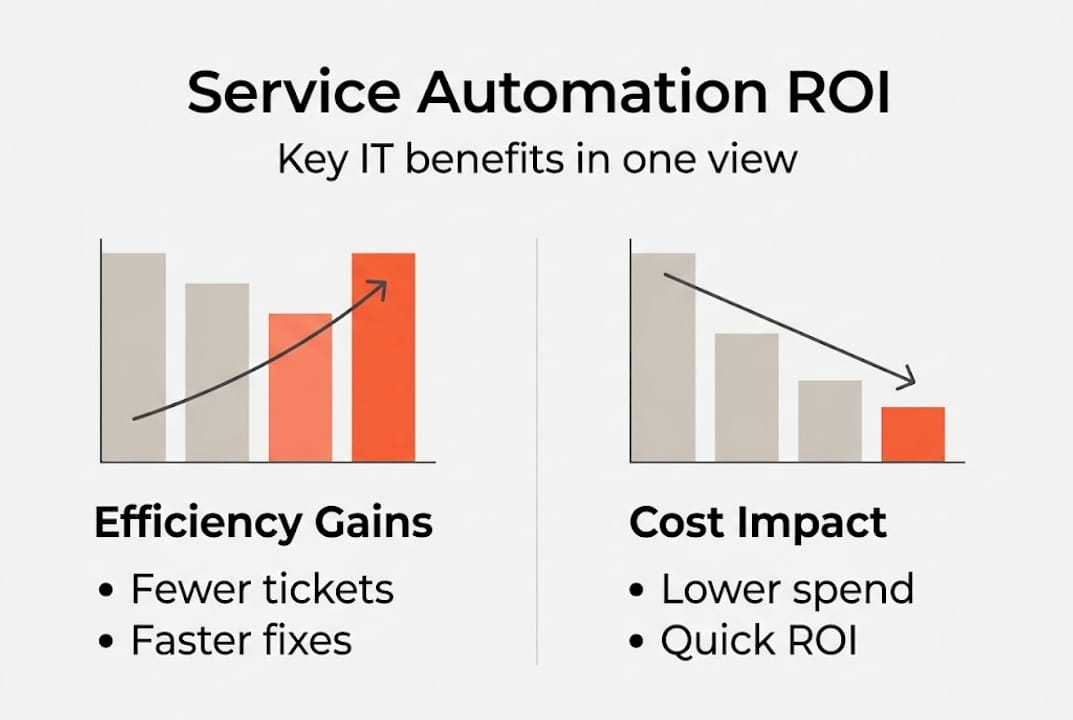
Gartner predicts that agentic AI will resolve 80% of common service issues autonomously by 2029, reducing operational costs by 30%. That is not a distant ambition. Organisations adopting agentic service automation today are already seeing early returns on that trajectory.
Key benefits at a glance:
- Faster device provisioning with no technician required at point of collection
- Reduced mean time to resolution across common incident categories
- Lower cost per ticket as automation handles high-volume, low-complexity requests
- Improved employee experience through 24/7 self-service availability
- Accurate, real-time asset data feeding directly into ITSM platforms
| Benefit area | Without automation | With automation |
|---|---|---|
| Device collection time | 24 to 48 hours (IT-mediated) | Under 15 minutes (self-service) |
| Ticket resolution rate | 60 to 70% first contact | Up to 85% with AI triage |
| Cost per support interaction | High (analyst time) | Significantly reduced |
| Asset data accuracy | Prone to manual error | Near real-time accuracy |
Empirical benchmarks from automation ROI studies show that high-leverage processes deliver 3 to 10 times return on investment within two quarters. That makes a compelling argument for prioritising automation in areas where transaction volume is high and the process is well-understood.
Statistic to note: Gartner forecasts a 30% reduction in operational costs as agentic AI matures across service management functions.
For IT leaders, enterprise asset management efficiency is one of the fastest paths to visible ROI. Automating the asset lifecycle from provisioning through return and redeployment removes entire categories of manual work and eliminates the data inconsistencies that frustrate both IT teams and finance departments.

Foundations for successful service automation
Automation is only as reliable as the processes and data underpinning it. Many enterprise automation initiatives stall or create new problems because the foundational work was skipped in the rush to deploy.
Automation fails on edge cases without structured data, clear ownership, and defined workflows. That is a consistent finding across implementations in financial services, healthcare, and logistics. The automation itself is rarely the problem. The problem is the messy, inconsistent input data and undefined exception-handling that sits underneath it.
The four foundations you need to establish before scaling automation:
- Structured data taxonomy: Every asset, user, location, and request type must be consistently classified. Ambiguous or duplicate categories cause automation to route incorrectly or stall.
- Defined workflow logic: Map every process end-to-end before automating it. Structured support workflows that are clear on paper are far easier to automate reliably.
- Clear ownership: Each automated process needs a named owner accountable for monitoring, exceptions, and continuous improvement. Without this, automation drifts.
- Pilot scope control: Start with high-volume, well-understood tasks. Avoid automating processes that still have active debates about how they should work manually.
Forrester highlights the importance of structured taxonomy and service context as a prerequisite for scalable automation. Without that shared language across IT, HR, and facilities teams, automation breaks at the boundaries between departments.
Pro Tip: Before selecting an automation platform, run a rapid audit of your three highest-volume IT processes. Score each one on data consistency, workflow clarity, and ownership accountability. The process with the highest score should be your first automation pilot. This approach, outlined in intelligent automation strategies, dramatically reduces early-stage risk.
| Scenario | Automation outcome |
|---|---|
| Structured data, defined workflow, clear owner | Reliable, scalable, measurable |
| Good data, unclear workflow | Partial automation, high exception volume |
| Poor data, defined workflow | Frequent errors, manual correction required |
| Poor data, unclear workflow | Automation amplifies existing chaos |
Reviewing IT process automation trends across global enterprises confirms this pattern. The organisations achieving the strongest returns are those that treated foundational readiness as a project phase, not an afterthought.
Notable limitations and best practices
Service automation is powerful, but it is not universally applicable. Understanding where it falls short is as important as knowing where it excels.
Agentic AI falters in ambiguous, emotional, or regulated scenarios. Human oversight remains essential for high-risk tasks such as security incidents, data breach response, and any situation involving employee grievances or legal obligations. Automation in these contexts without appropriate human-in-loop controls introduces serious organisational risk.
Specific scenarios where automation requires caution:
- Regulatory compliance tasks: Processes governed by GDPR, FCA rules, or sector-specific legislation need human review at key decision points.
- Security incident response: Automated triage is valuable, but containment and remediation decisions in complex breaches need experienced analysts.
- Emotionally sensitive interactions: Situations involving stressed employees or personal data requests are better handled by people.
- Novel or rare edge cases: Automation trained on historical patterns performs poorly when presented with genuinely new situations.
Automation works best when the scenario is predictable, the data is clean, and the stakes of an error are recoverable. Move those levers and the risk profile changes fundamentally.
Best practices for IT leaders balancing automation with oversight:
- Prioritise augmentation before full autonomy. Let automation handle the first 80% of a process and keep humans accountable for the final judgement.
- Build escalation paths that are fast and visible. Employees should never feel stuck in an automated loop with no exit.
- Monitor exception rates continuously. A rising edge case volume is an early signal that your automation scope is too broad.
Pro Tip: When deploying automation in logistics IT environments or any high-throughput setting, set a clear exception threshold. If more than 10% of transactions require manual intervention, pause, review the workflow, and tighten the scope before expanding further.
Automation that respects its own boundaries delivers better outcomes than automation that tries to handle everything. Knowing where to stop is a design decision, not a failure of ambition.
A fresh perspective: Why the smartest IT teams blend automation with human expertise
Here is the uncomfortable truth most automation vendors will not tell you: full autonomy is not the goal, at least not yet. The IT teams achieving the most impressive outcomes in 2026 are not those who have automated everything. They are the ones who have been ruthlessly deliberate about what they automate and what they protect with human judgement.
Augmentation builds trust. When employees and stakeholders see automation handling routine tasks reliably and quickly, confidence in the broader automation programme grows. That confidence is what funds the next phase of investment. Rushing to full autonomy before trust is established tends to produce one high-profile failure that sets the entire programme back by 18 months.
Human oversight is not a weakness in your automation strategy. It is a strategic advantage. It means your team can catch edge cases before they become incidents, refine automation logic based on real outcomes, and maintain accountability in a way that purely autonomous systems cannot. Reviewing asset management efficiency data consistently shows that hybrid approaches outperform pure automation in regulated and complex enterprise environments. Start with augmentation, prove the value, then extend autonomy where the evidence supports it.
Next steps: Efficient automation solutions for your enterprise
If the case for service automation resonates, the practical question is where to start building within your own organisation. Velocity Smart Technology offers enterprise-grade solutions designed specifically for IT leaders managing device distribution, support services, and asset workflows across large, distributed workplaces.
Our smart IT support kiosk enables real-time remote IT support and secure device exchange without onsite technicians, delivering 24/7 support availability across all your sites. For broader IT workflow automation, explore our automation solutions resource hub, where you will find practical guidance tailored to enterprise environments. If device provisioning and asset management are your immediate priority, our smart collect application automates equipment distribution natively inside ServiceNow, eliminating manual processes and GDPR risk in a single step.
Frequently asked questions
What kinds of IT tasks are best automated in enterprise environments?
High-volume repetitive tasks like device onboarding, incident management, and ticket routing are prime candidates. Service automation streamlines these processes consistently and reliably across large organisations.
How quickly can IT leaders realise ROI from service automation?
Returns can arrive faster than most expect. High-leverage processes deliver 3 to 10 times ROI within two quarters when automation is applied to well-structured, high-volume workflows.
What limits service automation in regulated or complex support scenarios?
Agentic AI falters in ambiguous, emotional, or regulated cases, making human oversight essential for high-risk incidents such as security breaches or data-related requests.
How can IT leaders ensure automation does not amplify chaos?
Establish structured data, clear ownership, and defined workflows before scaling. Automation without these foundations consistently produces higher exception volumes and erodes confidence in the programme.
Should IT teams strive for full autonomy or gradual augmentation?
Gradual augmentation builds trust far more reliably. Prioritise augmentation initially and extend full autonomy only where tested procedures and oversight mechanisms are firmly in place.
Recommended
- How to do more with less through intelligent automation
- Efficient IT Support Automation Steps for Enterprises
- Automating a proactive IT desk side support service
- Understanding Why Automate Support Workflows Matters
- Büroservice effizient nutzen: Workflow in KMU optimieren | ProOffice Business Center Blog
See what Smart Collect® could save you
Model your savings in two minutes, or book a 60-minute workshop to pressure-test the numbers against your estate.