 What is automated compliance? A guide for IT and compliance teams">
What is automated compliance? A guide for IT and compliance teams
TL;DR:
- Automated compliance uses software, APIs, and AI to continuously verify regulatory adherence, replacing manual reviews. It reduces audit effort by 40 to 60% and minimizes human error through real-time monitoring and automated evidence collection. Proper scope, defined controls, and human oversight are essential for effective and trustworthy automation in regulated industries.
Automated compliance is defined as the use of software, APIs, and AI to continuously verify that an organisation meets its regulatory obligations, replacing periodic manual reviews with ongoing, data-driven monitoring. Where traditional compliance programmes relied on quarterly evidence sprints and spreadsheet-heavy audit preparation, automation converts those activities into persistent, system-driven processes. Platforms such as ComplianceStack, Compyl, and Layer8 Labs have made this shift accessible to regulated enterprises across financial services, pharma, energy, and defence. The operational case is substantial: SOC 2 evidence collection drops from 200 to 400 hours annually to just 20 to 40 hours, a 90% reduction in manual audit labour. That figure alone reframes the conversation from “should we automate compliance?” to “how quickly can we start?”
What is automated compliance and why does it matter now?
Automated compliance, in its standard industry framing, is also referred to as compliance automation or continuous controls monitoring. The distinction matters: compliance automation describes the broader discipline, while continuous controls monitoring refers specifically to the real-time verification of individual controls against defined thresholds. Both sit under the same operational umbrella.
The importance of automated compliance has grown in direct proportion to regulatory complexity. Organisations operating across multiple jurisdictions now face overlapping frameworks including ISO 27001, SOC 2, GDPR, HIPAA, and FedRAMP, each with distinct evidence requirements and audit cycles. Managing these manually is not merely inefficient; it is structurally unsustainable at scale. Automation converts compliance from reactive, point-in-time checks into continuous, data-driven governance. This shift means that audit readiness is no longer a state achieved in the weeks before an audit. It becomes the default operating condition.
For compliance officers and IT professionals in regulated industries, the practical implication is clear. Automated systems pull logs, configurations, and control evidence automatically, removing the last-minute scramble that characterises traditional audit cycles. The role of automation in compliance is therefore not supplementary. It is foundational to operating at the pace and scale that modern regulatory environments demand.

How does automation reduce audit effort and human error?
The operational benefits of automated compliance are measurable and well-documented. Continuous monitoring reduces total audit preparation time by 40 to 60%, shifting teams from reactive quarterly sprints to an always-ready posture. That time saving translates directly into staff capacity redirected toward governance decisions rather than evidence gathering.
Human error is the more consequential risk. Up to 95% of data breaches involve human error, making manual compliance processes a structural vulnerability rather than a manageable risk. Automation reduces the surface area for those errors by removing humans from repetitive, rule-based tasks where mistakes are most likely to occur.
Continuous monitoring capabilities deliver an additional layer of protection. When an access violation occurs or a configuration drifts outside its defined boundary, automated systems detect and flag the issue in near real time rather than at the next scheduled review. This early detection capability is particularly valuable in cloud environments where configuration changes happen continuously across AWS, Azure, and GCP infrastructure.
Key operational benefits include:
- Audit trail integrity: Automated evidence collection creates timestamped, system-generated records that are more defensible than manually assembled documentation.
- Control coverage consistency: Automated checks run on schedule without the variability introduced by staff availability, competing priorities, or human oversight gaps.
- Faster remediation cycles: Early detection of control failures shortens the window between issue identification and resolution, reducing regulatory exposure.
- Reduced compliance fatigue: Removing repetitive evidence tasks from compliance teams improves focus on higher-order risk analysis and strategic planning.
“Automation enables audit readiness by pulling logs, configurations, and evidence automatically, avoiding the last-minute scramble that undermines confidence and causes audit delays.” — Benefits of compliance automation
What compliance tasks can and cannot be automated?
Not every compliance activity is a candidate for automation. Repetitive, deterministic tasks consume 60 to 80% of compliance team time and represent the highest-return targets for automation. Judgement-intensive activities, by contrast, require human reasoning that no current platform reliably replicates.
| Task category | Automation suitability | Examples |
|---|---|---|
| Evidence collection | High | Log exports, configuration snapshots, access reports |
| Policy distribution and acknowledgement tracking | High | Automated policy sends, completion records |
| Training completion monitoring | High | LMS integration, certification tracking |
| Continuous controls monitoring | High | Threshold alerts, drift detection |
| Risk acceptance decisions | Low | Weighing business context against regulatory risk |
| Applying regulatory guidance to novel situations | Low | Interpreting new legislation or enforcement actions |
| Regulatory inquiry responses | Low | Drafting responses requiring legal and strategic judgement |
| Whistleblower and incident handling | Low | Sensitive investigations requiring human discretion |
The boundary between these categories is not always obvious, and crossing it carelessly creates a specific failure mode. Attempting to automate judgement-intensive tasks produces dashboards full of misleading checkmarks, creating a false sense of control while genuine compliance gaps go undetected. This is one of the more consequential mistakes organisations make when deploying compliance automation for the first time.
The principle that governs effective scoping is “content before automating.” Automation verifies well-defined controls; it cannot substitute for the work of defining those controls in the first place. Organisations that skip control definition and move directly to automation end up automating ambiguity, which produces unreliable outputs and erodes trust in the programme.
Pro Tip: Before configuring any automation rule, write the control in plain language and confirm that a system can evaluate it with a binary pass or fail outcome. If the evaluation requires contextual judgement, keep it human-led.
What technologies and integrations power automated compliance?
The technical architecture of an automated compliance programme centres on API integrations with the systems that generate compliance-relevant data. Connecting to cloud providers such as AWS, Azure, GCP, Okta, and GitHub via native APIs produces more reliable and consistent evidence than file uploads or manual exports. API-sourced evidence carries stronger audit trail integrity because it is system-generated, timestamped, and tamper-evident.
Compliance platforms such as ComplianceStack, Compyl, and Layer8 Labs sit above these integrations as orchestration and reporting layers. Their core functions include:
- Evidence classification: Automatically categorising collected artefacts against specific control requirements across multiple frameworks.
- Risk prioritisation: Surfacing control failures by severity and regulatory impact rather than presenting undifferentiated alert volumes.
- Narrative generation: Using AI to draft control descriptions, risk summaries, and audit narratives, reducing the writing burden on compliance teams.
- Cross-framework mapping: Identifying where a single control satisfies requirements across ISO 27001, SOC 2, and GDPR simultaneously, reducing duplication of effort.
AI functions within these platforms operate as accelerators rather than autonomous decision-makers. AI-driven automation provides cognitive assistance but requires human decision-makers for final compliance assessment. This distinction is operationally significant. AI can classify evidence, flag anomalies, and draft narratives at speed, but the compliance officer retains accountability for the conclusions drawn from that output.
Continuous controls monitoring deserves specific attention as a technical capability. Point-in-time checks, conducted quarterly or annually, create windows of undetected non-compliance between assessments. Continuous monitoring closes those windows by evaluating controls against defined thresholds on an ongoing basis, generating alerts when drift occurs. For IT professionals managing cloud infrastructure, this capability integrates naturally with existing observability and SIEM tooling, making it a practical extension of existing monitoring investments rather than a separate programme. Exploring IT process automation trends across global enterprises illustrates how this integration is becoming standard practice in 2026.
How to implement automated compliance effectively
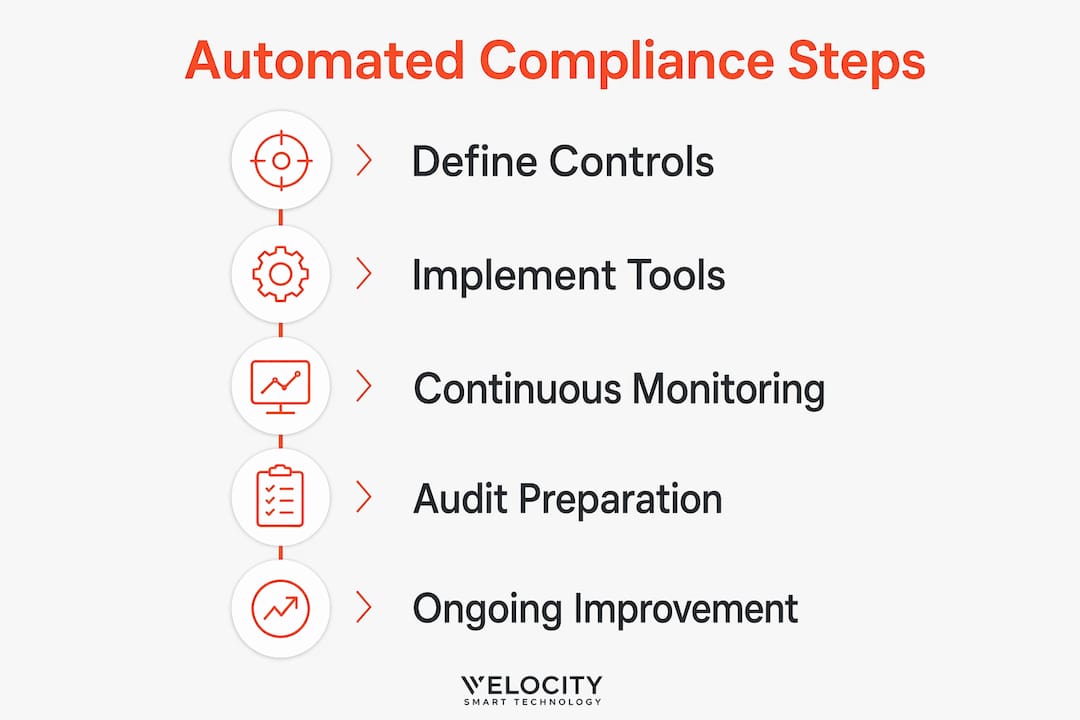
A structured implementation approach determines whether automated compliance delivers sustained value or becomes another underused platform. The following sequence reflects the operational logic that separates successful programmes from those that stall after initial deployment.
- Define compliance obligations precisely. Map every applicable regulatory framework to specific control requirements before selecting or configuring any automation tooling. Ambiguous obligations produce ambiguous automation outputs.
- Scope automation to high-return, deterministic tasks first. Evidence collection, policy acknowledgement tracking, and access reporting deliver immediate, measurable returns and carry low risk of misclassification. Start here before expanding to more complex use cases.
- Build continuous monitoring and metrics tracking. Define the metrics that will demonstrate programme health: control coverage percentage, failure rates by control family, mean time to remediation. These metrics provide the governance visibility that justifies the investment and guides ongoing improvement.
- Maintain human-in-the-loop for decisions and remediation. Using AI as an accelerator with mandatory human review avoids the risks of blind machine decisions. Every automated alert should route to a named owner with defined response obligations.
- Measure ROI against a documented baseline. Record pre-automation audit preparation hours, evidence collection time, and control failure rates. Post-implementation comparisons against this baseline provide the evidence needed to demonstrate programme value to leadership and justify further investment.
The ROI case for compliance automation is grounded in three measurable drivers: labour cost reduction, faster audit preparation, and earlier issue detection that prevents violations before they attract regulatory attention. Organisations that track all three consistently report that the programme pays for itself within the first audit cycle.
Pro Tip: Assign a named control owner to every automated alert before go-live. Automation without clear human accountability creates a situation where alerts are generated but no one acts on them, which is operationally worse than no monitoring at all.
Avoiding premature automation of judgement-heavy tasks is equally important as a governance discipline. The temptation to automate risk acceptance workflows or regulatory interpretation tasks is understandable given the time they consume. Resisting that temptation preserves the integrity of the programme and protects the organisation from the specific failure mode of misleading compliance dashboards that mask genuine gaps. Practical guidance on eliminating manual requests within IT environments offers a useful analogue for how to scope automation boundaries effectively.
Key takeaways
Automated compliance delivers its greatest value when organisations define controls precisely, automate deterministic tasks first, and maintain human oversight for all judgement-intensive decisions.
| Point | Details |
|---|---|
| Automated compliance definition | Software and AI continuously verify regulatory adherence, replacing periodic manual reviews with ongoing monitoring. |
| Audit effort reduction | Continuous monitoring cuts total audit preparation time by 40 to 60%, shifting teams to an always-ready posture. |
| Task scoping is critical | Automate evidence collection and policy tracking first; keep risk acceptance and regulatory interpretation human-led. |
| API integrations improve reliability | Connecting to AWS, Azure, GCP, Okta, and GitHub via API produces more defensible evidence than manual exports. |
| Human oversight remains non-negotiable | AI accelerates compliance workflows but requires human decision-makers for final assessment and remediation sign-off. |
The compliance officer’s role is being redefined, not replaced
Having worked alongside compliance teams in regulated industries for a number of years, I find the anxiety around automation understandable but largely misplaced. The tasks that automation displaces are the ones that compliance professionals find least rewarding: pulling evidence from disparate systems, chasing training completions, assembling audit binders under time pressure. Automation shifts compliance roles from manual checkers to strategic auditors, and in my observation, that shift consistently improves both job satisfaction and the quality of risk oversight.
What I have also seen, however, is that organisational readiness matters as much as platform capability. Teams that arrive at automation with poorly defined controls, unclear ownership, and no documented baseline find that the technology amplifies their existing problems rather than solving them. The discipline of defining content before automating is not a technical prerequisite. It is a governance prerequisite, and it requires compliance leadership to do the harder work of clarifying obligations before reaching for tooling.
The teams that get this right report something worth noting: continuous compliance genuinely reduces audit stress. When evidence is always current and controls are monitored in real time, the audit becomes a confirmation rather than a crisis. That shift in experience is, in my view, the most underrated benefit of the entire discipline.
— Anthony
How Velocity-smart supports compliance-ready IT operations
Physical IT asset management sits at an often-overlooked intersection with compliance. Every device handover, peripheral loan, and equipment return generates an audit trail that regulated organisations are expected to maintain. Velocity-smart’s Automation Unboxed platform addresses this directly by embedding device lifecycle workflows natively within ServiceNow, where audit records, CMDB entries, and access logs are created automatically as part of the transaction rather than reconstructed after the fact. Smart Lockers, Smart Vending, and the Smart Kiosk all operate within the same ServiceNow tenant, meaning every physical handover inherits the organisation’s existing RBAC and audit posture. For compliance officers in regulated industries, that means physical IT support becomes part of the compliance programme rather than a gap within it. Explore how smart locker systems can strengthen security compliance across distributed enterprise environments.
FAQ
What is the automated compliance definition?
Automated compliance is the use of software, APIs, and AI to continuously monitor and verify an organisation’s adherence to regulatory requirements, replacing manual, periodic evidence collection with ongoing, system-driven processes.
What tasks are best suited to compliance automation?
Repetitive, deterministic tasks such as evidence collection, policy acknowledgement tracking, training completion monitoring, and access reporting are best suited to automation, as they consume 60 to 80% of compliance team time and carry low risk of misclassification.
How much time can automated compliance save?
Organisations using continuous monitoring report a 40 to 60% reduction in total audit preparation time, and SOC 2 evidence collection can drop from 200 to 400 hours annually to just 20 to 40 hours, a 90% reduction in manual labour.
Does automation replace compliance officers?
Automation does not replace compliance officers. AI-driven platforms provide cognitive assistance and accelerate evidence gathering, but human decision-makers remain responsible for risk acceptance, regulatory interpretation, and final compliance assessment.
What integrations are needed for effective compliance automation?
Effective compliance automation requires API integrations with the systems that generate compliance-relevant data, including cloud providers such as AWS, Azure, and GCP, identity platforms such as Okta, and code repositories such as GitHub, to produce reliable, tamper-evident audit evidence.
Recommended
See what Smart Collect® could save you
Model your savings in two minutes, or book a 60-minute workshop to pressure-test the numbers against your estate.