 Benefits of automated device issuance for enterprises">
Benefits of automated device issuance for enterprises
TL;DR:
- Automated device issuance uses self-service systems with smart lockers and digital logs to streamline IT equipment distribution. It reduces staff time per transaction from 30 minutes to under two minutes, enhances accountability, and scales independently of headcount. Successful implementation depends on standardising asset data, processes, and integrating physical infrastructure to ensure full automation at enterprise scale.
Automated device issuance is defined as the process of distributing IT equipment through self-service systems that handle authentication, access control, and transaction logging without manual IT staff involvement. For large enterprises managing hundreds or thousands of devices across multiple sites, the benefits of automated device issuance extend well beyond convenience: they reshape cost structures, compliance posture, and the strategic capacity of IT teams. The industry term for the broader discipline is automated device lifecycle management, and understanding where issuance fits within that framework is the first step to building a credible business case.
What are the core benefits of automated device issuance?
Automated device issuance reduces staff time per transaction by 93%, dropping from an average of 30 minutes under manual workflows to under two minutes with self-service systems. That figure is not a marginal efficiency gain. Across an enterprise processing several hundred device transactions per month, it translates to thousands of recovered staff hours annually, without adding headcount.

The operating model is straightforward. Users authenticate via badge, PIN, or mobile application; the system releases the assigned device from a smart locker; and every transaction is logged automatically with a timestamp and user identity. IT staff are removed from the handover entirely. The result is a process that scales with demand rather than with team size, which is the defining advantage of device automation at enterprise scale.
Three named entities sit at the centre of any functioning automated issuance system: smart lockers as the physical access control layer, identity verification systems as the authentication mechanism, and integrated management software such as ServiceNow as the workflow and audit layer. Each component is necessary. Remove any one of them and the system reverts to partial automation, which carries most of the complexity of full automation with few of the accountability benefits.
How does automation reduce IT workload and operational costs?
The operational cost argument for automating device issuance is grounded in time economics. A 30-minute manual handover, when multiplied across 500 monthly transactions, consumes over 4,000 staff hours per year. At a fully loaded IT support cost, that figure represents a material budget line. Automation collapses the per-transaction cost to a fraction of its manual equivalent.
The table below illustrates the contrast between manual and automated issuance workflows across key operational dimensions.
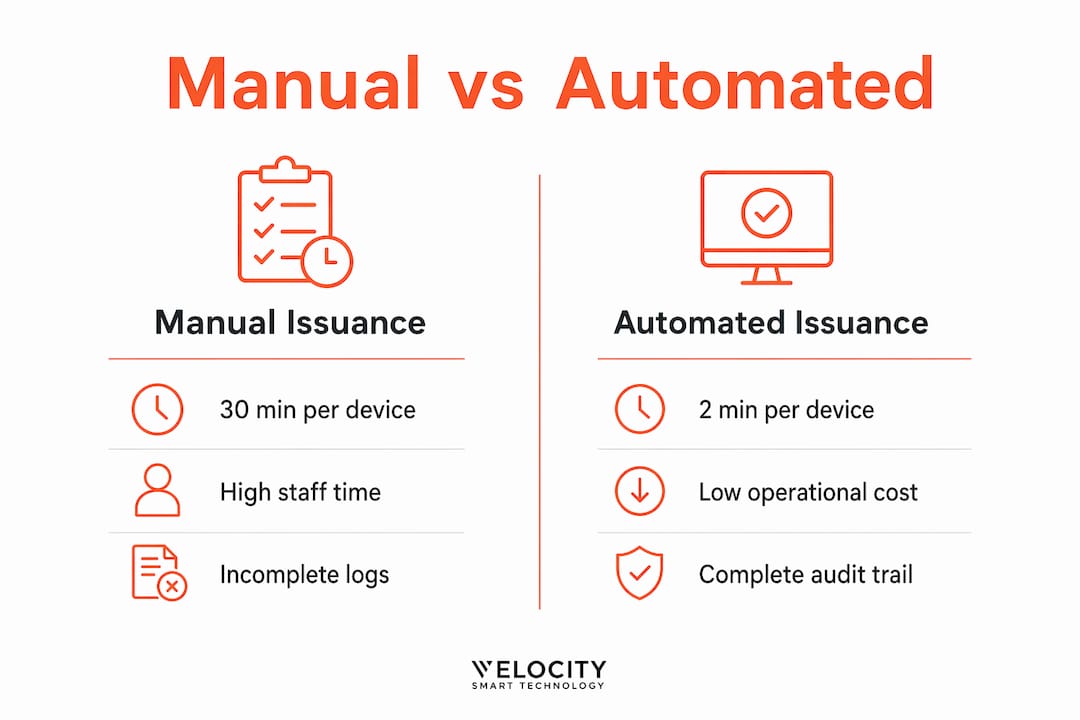
| Dimension | Manual issuance | Automated issuance |
|---|---|---|
| Staff time per transaction | ~30 minutes | Under 2 minutes |
| Audit trail | Incomplete or paper-based | Immutable digital record |
| Availability | Business hours only | 24/7 self-service |
| Scalability | Proportional to headcount | Decoupled from headcount |
| Error rate | Variable, human-dependent | Policy-enforced, consistent |
The scalability row deserves particular attention. Gartner projects that 70% of organisations will adopt managed device lifecycle services by 2028, up from fewer than 35% in 2025. This trajectory signals that enterprises are recognising a structural truth: IT device demand grows with workforce size, but IT team size cannot grow at the same rate without unsustainable cost increases. Automation decouples those two variables.
Pro Tip: Before committing to an automation platform, measure your current baseline manually. Log staff time per device transaction, error rates, and audit preparation hours over a 60-day period. These figures become your ROI denominator and make the business case to finance teams considerably more persuasive.
How does automation improve accountability and compliance?
The assumption that automation reduces accountability is one of the most persistent misconceptions in enterprise IT. The opposite is true. Automation enhances accountability by replacing inconsistent manual logs with complete, immutable transaction records that simplify audits and eliminate the gaps inherent in paper-based or spreadsheet-driven handover processes.
Manual device handoffs carry four structural risks that accumulate over time:
- Missing audit trails. Without a system-enforced log, device custody depends on individual staff members recording transactions accurately and consistently. In practice, this rarely happens under operational pressure.
- Device loss and untracked usage. Devices issued without authentication requirements are frequently misattributed, lost, or retained beyond their intended loan period with no automated alert triggered.
- Compliance exposure. Regulated industries including pharmaceuticals, financial services, and defence require demonstrable chain-of-custody records. Manual processes cannot reliably produce these at audit time.
- Delayed audit preparation. Audit tasks that previously took weeks to compile from disparate logs can be completed in minutes when transaction data is captured automatically in a centralised system.
“Automation does not remove human judgement from device management. It removes human error from device transactions. Those are fundamentally different things, and conflating them leads enterprises to underinvest in automation precisely where it would serve them most.”
Automated alerts for overdue returns and flagged damage reports add a further layer of operational discipline. Rather than relying on IT staff to chase outstanding devices reactively, the system enforces return deadlines and escalates exceptions through configured workflows. This is particularly valuable in shared-equipment environments such as manufacturing shift rotations or healthcare ward settings, where device turnover is high and accountability gaps are costly.
Automated vs partial automation: why physical infrastructure matters
Software automation alone does not deliver the full benefits of device deployment at enterprise scale. Physical infrastructure such as smart lockers is required to enforce authentication at the point of device pickup, preserving chain-of-custody integrity in a way that software workflows cannot achieve independently.
The distinction matters because many organisations implement MDM platforms or ServiceNow workflows and consider their device issuance process automated. In practice, if a staff member still physically hands over a device without a system-enforced authentication step, the chain of custody is broken at the most critical point. The table below contrasts fully integrated self-service systems with partial automation models.
| Capability | Fully integrated self-service | Software-only partial automation |
|---|---|---|
| Authentication at pickup | Enforced by smart locker hardware | Relies on manual staff verification |
| Chain-of-custody integrity | Unbroken, system-enforced | Dependent on staff compliance |
| 24/7 availability | Yes | No, requires staff presence |
| Audit readiness | Immediate, automated | Requires manual compilation |
| Integration with ServiceNow | Native workflow orchestration | API-dependent, variable reliability |
Velocity-smart’s Smart Collect platform operates as a ServiceNow-native application, meaning workflows, asset records, and audit data live inside the customer’s existing ServiceNow tenant rather than in a parallel database. This architectural choice matters for regulated enterprises: there is no data synchronisation risk, no separate vendor security review, and no divergence between the CMDB and physical device state. The smart locker efficiency gains documented by Velocity-smart customers are a direct consequence of this integrated model rather than software automation applied in isolation.
How to implement automated device issuance at enterprise scale
Successful implementation of automated device issuance follows a defined sequence. Organisations that attempt to automate before standardising their underlying processes consistently produce inconsistent results. Lack of process standardisation is the primary cause of failed or underperforming automation projects, not the technology itself.
A phased implementation approach reduces risk and accelerates measurable outcomes:
- Standardise asset registers and workflows first. Audit your current device catalogue, ownership records, and handover procedures. Inconsistencies in asset data will propagate through any automated system and undermine the accuracy of the logs it produces.
- Define ROI criteria before selecting a platform. Clear, measurable ROI criteria defined upfront, including setup time per device, error rates, and audit preparation hours, provide the framework for evaluating platform options and scoping the initial deployment.
- Run a pilot at a single high-volume site. Select a location with sufficient transaction volume to generate statistically meaningful data within 60 to 90 days. Manufacturing facilities, corporate headquarters, and large campuses are typically the most productive pilot environments.
- Track metrics weekly during the pilot. Staff time per transaction, device return compliance rates, and audit log completeness are the three metrics that most directly reflect the operational impact of automation.
- Plan for staff role evolution, not staff reduction. Automation removes repetitive logistics from IT roles. The staff time recovered should be redirected to device preparation, imaging, damage assessment, and strategic projects. These tasks remain manual and benefit from increased attention.
Pro Tip: Involve your internal audit and compliance teams in the pilot design. Their requirements for chain-of-custody documentation will shape the logging configuration, and their early endorsement of the system’s output significantly accelerates formal audit sign-off later.
What additional advantages does device automation deliver?
Beyond the headline time and cost figures, automated device management advantages compound across several dimensions that are less immediately visible but equally significant for enterprise IT strategy.
- Shift-start productivity. Faster device access eliminates the delays common in shift-based environments where employees queue for manual device handovers at the start of each working period. In manufacturing and healthcare settings, a two-minute self-service collection replaces a process that previously delayed productive work by 15 to 20 minutes per employee.
- Procurement intelligence. Automated systems generate utilisation data that manual processes cannot produce reliably. Device usage frequency, peak demand periods, and return patterns inform procurement decisions with evidence rather than estimation, reducing both over-provisioning and device shortages.
- Scalability without proportional cost growth. As Gartner’s adoption projections indicate, the enterprises moving to managed device lifecycle services are doing so precisely because headcount-dependent models cannot scale to meet growing device demand. A smart locker network can serve ten times the transaction volume of a staffed desk with no additional IT personnel.
- Reduced device loss in shared-equipment environments. Velocity-smart customer data shows a 90% reduction in shared-equipment loss and damage following deployment of automated issuance systems. This figure reflects the combined effect of authentication requirements, automated return reminders, and immutable custody records.
The operational case for smart lockers in enterprise IT is therefore not limited to cost reduction. It extends to data quality, procurement accuracy, and the capacity of IT teams to operate strategically rather than reactively.
Key takeaways
Automated device issuance delivers measurable operational gains only when physical access control, identity verification, and integrated management software operate as a unified system rather than independent components.
| Point | Details |
|---|---|
| Time savings are substantial | Automation reduces staff time per transaction from 30 minutes to under 2 minutes, a 93% reduction. |
| Accountability improves, not diminishes | Immutable digital logs replace inconsistent manual records, accelerating audit preparation from weeks to minutes. |
| Physical infrastructure is non-negotiable | Smart lockers enforce authentication at the point of pickup; software alone cannot preserve chain-of-custody integrity. |
| Standardisation precedes automation | Cleaning asset registers and standardising workflows before deployment is the critical success factor most organisations overlook. |
| Scalability decouples from headcount | Automated systems handle growing device demand without proportional increases in IT staffing costs. |
The strategic shift automation makes possible
Having worked closely with enterprise IT operations across regulated industries, I find the most underappreciated benefit of automated device issuance is not the time saving or the audit trail. It is what those recovered hours make possible.
IT teams that spend 30 minutes per device transaction are not making strategic decisions about device lifecycle policy, procurement optimisation, or workforce technology planning. They are processing queues. Automation handles the queue. That is not a small thing. Automation enables IT teams to shift focus from manual logistics to strategic innovation by handling repetitive tasks through policy-enforced workflows. In practice, this means the same team that previously managed 200 device transactions per month manually can now manage 2,000 automated transactions while directing their attention to the work that actually requires human judgement.
The counterargument I hear most often is that automation removes accountability. I have seen the opposite consistently. Organisations that relied on manual logs before automation frequently discovered, during their first post-deployment audit, that their historical records were incomplete, inconsistent, or simply missing for significant periods. The automated system did not create an accountability problem. It revealed one that already existed.
The one caution I would offer is this: do not automate a broken process. Organisations that rush to deploy smart lockers or self-service workflows without first standardising their asset registers and handover procedures will automate their inconsistencies at scale. The technology is not the risk. The undisciplined implementation is. Define your process, clean your data, then automate with confidence.
— Anthony
How Velocity-smart enables automated device issuance

Velocity-smart’s Smart Collect platform is a ServiceNow-native application that orchestrates smart lockers, smart vending machines, and smart kiosks from a single interface inside your existing ServiceNow tenant. Every device transaction, from new-starter kit collection to broken-laptop swap, is authenticated, logged, and recorded as a native CMDB entry with no parallel database and no data synchronisation risk. Customers including Roche, BAE Systems, and Centrica have used Smart Collect to achieve outcomes including 83% faster fulfilment, 60% reductions in on-site tickets, and 90% reductions in shared-equipment loss. To explore how the platform supports IT self-service automation at enterprise scale, visit the Velocity-smart website.
FAQ
What is automated device issuance?
Automated device issuance is the process of distributing IT equipment through self-service systems that authenticate users, release devices via smart lockers, and log every transaction automatically, removing IT staff from the handover process entirely.
Why automate device issuance rather than use manual handovers?
Manual device handovers average 30 minutes of staff time per transaction and produce incomplete audit trails. Automation reduces that to under two minutes while generating immutable, timestamped records that satisfy compliance requirements without additional effort.
Does automation reduce accountability for device custody?
Automation increases accountability by replacing inconsistent manual logs with complete digital records. Audit tasks that previously required weeks of manual compilation can be completed in minutes using automatically generated transaction data.
What infrastructure is required for automated device issuance?
Effective automated issuance requires both software workflow automation and physical smart locker hardware. Software alone cannot enforce authentication at the point of device pickup, which is the critical step for maintaining chain-of-custody integrity.
How should enterprises prepare before deploying automated device issuance?
Enterprises should standardise their asset registers and handover procedures before deployment. Process standardisation is the primary determinant of automation success; inconsistent inputs produce inconsistent automated outputs regardless of the platform selected.
Recommended
See what Smart Collect® could save you
Model your savings in two minutes, or book a 60-minute workshop to pressure-test the numbers against your estate.