
Cora software for enterprise PPM: shortlisting guide
Cora Systems delivers an enterprise-grade project and portfolio management (PPM) platform built for regulated, capital-intensive programmes that demand governance, predictability, and real-time portfolio visibility. If your organisation runs CapEx-heavy infrastructure, defence, or public-sector programmes and currently relies on spreadsheets or disconnected tools to track cost and schedule, Cora PPM belongs on your shortlist.
The platform is used across more than 50 countries, managing over $20 billion of projects, and independent reviewers on Gartner Peer Insights consistently highlight portfolio visibility and strategic alignment as its strongest attributes. The caveats are equally consistent: a meaningful learning curve and the need for structured change management before you go live.
Shortlist Cora if your organisation:
- Runs programmes governed by Earned Value Management (EVM) or strict stage-gate controls
- Operates in aerospace and defence, government, pharmaceuticals, or heavy engineering
- Has a PMO mature enough to enforce consistent data capture across cost codes and schedules
- Needs a single source of truth that replaces fragmented spreadsheet reporting at portfolio level
Conditional shortlist if you are mid-market, lack a dedicated PMO, or cannot commit the implementation effort a complex enterprise platform requires.
Key takeaways
Cora PPM is the right shortlist choice for regulated, capital-intensive enterprises with a mature PMO, but integration readiness and change management investment determine whether the platform delivers its promised visibility.
| Point | Details |
|---|---|
| Shortlist for regulated programmes | Cora PPM fits A&D, public sector, and heavy CapEx industries with EVM and governance requirements. |
| Budget beyond the licence | Enterprise costs extend well past the $50/user/year entry price; include integration, migration, and change management. |
| Validate integration readiness first | Confirm ERP latency, API coverage, and data governance before committing to a go-live timeline. |
| Plan for adoption, not just deployment | Gartner Peer Insights reviewers consistently flag the learning curve; structured training is a prerequisite. |
| Smart Collect® for physical IT risk | When distributed device logistics drive programme risk, Smart Collect® by Velocity-smart reduces execution friction. |
Table of Contents
- What does the Cora platform actually do?
- Core Cora software features your procurement team should evaluate
- How do Cora Edge and Cora GovCon fit your industry?
- Deployment options and integrations: what UK enterprises need to check
- Cora software pricing, licensing, and implementation timeline
- What do customers and independent reviewers say about Cora?
- How does Cora map against enterprise PPM categories?
- What questions should you ask Cora during procurement and demos?
- Analyst perspective: when does Cora deliver the most value?
- When physical IT logistics drive programme risk, Smart Collect® changes the equation
- Sources
What does the Cora platform actually do?
Cora PPM is an enterprise control tower for programme and portfolio management. Its core proposition, as Cora Systems positions it, is replacing spreadsheet-driven workflows with centralised, real-time portfolio data so CIOs and programme executives can make faster, better-evidenced investment decisions.
The practical outcomes the platform targets are:
- Predictability: baseline control, cost forecasting, and schedule variance alerts that surface problems before they become overruns
- Single source of truth: all project data, financials, and resource plans consolidated in one governed repository
- Governance: configurable approval workflows, audit trails, and role-based access that satisfy regulated-sector compliance requirements
- Forecast accuracy: CapEx/OpEx roll-ups and Estimate at Completion (EAC) calculations that finance teams can trust
Cora Systems is a global vendor with a deliberate focus on regulated industries. Its strategic portfolio management capability extends beyond project execution into prioritisation and investment decision support, making it relevant to both PMO leads and the CIO or CFO who needs portfolio-level visibility. Pre-configured industry modules and structured demos are positioned as time-to-value accelerators, reducing the configuration effort that typically slows enterprise PPM deployments.
Core Cora software features your procurement team should evaluate
The feature set that distinguishes an enterprise PPM platform from a mid-market tool is not the presence of a Gantt chart. It is the depth of financial controls, the auditability of governance workflows, and the platform’s ability to handle the transaction volumes and integration complexity of a large estate.
Cora’s project execution module covers integrated master schedules, Work Breakdown Structures (WBS), stage-gate controls, cost forecasting, baseline management, RAID registers, and configurable approval workflows. These are the table-stakes capabilities for any enterprise RFI. The features that separate mature platforms from lighter tools are:
Project execution and schedule
- Integrated Gantt with baseline comparison and critical-path visibility
- WBS with cost-code alignment for financial roll-ups
- Stage-gate workflows with configurable approval chains
Financial controls
- CapEx/OpEx forecasting with EAC and Estimate to Complete (ETC) calculations
- Multi-currency support and multi-ledger integration for global programmes
- Variance analysis and automated alerts when actuals deviate from baseline
Resource and capacity planning
- Workforce demand forecasting against available capacity
- Role-based resource allocation across the portfolio
- Timesheets integration for actuals capture
Risk and governance
- RAID registers with escalation workflows
- Audit trails and role-based security for regulated environments
- EVM support for defence and government programmes
Dashboards and analytics
- Roll-up dashboards and automated alerts for programme managers and executives
- Portfolio-level forecasting views for investment prioritisation
- Configurable reporting for different stakeholder audiences
Pro Tip: When running your demo, ask the vendor to show a schedule change propagating through to the EAC and the portfolio dashboard in a single workflow. If that takes more than three clicks or requires a manual recalculation, the integration between schedule and cost is not as tight as the marketing materials suggest.
Signals of genuine enterprise maturity to probe: transaction volume limits per project, localisation and language support, multi-site scheduling across time zones, and the number of native integration connectors available without custom development.
How do Cora Edge and Cora GovCon fit your industry?
Cora’s vertical modules are the most direct answer to the “how long will configuration take?” question that slows enterprise PPM evaluations. Rather than building governance workflows and compliance controls from scratch, Cora Edge and related industry products deliver pre-configured templates aligned to specific sector requirements.
Cora Edge targets manufacturing and engineering programmes. It is built around the delivery disciplines of capital project management: integrated cost and schedule control, contractor management, change control workflows, and the reporting cadences that engineering PMOs typically require. Organisations running large infrastructure or product-development programmes benefit most, because the pre-built workflows reflect the stage-gate and earned-value disciplines already embedded in those environments.
Cora GovCon addresses government contracting and defence programmes, where compliance with EVM reporting standards, audit readiness, and contract-level financial segregation are non-negotiable. The pre-configuration here covers the governance and reporting structures that defence prime contractors and public-sector bodies need from day one, rather than building them through months of configuration workshops.
Other regulated sectors including healthcare and aerospace and defence can also leverage pre-configured modules, reducing the time between contract signature and a production-ready deployment. The practical saving is not just calendar time. It is the reduction in configuration risk: pre-built compliance controls are tested against sector norms, whereas bespoke configurations carry the risk of gaps discovered only during an audit.
- Pre-configured workflows reduce the discovery and configuration phase by weeks, not days
- Industry-specific demos let procurement teams validate fit against real programme scenarios before committing
- Compliance controls built into the template reduce the risk of governance gaps in regulated environments
Deployment options and integrations: what UK enterprises need to check
For UK organisations, deployment mode and data residency are not afterthoughts. They belong in the first round of vendor qualification, particularly for public-sector bodies subject to UK Government data handling requirements and for regulated industries operating under FCA, MHRA, or MoD frameworks.
Deployment modes to confirm with Cora:
- Cloud (SaaS), private cloud, and on-premise options
- Data residency: confirm whether UK or EU data centre options are available and contractually guaranteed
- Disaster recovery and business continuity SLAs relevant to your risk classification
Integration checklist for UK enterprise estates:
- ERP and finance system connectivity (SAP, Oracle, Microsoft Dynamics) for actuals and budget synchronisation
- Single sign-on (SSO) via Active Directory or Azure AD
- API layer coverage: which objects are exposed, rate limits, and versioning policy
- Boomi iPaaS connectors for broader system integration where native connectors do not exist
- Microsoft Teams integration for notifications and workflow approvals
- Jira integration for development and delivery teams running agile workstreams alongside waterfall programmes
- Timesheets and actuals sync: batch versus real-time, and reconciliation strategy with your finance ledger
Operational questions that procurement teams often overlook: what is the latency expectation for ERP actuals to appear in the PPM dashboard? How does the platform handle concurrent users during month-end close when finance teams are bulk-updating cost data? What is the vendor’s stated scaling ceiling for projects and users per instance?
The Cora Data Hub is a specific extension worth evaluating if your estate includes multiple transactional systems feeding into portfolio reporting. It is designed to consolidate disparate data sources, but it increases architectural complexity and requires a mature iPaaS and reconciliation workflow to avoid creating a new source-of-truth problem rather than solving the existing one.
Pro Tip: Before any integration goes live, map every data field that flows between your ERP and Cora to its owner, update frequency, and validation rule. The most common cause of inaccurate portfolio dashboards is not a software defect; it is inconsistent cost-code mapping between the finance ledger and the PPM work breakdown structure. Fix the data governance model first, then connect the systems.
For broader context on enterprise workflow optimisation and the governance disciplines that make integrations reliable, the principles apply directly to how you structure data flows into a PPM platform.
Cora software pricing, licensing, and implementation timeline
Cora PPM’s publicly listed entry price starts at an accessible annual user licence fee, but that figure is a floor, not a budget. Enterprise deals are configured around modules, user counts, integration scope, and professional services, and the total cost of ownership diverges significantly from the per-user headline once you factor in implementation.
Enterprise cost drivers:
- Number of named users and concurrent access model
- Modules licensed: project execution, financial controls, resource planning, risk, dashboards
- Integration development: ERP connectors, SSO, Jira, Teams
- Data migration: cleansing, mapping, and loading historical project data
- Professional services: configuration, testing, and go-live support
- Change management and training: often underbudgeted and consistently cited as a risk factor in independent reviews
When building your business case, include a line for IT services budget reallocation: the cost of decommissioning spreadsheet workflows and the productivity dip during transition are real costs that procurement teams routinely omit.
Typical enterprise implementation timeline:
| Phase | Activity | Typical Duration |
|---|---|---|
| Discovery | Requirements, process mapping, data audit | 4–6 weeks |
| Configuration | Module setup, workflow design, role configuration | 6 weeks |
| Integration | ERP/finance connectors, SSO, Jira, Teams | 4 weeks |
| Pilot | UAT with a defined programme cohort | 4–6 weeks |
| Roll-out | Phased deployment by business unit or geography | 6–12 weeks |
| Training and adoption | User training, change management, hypercare | Ongoing |
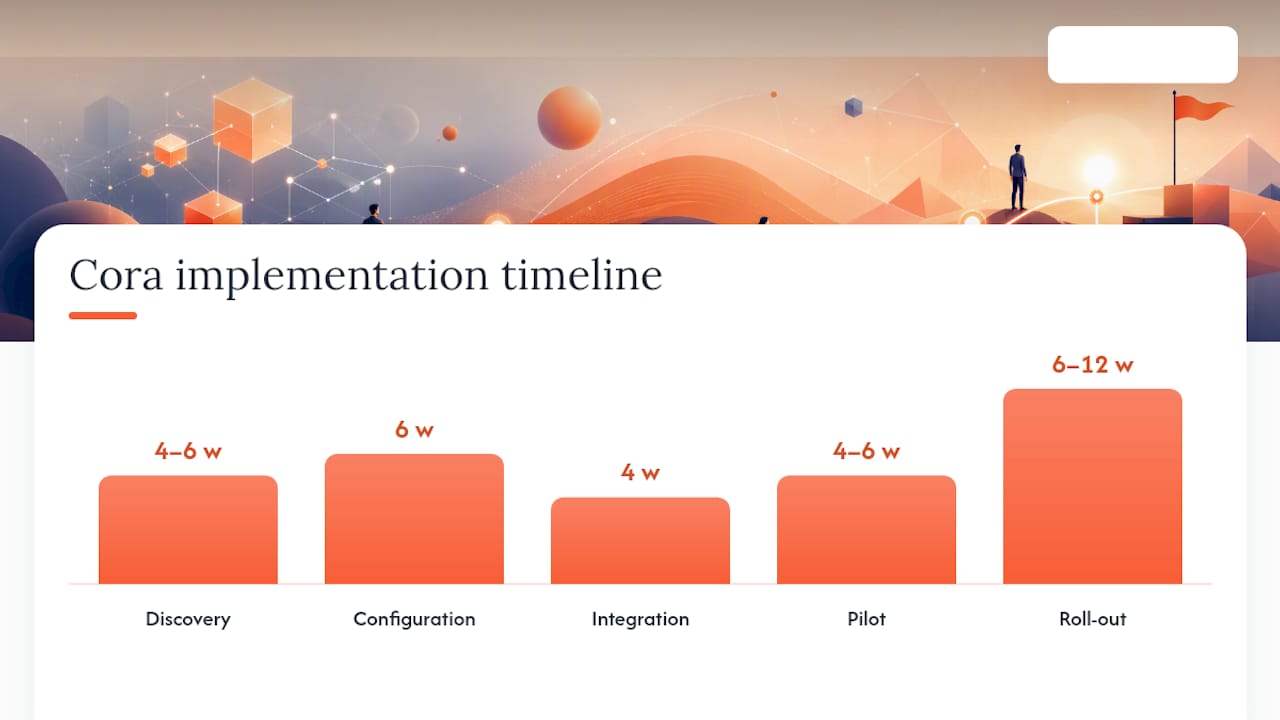
Total elapsed time from contract to production for a full enterprise deployment typically runs 6–12 months. Organisations that compress discovery or skip data cleansing consistently extend that timeline during integration and pilot phases.
What do customers and independent reviewers say about Cora?
Independent sentiment on Gartner Peer Insights clusters around two themes. Reviewers consistently credit Cora with strong portfolio visibility and the ability to align project delivery with strategic investment priorities. The platform’s governance controls and reporting depth draw positive commentary from PMO leads in regulated sectors. The counterweight is equally consistent: the platform has a meaningful learning curve, and organisations that underinvest in change management and user adoption programmes report lower realised value.
SoftwareAdvice adds scale context: the platform is cited across more than 50 countries managing over $20 billion of projects, which provides meaningful evidence of enterprise-grade scalability. The entry-level pricing signal ($50.00 per year per user) is useful as a budget anchor, but procurement teams should treat it as a starting reference rather than a planning figure.
What case studies and enterprise references indicate:
- Government and defence customers cite audit readiness and EVM compliance as primary value drivers
- Manufacturing and engineering customers highlight schedule and cost integration as the differentiating capability
- Regulated-sector customers value the pre-configured compliance controls in vertical modules
- Adoption timelines in case studies tend to be longer than initial estimates, reinforcing the change management caveat
How to weigh the evidence: vendor case studies are curated for positive outcomes. Use them to understand the use cases Cora performs best in, not as a proxy for typical results. Gartner Peer Insights and SoftwareAdvice reviews are more representative of the adoption experience, including the friction. Cross-reference both before shortlisting.
How does Cora map against enterprise PPM categories?
Placing Cora accurately in the market helps procurement teams avoid evaluating it against the wrong peer set. Cora is an enterprise PPM platform with a regulated-sector orientation. Comparing it to lightweight project tools or mid-market platforms on price or ease of deployment misframes the evaluation.
Shortlist mapping:
- Definite shortlist: regulated industries (A&D, public sector, pharmaceuticals, heavy engineering), CapEx-intensive programmes, organisations with a mature PMO and governance discipline, programmes requiring EVM and audit-ready reporting
- Conditional shortlist: organisations in transition from spreadsheet-based PMO to structured PPM, where the investment in change management and data discipline is planned and budgeted
- No: small or mid-market organisations without a dedicated PMO, programmes where agile delivery is the primary model and governance overhead is a constraint, organisations needing rapid deployment with minimal configuration
For context on enterprise project planning disciplines that underpin successful PPM adoption, the operational maturity requirements align closely with what Cora demands from its customers.
| Category dimension | Cora PPM profile |
|---|---|
| Best for | Regulated A&D, public sector, heavy CapEx industries |
| Pricing and licence model | Subscription; entry at $50/user/year; enterprise pricing by configuration |
| Deployment and integrations | Cloud, private cloud, on-premise; Teams, Jira, ERP via APIs and Boomi |
| Governance and EVM support | Strong; pre-configured for defence and government compliance |
| Scale and enterprise readiness | 50+ countries; $20bn+ projects managed; high transaction volume capable |
| Adoption effort | High; structured change management and training required |
| Analytics and decision support | Roll-up dashboards, forecasting, automated alerts; configurable by role |
What questions should you ask Cora during procurement and demos?
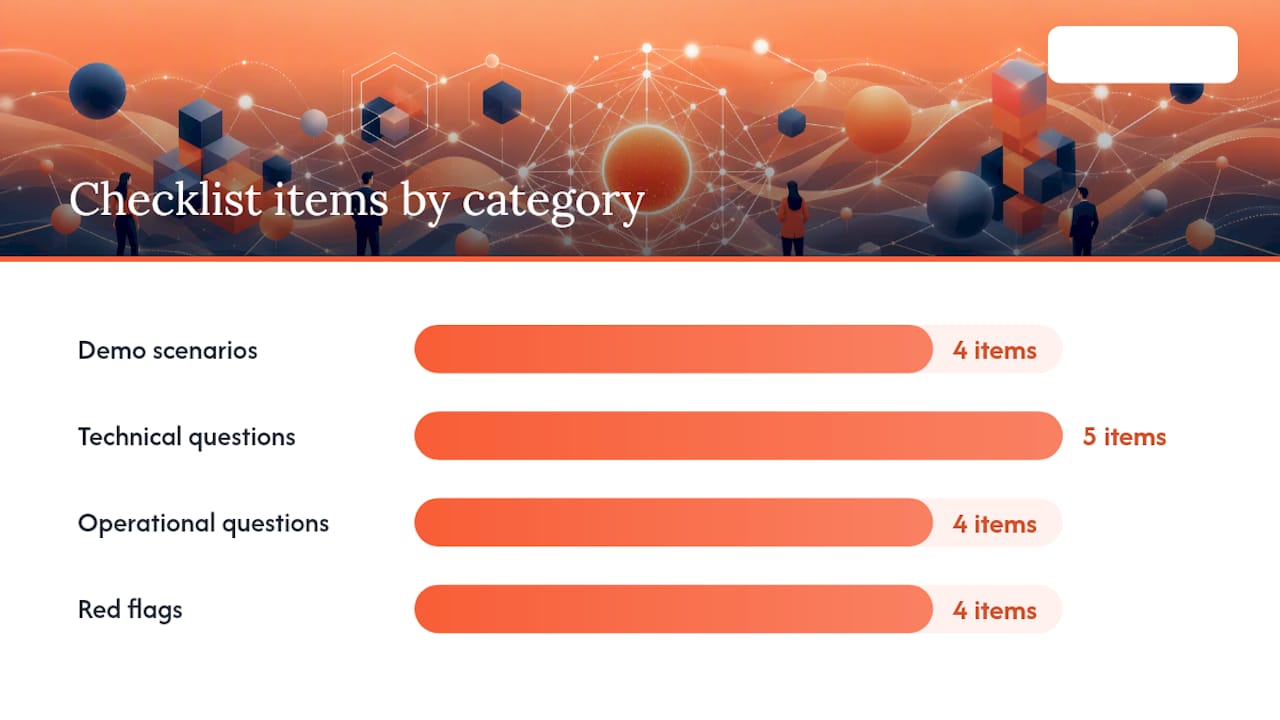
A structured demo script prevents vendors from showing only their strongest scenarios. These questions are designed to surface the gaps that matter for enterprise procurement.
Demo scenarios to test:
- Run an end-to-end cost change: update a work package cost, and show how it propagates to the EAC, the portfolio dashboard, and the finance reconciliation report without manual intervention.
- Simulate a schedule slip on a critical-path activity: show the impact on dependent tasks, resource demand, and the programme-level forecast in a single workflow.
- Demonstrate a resource reallocation across two concurrent programmes: show how capacity constraints surface and how the system supports the trade-off decision.
- Show an EVM roll-up from task level to programme level, including Budgeted Cost of Work Performed (BCWP) and Schedule Performance Index (SPI) calculations.
Technical questions:
- What is the API coverage for your data model? Which objects cannot be accessed via API?
- What is the latency between an ERP actuals posting and its appearance in the PPM dashboard?
- How does the platform handle multi-ledger environments where CapEx and OpEx are tracked in separate finance systems?
- What is the data model for cost codes, and how does it map to a standard chart of accounts?
Operational and people questions:
- What does a typical implementation team look like on the vendor side, and what is the expected client-side resource commitment?
- Who owns configuration post go-live: the client, a partner, or the vendor?
- What are the support SLAs for P1 incidents, and what is the escalation path?
- What does the training programme cover, and is there a user community or knowledge base for ongoing self-service?
Red flags in a pilot or PoC:
- Financial roll-ups that require manual reconciliation steps outside the platform
- Integration latency that makes the dashboard a lagging indicator rather than a real-time view
- Configuration changes that require vendor involvement rather than client-side administration
- User adoption metrics below 60% at the end of the pilot period
Analyst perspective: when does Cora deliver the most value?
Cora’s sweet spot is narrow but well-defined. The platform performs best in organisations that already have governance discipline and are looking to enforce and scale it, not in organisations that are trying to build governance culture from scratch using software as the catalyst. That distinction matters more than any feature comparison.
The implementation pitfall most commonly cited in independent reviews is not technical. It is organisational. Enterprises that deploy Cora without first standardising their cost-code taxonomy, stage-gate definitions, and data capture requirements at the project level find that the platform’s roll-up dashboards reflect the inconsistency of the underlying data rather than the portfolio clarity they were promised. The fix is not a configuration change; it is a governance conversation that should have happened before the contract was signed.
For PMO and IT leads considering Cora, the practical advice is to invest in three things before go-live: a data audit that maps every source system feeding into the PPM layer, a governance standardisation exercise that aligns stage-gate definitions and cost codes across business units, and a phased roll-out that starts with a high-governance programme where the discipline already exists. Proving value in a controlled environment before scaling to the full portfolio is consistently the approach that produces the adoption metrics and ROI outcomes that appear in vendor case studies.
When physical IT logistics drive programme risk, Smart Collect® changes the equation
For enterprises evaluating PPM platforms, the assumption is that programme risk is primarily digital: schedule slippage, cost overruns, resource conflicts. But for organisations running distributed workforces across multiple sites, a significant share of execution risk is physical. Device handovers delayed by manual processes, equipment unavailable at the point of need, and IT staff consumed by logistics rather than delivery are programme risks that no PPM dashboard can resolve.
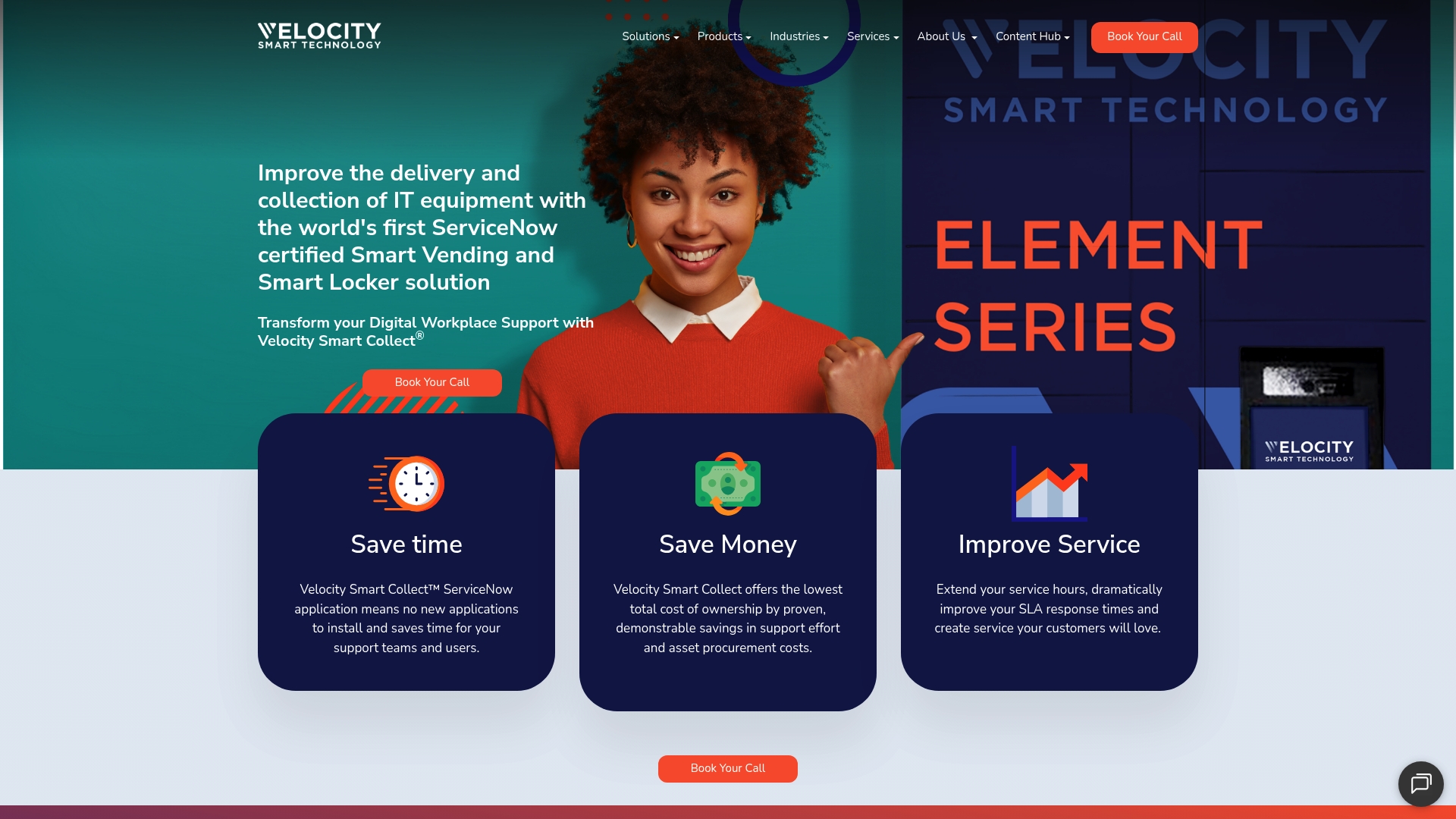
Smart Collect® by Velocity-smart addresses that specific gap. It is a ServiceNow-native platform that automates physical IT handovers through smart lockers, smart vending, and smart kiosks, running natively inside your existing ServiceNow tenant with no parallel database or separate security review. A global pharma customer using Smart Collect® achieved 500% uplift in IT service throughput and 83% faster fulfilment, outcomes delivered before agentic AI began driving the workflow. For programme teams where device logistics are on the critical path, those numbers represent a material reduction in execution risk. Request a walkthrough or view the full case study to see how the model applies to your estate.
Sources
Use these resources at each stage of your procurement process.
Vendor pages for feature verification and demos:
Independent review platforms for sentiment and adoption signals:
For adjacent physical IT support options:
Verification checklist by task:
Recommended
See what Smart Collect® could save you
Model your savings in two minutes, or book a 60-minute workshop to pressure-test the numbers against your estate.