 Device asset logging explained: boost control and efficiency">
Device asset logging explained: boost control and efficiency
TL;DR:
- Device asset logging creates a complete, auditable history of all device events throughout its lifecycle.
- Integrating logging with automation platforms improves efficiency, compliance, and device management.
- Many enterprises overlook logging as a strategic asset, limiting its full potential for security and support.
Every year, large enterprises lose thousands of pounds to devices that simply vanish from their records. A laptop reassigned without documentation, a tablet returned to the wrong location, a decommissioned phone never formally logged out — these small gaps compound into serious financial, security, and compliance risks. Device asset logging addresses this directly by creating a structured, auditable record of every device event across its entire lifecycle. This article covers what device asset logging is, how it works in practice, the business benefits it delivers, and how integrating it with automation platforms can transform IT efficiency for large organisations.
Table of Contents
- What is device asset logging?
- How does device asset logging work?
- The business benefits of device asset logging
- Integrating asset logging into enterprise automation
- Why most enterprises underestimate device asset logging
- How Velocity Smart Tech accelerates device asset logging
- Frequently asked questions
Key Takeaways
| Point | Details |
|---|---|
| Complete device timeline | Device asset logging records every device event, not just location, providing full lifecycle oversight. |
| Supports automation | Seamless logging enables efficient support, proactive management, and robust automation in large enterprises. |
| Boosts compliance | Comprehensive logs simplify auditing and regulatory compliance, reducing business risk. |
| Minimises asset loss | Real-time logging technologies reduce device loss and increase cost control. |
What is device asset logging?
Device asset logging is the structured recording of every interaction, movement, or change related to an IT device from the moment it enters the organisation until it is disposed of. Think of it as a running ledger for each device, capturing who touched it, when, why, and what happened as a result.
This is often confused with asset tracking, but the two serve different purposes. Asset tracking tells you where a device is right now. Asset logging tells you everything that has ever happened to it. One is a snapshot; the other is a complete history. If you want to understand the difference between asset logging and tracking, the distinction matters enormously when preparing for an audit or investigating a security incident.
A robust device asset log typically captures:
- Check-in and check-out events — who collected or returned a device and when
- Custody transfers — formal handoffs between employees, departments, or sites
- Maintenance records — repairs, software updates, and configuration changes
- Disposal and decommissioning events — end-of-life processing and data wiping confirmation
- Location changes — movement between offices, warehouses, or remote sites
“A device log is not just a record — it is the chain of evidence that protects your organisation during audits, disputes, and security investigations.”
For enterprises managing thousands of devices across multiple sites, the overview of device management challenges makes clear that unlogged devices are not merely an inconvenience. They are a liability. Regulatory frameworks such as ISO 27001 and GDPR require demonstrable control over data-bearing assets, and a complete asset log is the most direct way to satisfy those requirements. Methodologies such as active discovery, passive discovery, and chain of custody logging are the building blocks that make this possible at scale.

How does device asset logging work?
In an enterprise environment, device asset logging is not a single tool or process. It is a combination of methodologies, technologies, and integrations that work together to capture a complete picture of every device.
Active and passive discovery, RFID tagging, barcodes, and CMDB integration are the most widely used approaches. Here is how each one fits into the bigger picture:
- Active discovery — The system actively scans the network at scheduled intervals, identifying every connected device and logging its presence, configuration, and status automatically.
- Passive discovery — Rather than scanning, the system listens for device activity on the network, logging events as they occur in real time.
- RFID and barcode tagging — Physical tags are applied to devices. Scanning a tag at any point in the device’s journey creates an instant log entry, linking the physical asset to its digital record.
- Chain of custody logging — Every handoff is formally recorded, creating an unbroken sequence of accountability from procurement to disposal.
- CMDB and ITAM integration — All log data feeds into a centralised Configuration Management Database or IT Asset Management platform, making it searchable, reportable, and actionable.
| Methodology | Key strength | Limitation | Best fit |
|---|---|---|---|
| Active discovery | Automated, scalable | Misses offline devices | Large networked environments |
| Passive discovery | Real-time, low overhead | Requires persistent monitoring | Security-sensitive organisations |
| RFID tagging | Fast, accurate scanning | Hardware cost | High-volume device distribution |
| Barcode tagging | Low cost, simple | Manual scanning required | Smaller fleets or specific workflows |
| Chain of custody | Full accountability | Process discipline required | Regulated industries |
Barcode-based logging in IT support is particularly effective when combined with smart locker systems, where a scan at collection or return automatically updates the asset record without any manual data entry. Similarly, barcode scanner lockers are proving their value in high-throughput environments where speed and accuracy both matter.
Pro Tip: Combine passive discovery with RFID tagging for a layered approach. Passive discovery catches networked devices automatically, while RFID handles the physical handoffs that network scans cannot see.
Centralised logging is the critical enabler here. Without a single source of truth, log data sits in silos and loses its value. Smart solutions for reducing asset loss consistently point to centralisation as the factor that separates reactive IT teams from proactive ones.
The business benefits of device asset logging
When device asset logging is implemented well, the benefits extend far beyond tidy spreadsheets. They translate directly into financial savings, compliance confidence, and a better experience for employees.
Audit-readiness and compliance become far less stressful. Instead of scrambling to reconstruct device histories before an audit, your team can pull a complete, timestamped record for any asset in seconds. Asset logging enables audit-ready records that satisfy regulators and internal governance teams alike.
Financial control improves significantly. Accurate logs reveal devices that have gone missing, been duplicated in the system, or are sitting unused. Enterprises routinely discover that a meaningful proportion of their device fleet is either lost or redundant once proper logging is in place.
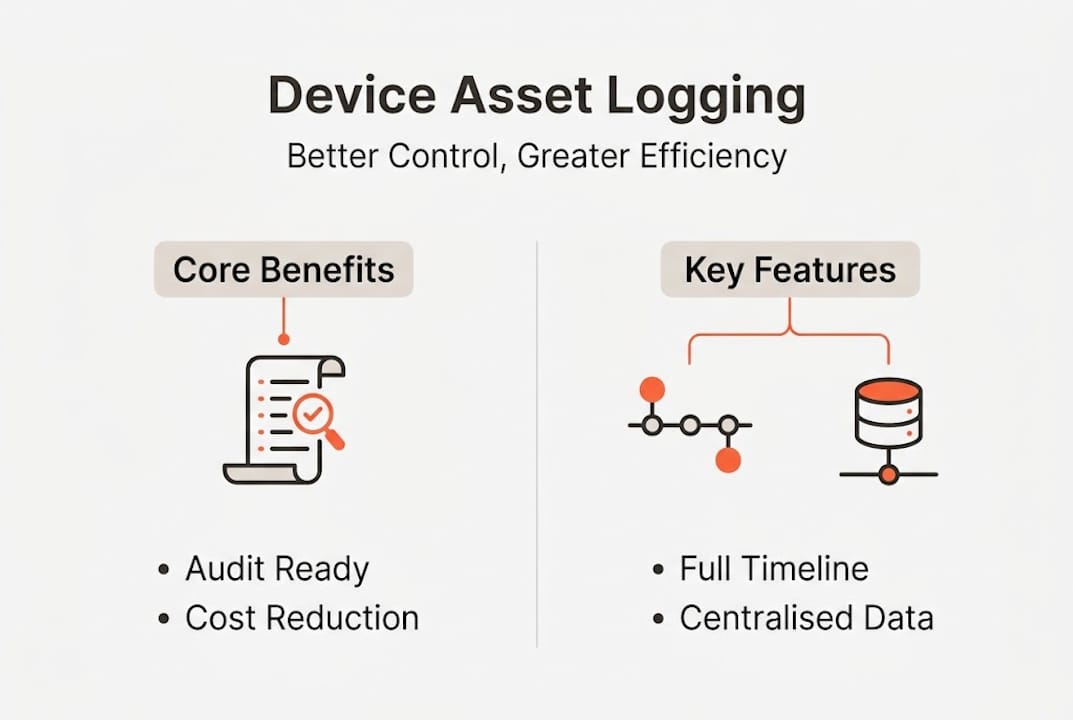
Support automation becomes possible. When your ITSM platform knows the full history of a device — its age, its previous issues, its current custodian — it can automate provisioning, replacement, and support workflows without human intervention. Driving efficiency in large organisations through this kind of automation is one of the most compelling arguments for investing in logging infrastructure.
Key benefits at a glance:
- Reduced time spent on manual reconciliation and audit preparation
- Lower device loss and theft rates through accountability
- Faster employee onboarding and device fulfilment
- Improved compliance posture across GDPR, ISO 27001, and sector-specific regulations
- Better visibility for budget planning and refresh cycles
Digital lockers for IT asset management take these benefits further by automating the physical side of device distribution, ensuring every collection and return is logged without relying on human memory or manual entry.
Pro Tip: Integrate asset logging with your MDM or UEM platform from day one. Retrofitting the integration later is significantly more complex and often results in gaps in historical data that undermine the very compliance benefits you are trying to achieve.
Automating compliance processes is increasingly recognised as a strategic priority for technology and financial services firms, and device asset logging is a foundational component of that approach.
Integrating asset logging into enterprise automation
Device asset logging reaches its full potential when it is not a standalone process but a live data feed into your broader automation ecosystem. This is where the real efficiency gains materialise.
Asset logging reduces manual reconciliation and enhances automation across MDM, UEM, and ITSM platforms by ensuring those systems always have accurate, current data to act on. When a device is checked out via a smart locker, the log entry can automatically trigger a provisioning workflow in your MDM platform. When a device is returned, the log can initiate a wipe-and-reset process without any technician involvement.
Here is a practical sequence for integrating asset logging with enterprise automation platforms:
- Define your data schema — Agree on the fields every log entry must capture: device ID, custodian, location, event type, timestamp, and condition.
- Connect your logging source to your CMDB — Ensure every log event updates the central record in real time, not in batch uploads that create lag.
- Map log events to ITSM workflows — Identify which log events should trigger automated actions: provisioning, alerts, replacements, or compliance flags.
- Set up exception reporting — Configure alerts for anomalies such as devices not returned within expected timeframes or assets appearing in unexpected locations.
- Review and iterate — Audit the integration quarterly to identify gaps and refine the workflows as your device fleet evolves.
Best practices for a successful integration:
- Use a platform that supports native integration with your existing ITSM tools rather than requiring middleware
- Ensure logging captures both successful and failed events — failed scans and access denials are often as informative as successful ones
- Train IT staff on the importance of consistent logging discipline, particularly for physical handoffs
- Leverage centralised asset tracking as the backbone of your automation strategy
- Review your logging methodology annually as your device fleet and workplace model evolve
Enhancing IT asset automation through integrated logging is not a one-time project. It is an ongoing capability that compounds in value as your data history grows and your workflows become more sophisticated.
Why most enterprises underestimate device asset logging
Here is an uncomfortable truth: most IT leaders treat device asset logging as a compliance obligation rather than a strategic capability. They implement just enough to satisfy an auditor and then move on. This is a significant missed opportunity.
The enterprises that gain the most from logging are those that treat it as the data foundation for everything else — support automation, employee experience, financial planning, and security response. When you connect logging to your support workflows, you stop reacting to device problems and start preventing them. When you link it to your digital locker infrastructure, you create a self-service model that reduces IT workload while improving the experience for employees.
The practical lesson we have seen repeatedly is this: start with one site, one device category, and one integrated workflow. Measure the impact rigorously. Then scale. Organisations that try to boil the ocean from day one rarely achieve the outcomes that those who start focused and expand deliberately do.
How Velocity Smart Tech accelerates device asset logging
Ready to put your device asset logging on autopilot? Velocity Smart Technology connects logging, automation, and support into a single, cohesive platform built natively on ServiceNow — the platform trusted by 85% of the Fortune 500.

Our Smart IT support kiosk enables employees to collect, return, and troubleshoot devices at workplace locations without requiring onsite technicians, with every interaction automatically logged. Our Smart Collect locker software automates device distribution and return, feeding real-time log data directly into your ITSM workflows. Explore how leading enterprises are reimagining IT operations through our Automation Unboxed resource hub and see what intelligent asset logging looks like in practice.
Frequently asked questions
How is device asset logging different from asset tracking?
Device asset logging creates a complete history of every event in a device’s lifecycle, while asset tracking tells you only the current location or status of a device. Logging is retrospective and auditable; tracking is present-tense and positional.
What are common challenges in implementing device asset logging?
The most frequent obstacles are integration complexity with existing platforms, inconsistent user adoption for manual logging steps, and choosing the right methodology for the scale and nature of your device fleet.
Why does device asset logging matter for audits and compliance?
Asset logging enables audit-ready records by ensuring every device event is captured with a timestamp and custodian, giving regulators and internal governance teams a clear, unbroken chain of evidence.
What technologies are used for device asset logging?
RFID, barcodes, active and passive discovery, agentless network scanning, asset tags, and centralised ITAM or CMDB platforms are the most widely used technologies for enterprise-scale device asset logging.
Recommended
See what Smart Collect® could save you
Model your savings in two minutes, or book a 60-minute workshop to pressure-test the numbers against your estate.