ESS employee services: automating physical IT fulfilment in ServiceNow
For enterprise ESS employee services, the answer is a ServiceNow-native physical fulfilment platform, not a locker bolted onto a portal. Extend ServiceNow with a Built on Now app that governs smart lockers, smart vending and a virtual kiosk, and writes every device transaction into your CMDB as a native record.
That gets you three form factors, each solving a distinct fulfilment problem:
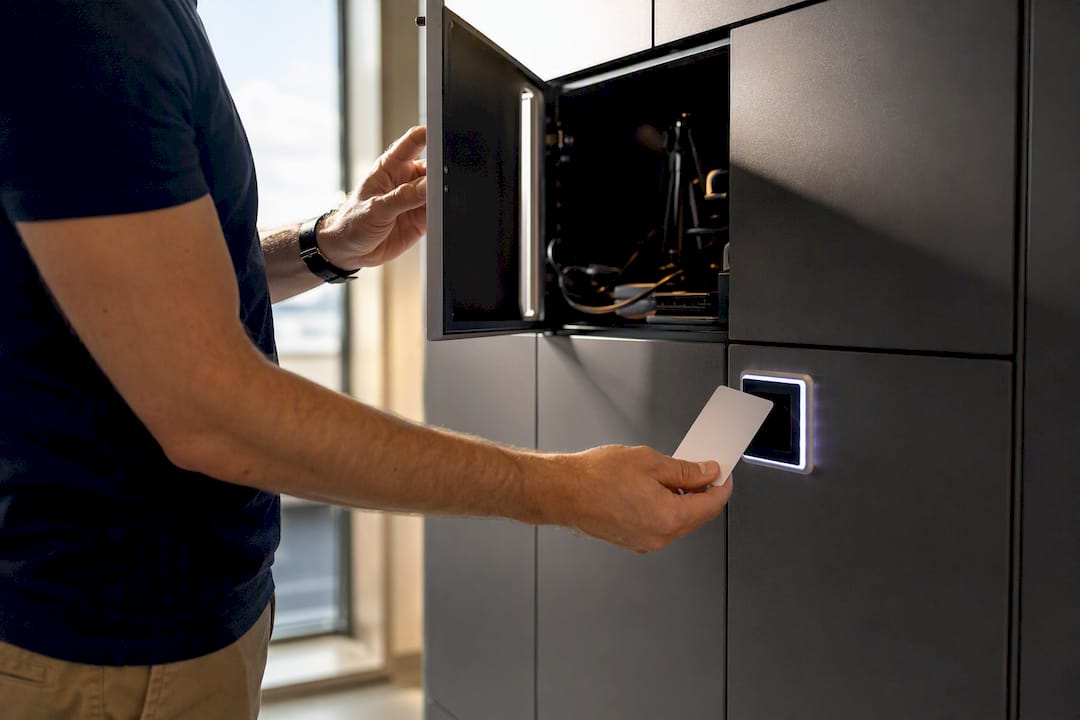
- Smart lockers — unattended device swaps, new-starter kit collection and equipment returns.
- Smart vending — 24/7 dispensing of peripherals and consumables with configurable allowances.
- Smart Kiosk™ — a virtual tech bar that resolves walk-up issues without an engineer.
Deployed correctly, expect faster fulfilment, fewer on-site tickets, and CMDB integration with no parallel database. Velocity Smart Technology reports a pharma customer achieving a substantial throughput uplift and a nuclear energy operator significantly reducing on-site tickets.
Key Takeaways
Tenant-resident deployment, native CMDB writes and archetype-based scaling determine whether ESS employee services deliver measurable throughput gains or become another integration liability.
| Point | Details |
|---|---|
| Verify tenant residency | Confirm the app writes CIs directly in your ServiceNow tenant, with no external database or sync job. |
| Build a small archetype library | Map three or four site models (HQ, branch, remote hub) to reusable service catalogue items. |
| Prioritise audit and reconciliation | In regulated industries, chain-of-custody and stock reconciliation usually gate go-live approval. |
| Benchmark against verified outcomes | Pharma and nuclear deployments show 500%+ throughput and 60% ticket reduction using conventional workflows. |
| Evaluate Smart Collect® directly | Velocity-smart’s Smart Collect® runs as a certified Built on Now app across lockers, vending and Smart Kiosk™. |
Table of Contents
- How does ESS employee services fit into ServiceNow workflows and CMDB?
- What use cases do smart lockers, vending and Smart Kiosk™ solve?
- What integration and audit controls should you validate before deployment?
- How do you scale ESS employee services across multiple sites?
- What should a procurement checklist for ESS employee services include?
- What the case studies actually prove about scale
- Smart Collect®: request a demo or workshop
- Frequently asked questions
- Sources
How does ESS employee services fit into ServiceNow workflows and CMDB?
“Built on Now” is a specific technical claim, not marketing language. It means the application is built on the Now Platform itself, runs inside your existing ServiceNow instance, and follows your release cadence rather than shipping its own roadmap. There’s no external database syncing device data back into ServiceNow on a schedule. There’s no middleware layer translating API calls between two systems that were never designed to talk to each other. The workflow that requests a laptop swap, the record that tracks its serial number, and the audit trail that proves who collected it all live in the same place your ITSM data already lives.
That matters most for CMDB integrity. When a locker releases a device, that transaction becomes a native configuration item update, not a scheduled import job that might run four hours late. Serial numbers, locations, ownership history and condition status stay queryable exactly like any other CI, because they are one.
Operationally, this gives platform owners three levers:
- RBAC inheritance — no separate permission model to maintain or audit.
- Full audit trails — every collection, return and vend logged against existing ServiceNow identity records.
- Restock and allowance controls — configurable vending limits and one-time dispensations, managed the same way you’d manage any other ServiceNow Store-listed application.
Pro Tip: Before evaluating any vendor, ask them to show you the CI record a device transaction creates. If they can’t produce one from inside your own tenant, you’re looking at an integration, not a native application.
What use cases do smart lockers, vending and Smart Kiosk™ solve?
Each form factor targets a different fulfilment pattern, and most enterprises need all three running together rather than picking one.
- Smart lockers handle full-device handovers: joiner kit delivery on day one, broken-laptop swaps that don’t require a desk visit, and loan equipment returns that used to sit in an IT cupboard for weeks. Roche runs this model across the US, Switzerland, Germany and China, and Smart Lockers support the barcode and RFID collection flows that keep chain-of-custody intact.
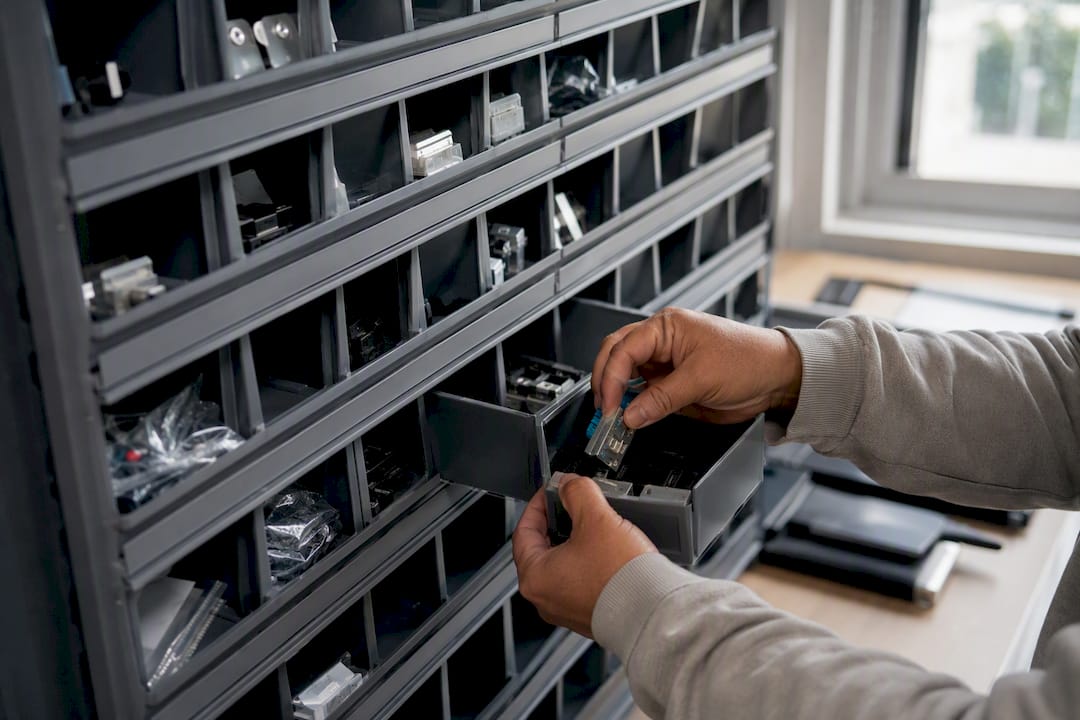
- Smart vending covers the peripherals and consumables that generate the highest volume of low-value tickets: mice, headsets, cables, dongles. Configurable allowances stop it becoming a free-for-all. A restricted vending allowance can cap an employee to one replacement headset per quarter, or authorise a one-time dispensation tied to a specific approved ticket.
- Smart Kiosk™ replaces the physical help desk with a virtual tech bar. Instead of a queue at a desk, employees get an AI-powered video resolver group for walk-up issues, cutting engineer dispatch for problems that don’t actually need a physical visit.
The common thread across all three: they reduce IT staff travel and desk-side callouts, which is precisely where a US aerospace and defence customer saw a notable reduction across dozens of sites.
What integration and audit controls should you validate before deployment?
Three checks separate a genuinely tenant-resident platform from one that merely claims to be.
First, confirm tenant residency in practice, not in the pitch deck. Ask the vendor to demonstrate a live transaction writing a CI directly into your sandbox instance, with no external call to a vendor-hosted database. If the demo requires a “sync” step, that’s your answer.
Second, confirm RBAC inheritance and CMDB writes work against your actual role hierarchy, not a generic demo tenant. A platform that reads your permissions but writes to its own schema will eventually create a reconciliation headache your audit team won’t thank you for.
Third, in regulated industries, chain-of-custody and stock reconciliation are usually the deciding factor for go-live, not the user interface. Build these into your proof-of-value success criteria from day one:
- Full audit trail of every collection, return and dispensation, tied to employee identity.
- Automated restock alerts before a locker or vending unit runs empty.
- Stock reconciliation reports that reconcile physical count against CMDB record count.
Velocity Smart Technology’s ISO 9001 and ISO 27001 certification is worth checking against whichever standard your compliance team already benchmarks vendors on.
One statistic worth sitting with: desktop support tickets typically cost significantly more to resolve than digital ones, and that gap widens further as AI drives down the cost of purely digital service work. Physical fulfilment is the cost line that doesn’t shrink on its own.
How do you scale ESS employee services across multiple sites?
Scaling physical fulfilment across dozens or hundreds of sites fails when every location gets a bespoke build. The fix is a small library of site archetypes, each mapped to a standard ServiceNow service catalogue item.
Most enterprises need no more than three or four archetypes: a headquarters model with high-density lockers and vending, a regional branch model with a single mid-size locker bank, and a remote hub model with vending only. Publishing each archetype as a catalogue item turns a new site rollout into a configuration exercise rather than a fresh engineering project.
For organisations running multiple ServiceNow instances, whether from historic M&A activity or regional data residency requirements, CMDB modelling has to account for synchronised update cycles across instances. Multi-instance governance typically requires:
- A named platform owner accountable for the physical fulfilment application across all instances.
- CI/CD pipelines that push configuration changes consistently rather than instance-by-instance.
- Central dashboards that aggregate throughput and stock data across every site and instance.
- Exception records for any site that genuinely can’t fit an existing archetype.
Enel’s six-country deployment is the kind of scale where archetype discipline stops being optional. Without it, every new country becomes a fresh integration project rather than a template roll-out, and your CMDB starts drifting from a single model into six loosely related ones.
What should a procurement checklist for ESS employee services include?
Run this checklist before signing anything, whether you’re issuing an RFP or scoping a proof-of-value.
- Confirm certification and tenant residency. Ask for Built on Now certification proof and current ISO 9001 and ISO 27001 status, then verify the application writes CIs inside your own tenant during the demo.
- Demand CMDB and RBAC evidence. Request sample CI records, a live RBAC test against your role hierarchy, and a reporting dashboard built entirely from native ServiceNow data.
- Check form factor fit against your estate. Match locker density, vending SKU range and Smart Kiosk™ coverage to your actual site mix, not a generic reference architecture.
- Ask for implementation model and channel partner options. Many enterprise rollouts run through systems integrators who already hold ServiceNow Service Specialist Partner status.
- Request measurable baselines. Ask for throughput improvements and staff time reclaimed from comparable regulated-industry deployments, not headline percentages without context.
Pro Tip: *Score any pilot against reclaimed IT staff time, not just ticket volume.
What the case studies actually prove about scale
The verifiable outcomes here predate agentic AI entirely. That’s worth sitting with: if a tenant-resident fulfilment platform delivers those numbers before AI is doing any of the routing or decision-making, the reasonable expectation is that these figures represent a floor, not a ceiling, as Now Assist and similar agentic tools mature into the workflow layer.

What convinces a platform owner isn’t the headline number so much as where it came from.
Smart Collect®: request a demo or workshop
Smart Collect® is the platform behind every mechanism described above: a Built on Now ServiceNow Store application that runs natively in your tenant, orchestrating smart lockers, smart vending and Smart Kiosk™ from a single control point with no external database and no middleware layer. It’s ISO 9001 and ISO 27001 certified, and it inherits your existing RBAC, audit trail and CMDB structure rather than replicating them.
If your organisation is weighing up a proof-of-value for physical fulfilment inside ServiceNow, the Smart Collect® product page covers the full feature set, and the IT asset locker specifications are worth reviewing before you scope hardware for a pilot site. The next practical step is requesting a workshop to map your own site archetypes against Smart Collect’s deployment model, and to see a live CMDB write inside your own sandbox instance before committing to a wider rollout.
Frequently asked questions
What does “ESS employee services” mean in a ServiceNow context? Here, it refers to employee-facing physical IT fulfilment and support delivered through ServiceNow: device pick-up and return, peripheral vending, and walk-up support via smart lockers, vending units and Smart Kiosk™, rather than HR self-service portals.
Does a physical fulfilment platform need its own database? No, and it shouldn’t. A genuinely Built on Now application writes device state, location and ownership directly into your existing CMDB as native configuration items, with no parallel database to reconcile.
How many site archetypes does a large enterprise typically need? Most organisations manage with three or four: a high-density headquarters model, a mid-size regional branch model, and a lightweight remote hub model, each published as a ServiceNow service catalogue item.
What proof points should a CIO ask for during a pilot? Ask for throughput improvement figures, staff time reclaimed, and ticket reduction percentages from comparable regulated-industry deployments, alongside a live demonstration of CI writes inside your own sandbox tenant.
Can Smart Kiosk™ fully replace an onsite help desk? It reduces engineer dispatch for issues resolvable through a virtual tech bar, but most enterprises run it alongside lockers and vending rather than as a complete replacement for every onsite scenario.
Sources
Recommended
See what Smart Collect® could save you
Model your savings in two minutes, or book a 60-minute workshop to pressure-test the numbers against your estate.