 How APIs transform asset management and IT support">
How APIs transform asset management and IT support
TL;DR:
- Proper API integration transforms asset management, increasing accuracy and operational efficiency significantly.
- Hybrid approaches combining real-time APIs with bulk data tools optimize large enterprise asset systems.
- Effective API governance, monitoring, and strategic planning are crucial for long-term success and avoiding technical debt.
Enterprise IT teams often underestimate how much strategic value sits locked inside their existing API infrastructure. ServiceNow ITAM benchmarks show improvements of 40% in asset tracking, 30% reductions in software costs, and up to 70% gains in operational efficiency. Those numbers belong to organisations that treat APIs as strategic assets, not mere technical connectors. This guide unpacks what API integration genuinely delivers for enterprise asset management, where the real-world friction points lie, and how IT leaders can move from tactical plumbing to a governance-driven integration model that drives lasting results.
Table of Contents
- What APIs really do for asset management
- Critical benefits of API-driven asset management
- API integration with ServiceNow: practical realities
- When APIs aren’t enough: alternatives and hybrid approaches
- Our perspective: rethinking API strategy for large enterprise asset management
- Next steps to revolutionise your IT asset management
- Frequently asked questions
Key Takeaways
| Point | Details |
|---|---|
| APIs enable modern asset management | They connect systems for automation, accuracy, and real-time visibility. |
| Quantifiable enterprise benefits | APIs drive up to 70% efficiency gains and 30% cost reduction when paired with governance. |
| Plan for edge cases in ServiceNow | Address rate limits, security, and multi-source data to avoid downtime and conflicts. |
| Consider API alternatives for scale | Tools like Perspectium or iPaaS may outperform APIs on bulk or hybrid enterprise needs. |
What APIs really do for asset management
Most IT leaders know that APIs connect systems. Far fewer understand the depth of transformation that well-designed API integration brings to asset management at enterprise scale. An API, or Application Programming Interface, is simply a defined contract between two software systems, specifying how they exchange data and trigger actions. In asset management, that contract becomes the backbone of everything from automated device provisioning to real-time compliance reporting.
At its core, an API integration connects your asset database, your IT service management platform, and your automation tooling into a single, coherent workflow. When a new employee joins, the API can trigger device assignment, update inventory records, push a notification to the service desk, and log a compliance entry, all without a human touching a keyboard. When a device reaches end of life, the same chain operates in reverse. This is what enterprise IT asset efficiency looks like when it is designed correctly.
APIs also serve as the integration layer for modern workplace technology. Mobile apps, IoT sensors, self-service kiosks, and smart locker systems all rely on APIs to report device status, authenticate users, and synchronise asset records. Without robust API connections, these tools produce isolated data that never enriches the wider asset management picture. With them, every touchpoint feeds a single source of truth that supports centralised asset tracking across every site and region.
The performance data is striking. Research shows APIs support a 22% increase in developer productivity and save organisations over 100,000 hours annually by eliminating manual data re-entry and reconciliation tasks. Those hours translate directly into IT staff capacity redirected towards higher-value work.
It is also worth clarifying the API’s role relative to other integration layers. Middleware and iPaaS platforms often sit above the API layer, orchestrating complex, multi-step integrations. APIs are the foundation. They are not a substitute for process design or governance, but no integration layer above them can function without them being well-defined and well-managed.
“APIs are the connective tissue of the modern enterprise. Their value is not in what they connect, but in what those connections make possible: automated, auditable, and scalable operations.”
The key functions APIs enable in asset management:
- Real-time asset tracking across distributed locations and systems
- Automated onboarding and offboarding of devices and users
- Compliance and licence reporting triggered by system events rather than scheduled manual audits
- IoT and self-service integration that feeds live device status into asset records
- Cross-platform data synchronisation that eliminates reconciliation backlogs
Critical benefits of API-driven asset management
The business case for API-driven asset management rests on measurable outcomes, not theoretical efficiency. Organisations that have implemented structured API integration within their ServiceNow environment report 40% better asset tracking, 30% software cost reduction, and a 70% gain in operational efficiency. These figures reflect the compounding effect of removing manual processes, improving data accuracy, and enabling real-time decision-making.
Consider the licence management challenge alone. Without API integration, licence reconciliation is a periodic, error-prone exercise. With it, licence usage data flows continuously from endpoints into your asset management system, triggering alerts when utilisation drops below a threshold or when unapproved software appears. The savings on unused or duplicated licences quickly justify the integration investment.

Agility is another underappreciated gain. When your enterprise adds a new device category, such as a fleet of tablets for a new operational site, API-driven asset management means those devices are tracked, provisioned, and policy-governed from day one. Manual processes would require weeks of catalogue updates, spreadsheet changes, and service desk training. With strong asset loss prevention strategies underpinned by API integration, inventory accuracy improves dramatically and shrinkage becomes detectable rather than discovered in the next annual audit.
| Metric | Before API integration | After API integration |
|---|---|---|
| Asset tracking accuracy | ~60% | ~85%+ |
| Software licence waste | 25-35% overspend | Reduced by up to 30% |
| Onboarding time per device | 2-4 hours manual | Minutes, automated |
| Compliance reporting lag | Days to weeks | Real-time |
| IT staff hours on reconciliation | High | Significantly reduced |
The shift to automating asset handling also tightens the link between asset data and financial planning. When inventory is accurate in real time, procurement decisions are grounded in fact rather than estimation, reducing both over-purchasing and emergency spend.
- Define asset lifecycle stages clearly before building API workflows
- Map every data field to a single authoritative source to prevent conflicts
- Automate compliance alerts at the point of policy breach, not after the fact
- Use API event logs as an audit trail for risk and regulatory reporting
- Review and retire deprecated API connections on a regular governance cycle
Pro Tip: Connect real-time asset dashboards directly to your ServiceNow API feeds and configure threshold-based compliance alerts. Visibility at this level transforms asset management from a reactive function into a proactive governance tool.
API integration with ServiceNow: practical realities
Understanding the benefits is one thing. Knowing what ServiceNow API integration actually involves in a production enterprise environment is where many programmes encounter friction. The practical realities are worth examining honestly.
ServiceNow’s REST API is powerful, but it operates within defined boundaries. Rate limits of approximately 100,000 requests per hour, combined with thread concurrency restrictions, mean that poorly designed integrations will hit 429 errors under load. In a large enterprise with dozens of integrated systems, this is not an edge case. It is a near certainty unless integration architects plan for it from day one.
Data conflicts are equally common. When multiple source systems feed asset records into ServiceNow, the same device can appear with conflicting statuses depending on which system wrote last. Resolving this requires clear data ownership rules, documented field-level authority, and automated reconciliation routines that detect and flag discrepancies rather than silently overwriting records.
Semaphore saturation is a subtler risk. ServiceNow uses semaphores to manage concurrent script execution, and high-volume API integrations can exhaust available semaphores, causing queued processes to fail. Monitoring semaphore usage is not optional in large deployments; it belongs in your integration health dashboard from launch.
“The integrations that fail in production are rarely the ones that failed in testing. They are the ones that were never stress-tested against real enterprise data volumes and concurrency patterns.”
Security must be addressed at the API design stage, not bolted on afterwards. Access control lists (ACLs) should enforce the principle of least privilege, meaning every integration receives only the permissions it genuinely requires. OAuth 2.0 is the current standard for API authentication, and token rotation policies should be defined before go-live. Review ServiceNow API integration pitfalls thoroughly during your planning phase.
| Approach | Best for | Key advantage | Key limitation |
|---|---|---|---|
| Direct API | Real-time, low-volume workflows | Full control and flexibility | Rate limits, custom maintenance |
| iPaaS | Hybrid and complex integrations | Pre-built connectors, lower dev cost | Vendor dependency, data residency |
| Perspectium | Bulk data replication | High throughput, no rate limit risk | Less suited to real-time triggers |
Following integration workflow best practices and understanding the nuances of digital locker integration with ServiceNow will save considerable rework downstream.
Pro Tip: Build automated reconciliation routines that run on a scheduled cadence and compare records across integrated systems. Pair this with API monitoring that captures response times, error rates, and rate limit proximity so your team can act before failures reach end users.
When APIs aren’t enough: alternatives and hybrid approaches
APIs excel in specific conditions. They handle real-time, event-driven workflows exceptionally well and are ideal for triggering actions in ServiceNow based on device status changes, user requests, or compliance events. However, API-only approaches struggle when the data volumes climb into the millions of records or when the integration requires continuous bulk synchronisation between large data stores.
This is where tools like Perspectium and iPaaS platforms earn their place. Perspectium is designed specifically for high-throughput ServiceNow data movement, replicating records in bulk without touching the API rate limit ceiling. It suits scenarios such as populating a data warehouse, synchronising large CMDB datasets, or feeding analytics platforms with historical asset data. The ITAM empirical benchmarks for operational efficiency gains are most fully realised when the right tool is matched to the right use case.
iPaaS platforms such as MuleSoft or Boomi occupy a different niche. They orchestrate complex, multi-system integrations that span cloud and on-premise environments, handling data transformation, routing, and error management in a single visual workflow. The trade-off is vendor dependency and the overhead of maintaining another platform. Custom API integrations offer more flexibility and tighter control but demand skilled developers and ongoing maintenance investment.
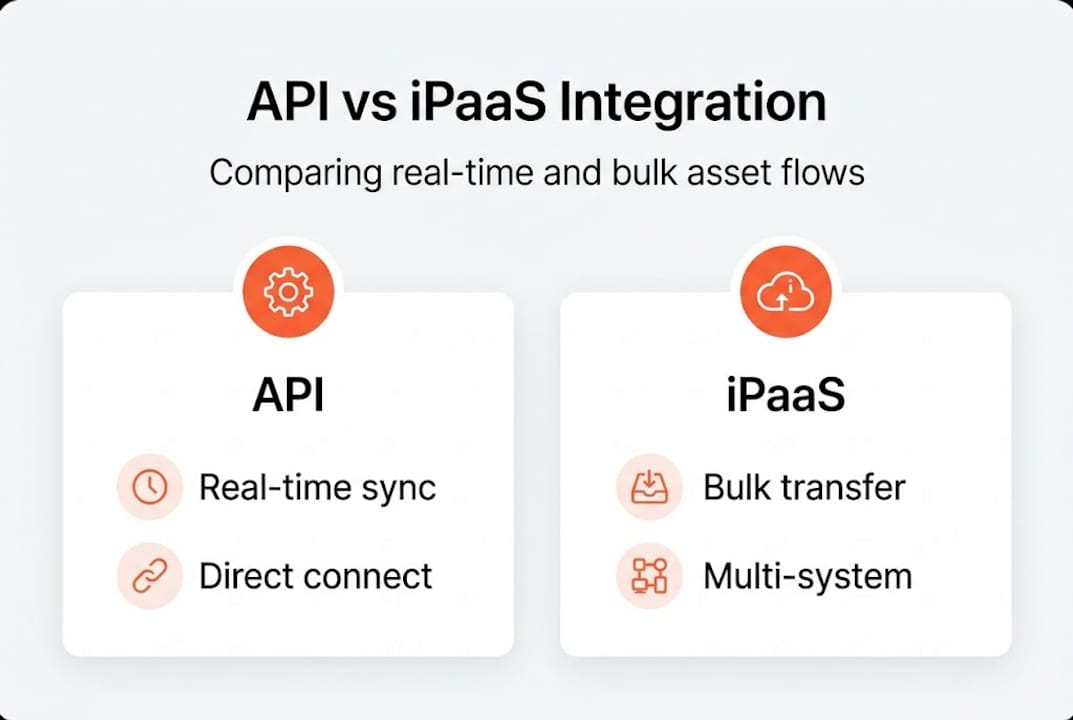
The asset support transformation potential and the expanding asset vending machine role in enterprise IT both benefit from a hybrid model where real-time API calls handle employee-facing interactions while bulk frameworks manage background data synchronisation.
When to use APIs versus alternatives:
- Use APIs for real-time device provisioning, user authentication, and event-driven compliance triggers
- Use Perspectium for bulk CMDB replication, historical data migration, and high-volume record synchronisation
- Use iPaaS for multi-cloud, hybrid environments requiring orchestration across many systems
- Use a hybrid model when you need both real-time responsiveness and large-scale data integrity
- Audit regularly to retire integrations that no longer serve a defined business purpose
Pro Tip: Design your integration architecture so APIs handle the real-time layer and a bulk framework operates beneath it for data integrity. Neither approach alone covers the full spectrum of enterprise asset management demands.
Our perspective: rethinking API strategy for large enterprise asset management
Most enterprises we encounter have built API integrations tactically, solving immediate problems without a governing framework. The result is a patchwork of connections that nobody fully owns, rarely monitors, and cannot confidently audit. The integrations work, until they do not.
Strategic API management demands the same governance rigour as any other critical infrastructure. That means documented data ownership, defined monitoring thresholds, scheduled integration reviews, and a clear decommissioning process for redundant connections. Organisations that apply this discipline consistently are the ones that extract compounding value from their ServiceNow investment year after year.
The Fortune 500 ITAM strategies that perform best share one characteristic: they treat their API layer as a living system that requires ongoing stewardship, not a one-time implementation project. Hybrid models that combine API agility with bulk data resilience, paired with clear policies on data authority, are what separate the enterprises that adapt quickly from those that accumulate technical debt silently.
Next steps to revolutionise your IT asset management
If this guide has clarified where your API strategy needs to mature, the logical next step is to see how purpose-built solutions can close the gap between aspiration and operational reality.
Velocity Smart’s platform is built natively inside ServiceNow, meaning every device interaction, whether through a smart IT support kiosk, a smart locker, or a vending machine, writes directly into your existing asset records without additional data platforms or GDPR exposure. Explore our automation for IT asset management resources to understand how intelligent automation compounds the benefits of your API investments. To see how certified asset locker integrations work inside your ServiceNow environment, speak with our team today.
Frequently asked questions
What are common pitfalls when integrating APIs with ServiceNow for asset management?
Typical issues include hitting API rate limits and data conflicts from multiple source systems, as well as security gaps from over-permissioned access. Best practice combines active monitoring, retry logic, and clearly documented data ownership rules from the outset.
How much efficiency or cost savings can be expected from API-driven IT asset management?
Recent research cites 40% faster asset tracking, 30% lower software spend, and up to 70% operational efficiency gains in organisations using ServiceNow ITAM with structured API integration. Results scale with governance maturity.
When should enterprises consider alternatives to standard APIs for asset management integration?
Alternatives such as Perspectium or iPaaS become necessary when bulk data volumes, high-throughput synchronisation, or complex multi-cloud environments exceed what standard API rate limits and concurrency constraints can reliably support.
What security considerations are critical for API-based asset management?
Strict access controls and least privilege principles should govern every API integration, supported by OAuth 2.0 authentication, regular token rotation, and continuous monitoring of API activity logs to detect anomalous behaviour early.
Recommended
See what Smart Collect® could save you
Model your savings in two minutes, or book a 60-minute workshop to pressure-test the numbers against your estate.