 Why Improve Asset Tracking Accuracy for Enterprises">
Why Improve Asset Tracking Accuracy for Enterprises
Over 50 percent of British businesses report losing track of valuable assets each year. Keeping up with changing regulations and rising costs makes accurate tracking more important than ever. Understanding how asset tracking accuracy works helps organisations take control, cut unnecessary expenses, and stay ahead of compliance demands. This guide unpacks the precision, technology, and best practices driving effective asset management in even the most dynamic British workplaces.
Table of Contents
- Defining Asset Tracking Accuracy And Its Role
- Common Asset Tracking Methods Explained
- Key Benefits Of Enhanced Tracking Precision
- Compliance, Security, And Data Integrity Risks
- Maximising Automation And Servicenow Integration
Key Takeaways
| Point | Details |
|---|---|
| Importance of Asset Tracking Accuracy | Asset tracking accuracy improves resource management, reduces financial waste, and enhances operational visibility for organisations. |
| Advanced Tracking Technologies | Implementing RFID, Bluetooth, and Wi-Fi tracking methods enables precise monitoring and management of assets. |
| Compliance and Security | Robust tracking systems must integrate security measures to protect sensitive data and ensure compliance with regulatory standards. |
| Benefits of Automation | Integrating asset tracking with automation platforms like ServiceNow streamlines workflows, enhances real-time insights, and increases overall efficiency. |
Defining Asset Tracking Accuracy and Its Role
Asset tracking accuracy represents the precision with which organisations monitor and manage their physical resources throughout their operational lifecycle. At its core, asset tracking involves systematically capturing, recording, and maintaining detailed information about equipment, technology infrastructure, and critical business assets.
The fundamental purpose of asset tracking accuracy extends far beyond simple inventory management. By implementing robust tracking mechanisms, enterprises can transform how they understand, utilise, and optimise their technological investments. Precise asset tracking enables organisations to reduce operational inefficiencies, minimise financial waste, and maintain comprehensive visibility into their resource deployment. According to research, organisations with high-accuracy tracking systems can significantly reduce asset loss, prevent unnecessary equipment purchases, and streamline maintenance schedules.
Critical components of asset tracking accuracy include real-time location monitoring, status reporting, and comprehensive lifecycle documentation. Modern enterprises leverage advanced technologies like RFID, GPS, and sophisticated digital platforms to achieve granular tracking capabilities. Centralized asset tracking approaches allow businesses to consolidate asset information, creating a single source of truth that supports strategic decision-making and operational planning.
Key benefits of maintaining high asset tracking accuracy encompass:
- Reduced financial risk through precise inventory management
- Enhanced regulatory compliance and audit readiness
- Improved operational efficiency and resource allocation
- Simplified maintenance and replacement planning
- Decreased instances of equipment loss or misplacement
By prioritising accurate asset tracking, organisations can transform their technological infrastructure from a potential cost centre into a strategic, well-managed resource ecosystem.
Common Asset Tracking Methods Explained
Enterprises today leverage multiple sophisticated technologies to track and manage their critical assets with precision. Asset tracking technologies have evolved dramatically, offering organisations increasingly granular methods for monitoring equipment, infrastructure, and valuable resources across complex operational environments.
Three primary tracking methodologies stand out in modern enterprise settings. Bluetooth Low Energy (BLE) enables real-time location tracking through low-power radio signals that communicate between specialised tags and receivers. These systems provide exceptional indoor tracking capabilities, allowing businesses to pinpoint asset locations with remarkable accuracy. Wi-Fi-based tracking represents another sophisticated approach, utilising existing network infrastructure to estimate and monitor asset positions by connecting Wi-Fi-enabled tags to standard access points.
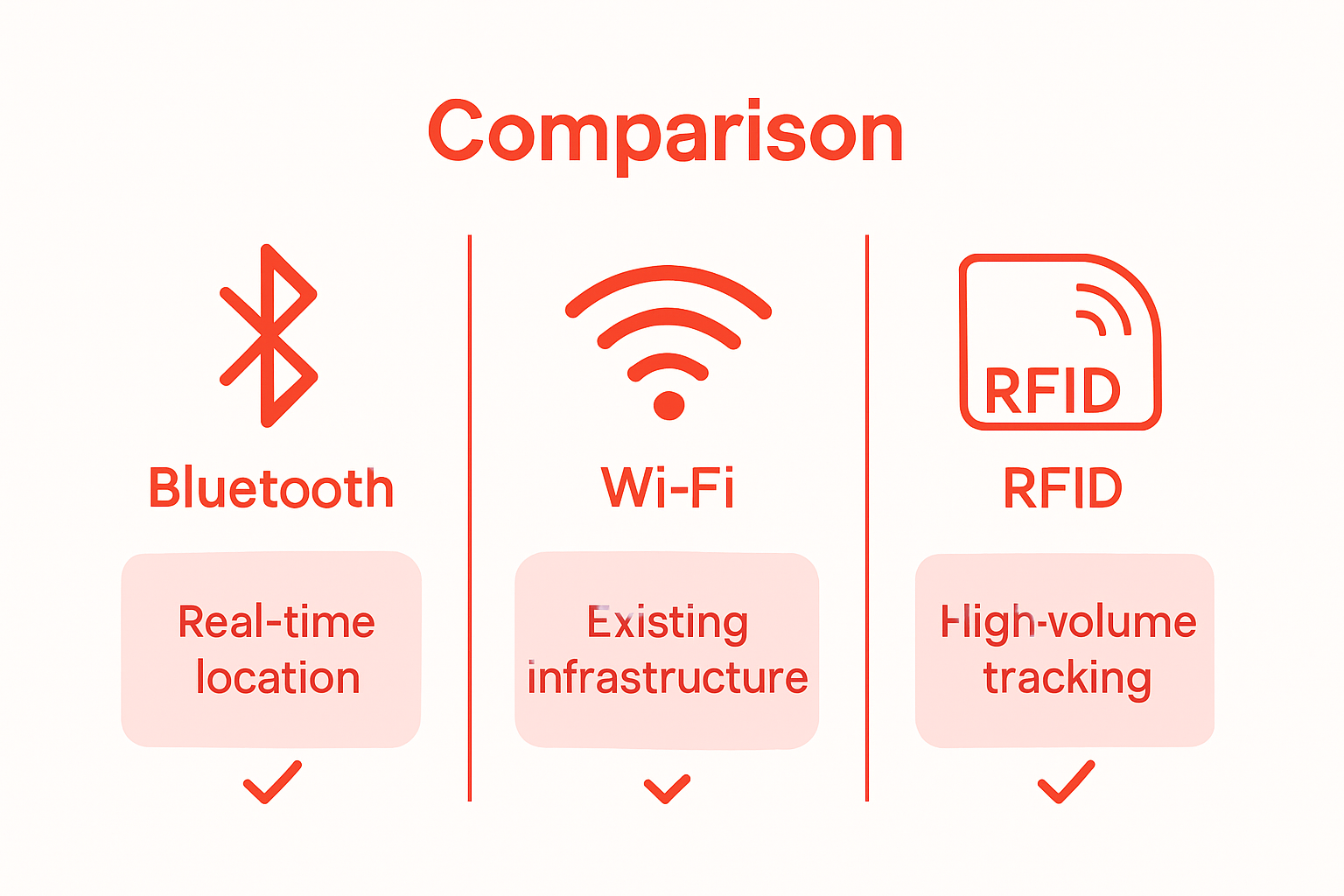
Radio-Frequency Identification (RFID) technologies offer yet another robust tracking mechanism. RFID systems use active or passive tags that communicate via radio waves, enabling organisations to identify, locate, and monitor assets with remarkable efficiency. These tags can be integrated into equipment, allowing continuous tracking and status reporting without direct line-of-sight requirements. Passive RFID tags are particularly cost-effective, while active tags provide extended communication ranges and additional sensing capabilities.
Key characteristics of these tracking methods include:
- Real-time location monitoring
- Varied communication ranges
- Different power consumption profiles
- Scalability across diverse operational environments
- Integration capabilities with existing technological infrastructure
By understanding and strategically implementing these tracking technologies, enterprises can transform their asset management from reactive processes to proactive, data-driven systems that enhance operational efficiency and reduce financial risks.
Key Benefits of Enhanced Tracking Precision
Enhanced asset tracking precision represents a transformative approach for organisations seeking to optimise their operational infrastructure. Smart solutions that mitigate asset loss have become increasingly critical in today’s complex technological ecosystems, enabling businesses to maintain comprehensive visibility and control over their critical resources.
Comprehensive tracking precision delivers substantial strategic advantages across multiple organisational dimensions. Operational efficiency emerges as a primary benefit, with organisations experiencing dramatic reductions in administrative overhead and resource management complexities. By implementing advanced tracking methodologies, businesses can significantly improve demand forecasting, optimise resource allocation, and align technological investments with strategic objectives. These precision-driven approaches enable real-time insights that transform reactive asset management into proactive, data-informed decision-making processes.
Regulatory compliance and financial risk mitigation represent additional critical outcomes of enhanced tracking precision. Industries ranging from healthcare to logistics rely on accurate asset monitoring to prevent potential losses, ensure equipment availability, and maintain rigorous documentation standards. Precise tracking technologies enable organisations to implement robust audit trails, reduce instances of equipment misplacement, and demonstrate meticulous resource management to stakeholders and regulatory bodies.
Key strategic benefits of enhanced tracking precision include:
- Reduced operational costs
- Improved inventory management accuracy
- Enhanced regulatory compliance
- Proactive maintenance scheduling
- Minimised risk of asset theft or loss
- Optimised resource allocation
- Increased organisational transparency
By embracing sophisticated tracking technologies, forward-thinking enterprises can transform their asset management from a traditional administrative function into a strategic competitive advantage that drives operational excellence and financial performance.
Compliance, Security, and Data Integrity Risks
In today’s complex regulatory landscape, enterprises face unprecedented challenges in maintaining robust asset tracking protocols that simultaneously protect sensitive information and meet stringent compliance requirements. Improve Security Compliance with Smart Locker Systems has become a critical consideration for organisations navigating increasingly sophisticated technological and legal environments.

Data integrity and security represent fundamental concerns for enterprises implementing asset tracking technologies. Comprehensive tracking systems must address multiple layers of risk, including potential unauthorised access, data breaches, and regulatory non-compliance. Advanced tracking methodologies leverage encryption, multi-factor authentication, and granular access controls to create robust protective mechanisms that safeguard sensitive organisational assets and maintain meticulous documentation trails.
Modern asset tracking technologies integrate sophisticated security features designed to mitigate potential risks across various operational domains. Organisations can implement multi-layered security protocols that include biometric authentication, real-time monitoring, and automated compliance reporting. These advanced systems enable businesses to create comprehensive audit trails, prevent unauthorized asset movements, and demonstrate rigorous adherence to industry-specific regulatory standards.
Key security and compliance considerations include:
- Encrypted data transmission
- Granular user access controls
- Comprehensive audit logging
- Real-time asset location monitoring
- Automated compliance reporting
- Secure authentication mechanisms
- Protection against unauthorized asset access
By adopting sophisticated asset tracking approaches that prioritise security and compliance, organisations can transform potential vulnerabilities into strategic advantages that protect critical resources and maintain operational integrity.
Maximising Automation and ServiceNow Integration
Enterprises are increasingly recognising the transformative potential of seamlessly integrating asset tracking technologies with sophisticated automation platforms. Integrating Smart Lockers with ServiceNow represents a critical strategy for organisations seeking to streamline operational workflows and enhance technological efficiency.
The ServiceNow ecosystem enables organisations to create intelligent, interconnected asset management processes that transcend traditional tracking methodologies. By leveraging advanced integration capabilities, businesses can transform raw asset data into actionable insights, automating critical workflows and reducing manual intervention. These sophisticated platforms facilitate real-time asset monitoring, intelligent routing of support requests, and comprehensive tracking of equipment lifecycle stages, effectively eliminating inefficient manual processes.
Advanced automation technologies fundamentally reshape how organisations approach asset management and technological resource allocation. Intelligent tracking systems can now automatically generate maintenance requests, trigger replacement workflows, and provide predictive analytics about asset performance and utilisation. This level of integration allows enterprises to move beyond reactive asset management, creating proactive, data-driven strategies that optimise resource allocation, reduce operational costs, and significantly improve overall organisational efficiency.
Key benefits of ServiceNow integration include:
- Seamless workflow automation
- Real-time asset visibility
- Reduced manual administrative tasks
- Predictive maintenance capabilities
- Enhanced reporting and analytics
- Improved compliance tracking
- Streamlined service desk operations
By embracing sophisticated automation and ServiceNow integration, forward-thinking enterprises can transform their asset management from a traditional administrative function into a strategic, intelligence-driven capability that delivers measurable operational value.
Elevate Your Asset Tracking Accuracy with Velocity Smart Technology
Enterprises seeking to overcome the challenges of inaccurate asset tracking can transform their approach with solutions designed to integrate seamlessly into existing ecosystems. This article highlights critical pain points such as loss prevention, compliance risks, and inefficient manual processes that slow down operations and increase costs. By embracing precision-driven methodologies like real-time monitoring and automation, organisations unlock strategic value and operational excellence.
Velocity Smart Technology offers a cutting-edge way to automate asset management through smart lockers and vending solutions built natively on ServiceNow. Our flagship platform, Velocity Smart Collect, addresses concerns over data integrity and GDPR compliance by operating entirely within the ServiceNow environment. This innovative approach eradicates manual data entry, enhances security protocols, and amplifies workflow automation to ensure your assets are precisely tracked, maintained, and optimised.
Discover how you can reduce support costs, improve employee experience, and eliminate asset loss with Velocity Smart Technology.
Ready to move beyond reactive asset management to a smart, data-driven future? Explore how integrating with ServiceNow and leveraging our automated asset solutions empowers your enterprise to maintain accuracy, enhance compliance, and boost operational efficiency. Visit Velocity Smart Technology today to transform your asset tracking accuracy and take control of your resources like never before.
Frequently Asked Questions
What is asset tracking accuracy, and why is it important?
Asset tracking accuracy is the precision with which organizations monitor and manage their physical resources throughout their operational lifecycle. It is important because it enables companies to reduce operational inefficiencies, minimize financial waste, and maintain comprehensive visibility of resource deployment.
What are the benefits of improving asset tracking accuracy?
Improving asset tracking accuracy can lead to reduced financial risk, enhanced regulatory compliance, improved operational efficiency, simplified maintenance and replacement planning, and decreased instances of equipment loss or misplacement.
What technologies can enhance asset tracking accuracy for enterprises?
Technologies such as Bluetooth Low Energy (BLE), Wi-Fi-based tracking, and Radio-Frequency Identification (RFID) can enhance asset tracking accuracy. These technologies offer real-time location monitoring, varied communication ranges, and integration capabilities with existing infrastructure.
How does automation and ServiceNow integration boost asset tracking capabilities?
Automation and ServiceNow integration allow organizations to streamline operational workflows by transforming raw asset data into actionable insights. This leads to real-time asset visibility, predictive maintenance capabilities, and reduced manual administrative tasks, ultimately improving overall organisational efficiency.
Recommended
- What is Asset Tracking? Understanding Its Importance and Function
- Complete Guide to Centralized Asset Tracking
- Smart solutions that reduce the impact of asset loss
- Hide and seek: Do you know where your IT assets are?
- 2025 Guide to Insurance Analytics: Transform Your Decisions - Digital Insurance Platform | IBSuite Insurance Software | Modern Insurance System
See what Smart Collect® could save you
Model your savings in two minutes, or book a 60-minute workshop to pressure-test the numbers against your estate.