 IT asset allocation guide: reduce costs & automate">
IT asset allocation guide: reduce costs & automate
TL;DR:
- Enterprises often lose money due to poor asset allocation rather than reckless spending.
- Modern asset management is a dynamic process that uses automation and strategic planning.
- Effective allocation relies on lifecycle management, application rationalisation, and fostering company-wide accountability.
Enterprises routinely leave significant money on the table, not through reckless spending, but through poor asset allocation. Poor visibility, fragmented ownership, and reactive decision-making mean IT leaders miss out on up to 23% IT spend reduction that best-in-class organisations routinely capture. The good news is that modern asset allocation is no longer a static inventory exercise. It is a dynamic, strategic discipline that integrates automation, lifecycle thinking, and cost management into a single operating model. This guide walks IT leaders at large enterprises through the frameworks, tools, and cultural shifts needed to turn asset allocation into a genuine competitive advantage.
Table of Contents
- Understanding IT asset allocation: foundations and frameworks
- Core methodologies: lifecycle, rationalisation, and risk-based planning
- Driving automation and cost savings: modern tools and practices
- Benchmarks, benefits, and pitfalls: what the data tells us
- Emerging challenges and the future: AI, sustainability, and culture
- Why asset allocation needs a cultural, not just a technical, revolution
- Take the next step to smarter asset allocation
- Frequently asked questions
Key Takeaways
| Point | Details |
|---|---|
| Portfolio approach is critical | Treat assets as a strategic portfolio using value, risk and ROI to drive business outcomes. |
| Automation delivers real savings | Modern tools and workflow automation cut manual effort and reduce IT spend by up to 23%. |
| Ongoing culture shift required | Long-term savings and agility depend more on ownership and behaviour than technology alone. |
| Benchmarks guide realistic goals | Leading enterprises achieve 15x ROI and avoid SaaS overspend with disciplined allocation. |
Understanding IT asset allocation: foundations and frameworks
Strategic IT asset allocation means treating your technology portfolio the way a fund manager treats an investment portfolio. Every asset, whether hardware, software, cloud service, or licence, carries a cost, a risk profile, and a measurable return. The goal is to continuously rebalance that portfolio to maximise business value while minimising waste.
IT asset allocation for large enterprises involves evaluating each asset against four criteria: total cost of ownership (TCO), business value delivered, technical health, and risk exposure. Without this lens, IT teams default to renewing contracts on autopilot and purchasing new hardware without retiring old stock.
Typical IT asset categories in a large enterprise include:
- Hardware: laptops, desktops, servers, mobile devices, peripherals
- Software licences: productivity suites, security tools, specialist applications
- Cloud services: IaaS, PaaS, SaaS subscriptions
- Network infrastructure: switches, routers, access points
- Support contracts: maintenance agreements, vendor SLAs
The table below illustrates how a portfolio-based approach differs from traditional IT asset management:
| Dimension | Traditional approach | Portfolio-based approach |
|---|---|---|
| Focus | Inventory and compliance | Value, risk, and ROI |
| Decision driver | Budget cycles | Business priority |
| Asset review frequency | Annual | Continuous |
| Cost visibility | Departmental silos | Enterprise-wide TCO |
| Retirement trigger | End of life | Value threshold |
“The organisations that treat IT assets as a managed portfolio, rather than a cost centre to be controlled, consistently outperform peers on both efficiency and innovation metrics.”
Aligning allocation decisions with business priorities is what separates reactive IT departments from strategic ones. Improving IT asset management efficiency starts with this portfolio mindset. For a deeper grounding in investment-grade thinking, the IT investment management guide offers a solid reference framework.
Core methodologies: lifecycle, rationalisation, and risk-based planning
Leading enterprises operationalise asset allocation through three interlocking disciplines: lifecycle management, application rationalisation, and risk-based planning.
Lifecycle management tracks every asset from acquisition through maintenance, upgrade, and retirement. Lifecycle management stages are well established, yet many organisations still lack the tooling to enforce them consistently. The result is “zombie” assets: devices or licences that are paid for but deliver no value.

Application rationalisation applies a structured decision model to every software asset. The four options are retain, modernise, consolidate, or retire. This discipline alone can eliminate 20 to 30 per cent of a typical enterprise software portfolio.
Steps for risk-based asset allocation planning:
- Inventory and classify all assets by category, owner, and criticality
- Score each asset on TCO, business value, technical health, and security risk
- Map dependencies to understand what breaks if an asset is retired
- Assign rationalisation categories using the retain, modernise, consolidate, retire model
- Set milestone gates to review allocation decisions at defined intervals
- Report outcomes to senior stakeholders with clear ROI metrics
| Rationalisation category | Typical action | Expected outcome |
|---|---|---|
| Retain | Continue as-is with optimisation | Stable TCO, reduced risk |
| Modernise | Upgrade or re-platform | Improved performance, lower support cost |
| Consolidate | Merge redundant tools | Licence savings, simplified management |
| Retire | Decommission and remove | Immediate cost elimination |
Pro Tip: Build explicit “kill-switch” milestone gates into every asset’s lifecycle plan. If an asset cannot demonstrate measurable value at each gate, it is automatically flagged for retirement. This prevents zombie assets from quietly consuming budget year after year.
Zero Trust security principles also inform allocation decisions. Assets that cannot be patched, monitored, or governed to Zero Trust standards should be prioritised for retirement regardless of their age. Robust centralised asset tracking makes these decisions data-driven rather than political. Explore how enhancing asset automation accelerates lifecycle transitions at scale. Deloitte’s asset management strategies research reinforces why lifecycle discipline is a board-level concern.
Driving automation and cost savings: modern tools and practices
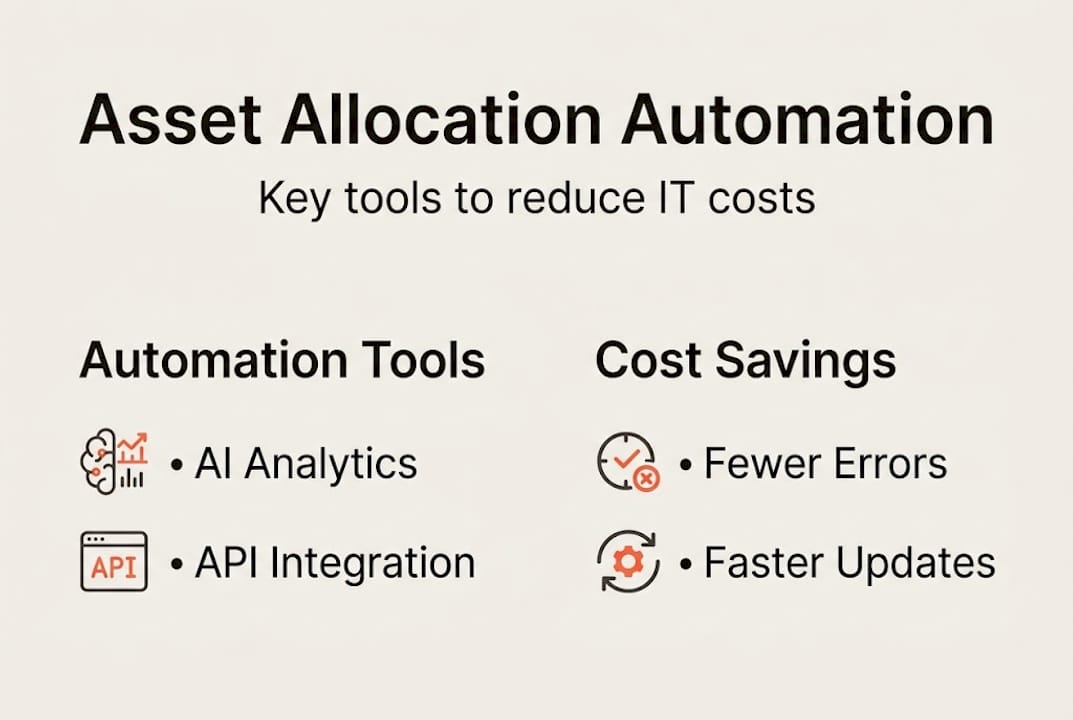
Robust methodology is only part of the story. The next leap comes by harnessing automation. Modern IT asset allocation platforms combine real-time inventory discovery, automated licence reclamation, and cloud-native workflow engines to eliminate the manual effort that drains IT teams.
Key automation-enabled allocation practices include:
- Real-time discovery: continuous scanning that achieves 95%+ asset discovery accuracy and eliminates spreadsheet-based audits
- Automated licence reclamation: software licences unused for 30 or more days are flagged and reclaimed automatically
- Predictive maintenance scheduling: AI models forecast hardware failure windows, enabling proactive replacement before productivity is lost
- Cloud cost optimisation: automated right-sizing of cloud instances based on actual consumption data
- Workflow automation: device requests, approvals, and fulfilment handled end-to-end without manual intervention
Pro Tip: Use AI-driven analytics to model asset lifecycle trajectories at least 12 months ahead. This allows procurement teams to negotiate renewal terms from a position of strength rather than scrambling at contract expiry.
Automation delivers measurable results. Organisations that invest in intelligent discovery and workflow automation report 25 to 35% efficiency gains alongside 15 to 30 per cent reductions in software spend. These are not aspirational figures. They reflect what happens when manual processes are replaced with event-driven automation.
API-first integration is the architectural principle that makes this possible. When your ITAM platform connects natively to your ITSM, CMDB, and procurement systems, data flows without re-keying and decisions are made on accurate, current information. Explore intelligent automation strategies for practical implementation guidance, see how automated IT asset support works at the device level, and review the latest IT automation trends shaping global enterprises. For a technical deep dive, Lansweeper’s guide on automated asset inventory is worth reviewing.
Benchmarks, benefits, and pitfalls: what the data tells us
Automation delivers, but how much should you expect in real results and what slows you down? The data provides clear targets and equally clear warnings.
| Metric | Industry average | Best-in-class |
|---|---|---|
| IT spend reduction | 8 to 12% | Up to 23% |
| Software ROI | 3 to 5x | 15x ROI on cost-out |
| Overspend avoided | 5 to 8% | 12 to 20% |
| Asset discovery accuracy | 70 to 80% | 95%+ |
These figures are achievable, but only if you avoid the pitfalls that derail most programmes. Common obstacles include:
- SaaS sprawl: uncontrolled subscription growth driven by departmental purchasing
- Shadow IT: technology procured outside IT governance, invisible to CMDB
- Inaccurate CMDB data: stale records that undermine every downstream decision
- Dual-running costs: legacy systems kept alive alongside their replacements during transitions
- Lack of business unit engagement: IT-led programmes that fail without stakeholder buy-in
“69% of enterprises report shadow IT and SaaS sprawl as active threats to their asset management programmes, with nearly half of all software licences going unused.”
Regular milestone reviews and clear incentives for business unit participation are what separate sustained savers from one-time optimisers. Understanding the IT inefficiency costs that accumulate from these pitfalls helps build the business case for ongoing investment. Zylo’s analysis of IT spend optimisation provides useful benchmarking data for SaaS-heavy environments.
Emerging challenges and the future: AI, sustainability, and culture
Benchmarks inform current practice, but new risks and opportunities are already reshaping the discipline. IT leaders need to plan for a more complex environment, not a simpler one.
Key future challenges include:
- AI complexity: managing AI infrastructure, model licences, and GPU assets requires new valuation frameworks
- Vendor lock-in: cloud and SaaS concentration risk is growing as portfolios consolidate
- ESG mandates: sustainability reporting now requires granular data on device energy consumption and e-waste
- GDPR and DORA compliance: data residency and operational resilience rules impose new constraints on asset decisions
- Data ownership: as AI tools process sensitive data, asset allocation must account for data governance risk
Despite these pressures, less than 40% of ITAM programmes are currently cloud or AI-ready. That gap represents both a risk and an opportunity for organisations willing to invest now.
Pro Tip: Treat ITAM as a cross-functional, board-level concern rather than an IT operations task. Organisations that embed asset allocation into their executive governance structures consistently outperform those that leave it to IT alone.
Cultural accountability is the missing ingredient in most programmes. Dashboards that surface asset utilisation by business unit, combined with financial incentives for efficient consumption, drive the behavioural change that technology alone cannot deliver. Explore how digital transformation in ITAM is reshaping enterprise asset strategies. Deloitte’s ITAM strategic imperative research reinforces why board-level visibility matters.
Why asset allocation needs a cultural, not just a technical, revolution
Here is an uncomfortable truth that most IT asset management programmes avoid: the technology is rarely the problem. Platforms, discovery tools, and automation engines are mature and effective. What consistently fails is the human layer around them.
We have seen enterprises invest heavily in ITAM tooling, only to watch cost leaks persist because no one owns the outcome. Business units continue to procure shadow IT because there is no incentive to stop. Contracts renew automatically because the person who could challenge them has no visibility and no mandate.
The organisations that achieve sustained IT savings do something structurally different. They assign named owners to asset categories with accountability tied to performance reviews. They publish utilisation dashboards that make waste visible to senior leadership. They treat asset allocation as a continuous, cross-functional discipline rather than a periodic IT project.
The shift from transactional to strategic asset stewardship is fundamentally a leadership challenge. IT leaders who champion intelligent automation as a board-level priority, and who build the cultural infrastructure to sustain it, are the ones who deliver the 23% savings that remain theoretical for everyone else.
Take the next step to smarter asset allocation
Ready to put these strategies into practice? The frameworks in this guide only deliver results when they are backed by the right operational infrastructure.
Velocity Smart Technology helps large enterprises automate device distribution, IT support, and asset workflows at scale. Our smart IT support kiosk enables real-time remote support and equipment exchange without onsite technicians, directly reducing the manual overhead that inflates IT operating costs. Built natively on ServiceNow, our platform eliminates data re-keying and connects asset allocation decisions to live workflow data. Visit Velocity Smart Technology to explore our full suite of ITAM solutions, or subscribe to automation unboxed for practical insights delivered directly to your inbox.
Frequently asked questions
What is IT asset allocation and why is it different from asset management?
IT asset allocation refers to strategically distributing and optimising resources across hardware, software, and services for maximum business value, while asset management is broader and includes inventory control and lifecycle tracking.
How does automation impact IT asset allocation in large enterprises?
Automation enables real-time inventory, predictive maintenance, and cost savings of 25 to 35% through reduced manual effort and optimised workflows across the asset lifecycle.
What are the common challenges with asset allocation in hybrid and remote IT environments?
Common challenges include shadow IT, SaaS sprawl, complex cloud billing, and ensuring data quality across decentralised systems, with 69% of enterprises reporting these as active programme threats.
What ROI benchmarks can IT leaders realistically aim for?
Top-performing enterprises achieve 15x ROI on software cost reductions and up to 23% sustained IT spend savings through disciplined, portfolio-based asset allocation.
Recommended
- IT Asset Management: Driving Efficiency in Fortune 500 Enterprises
- Complete Guide to Centralized Asset Tracking
- Smart solutions that reduce the impact of asset loss
- Bigger Lockers: Enhancing IT Asset Automation
- Top 7 Accounting Tasks to Automate in 2025 - Ready Accounting
See what Smart Collect® could save you
Model your savings in two minutes, or book a 60-minute workshop to pressure-test the numbers against your estate.