 Pharma IT asset compliance: a 2026 guide for IT teams">
Pharma IT asset compliance: a 2026 guide for IT teams
TL;DR:
- Pharma IT asset compliance involves managing both IT and OT assets with validated lifecycle controls and digital records. It requires integrated inventories, continuous validation, and automated audit trails to meet regulatory standards such as 21 CFR Part 11 and EU GMP Annex 11. Connecting asset records across systems reduces audit risks and enhances inspection readiness.
Pharma IT asset compliance is the coordinated management of pharmaceutical IT and operational technology (OT) assets to meet strict regulatory standards, including 21 CFR Part 11 and EU GMP Annex 11, through validated lifecycle control and integrated digital record-keeping. The industry term for this discipline is IT asset management in pharma, and it extends well beyond software licensing to cover every physical and digital asset that touches a GMP-regulated process. For IT compliance professionals in pharmaceutical environments, the stakes are concrete: uninventoried or unvalidated assets create direct audit liabilities with the FDA and EMA. This guide covers the practical frameworks, regulatory requirements, and digital tools that define effective compliance in 2026.
What is pharma IT asset compliance and why does it matter?
Pharma IT asset compliance covers both IT assets, such as servers, workstations, and software systems, and OT assets, including programmable logic controllers (PLCs), human-machine interfaces (HMIs), sensors, and skid controllers. Pharmaceutical manufacturing environments have 6 to 10 times more OT assets than standard IT assets. That ratio means a compliance programme focused only on IT infrastructure misses the majority of GMP-relevant equipment on the floor.
The regulatory consequence is direct. FDA inspectors and EMA auditors request full asset registers during facility inspections. Fragmented or incomplete records are not treated as administrative oversights. They are treated as evidence of inadequate control. Organisations that integrate IT and OT asset management into a single governed register reduce that risk substantially.
Compliance software platforms such as Oxmaint provide validated computerised maintenance management systems (CMMS) that link asset records to qualification protocols, calibration schedules, and electronic audit trails. These tools form the operational backbone of a defensible compliance posture.
How do you build an auditable IT and OT asset inventory?
A validated asset register is the foundation of any pharmaceutical IT compliance programme. Without it, patch management, change control, and qualification activities cannot be reliably tied to specific assets, which creates traceability gaps that regulators flag immediately.
Building that register requires four structured steps:
- Asset discovery and classification. Catalogue every IT and OT asset across the facility, including legacy equipment. Classify each asset by type: IT infrastructure, manufacturing OT, laboratory instruments, or quality systems.
- Criticality scoring and GMP tiering. Assign each asset a GMP impact tier based on its direct or indirect influence on product quality and patient safety. A PLC controlling a bioreactor sits in a different tier than a general-purpose office workstation.
- Linking to quality systems. Connect each asset record to its relevant validation documentation, calibration records, and maintenance history. This linkage is what makes an inventory audit-ready rather than merely comprehensive.
- Ongoing maintenance with validated CMMS tools. Use a validated CMMS or centralised asset tracking platform to maintain records continuously, not just ahead of inspections.
Fragmented asset records create audit liabilities when IT systems, maintenance CMMS platforms, and validation master plans do not align. Uninventoried OT assets cannot be patched or assessed for cybersecurity vulnerabilities, which compounds the inspection risk.
Pro Tip: Link your asset inventory directly to your Validation Master Plan. When an inspector requests the qualification status of a specific piece of equipment, you should be able to retrieve it in under two minutes. If you cannot, your records structure needs redesigning before your next audit.

What regulations govern IT asset management in pharma?
Three regulatory frameworks define the compliance obligations for IT and OT assets in pharmaceutical environments.
21 CFR Part 11 governs electronic records and electronic signatures in FDA-regulated facilities. Under this regulation, GMP-relevant data must be secured from unauthorised access and tampering throughout its full lifecycle. Audit trails must be computer-generated, time-stamped, and operator-attributable.
EU GMP Annex 11 mandates that computerised systems in GMP environments meet data integrity requirements under the ALCOA+ framework. ALCOA+ requires data to be Attributable, Legible, Contemporaneous, Original, Accurate, Complete, Consistent, Enduring, and Available. Annex 11 also requires continuous lifecycle control covering supplier management, access control, backup procedures, audit trails, archiving, and periodic review.
EU GMP Annex 22, introduced to address AI and advanced computing systems, extends these obligations to cloud-hosted and AI-driven systems. Validation is no longer a one-time activity but an ongoing assurance process throughout the system’s operational life.
Key compliance obligations across these frameworks include:
- Automated, tamper-evident audit trails for all GMP-relevant data changes
- Electronic signatures with equivalent legal weight to handwritten ones
- Documented network segmentation between corporate IT and OT environments
- Periodic system review and documented evidence of continued fitness for purpose
- Controlled remote access workflows with documented authorisation
“Audit trail systems must capture all GMP-relevant changes automatically and be reviewable for regulatory adherence, with electronic signatures carrying equivalent legal weight as handwritten ones.” — Annex 11 CSV Practical Approach
One significant regulatory shift is the move from Computer System Validation (CSV) to Computer Software Assurance (CSA). FDA guidance on CSA prefers risk-based analysis focused on patient safety impact over rigid scripted validation protocols. This shift reduces validation overhead for lower-risk systems while concentrating effort where it matters most.
Cybersecurity obligations have also hardened. Documented network segmentation between corporate IT and OT is now a compliance obligation, not merely a security best practice. Inspectors increasingly request automated documentation proving segmentation and controlled remote access.
How do you implement validated asset lifecycle management?
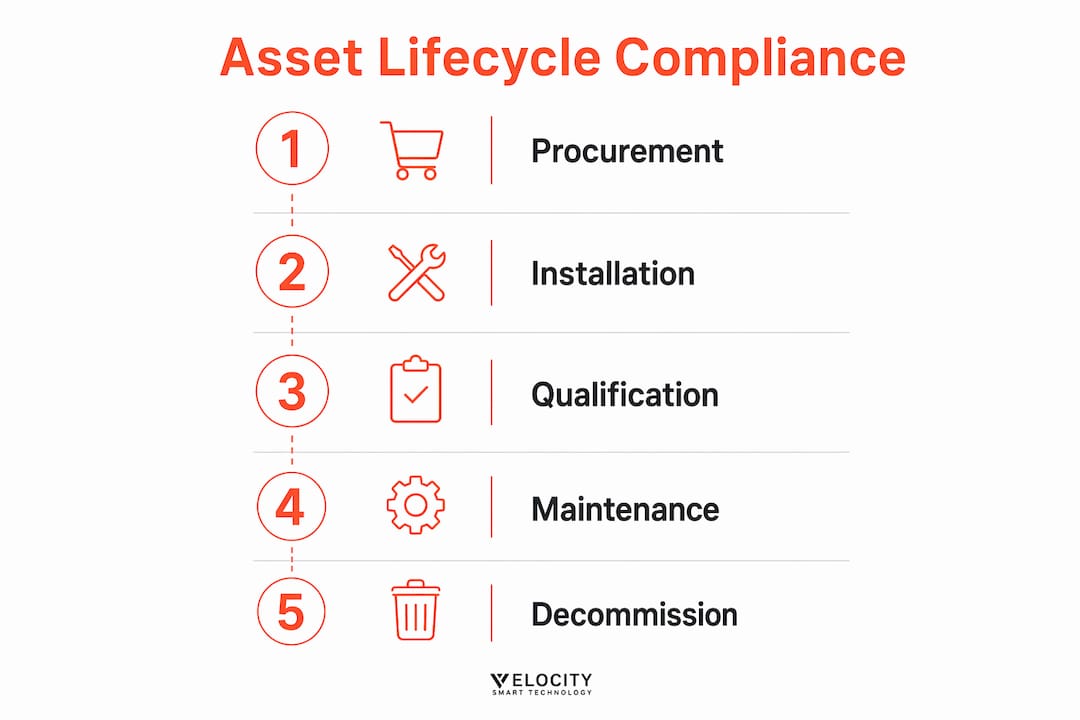
Effective lifecycle management in pharma requires linking every stage of an asset’s operational life to auditable documentation. Equipment lifecycle compliance requires control of qualification protocols (IQ/OQ/PQ), calibration management, preventive maintenance, and retirement documentation, all linked per asset in a single accessible record.
The practical implementation follows this structure:
- Qualification linkage. Attach IQ, OQ, and PQ records directly to the asset configuration item in your CMMS or CMDB. For instruments such as HPLC systems and autoclaves, this linkage is the primary evidence an inspector will review.
- Calibration management. Schedule and record calibration events against each asset record. Overdue calibration on a GMP-critical instrument is a direct finding.
- Preventive maintenance with electronic sign-off. Digitise maintenance workflows so technician qualifications and task completion are captured electronically, with time-stamps and operator attribution.
- Automated compliance reporting. Generate audit-ready dashboards from live asset data rather than compiling reports manually ahead of inspections.
- Controlled retirement. Document decommissioning with a formal IT asset disposal process that retains records for the required retention period.
Digital qualification tracking and GMP-compliant asset management can be configured within 4–6 weeks using validated platforms. That timeline includes calibration management, preventive maintenance scheduling, and electronic record-keeping compliant with 21 CFR Part 11.
The table below maps lifecycle stages to their compliance documentation requirements:
| Lifecycle Stage | Compliance Requirement | Key Evidence |
|---|---|---|
| Procurement and installation | IQ protocol completion | Signed IQ report linked to asset record |
| Commissioning | OQ and PQ execution | Approved test results with electronic signatures |
| Operational use | Calibration and PM schedules | Time-stamped maintenance records with technician attribution |
| Change management | Impact assessment and re-qualification | Change control record linked to affected asset |
| Retirement | Decommissioning documentation | Archived records retained per regulatory requirement |
Pro Tip: Before applying any software patch or hardware change to a GMP-critical asset, complete a documented impact assessment. Regulators treat undocumented changes to validated systems as validation failures, regardless of whether the change caused a quality event.
Smart locker solutions, such as those deployed by Velocity-smart for customers including Roche and BioNTech, add a physical control layer to this framework. Secure, access-controlled handover of IT equipment creates a hardware-level audit record that complements the digital lifecycle documentation in your CMDB.
What are the most common audit failures in pharma IT compliance?
The most frequent cause of audit findings in pharmaceutical IT compliance is not a single missing document. It is the structural disconnection between IT records, OT maintenance records, and validation documentation. When these three systems do not align, inspectors cannot trace a change from its authorisation through to its execution and verification.
Specific failure patterns include:
- Legacy systems without modern controls. Legacy IT systems lacking modern compliance controls must have documented compensating measures and a clear replacement plan. Regulators do not grant exemptions for outdated technology.
- Incomplete OT inventories. Non-inventoried OT assets cannot be included in change controls or patched against known vulnerabilities. This creates both a cybersecurity exposure and a direct inspection risk.
- Disconnected validation and maintenance records. When a maintenance technician completes a repair but that activity is not linked to the asset’s validation status, the qualification record becomes unreliable.
- Manual audit trail compilation. Manually assembled audit trails are inherently incomplete and inconsistent. Automated, system-generated trails are the regulatory expectation under both 21 CFR Part 11 and Annex 11.
The risk-based CSA approach directly addresses the overhead problem. By concentrating validation effort on systems with direct patient safety impact, organisations reduce the total compliance burden while improving the quality of evidence for high-risk assets. Effective pharma IT compliance hinges on integrating digital asset and maintenance records to produce auditable, GMP-ready lifecycle documentation accessible in real time.
For organisations managing cloud-hosted systems, understanding compliance obligations in cloud environments is increasingly relevant as regulators extend Annex 11 and Annex 22 expectations to hosted infrastructure.
Key takeaways
Pharma IT asset compliance requires a unified, continuously maintained register of IT and OT assets linked to validated lifecycle documentation, electronic audit trails, and risk-based assurance processes.
| Point | Details |
|---|---|
| Unified IT and OT inventory | Pharmaceutical sites have 6–10 times more OT than IT assets; both must be inventoried and GMP-tiered. |
| Continuous lifecycle validation | Annex 11 and Annex 22 require ongoing assurance, not one-time certification, throughout a system’s operational life. |
| Risk-based CSA over rigid CSV | FDA’s CSA guidance focuses validation effort on patient safety impact, reducing overhead for lower-risk systems. |
| Automated audit trails | System-generated, tamper-evident audit trails are the regulatory expectation under 21 CFR Part 11 and EU GMP Annex 11. |
| Integrated records prevent findings | Disconnected IT, OT, and validation records are the primary structural cause of audit failures in pharma environments. |
The compliance posture that actually holds up under inspection
Having worked closely with IT compliance teams across regulated industries, I have observed one pattern more than any other: organisations that pass inspections cleanly are not the ones with the most documentation. They are the ones whose documentation is structurally connected.
The shift from CSV to CSA is genuinely significant, but I think it is being misread by some teams as a licence to do less. It is not. It is a directive to do the right things with greater precision. The FDA is not reducing scrutiny on high-risk systems. It is asking you to apply your validation effort where it actually protects patients, and to be able to demonstrate that reasoning clearly.
The trend I expect to define the next three years is the convergence of IT asset management, OT maintenance systems, and quality management platforms into a single governed record. Organisations still running these as separate systems are carrying structural audit risk that will only become more visible as Annex 22 expectations mature around AI and cloud-hosted systems. The teams that get ahead of this now, by building integrated registers and automating lifecycle documentation, will find inspections significantly less disruptive. Those that do not will continue to spend the weeks before every audit in reactive document assembly. That is not a compliance programme. It is a compliance performance.
— Anthony
How Velocity-smart supports pharma IT asset control
Physical IT asset handovers are a compliance gap that most digital-only platforms cannot close. Velocity-smart’s Smart Collect platform runs natively inside ServiceNow, inheriting your existing CMDB, RBAC, and audit trail infrastructure. Every device handover, equipment loan, and peripheral exchange is recorded as a native ServiceNow configuration item, creating a hardware-level audit record that aligns directly with your GMP lifecycle documentation.
For pharmaceutical customers including Roche and BioNTech, Velocity-smart delivers secure, access-controlled asset distribution through Smart Lockers and Smart Vending units, with full traceability back to the CMDB. The result is a physical compliance layer that complements your validated digital records, reduces manual handling, and supports audit readiness without adding administrative overhead. If you are building or reviewing your IT asset compliance framework, smart locker solutions for pharma are worth examining as a practical component of that architecture.
FAQ
What is pharma IT asset compliance?
Pharma IT asset compliance is the systematic management of IT and OT assets in pharmaceutical environments to meet regulatory requirements including 21 CFR Part 11 and EU GMP Annex 11. It covers validated lifecycle control, electronic audit trails, and integrated digital record-keeping across all GMP-relevant assets.
What regulations apply to IT asset management in pharma?
The primary regulations are 21 CFR Part 11 for electronic records and signatures, EU GMP Annex 11 for computerised systems, and EU GMP Annex 22 for AI and cloud-hosted systems. All three require continuous lifecycle validation, documented audit trails, and data integrity under the ALCOA+ framework.
What is the difference between CSV and CSA in pharma compliance?
Computer System Validation (CSV) uses scripted, protocol-heavy testing for all systems. Computer Software Assurance (CSA) is the FDA’s preferred risk-based approach, concentrating validation effort on systems with direct patient safety impact and reducing overhead for lower-risk software.
Why do OT assets matter for pharmaceutical IT compliance?
Pharmaceutical sites have 6 to 10 times more OT assets than IT assets, including PLCs, HMIs, and sensors that directly influence product quality. Uninventoried OT assets cannot be patched, included in change controls, or assessed for cybersecurity vulnerabilities, creating direct audit risk.
How quickly can gmp-compliant asset management be implemented?
Digital qualification tracking and GMP-compliant asset management can be configured within 4–6 weeks using validated platforms such as Oxmaint. This includes calibration management, preventive maintenance scheduling, and 21 CFR Part 11-compliant electronic record-keeping.
Recommended
See what Smart Collect® could save you
Model your savings in two minutes, or book a 60-minute workshop to pressure-test the numbers against your estate.