
Top benefits of real-time asset tracking for IT leaders
Managing thousands of devices across multiple sites, with staff working in hybrid patterns and IT teams stretched thin, has made asset visibility a genuine operational risk. When a laptop goes missing, a loaner device sits uncollected, or an audit reveals gaps in your inventory records, the cost is not just financial. It is reputational and operational. Real-time asset tracking gives IT leaders the instant, accurate picture they need to act before problems escalate. This article covers the core technology, the direct business advantages, how to match solutions to your environment, and why forward-thinking enterprises are treating this capability as a strategic foundation rather than a nice-to-have.
Table of Contents
- What is real-time asset tracking?
- Key advantages for IT enterprise operations
- How accuracy, scale, and environment impact results
- Integration with enterprise systems and automation
- A strategic view: Why real-time tracking is now essential
- Accelerate IT efficiency with purpose-built asset tracking
- Frequently asked questions
Key Takeaways
| Point | Details |
|---|---|
| Instant device visibility | Real-time location tracking dramatically reduces lost time and asset downtime in large enterprises. |
| Automated processes | Pairing tracking with ITSM and automation cuts manual auditing effort and speeds up support. |
| Technology fit matters | Choosing the right RTLS for your environment ensures accuracy and maximises business value. |
| Security and compliance | Continuous tracking strengthens control over device movement, audit trails, and compliance responses. |
What is real-time asset tracking?
At its core, what is asset tracking comes down to knowing where your assets are, right now, not where they were last Tuesday. Real-time asset tracking uses a real-time location system (RTLS) to continuously or event-driven monitor the physical location of tagged assets across a facility or estate. Unlike periodic manual audits, RTLS delivers live data to a software interface, enabling instant decisions.
The RTLS technologies most relevant to enterprise IT environments are:
- Ultra-wideband (UWB): Sub-metre accuracy, ideal for dense or complex facilities. UWB achieves a root mean square error (RMSE) of just 0.124 metres, making it the most precise option available.
- Bluetooth Low Energy (BLE): Lower cost, moderate accuracy (1 to 3 metres), well suited to open-plan offices and warehouses.
- RFID (Radio Frequency Identification): Event-driven rather than continuous, excellent for access points, storerooms, and check-in or check-out scenarios.
- GPS: Best for outdoor or cross-site tracking, less effective indoors.
Each technology involves three layers: tags attached to physical assets, network infrastructure (anchors, readers, or gateways), and a software interface that visualises and alerts on location data. Centralised tracking systems pull this data into a single dashboard, removing the silos that plague manual approaches.
| Technology | Typical accuracy | Coverage | Best use case |
|---|---|---|---|
| UWB | 0.1 to 0.3 m | Indoor, complex | High-value assets, dense facilities |
| BLE | 1 to 3 m | Indoor, open areas | Laptops, peripherals, mobile devices |
| RFID | Event-based | Doorways, zones | Check-in/out, storerooms |
| GPS | 3 to 5 m | Outdoor, cross-site | Fleet, field equipment |
Typical IT assets that benefit most include laptops, mobile devices, servers, specialist equipment, loaner pools, and AV hardware. Any asset that moves, gets borrowed, or requires regular auditing is a strong candidate for RTLS.
Key advantages for IT enterprise operations
With the technology foundation clear, the question becomes: what does this actually solve for your team on a daily basis? The answer is significant. Real-time tracking enables enterprises to monitor devices across facilities and prevent unauthorised movement, which alone addresses two of the most persistent pain points in large-scale IT operations.
Here is what IT teams consistently report as the daily problems RTLS solves:
- Device search time: Staff no longer spend hours hunting for a specific laptop or loaner device. Location is available in seconds.
- Unauthorised movement alerts: Instant notifications when a device leaves a designated zone, reducing theft and misplacement.
- Automated audit trails: Every movement is logged, making compliance audits faster and more accurate.
- Faster device swaps: When a user needs a replacement, IT knows exactly which device is available and where it is.
- Reduced asset loss: Proactive alerts prevent devices from disappearing into the estate unnoticed.
- Improved deployment planning: Visibility into device utilisation helps IT teams plan refreshes and procurement more accurately.
“Enterprises using real-time asset tracking report dramatic reductions in device downtime, with some organisations recovering lost devices within minutes rather than days.”
The cumulative effect is a shift from reactive to proactive IT support. Rather than responding to a missing device report, your team already knows where IT devices are before anyone raises a ticket.
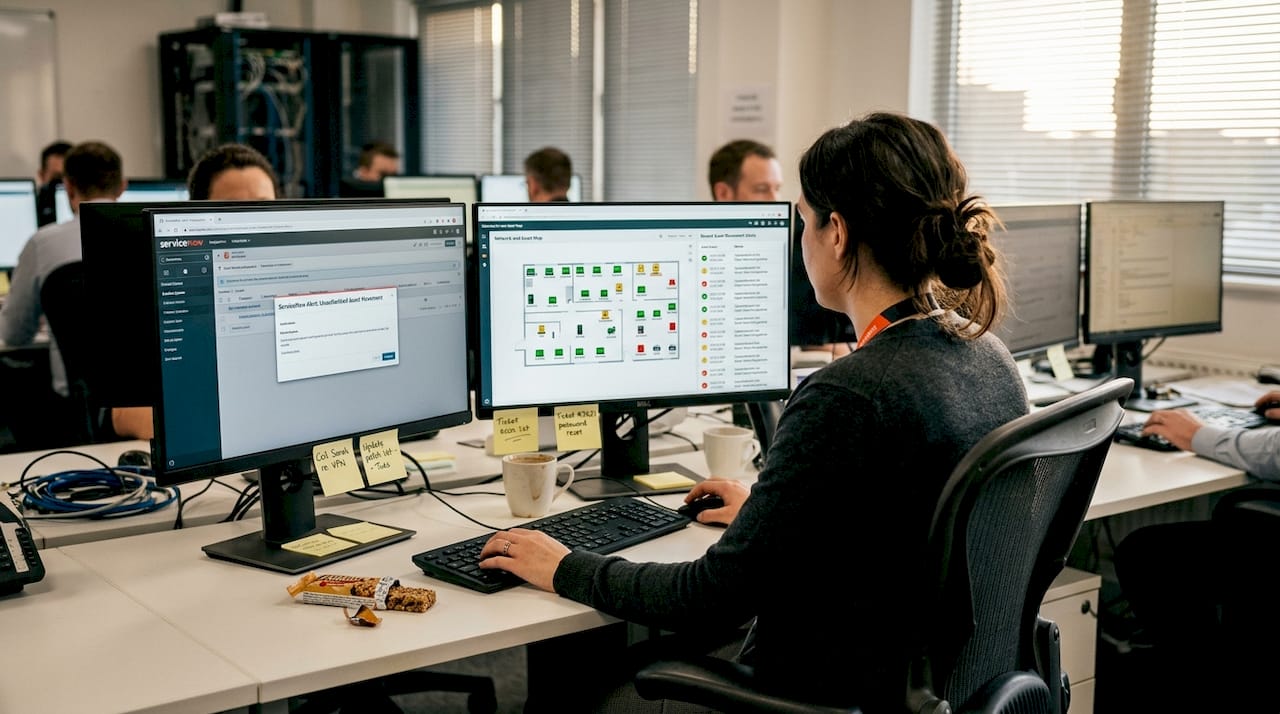
Pro Tip: Integrate your RTLS platform directly with your IT service management (ITSM) system, such as ServiceNow, so that location data automatically populates asset records and triggers support workflows without manual intervention.
Security benefits compound over time. As your tracking data matures, patterns emerge: devices that frequently leave authorised zones, assets that go unaccounted for during shift changes, or equipment that is consistently under-utilised. These insights are not available from a spreadsheet.
How accuracy, scale, and environment impact results
Choosing the right RTLS technology is not simply a matter of picking the most accurate option. Your facility type, asset count, and operational patterns all shape which solution delivers the best return.
In environments with metal racking, server cabinets, or dense equipment, radio signals behave unpredictably. This is known as non-line-of-sight (NLOS) interference, and it is where many BLE deployments underperform. UWB handles this significantly better. Research shows that UWB reduces positioning error by 24% in NLOS conditions and can track up to 3,600 parts per day in metal-heavy facilities. For IT environments with server rooms, data centres, or equipment stores, that accuracy matters.
BLE remains a strong choice for open-plan offices, meeting rooms, and general workplace environments where sub-metre precision is not critical. RFID is often the most cost-effective option when you only need to know that a device has passed through a specific point, such as a storeroom door or a smart locker.
Digital locker and asset management platforms benefit enormously from event-based RFID at collection and return points, combined with BLE or UWB for broader facility tracking. This hybrid approach balances cost and accuracy effectively.
For multi-site rollouts, consider these practical factors:
- Anchor density: UWB requires more infrastructure per square metre than BLE, increasing deployment cost.
- Asset volume: High asset counts favour systems with fast tag-read rates and scalable back-end software.
- Continuous vs. event-based: Not every asset needs constant tracking. Asset automation workflows often only require an event trigger at key points in the asset lifecycle.
Matching technology to environment is the single most important decision in any RTLS deployment. Getting this right at the outset avoids costly retrofits and ensures your data is reliable from day one.
Integration with enterprise systems and automation
Tracking data is only as valuable as what you do with it. The real productivity gains come when location data flows automatically into your enterprise systems, triggering workflows, updating records, and removing manual steps entirely.
For IT teams, the most impactful integration is with your ITSM platform. When RFID and BLE device management feeds directly into ServiceNow or a comparable platform, audits become automatic, unauthorised movement triggers tickets, and device collection is logged without anyone lifting a finger.
A successful deployment typically follows these steps:
- Asset tagging: Attach appropriate tags to all in-scope assets, recording tag IDs against asset records in your ITSM.
- Infrastructure deployment: Install anchors, readers, or gateways across your facilities, mapped to floor plans.
- System integration: Connect your RTLS platform to your ITSM and any electronic locker or kiosk systems via API.
- Workflow configuration: Define alerts, automated ticket creation, and audit triggers based on location events.
- Adoption and training: Ensure IT staff and end users understand how to interact with the new system, particularly at collection and return points.
Pro Tip: Choose platforms with open, well-documented APIs. Proprietary closed systems may appear cheaper initially but create significant barriers when you want to extend automation or integrate new tools.
Streamlined IT support becomes achievable when smart lockers and kiosks are part of the ecosystem. Employees can collect replacement devices, return faulty equipment, and receive support without waiting for a technician. The tracking system confirms every transaction, maintaining an accurate asset record automatically.
Ongoing analytics are equally important. Dashboards showing utilisation rates, dwell times, and movement patterns help IT leaders make evidence-based decisions about procurement, deployment, and support resourcing.
A strategic view: Why real-time tracking is now essential
For years, real-time asset tracking was positioned as a premium capability, something large manufacturers or logistics companies might invest in, but not a core requirement for enterprise IT. That perception is now outdated, and the organisations still holding onto it are paying a hidden cost.
The shift to hybrid working, distributed teams, and multi-site operations has fundamentally changed the risk profile of IT asset management. Periodic audits, which were already imperfect, are now genuinely inadequate. By the time a quarterly inventory check reveals a missing device, the compliance window may have closed or the data breach may have occurred.
What surprises many IT leaders when they implement RTLS is the second-order benefit: the shift from break-fix support to anticipatory support. When you know where every device is, how often it moves, and when it was last used, you can predict failures, plan replacements, and allocate resources before problems arise. That is a fundamentally different operating model.
Centralised tracking insights also reveal inefficiencies that were invisible before. Assets sitting idle for months, devices concentrated in one building while another site runs short, loaner pools that are either over-stocked or perpetually empty. These are solvable problems once you have the data.
The upfront investment in RTLS infrastructure is real. But the cost of not having it, measured in lost devices, failed audits, wasted IT hours, and employee downtime, is consistently higher. The question for IT leaders in 2026 is not whether to invest in real-time tracking, but how quickly to do it.
Accelerate IT efficiency with purpose-built asset tracking
If the advantages outlined here resonate with the challenges your IT team faces, the next step is finding a platform built specifically for enterprise-scale device management and support automation.
Velocity Smart Technology’s smart IT support kiosk and smart locker solutions are designed to work natively within ServiceNow, giving your team real-time visibility, automated workflows, and hands-off device collection and return across every site. Explore our full range of automation solutions to see how enterprises are reducing support costs, improving compliance, and transforming the employee experience. Book a demo to get tailored advice for your environment.
Frequently asked questions
What are the main technologies behind real-time asset tracking?
The key technologies are ultra-wideband (UWB), Bluetooth Low Energy (BLE), RFID, and GPS, each offering different strengths in accuracy and coverage. RTLS technologies provide continuous or event-based location data depending on the use case and environment.
How does real-time tracking reduce IT support costs?
It eliminates manual search time, automates audit trails, prevents device loss, and connects directly to support workflows, reducing the hours your team spends on reactive tasks. Real-time systems enable device monitoring that cuts both downtime and administrative overhead significantly.
Is real-time tracking suitable for challenging environments like metal-heavy facilities?
Yes. UWB and advanced positioning algorithms mitigate interference effectively, with UWB improving accuracy by 24% in non-line-of-sight conditions and supporting tracking of up to 3,600 assets per day in metal-dense environments.
Can these tracking systems integrate with IT service management platforms?
Yes, most enterprise RTLS solutions offer open APIs and ready-built integrations with platforms such as ServiceNow, enabling seamless workflow automation without manual data entry.
Do all IT assets benefit equally from real-time tracking?
High-value, mobile, and frequently accessed assets yield the strongest return on investment. Stationary or rarely moved assets may only require event-based tracking at key points rather than continuous monitoring.
Recommended
See what Smart Collect® could save you
Model your savings in two minutes, or book a 60-minute workshop to pressure-test the numbers against your estate.