 ServiceNow CMDB asset tracking: enterprise guide 2026">
ServiceNow CMDB asset tracking: enterprise guide 2026
TL;DR:
- Effective ServiceNow asset tracking relies on proper governance of Model Category mappings, status management, and automated workflows. Confusing Configuration Items with Assets leads to financial invisibility and data discrepancies, which can be prevented through audits and disciplined configuration. ServiceNow HAM automates the full asset lifecycle, and physical automation platforms like Velocity-smart bridge the gap between digital workflows and real-world asset handling.
ServiceNow CMDB asset tracking is the process of synchronising configuration item data with asset lifecycle information to deliver comprehensive visibility and control over IT assets across large enterprise environments. The distinction between a Configuration Item (CI) and an Asset in ServiceNow is not semantic. It is structural, and confusing the two produces governance failures that compound over time. ServiceNow’s Asset Management module controls inventory, cost, and lifecycle compliance, while the CMDB models technical configuration and service relationships. Effective IT asset tracking requires both to work in concert, supported by tools including Hardware Asset Management (HAM) and Discovery. The outcome is full lifecycle control, from procurement through disposal, with financial and operational data aligned in a single authoritative record.
What are configuration items vs assets in ServiceNow?
Asset Management and CMDB serve fundamentally different purposes, and treating them as one system creates gaps that undermine both financial reporting and service operations. Understanding the distinction is the first step toward reliable ITSM asset tracking.
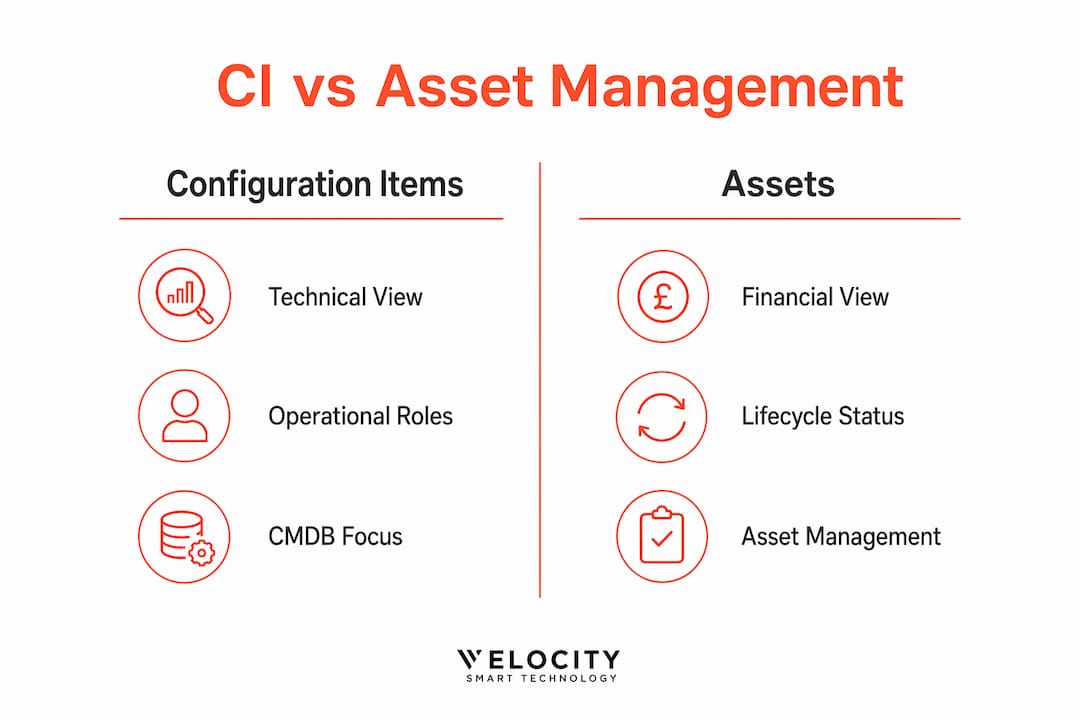
Configuration Items represent the technical view of your infrastructure. A CI describes what a device is, how it connects to other components, and what services depend on it. CI classes in ServiceNow include Computer, Network Gear, Server, and Storage Device. The CMDB models relationships between these classes to support impact analysis, change management, and incident resolution. The operational lens is primary here.
Assets, by contrast, carry the financial and lifecycle view. An Asset record in ServiceNow tracks ownership, cost centre, depreciation, contract linkage, and disposal status. Where a CI answers “what is this device doing in my environment,” an Asset answers “who owns it, what did it cost, and when does the contract expire.” Both records can and should exist for the same physical device.
The synchronisation between the two is controlled and deliberate, not automatic in every field. Key distinctions include:
- Operational Status on a CI reflects its readiness within the service model. It does not sync to the linked Asset record.
- Install Status is the field designed to sync between CI and Asset, controlled via the Asset CI Field Mappings table.
- A laptop discovered by ServiceNow Discovery populates a CI record first. The corresponding Asset record is created or updated only if the CI class has a correctly configured Model Category.
- Confusion between Operational Status and Install Status is one of the most common causes of status drift in enterprise CMDBs.
The governance consequence of conflating CIs and Assets is significant. Financial teams lose visibility of assets that exist in the CMDB but have no corresponding Asset record. Service teams make change decisions based on incomplete relationship data. Both failures are avoidable with the right configuration.
How do model category mappings prevent ghost cis?
Model Categories are the structural link between CI classes and Asset Classes in ServiceNow. When a CI is discovered, ServiceNow checks the CI’s Model Category to determine whether a corresponding Asset record should be created. If that mapping is absent, the CI exists in the CMDB with no financial counterpart. These orphaned records are commonly called “ghost CIs,” and they represent assets that are operationally visible but financially invisible.
Fixing this requires a structured audit. Follow these steps to verify and correct your Model Category configuration:
- Audit all active CI classes. Navigate to the CI Class Manager in ServiceNow and export a list of every active CI class in your instance.
- Check Model Category assignment. For each CI class, confirm that a Model Category is assigned. Classes without one cannot trigger Asset record creation.
- Verify Asset Class linkage. Each Model Category must link to an Asset Class (Hardware, Consumable, Software Licence, and so on). Missing this link breaks the chain between discovery and financial tracking.
- Identify orphaned CI classes. Run a report against the
cmdb_model_categorytable to surface CI classes that have no Model Category or whose Model Category has no Asset Class. RapDev’s CMDB audit framework provides a practical query structure for this. - Remediate and validate. Assign correct Model Categories to orphaned classes, then trigger a Discovery run or use the Asset CI Reconciliation job to generate missing Asset records.
Pro Tip: Run a scheduled report monthly that flags any CI class added in the past 30 days without a Model Category. New CI classes introduced during platform upgrades or integrations are a common source of fresh ghost CIs.
The table below summarises the relationship between key entities in the mapping chain:
| Entity | Location in ServiceNow | Purpose |
|---|---|---|
| CI Class | CMDB Class Manager | Defines the type of configuration item discovered |
| Model Category | Product Catalogue / Model | Links CI class to an Asset Class for record creation |
| Asset Class | Asset Management | Determines financial tracking type (Hardware, Licence, etc.) |
| Asset Record | Asset Management module | Holds financial, contractual, and lifecycle data |
Auditing CI class coverage at this level of granularity is the single most effective governance action an enterprise team can take to close the gap between technical and financial asset visibility.
How to synchronise CI and asset records effectively
ServiceNow Discovery populates CI tables directly. Asset data is populated indirectly, driven by CI-to-Asset field mappings and discovery source history. This architecture means that troubleshooting a missing or stale Asset record almost always starts at the CI, not at the Asset form itself.

The Asset CI Field Mappings table (alm_asset_ci_field_mapping) controls which CI fields write to which Asset fields, and in which direction. Most mappings are unidirectional, flowing from CI to Asset. Bidirectional mappings exist for specific fields but require careful governance to maintain integrity.
Common synchronisation issues and their diagnostic starting points:
- Asset record not created after Discovery. Check the CI’s Model Category first. If it is absent or misconfigured, no Asset record will be created regardless of Discovery success.
- Install Status not updating on the Asset. Verify the field mapping exists in the Asset CI Field Mappings table and that the CI’s Install Status field is being populated by Discovery or by a workflow.
- Stale data on the Asset record. Check the Discovery Source history on the CI. If Discovery has not run recently, the CI data is stale, and the Asset will reflect that staleness.
- Operational Status diverging from Install Status. These fields serve different purposes and do not sync to each other. Manage them independently and monitor for divergence as a data quality signal.
Pro Tip: Before modifying any Asset CI Field Mapping, document the out-of-the-box configuration. Customising synchronisation without strong business justification risks breaking bidirectional sync and losing vendor support until the change is reverted.
The safest approach for most enterprise teams is to validate out-of-the-box mappings thoroughly before considering any modification. The default configuration covers the majority of enterprise use cases. Custom mappings should be treated as exceptions, not defaults, and documented in your change management process.
How does ServiceNow HAM automate end-to-end asset lifecycle?
ServiceNow Hardware Asset Management (HAM) is the purpose-built suite for end-to-end asset visibility, covering procurement, deployment, usage monitoring, and disposal within a single platform. HAM integrates directly with the CMDB, Software Asset Management, and Cloud Cost Management, giving enterprise IT teams a consolidated view of financial, contractual, and inventory data.
The core capabilities of HAM that matter most for large enterprises include:
- Automated request-to-dispose workflows. HAM orchestrates the full asset journey from purchase order through retirement, with task assignments linked to incidents and change requests.
- Centralised asset data for accurate reporting. All asset state, location, and ownership data sits in one place, queryable alongside CMDB relationship data.
- Compliance and audit support. HAM tracks contractual obligations, warranty expiry, and licence entitlements, reducing audit risk.
- Integration with Software Asset Management. Hardware and software records link at the asset level, enabling cost optimisation across both domains.
The April 2026 HAM Advanced release introduced AI-driven asset planning capabilities alongside improved end-to-end visibility features. These additions help enterprises reduce cost and risk while improving utilisation rates and compliance posture. The AI planning layer analyses historical asset data to surface recommendations on refresh cycles and procurement timing.
“Centralised asset data and automated lifecycle workflows are not aspirational features in HAM. They are the operational foundation that makes AI-driven planning credible. Without clean, synchronised CMDB and Asset records, AI recommendations are built on unreliable inputs.”
For enterprises managing IT asset lifecycle at scale, HAM’s value compounds when combined with physical automation. The software workflow is only as effective as the physical handover process that executes it. That is the gap that physical automation platforms address alongside HAM.
Key takeaways
Effective ServiceNow CMDB asset tracking requires governance of Model Category mappings, disciplined status field management, and HAM automation working together to maintain financial and operational alignment.
| Point | Details |
|---|---|
| CIs and Assets serve distinct roles | CMDB tracks operational configuration; Asset Management tracks financial lifecycle. Never conflate the two. |
| Model Categories are the critical link | Every CI class must map to a Model Category and Asset Class, or discovered assets remain financially invisible. |
| Status fields do not all sync | Install Status syncs between CI and Asset; Operational Status does not. Manage them independently. |
| Troubleshoot from the CI, not the Asset | Missing or stale Asset records trace back to CI discovery source and field mapping gaps. |
| HAM automates the full lifecycle | The HAM suite, including the 2026 Advanced release, delivers request-to-dispose workflows and AI-driven planning. |
Why governance beats integration complexity every time
In my experience working with enterprise ServiceNow implementations, the teams that struggle most with CMDB asset tracking are rarely the ones with the most complex environments. They are the ones that underinvested in governance at the CI class level.
The most common failure pattern I see is this: a platform upgrade or new integration introduces several new CI classes. No one audits whether those classes have Model Categories. Six months later, finance raises a query about assets that appear in Discovery reports but are absent from the Asset Management module. The investigation reveals dozens of ghost CIs, each representing a device that has been operationally tracked but financially invisible since the upgrade.
The fix is not technically difficult. The governance discipline to prevent it recurring is harder to sustain. My recommendation is to treat CI class governance as a standing agenda item in your CMDB health reviews, not a one-time remediation project. Build a scheduled report that surfaces new CI classes without Model Categories within 30 days of creation. Assign ownership of that report to a named individual, not a team.
On status fields, I have seen well-intentioned teams modify the Asset CI Field Mappings table to force Operational Status to sync to the Asset record. The result is almost always status drift in the opposite direction, where asset lifecycle transitions start overwriting CMDB operational data. The out-of-the-box separation exists for a reason. Respect it unless you have a documented, tested business case for the change.
The teams that get this right treat CMDB asset tracking as a governance discipline first and a technical configuration second. The technology works. The governance is what sustains it.
— Anthony
How Velocity-smart extends ServiceNow HAM to the physical layer
ServiceNow HAM manages the digital workflow of asset lifecycle with precision. The gap it cannot close is the physical handover: the moment a device needs to move from a locker to an employee’s hands, or a peripheral needs to be dispensed at 11pm without a technician present. Velocity-smart’s Smart Collect platform is built natively inside ServiceNow, writing asset state, location, and ownership history directly to your CMDB as native records. There is no middleware, no parallel database, and no additional security review. For enterprise IT teams running HAM, Smart Collect is the physical execution layer that completes the workflow. Explore how IT self-service hardware automation integrates with ServiceNow to close that gap, or see how smart vending for IT delivers peripherals and consumables on demand, 24/7, with every transaction recorded in your CMDB.
FAQ
What is the difference between a CI and an asset in ServiceNow?
A Configuration Item (CI) represents the technical and operational view of a device within the CMDB, including its relationships and service dependencies. An Asset record holds the financial and lifecycle data, including cost, ownership, and contract information, for the same physical device.
Why are some discovered cis missing from asset management?
Missing Asset records are caused by CI classes that lack a correctly configured Model Category linked to an Asset Class. Without this mapping, ServiceNow Discovery cannot trigger Asset record creation, leaving the device financially invisible.
Which status field syncs between CI and asset records?
Install Status is the field designed to synchronise between CI and Asset records, controlled via the Asset CI Field Mappings table. Operational Status on the CI does not sync to the Asset record and must be managed independently.
What does ServiceNow HAM advanced add for enterprise asset tracking?
The 2026 HAM Advanced release introduced automated request-to-dispose workflows, centralised asset reporting, and AI-driven asset planning. These features help enterprises reduce cost, improve utilisation, and maintain compliance across the full hardware lifecycle.
How should enterprises troubleshoot stale or missing asset records?
Start at the CI record, not the Asset form. Check the CI’s discovery source history, verify the Model Category and Asset Class mapping, and confirm the relevant fields are populated in the Asset CI Field Mappings table. Most root causes sit at the CI level.
Recommended
See what Smart Collect® could save you
Model your savings in two minutes, or book a 60-minute workshop to pressure-test the numbers against your estate.