 IT automation case study pharma: what the data shows">
IT automation case study pharma: what the data shows
TL;DR:
- Pharmaceutical IT automation replaces manual workflow steps using validated software, AI, and middleware.
- It delivers measurable results like reduced cycle times, lower costs, and increased capacity across regulated environments.
Pharmaceutical IT automation is defined as the application of software, AI agents, and validated middleware to replace manual steps in clinical, regulatory, and manufacturing workflows. The results from leading firms are not incremental. Novo Nordisk cut clinical study report generation from over ten weeks to ten minutes. STADA reduced batch release throughput time by 44% using digital process mining. These are not pilot results. They are production outcomes from regulated environments where every change requires documented validation. For IT decision-makers in pharma, the question is no longer whether to automate. It is which technologies, in which sequence, deliver results without breaking compliance.
What does an IT automation case study in pharma actually look like?
The most instructive pharma automation case studies share a common structure. They begin with a manual process carrying significant regulatory risk, apply a validated technology layer, and measure the outcome against a documented baseline. That structure matters because it mirrors the validation discipline pharma IT teams already apply to system changes.
Novo Nordisk’s documentation automation is the clearest example. The firm deployed an AI platform called NovoScribe to generate clinical study reports. The documentation turnaround dropped from more than ten weeks to ten minutes. That is not a process improvement. It is a category change in how regulatory documentation is produced. The same deployment achieved a 95% reduction in clinical pathology data validation time. That figure means validation teams spend almost all their time on exceptions and judgement calls rather than data gathering.
STADA’s case is equally instructive on the manufacturing side. The firm used Celonis process mining to create a digital twin of its batch release workflow. Over 100 employees now work from a real-time visibility dashboard that surfaces bottlenecks before they delay release. The 44% reduction in batch release throughput time translates directly into faster patient access to medicines. That outcome is the kind of figure a CFO and a Chief Medical Officer can both act on.
A top-10 pharma firm applied AI to medical writing and field medical operations. The firm saved $2.1M annually in outsourced medical writing costs. Medical Science Liaisons cut congress response time by 50%, saving the equivalent of two full-time months of effort per congress cycle. These are not soft efficiency gains. They are measurable reductions in headcount cost and cycle time.
Which technologies drive pharmaceutical IT automation success?
The technologies appearing consistently across pharma automation case studies fall into four categories. Each addresses a different layer of the pharmaceutical IT stack.
- AI document generation platforms. Tools like NovoScribe apply large language models to regulatory document workflows. They ingest structured clinical data and produce draft reports that meet ICH and FDA formatting requirements. The human role shifts from writing to reviewing. That shift is where the time saving occurs.
- Validated middleware and integration platforms. Pharma technology stacks typically include SAP, Veeva Vault, LIMS, and MES systems. These rarely communicate natively. Middleware platforms connect them in hours rather than months, without altering the validated state of any individual system. That is the critical distinction: the integration layer is validated separately, leaving existing system configurations untouched.
- Process mining and digital twins. Celonis and comparable platforms ingest event log data from ERP and MES systems to build a real-time map of how processes actually run. STADA’s deployment shows that digital twins identify bottlenecks that are invisible in static process documentation. You cannot automate what you cannot see accurately.
- Robotic process automation (RPA). RPA handles high-volume, rule-based tasks such as data transfer between systems, report formatting, and change request routing. Saxon AI’s work in API change request management demonstrates how RPA layers can sit above validated ERP configurations without triggering re-validation cycles.
MSD’s $1B partnership with Google Cloud signals where the sector is heading. The collaboration deploys AI agents across R&D and manufacturing workflows to augment human judgement rather than replace it. That framing matters for IT leaders building the business case internally.
Pro Tip: Map your current process in a digital twin tool before selecting an automation platform. Automating a broken process produces a faster broken process. STADA’s results came from fixing the workflow first, then automating it.
What are the measurable benefits of automation in pharma IT?
The quantitative case for pharmaceutical IT automation is now well evidenced across multiple firms and workflow types. The table below summarises the headline outcomes from documented case studies.

| Organisation | Workflow automated | Outcome |
|---|---|---|
| Novo Nordisk | Clinical study report generation | 10 weeks to 10 minutes; 95% reduction in data validation time |
| STADA | Batch release process | 44% reduction in throughput time |
| Top-10 pharma firm | Medical writing and MSL operations | $2.1M annual saving; 50% faster MSL response |
| Leading pharma (unnamed) | Sample management in clinical trials | 85% reduction in sample task effort; doubled trial capacity |
The 85% reduction in sample management effort deserves particular attention. Doubling clinical trial capacity without adding headcount is the kind of outcome that changes how a firm competes in late-stage development. It compresses timelines that previously required additional resourcing.
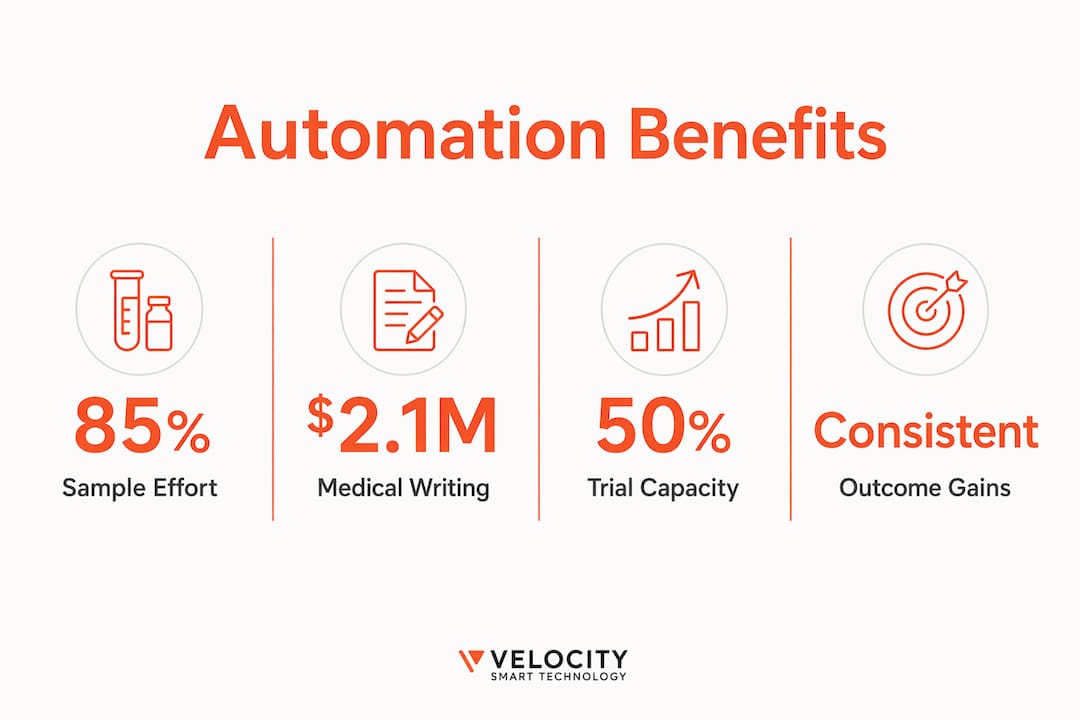
The $2.1M annual saving in medical writing is also structurally significant. Outsourced medical writing is a variable cost that scales with regulatory submission volume. Automating the first draft removes the largest cost driver in that spend category. The saving recurs every year and compounds as submission volumes grow.
Across all these case studies, the pattern is consistent. Automation in pharma IT does not deliver marginal improvements. It delivers step changes in throughput, cost, and capacity. The firms achieving these results are not exceptional. They applied validated technology to well-mapped processes and measured the outcome rigorously.
How do pharma IT teams maintain compliance while automating?
Regulatory compliance is the constraint that makes pharmaceutical IT automation harder than automation in other industries. Every system change in a GxP environment requires documented validation. That requirement does not disappear when you add an automation layer. It applies to the automation layer itself.
The compliance approach that works in practice follows four steps:
- Validate the integration layer separately. Middleware platforms designed for pharma, such as those connecting SAP to Veeva or LIMS to MES, are validated as standalone components. The existing validated state of each connected system remains unchanged. This avoids triggering re-validation of the ERP or QMS, which can take months.
- Build immutable audit logs into every automated step. 21 CFR Part 11 and EU GMP Annex 11 both require electronic records to be attributable, legible, contemporaneous, original, and accurate. Automation platforms that write to a native audit trail within the existing validated system satisfy this requirement without additional tooling.
- Implement human approval gates at regulated decision points. Automation handles data gathering, formatting, and routing. A qualified person or authorised reviewer approves the output before it advances. This preserves the human accountability that regulators require while removing the manual effort that precedes the decision.
- Document the automation layer in the validation master plan. Regulators expect to see the automation component described in the site’s validation documentation. Firms that treat the automation layer as an IT project rather than a GxP system change create audit findings.
Maintaining validated configuration is the single most common failure point in pharma automation programmes. Teams that skip the validation planning phase to accelerate deployment typically spend more time in remediation than they saved in the original project.
Pro Tip: Engage your quality assurance team at the technology selection stage, not after the platform is chosen. The cost of retrofitting compliance documentation into an automation platform that was not designed for GxP environments is substantial.
What cultural and operational shifts does pharma automation require?
Cultural resistance, not technical limitations, is the primary barrier to successful automation adoption in pharmaceutical environments. This finding appears consistently across case studies and is worth taking seriously as a planning constraint.
The resistance is rational. Automation changes what skilled staff do every day. A clinical data manager who has spent years building expertise in manual validation processes faces a genuine question about their role when 95% of that validation time is eliminated. The answer to that question must be clear before deployment begins, not after.
Successful pharma automation programmes address the cultural dimension through several consistent practices:
- Reframe the role, not just the process. Staff moving from manual data gathering to exception management and judgement calls are doing more valuable work, not less. That reframing must come from leadership and be reinforced through job descriptions and performance metrics.
- Select platforms accessible to non-technical users. STADA’s real-time dashboard is used by over 100 employees across functions. That adoption breadth is only possible because the interface does not require data science skills. Platforms that require IT mediation for every query create bottlenecks and reduce adoption.
- Start with a phased implementation. Automating broken processes produces poor results and erodes confidence in the programme. The first phase should always be workflow mapping. The second phase is process improvement. Automation comes third.
- Measure and communicate outcomes early. Early wins, even small ones, build the internal credibility that sustains a multi-year automation programme. Document the baseline before deployment and report against it within the first quarter.
The shift to exception-based quality management is the most significant operational change automation brings to pharma. Teams that make this transition successfully report higher job satisfaction, not lower. The work becomes more intellectually demanding, not less.
Key takeaways
Pharmaceutical IT automation delivers step-change outcomes in throughput, cost, and compliance when applied to well-mapped processes through validated integration layers.
| Point | Details |
|---|---|
| Map before automating | Use process mining or digital twins to identify bottlenecks before selecting an automation platform. |
| Validate the integration layer | Connect SAP, Veeva, LIMS, and MES through middleware validated separately, preserving existing system states. |
| Quantify the baseline | Document current cycle times and costs before deployment to measure and communicate outcomes credibly. |
| Address cultural resistance early | Reframe staff roles around exception management before go-live, not after resistance emerges. |
| Build compliance in from the start | Engage quality assurance at technology selection stage to avoid costly remediation after deployment. |
The agentic AI shift is closer than most pharma IT teams think
The case studies in this article were built on conventional automation: RPA, process mining, validated middleware, and first-generation AI document tools. The next wave is agentic AI, and MSD’s partnership with Google Cloud is the clearest signal of where the sector is heading.
What strikes me about that partnership is the framing. MSD and Google Cloud are not talking about replacing scientists or regulatory affairs professionals. They are talking about deploying AI agents that handle the routine cognitive load so that human experts can focus on the decisions that actually require their judgement. That is the right framing, and it is the framing that will get automation programmes approved by boards and quality teams alike.
The firms that will extract the most value from agentic AI in pharma are the ones that have already done the foundational work: validated integrations, clean CMDB data, documented process maps, and a quality team that understands how automation layers fit into the validation master plan. The firms that skip that foundation and jump straight to agentic AI will find that the agents amplify the existing disorder rather than resolve it.
My strong view is that the physical layer of IT support in pharma is the next frontier. Clinical sites, manufacturing facilities, and research campuses all have IT hardware that needs to move: devices issued to new starters, peripherals replenished at lab benches, broken equipment swapped out without waiting for an engineer. That physical handover is the last manual step in an otherwise automated IT service chain. The role of automation in ITSM is expanding precisely because that gap is now visible to every IT leader who has watched their digital ticket costs fall while physical support costs hold firm.
— Anthony
How Velocity-smart supports pharma IT automation programmes
Pharmaceutical IT teams that have automated their clinical and regulatory workflows often find that physical IT support remains the last manual bottleneck. Device handovers, peripheral replenishment, and equipment returns still require an engineer on site.
Velocity-smart’s Smart Collect platform closes that gap natively inside ServiceNow. A global pharma customer using Smart Collect achieved a 500% uplift in IT service throughput and 83% faster fulfilment, with 74% less employee downtime. Those outcomes were delivered before agentic AI was driving the workflow. The Automation Unboxed programme explains how Velocity-smart connects physical IT handovers to the same ServiceNow workflows that govern your digital service operations. For pharma IT leaders building the complete automation picture, that connection is where the remaining cost sits.
FAQ
What is IT automation in the pharmaceutical industry?
IT automation in pharma is the use of AI platforms, validated middleware, RPA, and process mining to replace manual steps in clinical, regulatory, and manufacturing IT workflows. The goal is to reduce cycle times and costs while maintaining GxP compliance.
How does Novo Nordisk use IT automation?
Novo Nordisk deployed an AI platform called NovoScribe to automate clinical study report generation, reducing turnaround from over ten weeks to ten minutes and cutting clinical pathology data validation time by 95%.
How do pharma firms maintain compliance when automating IT systems?
Pharma firms maintain compliance by validating the automation layer separately from existing ERP, QMS, and LIMS systems, building immutable audit logs into every automated step, and implementing human approval gates at regulated decision points in line with 21 CFR Part 11 and EU GMP Annex 11.
What is process mining and why does it matter in pharma automation?
Process mining ingests event log data from ERP and MES systems to build a real-time map of how workflows actually run. STADA used Celonis process mining to identify bottlenecks in its batch release process, achieving a 44% reduction in throughput time.
What is the biggest barrier to pharma IT automation adoption?
Cultural resistance is the primary barrier, not technical complexity. Staff whose roles change significantly through automation require early reframing of their responsibilities around exception management and judgement, rather than manual data processing.
Recommended
See what Smart Collect® could save you
Model your savings in two minutes, or book a 60-minute workshop to pressure-test the numbers against your estate.