The last mile of IT support: a guide for enterprise IT
The last mile of IT support: a guide for enterprise IT">
The last mile of IT support: a guide for enterprise IT

TL;DR:
- The last mile of IT support involves physical device exchanges and on-site intervention, which are costly and often manual. Hybrid models combining remote resolutions with automated physical endpoints reduce downtime and increase staff productivity. Integrating these endpoints into ITSM platforms like ServiceNow ensures real-time asset tracking and cost-effective support delivery.
The last mile of IT support is the physical delivery and hands-on intervention stage that connects digital service workflows to the end user. Remote tools resolve the majority of tickets, but the moment a laptop fails, a device needs swapping, or a peripheral must reach a distributed worker, a human historically had to show up. That dependency is the single largest cost driver in enterprise IT support delivery. Desktop support tickets cost roughly $70 each compared to $22 for digital resolution, and as AI collapses digital costs further, the gap between remote and physical support widens to a level no CFO can ignore.
What is the last mile of IT support?
The last mile of IT support refers to the final, physical stage of the IT service chain. It is the point at which digital workflows must translate into a tangible outcome: a device in a user’s hands, a peripheral exchanged, or a broken machine collected and replaced. Industry frameworks formalise this as Tier 4 support, a distinct escalation tier covering physical asset distribution and external vendor interaction, separate from Tiers 1 through 3.
This distinction matters operationally. Remote IT support resolves 70–80% of software and configuration issues without any physical intervention. The remaining 20–30% drives the majority of IT support spend. Hardware failures, access control issues, and complex onsite fixes all require physical presence, and that presence carries a cost that remote tooling cannot reduce.
The term “last mile” is borrowed from logistics, where it describes the final, most expensive leg of a delivery chain. In IT, the analogy holds precisely. The infrastructure for remote resolution is mature and well-funded. The physical handover remains largely manual, poorly documented, and disproportionately expensive.
What challenges does the last mile of IT support address?
Physical IT support carries costs that compound quickly in large enterprises. On-site intervention covers 15–20% of complex tickets but generates multi-hour operational disruptions through travel time, scheduling delays, and the gap between ticket creation and technician arrival. That gap is known as shadow downtime: the period during which a user cannot work but the ticket has not yet been resolved.

Shadow downtime is rarely measured, which means it is rarely managed. A user waiting three hours for a replacement laptop is not captured in mean time to resolution metrics. The productivity loss is real, but it sits outside the ITSM dashboard. Enterprises that treat physical support as a logistics problem rather than a pure IT problem begin to surface and reduce this cost.
The financial exposure is direct. Dispatching a technician costs $200–$500 per visit in major metropolitan areas, frequently exceeding the value of the device being replaced. At scale, across hundreds of sites and thousands of tickets annually, that spend becomes a material line item.
A further challenge is documentation. Physical handovers are often absent from ITSM records entirely. The hand-off gap in physical IT support creates documentation black holes: no chain of custody, no asset state update, no audit trail. When a device changes hands without a corresponding ITSM event, asset lifecycle data degrades and compliance risk increases.
Pro Tip: Map your shadow downtime before building a business case for physical support automation. Calculate the average hours lost between ticket creation and hardware resolution, multiply by headcount affected, and apply a fully loaded hourly rate. The resulting figure typically dwarfs the cost of the automation investment.
Key challenges the final stage of IT support must address:
- Hardware failures that remote tools cannot resolve
- Scheduling delays and travel costs for manual technician dispatch
- Shadow downtime between ticket creation and physical resolution
- Missing or incomplete ITSM records for physical asset handovers
- Compliance and audit exposure from undocumented device transfers
How do hybrid IT support models combine remote and physical endpoints?
Hybrid IT support models combine remote Tier 1–3 resolution with automated physical endpoints to close the last mile without dispatching an engineer for every ticket. The model works by positioning hardware at or near the point of need, then triggering automated handovers through the ITSM platform when a ticket escalates to physical intervention. Enterprises adopting hybrid models report a 30% decrease in downtime and a 70% boost in staff productivity.

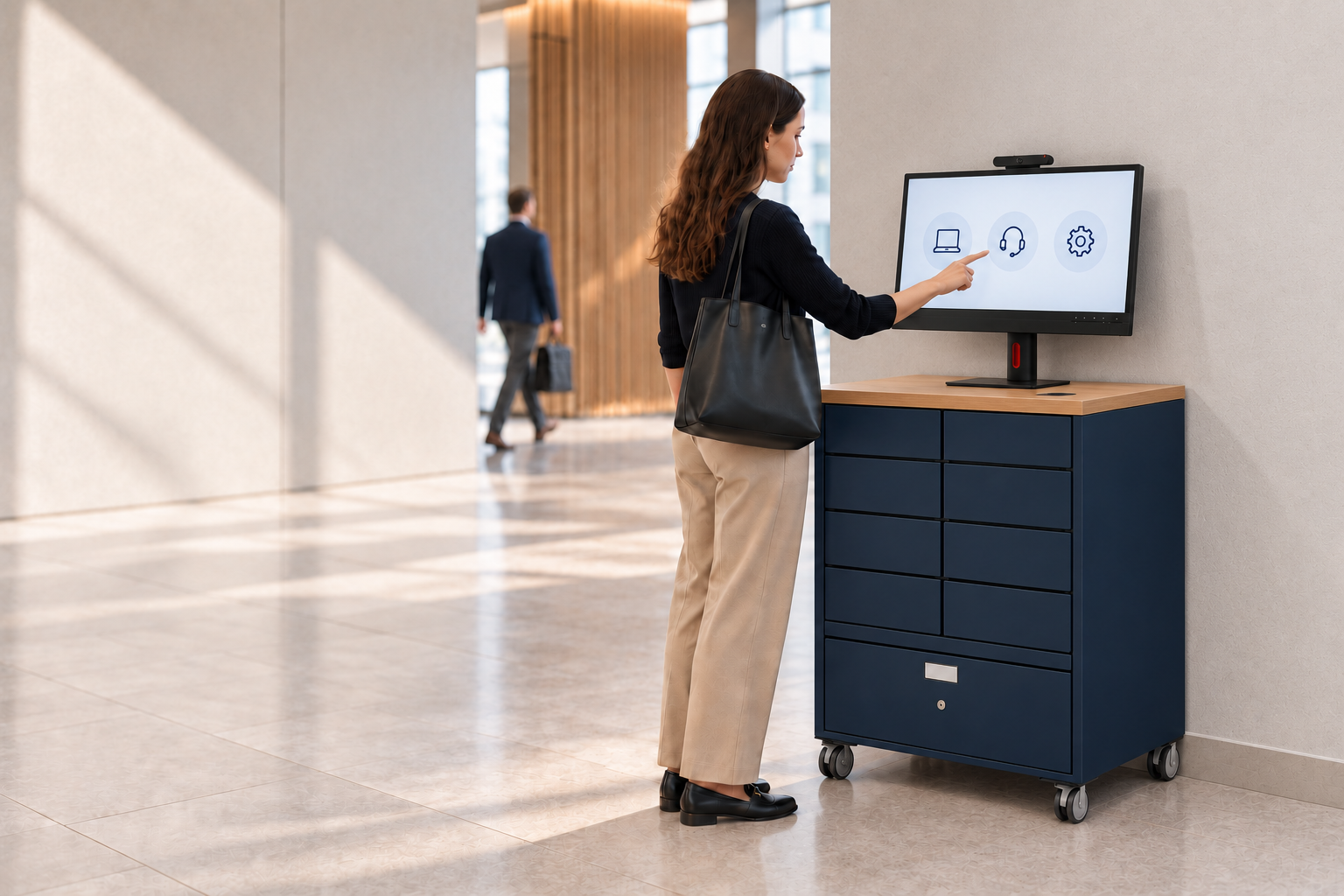
The physical endpoints in a hybrid model typically take three forms. Smart lockers handle full-device handovers: new-starter kit delivery, broken-laptop swaps, and equipment loans. Smart vending machines dispense peripherals, consumables, and accessories on demand, 24 hours a day. IT support kiosks provide walk-up assistance, combining self-service diagnostics with video-based remote support for issues that need human judgement but not a physical visit.
ServiceNow is the integration layer that makes this model auditable. When a physical handover is logged as an automated event inside the ITSM platform, it becomes a native record in the CMDB. Asset state, device location, and ownership history update in real time. The documentation black hole closes.
| Support model | Resolution method | Typical cost per ticket | Shadow downtime |
|---|---|---|---|
| Remote only (Tier 1–3) | Software, configuration, remote access | Low | Minimal |
| Manual technician dispatch | Engineer travels to site | $200–$500 per visit | Hours to days |
| Hybrid with automated endpoints | Smart locker, kiosk, or vending machine | Low to moderate | Near zero |
Pro Tip: When evaluating hybrid models, prioritise ITSM-native integrations over middleware layers. A platform that runs inside your existing ServiceNow tenant inherits your RBAC, audit trail, and CMDB without requiring a separate security review or data synchronisation process.
The role of smart lockers in IT support extends beyond simple storage. When connected to a ServiceNow workflow, a locker becomes a physical ticket-closing event. The user receives a PIN or QR code, collects the device, and the ticket closes automatically. No engineer, no scheduling, no delay.
What strategies can enterprises adopt to optimise end-user support delivery?
Treating the last mile as a supply chain problem is the single most effective reframe available to enterprise IT leaders. Enterprises that approach physical support as asset positioning and logistics reduce onsite technician visits by 30–40%. The operational logic is the same as just-in-time manufacturing: stage the right asset at the right location before the failure occurs, not after the ticket arrives.
A practical optimisation programme follows this sequence:
- Audit ticket data by failure type and location. Identify which hardware categories generate the most physical dispatches and which sites carry the highest frequency. This creates the deployment map for physical endpoints.
- Deploy smart lockers and kiosks at high-frequency sites. Distributed self-service hardware endpoints cut shadow downtime to near zero by giving users immediate access to replacement devices without waiting for a technician.
- Integrate every physical handover into the ITSM workflow. ITSM platforms must treat physical handovers as auditable automated events to maintain full ticket lifecycle visibility. Platforms like ServiceNow support this natively when the physical endpoint is a certified application rather than a third-party integration.
- Implement proactive monitoring and automated dispatch triggers. Predictive analytics on device health data can trigger a locker pre-load before a failure is reported, converting reactive break-fix into proactive replacement.
- Partner with local MSPs for complex physical interventions. Local MSP partnerships provide hands-on, site-specific expertise that remote-only providers cannot replicate. Reserve MSP dispatch for genuinely complex scenarios; automate everything transactional.
Pro Tip: Build a critical hardware register segmented by site and failure frequency. Lockers stocked with the wrong devices are just expensive furniture. Stock decisions should be driven by ticket history, not procurement convenience.
Velocity-smart’s Smart Collect platform operationalises this approach natively inside ServiceNow. Roche runs the platform across the US, Switzerland, Germany, and China. A US nuclear energy operator using Smart Collect cut onsite tickets by 60% and reclaimed 31–42% of IT staff time. These outcomes were achieved before agentic AI entered the workflow. As ServiceNow Now Assist matures, the same infrastructure closes tickets end-to-end without human intervention at any stage.
Measuring effectiveness requires metrics beyond mean time to resolution. Track shadow downtime reduction, dispatch frequency per site, asset utilisation rates, and CMDB data completeness. Automation of support processes that includes physical endpoints produces measurable gains across all four dimensions.
How does automating physical IT support reduce costs and improve user experience?
Automated physical endpoints change the economics of IT support delivery at the point where costs are highest. Smart lockers and kiosks enable near-zero latency hardware access, cutting shadow downtime and removing the scheduling dependency that makes manual dispatch so expensive. A user who collects a replacement laptop from a locker at 07:30 loses no productive time. A user waiting for a technician to arrive at 14:00 loses most of a working day.
The financial case is direct. Eliminating a $300 technician dispatch and replacing it with an automated locker transaction that costs a fraction of that figure produces immediate, measurable savings. At enterprise scale, across thousands of tickets annually, the cumulative reduction is material. A global pharma customer using Velocity-smart’s Smart Collect platform saw 83% faster fulfilment and 74% less employee downtime. A UK utility reduced shared-equipment loss and damage by 90%.
User experience improvements follow the same logic. Immediate hardware access removes frustration, reduces calls to the service desk, and increases confidence in IT as a function. The proactive staging of equipment near users transforms physical IT support from a reactive emergency into a predictable, low-friction service.
Implementation requires attention to three practical considerations:
- Security and access control. Physical endpoints must enforce identity verification. ServiceNow-native platforms inherit existing RBAC and authentication policies, removing the need for separate access management.
- CMDB integration. Every transaction must update asset records in real time. Platforms that write directly to the CMDB as native records eliminate the data synchronisation risk that middleware layers introduce.
- Change management. Users and IT staff both need to understand the new workflow. Adoption rates for self-service hardware endpoints are high when the process is simple and the communication is clear.
Key takeaways
The last mile of IT support is the highest-cost, lowest-automation stage of enterprise IT service delivery, and hybrid models combining ServiceNow-native physical endpoints with remote resolution are the most effective way to close that gap.
| Point | Details |
|---|---|
| Physical support drives disproportionate cost | Technician dispatch costs $200–$500 per visit, often exceeding device value. |
| Shadow downtime is the hidden metric | Lost productivity before physical resolution arrives is rarely measured but consistently significant. |
| Hybrid models cut downtime and lift productivity | Enterprises adopting hybrid remote and automated physical models report 30% less downtime and 70% higher staff productivity. |
| ITSM integration is non-negotiable | Physical handovers must be logged as native ITSM events to maintain audit trails and CMDB accuracy. |
| Treat hardware logistics as supply chain | Staging assets near users before failures occur reduces onsite technician visits by 30–40%. |
The physical layer is where IT strategy becomes real
Enterprise IT has invested heavily in remote resolution, AI-assisted triage, and ITSM automation. Those investments are sound. But the assumption that physical support will simply follow the same automation curve is, in my view, the most expensive mistake IT leaders make.
The physical layer does not automate itself. It requires deliberate infrastructure: hardware endpoints positioned at the right sites, connected to the right workflows, and managed with the same rigour applied to any other part of the service chain. I have seen organisations deploy smart lockers as a cost-cutting exercise, stock them with the wrong devices, and then wonder why adoption is low. The technology is not the constraint. The operational model is.
The most effective IT leaders I have observed treat physical support as a logistics discipline. They apply ticket data to stocking decisions, integrate every handover into ServiceNow as an auditable event, and reserve engineer dispatch for genuinely complex interventions. That combination, remote resolution for the 70–80% and automated physical endpoints for the transactional remainder, is where the real cost reduction lives. The automation of proactive IT deskside support is not a future state. It is available now, and the enterprises that have deployed it are already operating at a structurally lower cost base than those still dispatching engineers to swap laptops.
— Anthony
Automate your physical IT support with Velocity-smart

Velocity-smart builds the only ServiceNow-native platform that lets AI agents close physical-handover tickets without dispatching an engineer. Smart Collect orchestrates smart lockers, smart vending machines, and IT support kiosks from a single application running inside your ServiceNow tenant. Every handover is an auditable ITSM event. Every asset update writes directly to your CMDB. Customers including Roche, BAE Systems, and Entergy have used the platform to cut onsite tickets, reclaim IT staff time, and reduce employee downtime at scale. Explore the enterprise automation platform to see how the physical last mile closes without a single engineer dispatch, or review the self-service hardware guide for a practical framework on deploying physical endpoints across distributed sites.
FAQ
What is the last mile of IT support?
The last mile of IT support is the physical delivery and hands-on intervention stage that connects digital ITSM workflows to the end user. It covers device handovers, break-fix hardware exchanges, and any support task that cannot be resolved remotely.
Why does physical IT support cost more than remote resolution?
Dispatching a technician costs $200–$500 per visit in major metropolitan areas, driven by travel, labour, and the shadow downtime users experience while waiting. Remote resolution carries a fraction of that cost per ticket.
How do smart lockers reduce IT support costs?
Smart lockers enable users to collect replacement devices immediately, removing the scheduling delay and travel cost of technician dispatch. When integrated with ServiceNow, each transaction closes the ticket automatically and updates the CMDB in real time.
What is shadow downtime in IT support?
Shadow downtime is the period of lost user productivity between ticket creation and physical resolution. It is rarely captured in standard ITSM metrics but represents a significant operational cost, particularly when manual technician dispatch introduces multi-hour delays.
How does ServiceNow integrate with physical IT support endpoints?
ServiceNow-native platforms such as Velocity-smart’s Smart Collect run inside the customer’s existing tenant, logging every physical handover as an auditable event and updating asset records directly in the CMDB without middleware or data synchronisation.
Recommended
See what Smart Collect® could save you
Model your savings in two minutes, or book a 60-minute workshop to pressure-test the numbers against your estate.