
The role of asset auditing in IT device management
TL;DR:
- Most IT leaders view asset auditing as a simple counting task, but its true purpose is to connect physical devices to financial, security, and operational records. Continuous, automated audits ensure accurate, up-to-date data across systems, reducing errors and strengthening control environments critical for compliance and security. Implementing smart, integrated solutions creates a real-time, reliable asset management process that adapts to the dynamic enterprise landscape.
Most IT leaders treat asset auditing as a counting exercise. Count the laptops, tick the boxes, file the report. But that framing misses the point entirely. The role of asset auditing is to connect physical devices to financial records, ownership approvals, security configurations, and operational controls — and when that connection breaks down, enterprises face errors in finance and operations that surface at the worst possible moments. Poor auditing means inaccurate depreciation, failed compliance checks, and devices that exist on the network but nowhere in your records. This guide gives you a practical framework to fix that.
Table of Contents
- Understanding the core role of asset auditing in enterprise IT
- Key processes and frameworks for IT asset auditing success
- Reconciling asset data across systems to maintain accuracy
- Integrating security compliance and lifecycle controls in asset auditing
- Practical ways to implement continuous asset auditing and automation
- Why traditional periodic audits are no longer enough: a fresh perspective
- Enhancing asset auditing with smart IT support solutions
- Frequently asked questions
Key Takeaways
| Point | Details |
|---|---|
| Asset auditing purpose | It links physical assets with financial and operational controls to ensure accurate reporting and compliance. |
| Process discipline | Effective auditing requires clear scope, cross-functional collaboration, and actionable remediation plans. |
| Data reconciliation | Maintaining a single source of truth needs automated reconciliation across IT, procurement, and financial systems. |
| Security integration | Auditing extends beyond counts to verifying security configurations and lifecycle controls. |
| Continuous automation | Ongoing automated updates prevent stale data and reduce burdensome periodic audits. |
Understanding the core role of asset auditing in enterprise IT
Asset auditing is a management control process, not an inventory counting task. It verifies that assets exist in the right place, belong to the right owner, carry the right configuration, and are recorded accurately across every system that touches them. For IT leaders managing thousands of devices across distributed sites, that distinction matters enormously.
A continuous fixed asset audit ties physical assets to financial records including depreciation schedules, disposal approvals, and procurement authorisations. Run it annually and you are perpetually behind. Run it continuously and you maintain a living control environment that holds up under external scrutiny.
In practice, a well-scoped IT asset audit covers:
- Physical existence and location: Is the device where the record says it is?
- Ownership and authorisation: Is it assigned to the right person, team, or cost centre?
- Condition and lifecycle stage: Is it within warranty, due for refresh, or pending disposal?
- Software licences: Are licence counts reconciled against active installations?
- Configuration posture: Does the device meet your security baseline?
The importance of audit trails becomes obvious when finance or an external auditor asks for evidence. If your records only capture point-in-time snapshots, you cannot demonstrate control. If they capture continuous movements and approvals, the evidence practically tells its own story.
Key processes and frameworks for IT asset auditing success
A consistent audit process is more valuable than an occasional thorough one. Enterprises that audit in structured, repeatable cycles generate better data and spend less time firefighting discrepancies at year-end.
IT asset inventory audits follow a defined sequence: plan scope, define the inventory framework, gather existing records, discover assets through automated tools, validate findings, assess compliance, then implement remediation controls. That sequence matters because skipping steps creates compounding errors downstream.
Here is how to apply that sequence in a large enterprise context:
- Define your audit scope. Are you auditing for financial accuracy, security compliance, licence optimisation, or lifecycle planning? Each goal changes what you measure and how you prioritise exceptions. Choose one primary driver per audit cycle.
- Agree on taxonomy. Every team must use the same naming conventions for device types, locations, and status fields. Without this, reconciliation across systems is guesswork.
- Involve procurement, finance, and security. Asset management reviews that involve only IT miss critical data held in finance systems and procurement contracts.
- Gather records before you discover. Pull your authoritative data first, then run discovery tools. This prevents discovery output from simply overwriting your existing records without validation.
- Validate through multiple sources. Cross-reference serial numbers from procurement against service desk records, network discovery, and physical checks. Reconciliation is iterative, not a single pass.
- Convert findings into owned remediation tasks. Every discrepancy needs an owner and a deadline. Audits that produce reports but no accountability change nothing.
Pro Tip: Scope each audit cycle to a specific business objective. Trying to achieve financial accuracy, security compliance, and licence optimisation simultaneously dilutes your team’s focus and reduces the quality of every outcome.
Following IT asset management efficiency principles means treating each audit cycle as preparation for the next. Document what you found, how you found it, and what changed as a result.
Reconciling asset data across systems to maintain accuracy
The hardest part of asset auditing in a large enterprise is not finding assets. It is reconciling conflicting records across systems that were never designed to talk to each other. Your service desk holds one version of a device’s location. Your procurement system holds another. Your network discovery tool holds a third. All three can be simultaneously wrong.
Maintaining a single source of truth requires reconciling authoritative systems across procurement, finance, service desk, and discovery tools on a continuous basis. The goal is not to eliminate every discrepancy instantly. It is to detect exceptions quickly and resolve them before they compound.
| Factor | Manual reconciliation | Automated reconciliation |
|---|---|---|
| Update frequency | Periodic, often quarterly or annual | Continuous, triggered by changes |
| Error rate | High due to manual re-keying | Low when integrations are maintained |
| Audit evidence quality | Point-in-time snapshots | Continuous control trail |
| Staff effort | High, disruptive to operations | Focused on exception handling |
| Risk of stale data | Significant | Minimal with correct configuration |
| Cost to scale | Increases with asset volume | Largely fixed once configured |
Effective reconciliation focuses on matching specific identifiers: serial numbers, hostnames, MAC addresses, physical location codes, and assigned owner. When these identifiers align across systems, the record is reliable. When they conflict, that is your exception to investigate. Organisations working with infrastructure consulting partners often discover that their biggest reconciliation failures trace back to missing identifiers at the point of procurement, not at the point of audit.
Physical verification should be a targeted activity. Reserve it for exceptions that automated reconciliation flags rather than conducting bulk physical counts on a schedule. That approach reduces disruption significantly while maintaining better evidence quality.
Pro Tip: Establish a data quality score for your asset register. Track the percentage of records with complete identifiers monthly. A rising score means your reconciliation process is working. A falling score signals that a process upstream (typically procurement or onboarding) has broken down.
Enterprise asset access controls also feed directly into reconciliation quality. Every time a device is collected or returned through a controlled access point, you generate a timestamped, attributed record that confirms physical existence without requiring a separate audit step.
Integrating security compliance and lifecycle controls in asset auditing
Physical existence is only one dimension of what an asset audit must verify. For IT leaders, the more operationally significant dimension is often security configuration. A device that exists, is correctly assigned, and is accurately recorded can still represent a serious risk if its configuration has drifted from your approved baseline.

NIST guidance recommends pairing asset audits with configuration checklists to detect unauthorised changes and strengthen security posture. That approach turns the audit process into a dual-purpose control: verifying both physical and configuration integrity simultaneously.
Security and lifecycle integration means your audits must cover:
- Intake: Is the device enrolled, configured, and recorded before it reaches the end user?
- Deployment: Is the baseline configuration verified at the point of issue?
- Maintenance: Are patches, certificate renewals, and configuration changes recorded against the asset?
- Refresh: Is the refresh trigger linked to a lifecycle record rather than a support ticket?
- Disposal: Is decommissioning confirmed, data wiped, and the record closed in every system?
“Checklists are not bureaucracy. They are the mechanism by which complex, high-stakes processes are executed consistently by people under pressure. In asset auditing, they are also your primary evidence that controls existed and were followed.”
Embedding lifecycle controls into auditing means you gain IT asset automation benefits at every stage. Each lifecycle event becomes a data point, each approval becomes a record, and your audit evidence builds itself as operations proceed rather than being assembled retrospectively under pressure.
Practical ways to implement continuous asset auditing and automation
Shifting from periodic audits to continuous auditing requires changing both technology and process habits. The technology part is more straightforward than most teams expect. The process habit change is harder.
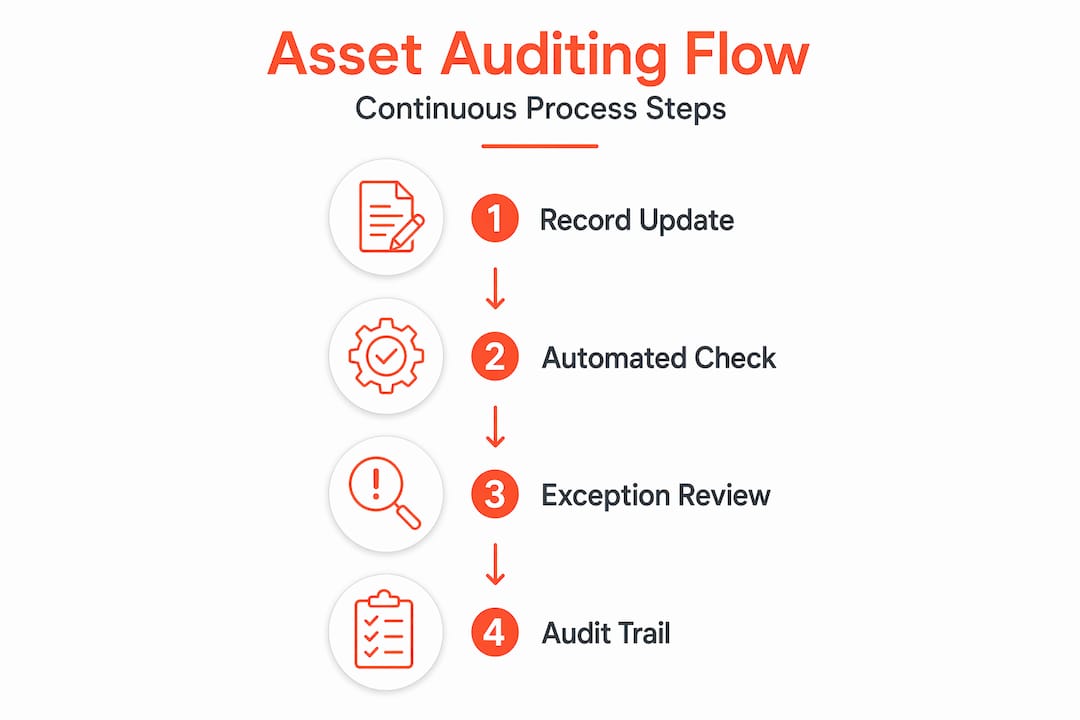
The core principle is this: every system that touches an asset should update the authoritative record automatically. Procurement creates the record. Service desk updates location and assignment. Endpoint management tools update configuration status. Discovery tools confirm network presence. Physical collection or return points confirm physical status.
- Integrate procurement workflows so every purchase order creates or updates an asset record without manual intervention.
- Connect your service desk so assignment changes, relocations, and fault reports update the asset register in real time.
- Schedule network discovery runs to flag devices present on the network but absent from your asset register.
- Use cycle counts on high-value or high-risk asset categories rather than full physical audits.
- Build exception reports that surface discrepancies daily, with clear ownership routing for resolution.
| Audit approach | Frequency | Staff effort | Data currency | Evidence quality |
|---|---|---|---|---|
| Periodic manual audit | Annual or quarterly | Very high | Stale between cycles | Snapshot only |
| Cycle count programme | Rolling monthly | Moderate | Reasonably current | Improved but still periodic |
| Continuous automated auditing | Ongoing | Low, focused on exceptions | Current | Continuous control trail |
Automation prevents inventory drift and the audit blind spots that emerge when fast-moving IT environments outpace manual recording processes. When your environment changes daily, a quarterly count is already obsolete before the ink is dry.
Pro Tip: Train your IT team to read exception reports rather than conduct full counts. An analyst who can interpret and resolve exceptions efficiently is more valuable to your audit programme than ten people with clipboards. Consider pairing this with automated IT support workflows that trigger asset record updates automatically when devices are exchanged or repaired.
Organisations exploring automation for enterprises find that the initial integration effort pays back quickly in reduced audit preparation time and fewer findings from external auditors.
Why traditional periodic audits are no longer enough: a fresh perspective
There is an uncomfortable truth that most IT audit guidance sidesteps. Annual physical counts are not just inefficient. They actively create a false sense of control. Your team spends days counting, produces a report showing 94% accuracy, and then the environment changes 200 times in the next quarter without a single update to the register. By the time the next count happens, that 94% is a fiction.
The environments we manage now are simply too dynamic for periodic auditing to be meaningful. Devices ship directly to home workers. Assets move between sites without tickets. Equipment is replaced through self-service kiosks. Licences are provisioned and removed on demand. A count on a Tuesday tells you nothing reliable about a Wednesday.
Auditors prioritise evidence quality and control trails over raw asset counts. They are not looking for a perfect number. They are looking for proof that you have a functioning control environment. Continuous exception reconciliation provides that proof far more convincingly than any snapshot count.
The organisations that perform best under external audit scrutiny are not the ones that conducted the most thorough annual counts. They are the ones that built centralised asset tracking processes that generate a continuous, attributed, timestamped control trail. When an auditor asks “show me how you know this device belongs to this person in this location,” they can answer in seconds rather than days.
Shifting to continuous auditing is not a technology decision alone. It requires reframing what an audit is. It is not an event. It is a permanent operating state.
Enhancing asset auditing with smart IT support solutions
Turning continuous asset auditing from a concept into operational reality requires infrastructure that records every asset movement, exchange, and return automatically. That is precisely where Velocity Smart Technology’s platform delivers measurable impact for IT leaders managing distributed enterprise environments.

Velocity’s Smart IT Support Kiosks enable real-time device exchange and return at workplace locations, generating timestamped asset records without requiring onsite technicians. Every transaction updates your asset register automatically. The Automation Unboxed platform brings device distribution, returns, and lifecycle controls into a single automated workflow, eliminating the manual re-keying that corrupts asset data. Built natively on ServiceNow, Velocity’s smart locker and vending software integrates asset collection and return events directly into your existing asset management and audit workflows. The result is a continuous, attributed control trail that makes audit readiness a by-product of normal operations.
Frequently asked questions
What is the main purpose of asset auditing in large enterprises?
Asset auditing verifies that physical assets match their recorded data, ensuring accurate financial reporting, operational control, and compliance in large enterprises. It reconciles recorded systems with physical existence and correct ownership to prevent downstream errors in finance and operations.
How often should IT asset audits be conducted for best results?
IT asset audits should be ongoing and continuous rather than purely periodic, incorporating automated updates and regular cycle counts to maintain current, reliable data. A continuous audit process that ties physical assets to financial records and controls is far more effective than annual point-in-time counts.
What are common mistakes to avoid in IT asset auditing?
A common mistake is trying to audit everything at once without a clear business goal, which reduces accuracy and wastes resources. Incorrect scoping without business goals is the most frequent cause of ineffective IT asset audits.
How does automation improve asset auditing processes?
Automation keeps asset records current by integrating procurement, discovery, and service desk updates, turning audits into exception management rather than manual recounts. It prevents inventory drift and the audit blind spots that develop when environments change faster than manual processes can track.
Why is IT asset register accuracy critical for IT security?
Accurate asset registers enable timely identification of unmanaged or vulnerable devices, supporting patch management, security compliance, and incident response efforts. Unmanaged devices pose direct security risks, and an inaccurate register means those risks remain invisible until something goes wrong.
Recommended
See what Smart Collect® could save you
Model your savings in two minutes, or book a 60-minute workshop to pressure-test the numbers against your estate.