 The role of automation in growth for enterprise IT">
The role of automation in growth for enterprise IT
TL;DR:
- Automation enhances enterprise IT growth by increasing service capacity and enabling skilled staff to focus on higher-value tasks.
- It reduces resolution times through structured workflows, context preservation, and AI assistants, as demonstrated by Vermeer.
- Effective scaling requires governance frameworks, precise measurement, and KPIs that prioritize capacity expansion over cost savings.
Automation is the primary mechanism by which enterprise IT organisations convert operational capacity into measurable growth, without proportionate increases in headcount or cost. For CIOs and IT Directors, the role of automation in growth extends well beyond ticket deflection or cost reduction. It determines how quickly your organisation can scale service delivery, absorb demand spikes, and free skilled engineers for work that genuinely requires human judgement. The evidence is now substantial: from San Francisco Fed macroeconomic modelling to Freshworks case studies at Vermeer, automation’s effect on productivity is quantifiable, compounding, and strategically significant. The question is no longer whether to automate, but how to govern and scale it for growth rather than efficiency alone.
What does empirical evidence say about automation’s impact on growth?
Automation’s macroeconomic growth credentials are well established. A San Francisco Fed task-based model projects a real output increase of approximately 7% by 2075 as AI automation diffuses across industries, with rising real wages accompanying that expansion. That figure represents compounding returns from scale adoption, not a one-time efficiency gain. It signals that organisations which adopt automation early and at scale will accumulate structural advantages that late movers cannot easily replicate.
At the firm level, a study of 52 countries from 2007 to 2019 found that robot adoption raises total factor productivity, lowers unemployment, and improves real wages, particularly at the upper end of the wage distribution. This matters for enterprise IT leaders because it reframes the workforce conversation. Automation does not simply displace labour. It reconfigures it, concentrating human effort on higher-value tasks while machines handle repetitive execution. Research from The Conversation reinforces this: industries most exposed to AI are seeing productivity gains and employment growth simultaneously, not a trade-off between the two.
The enterprise IT implications are direct. Organisations that treat automation as a growth instrument, rather than a cost-cutting exercise, position themselves to scale service capacity without linear headcount growth. The data supports this framing at every level of analysis, from macroeconomic modelling to sector-specific employment studies.
Key empirical findings for CIOs to anchor their business cases:
- Real output growth of ~7% projected by 2075 through broad AI automation diffusion, with scale adoption reaching 23% of firms by 2035
- Total factor productivity gains confirmed across 52 countries following industrial robot adoption
- Employment and wage growth observed in sectors with the highest AI exposure, contradicting displacement-only narratives
- Managed AI services delivering 236% ROI over three years, with 80% elimination of end-user downtime
How does automation improve IT service delivery operationally?
The operational case for automation in IT service management is best understood through the mechanics of where time is lost. In a conventional ITSM environment, the gap between ticket creation and resolution is filled with manual triage, routing decisions, status updates, and handoff communications. Each of those steps introduces latency, and latency compounds across thousands of monthly tickets into a measurable drag on service throughput.

Vermeer, the global agricultural equipment manufacturer, demonstrates what structured automation removes from that equation. After implementing automated ticket routing and the AI assistant Freddy Copilot within Freshworks, Vermeer reduced IT service resolution times by nearly 50% and raised customer satisfaction scores to 95%. The mechanism was not simply speed. It was the elimination of context loss at each handoff point. When a ticket routes automatically to the correct resolver group with full context intact, the resolver begins work immediately rather than spending time reconstructing the problem. That distinction, between fast routing and context-preserving routing, is where automation’s growth leverage in ITSM is concentrated.
For CIOs building the operational case, the practical mechanisms worth prioritising are:
- Automated ticket classification and routing: Removes manual triage and eliminates misrouting delays that inflate mean time to resolution
- AI-powered assistants for first-contact resolution: Tools like Freddy Copilot handle predictable, high-volume queries without human intervention, freeing L1 engineers for escalations
- Change management workflow automation: Reduces approval cycle times and audit preparation effort in regulated environments
- Physical workflow automation: Smart lockers and self-service kiosks remove the dispatch requirement from hardware handover tickets entirely, which is the layer that digital automation cannot reach
Pro Tip: Prioritise automating processes that are both predictable and high-volume. Fixed adoption costs are real, and the economic return compounds fastest when automation runs against a large, repeatable transaction base. Start with password resets, hardware loan requests, and peripheral provisioning before moving to more complex workflows.
How should CIOs use automation as a growth strategy, not just a cost tool?
Harvard Business Review’s analysis of enterprise AI adoption identifies a consistent pattern: most organisations deploy automation to reduce costs, and in doing so, they capture only a fraction of the available value. The larger opportunity lies in growth, specifically in using automation to expand what your IT organisation can deliver without expanding its cost base proportionately. This is a strategic reorientation, not a tactical adjustment.
The Bank of Canada frames this well: AI-driven productivity improvements enable organisations to transform work into goods and services more efficiently, driving growth rather than simply making employees work harder. For IT leaders, that translates into a specific question: what new services, geographies, or employee experiences can your team now deliver because automation has freed the capacity?
A structured approach to growth-oriented automation strategy for CIOs:
- Redefine your KPIs. Move beyond ticket deflection rate and cost-per-ticket. Measure service throughput, cycle time from request to resolution, and employee experience scores. These metrics reveal whether automation is expanding capacity or merely shifting cost.
- Map capacity freed, not just cost saved. When automation handles 40% of L1 volume, quantify what your engineers do with that reclaimed time. If the answer is “the same work, more slowly,” the growth case has not been made.
- Align automation investments with business expansion plans. If your organisation is opening new sites, onboarding large cohorts of new starters, or integrating acquired entities, automation for device provisioning and IT onboarding should be scoped ahead of those events, not in response to them.
- Design for employee experience, not just resolution speed. Automation that employees find frustrating or opaque generates shadow IT and workarounds. The growth value of automation depends on adoption, and adoption depends on experience quality.
Pro Tip: When presenting automation investment cases to the board, frame the primary metric as throughput capacity added per pound spent, not cost per ticket reduced. This positions IT as a growth enabler rather than a cost centre, which changes the conversation about budget allocation.
How can enterprises scale and govern automation for sustained growth?
Scaling automation in enterprise IT is not primarily a technology problem. It is a governance and economics problem. The San Francisco Fed’s task-based modelling makes this explicit: fixed adoption costs dominate initial automation investments, which means the economic return is heavily dependent on transaction volume. An automation that processes 500 tickets per month delivers a fundamentally different ROI profile than one processing 5,000. Selecting the right processes to automate first is therefore a financial decision as much as an operational one.
Measurement maturity is the second governance requirement. Tracking automation performance at the workflow level, specifically runtime, error rates, and throughput per process, allows IT leaders to identify where automation is compounding value and where it is degrading. Itential’s customer data illustrates this: organisations that instrument their automation at the transaction level can identify underperforming workflows before they erode the business case, and can demonstrate ROI with the specificity that CFOs and boards require.
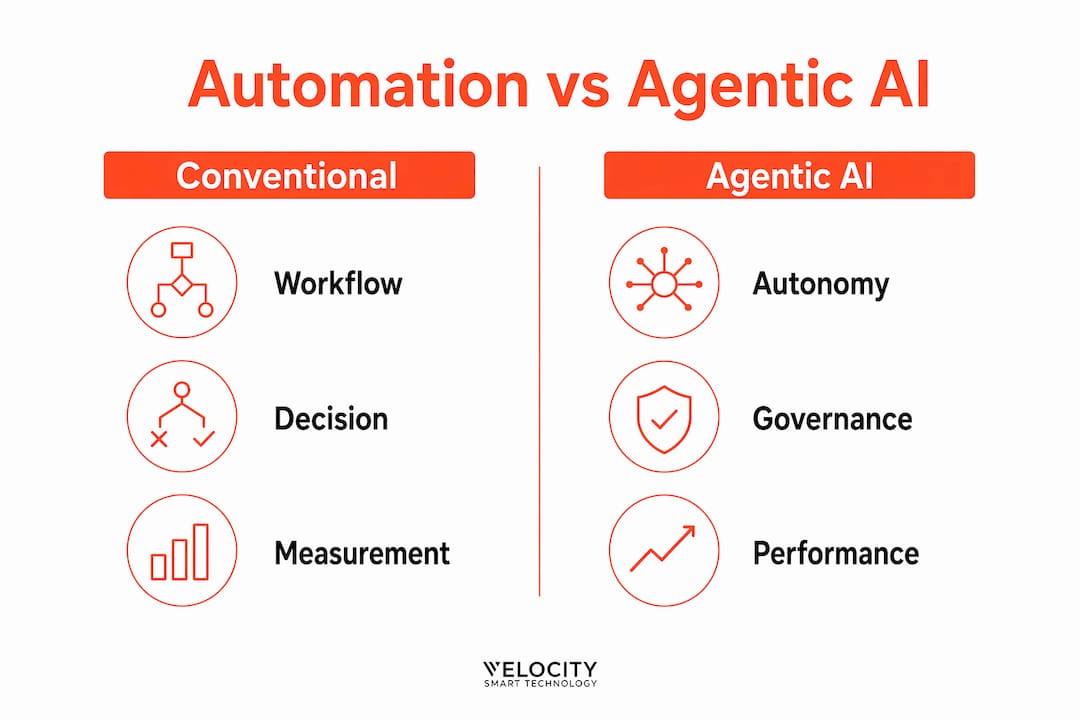
The third governance consideration is the trajectory of agentic AI. By 2029, 70% of enterprises will deploy agentic AI for IT infrastructure management, up from under 5% in 2025. That adoption curve is steep, and it changes the governance model. Agentic AI systems make autonomous decisions across multi-step workflows, which requires audit trails, exception handling protocols, and human-in-the-loop checkpoints that traditional workflow automation does not demand.
| Governance dimension | Conventional workflow automation | Agentic AI automation |
|---|---|---|
| Decision authority | Rule-based, deterministic | Autonomous, context-adaptive |
| Audit requirement | Transaction logs | Decision rationale trails |
| Error handling | Predefined exception routes | Dynamic escalation with context |
| Governance maturity needed | Moderate | High |
| Scale economics | Linear with volume | Exponential with task complexity |
For CIOs planning IT process automation at scale, the governance framework must be built before the technology is deployed, not retrofitted after the first incident.
Key takeaways
Automation drives enterprise IT growth by expanding service throughput and freeing skilled capacity, not merely by reducing cost per ticket.
| Point | Details |
|---|---|
| Growth over efficiency | Measure automation by throughput and capacity added, not cost saved alone. |
| Scale economics matter | Fixed adoption costs mean high-volume, repeatable tasks deliver the strongest compounding ROI. |
| Context-preserving routing | Eliminating handoff gaps, as Vermeer demonstrated, is where resolution time gains are concentrated. |
| Governance precedes scale | Agentic AI adoption requires audit trails and exception protocols before deployment, not after. |
| Physical layer is the gap | Digital automation cannot close hardware handover tickets without a physical endpoint in the workflow. |
Why most CIOs are still leaving growth on the table
I have spent considerable time reviewing how enterprise IT organisations frame their automation investments, and the pattern is consistent enough to be worth stating plainly. Most CIOs build their automation business cases around cost reduction because that is what finance teams respond to. The problem is that cost-reduction framing produces cost-reduction outcomes. You automate the cheapest processes, measure savings against baseline spend, and declare success when the numbers improve. The growth case never gets made because it was never the objective.
What I find more instructive is the Vermeer example, not because a 50% reduction in resolution time is impressive in isolation, but because of what that freed capacity enables. When your L1 team is no longer manually triaging and routing tickets, they are available for the work that actually differentiates your IT organisation: proactive monitoring, service design, and supporting business expansion. That is where automation’s growth value lives, in the capacity it creates, not the cost it removes.
The organisations I see capturing the most value from automation are those that set growth KPIs before they select tools. They ask what new services they will deliver with the capacity freed, and they hold themselves accountable to that answer. The technology is secondary to that discipline. If you are currently measuring your automation programme by cost-per-ticket alone, you are measuring the wrong thing, and the board will eventually notice the gap between IT spend and business growth.
— Anthony
See how Velocity-smart automates physical IT service delivery
The insights above apply directly to how Velocity-smart approaches enterprise IT automation. Velocity Smart Technology’s Smart Collect platform runs natively inside ServiceNow, automating the physical layer of IT service delivery that digital workflows cannot reach. Smart Lockers, Smart Vending, and Smart Kiosk solutions remove the dispatch requirement from hardware handover tickets entirely, turning physical support into a measurable, auditable workflow. For CIOs looking to move beyond efficiency metrics and build a genuine growth case for IT automation, the Automation Unboxed resource provides a practical starting point. You can also explore how enterprises are automating IT hardware self-service at scale across distributed sites.
FAQ
What is the role of automation in growth for enterprise IT?
Automation drives growth in enterprise IT by expanding service throughput and freeing skilled capacity without proportionate headcount increases. The San Francisco Fed projects real output growth of approximately 7% by 2075 through broad AI automation diffusion, with compounding returns at scale.
How does automation affect IT service resolution times?
Structured automation, including automated ticket routing and AI-powered assistants, can reduce resolution times by close to 50%, as demonstrated by Vermeer’s implementation of Freddy Copilot within Freshworks. The primary mechanism is eliminating context loss at handoff points between workflow stages.
What KPIs should CIOs use to measure automation’s growth impact?
CIOs should measure service throughput, cycle time from request to resolution, and employee experience scores alongside cost metrics. Harvard Business Review identifies growth-oriented KPIs as the distinguishing factor between organisations that capture full automation value and those that capture only efficiency savings.
How quickly is agentic AI adoption growing in enterprise IT?
Gartner projects that 70% of enterprises will deploy agentic AI for IT infrastructure management by 2029, up from under 5% in 2025. That trajectory requires governance frameworks, including audit trails and exception protocols, to be in place before deployment.
What is the biggest governance risk when scaling automation in IT?
The primary governance risk is deploying automation, particularly agentic AI, without transaction-level measurement in place. Without tracking runtime, error rates, and throughput per workflow, underperforming automations erode the business case before they are identified and corrected.
Recommended
See what Smart Collect® could save you
Model your savings in two minutes, or book a 60-minute workshop to pressure-test the numbers against your estate.