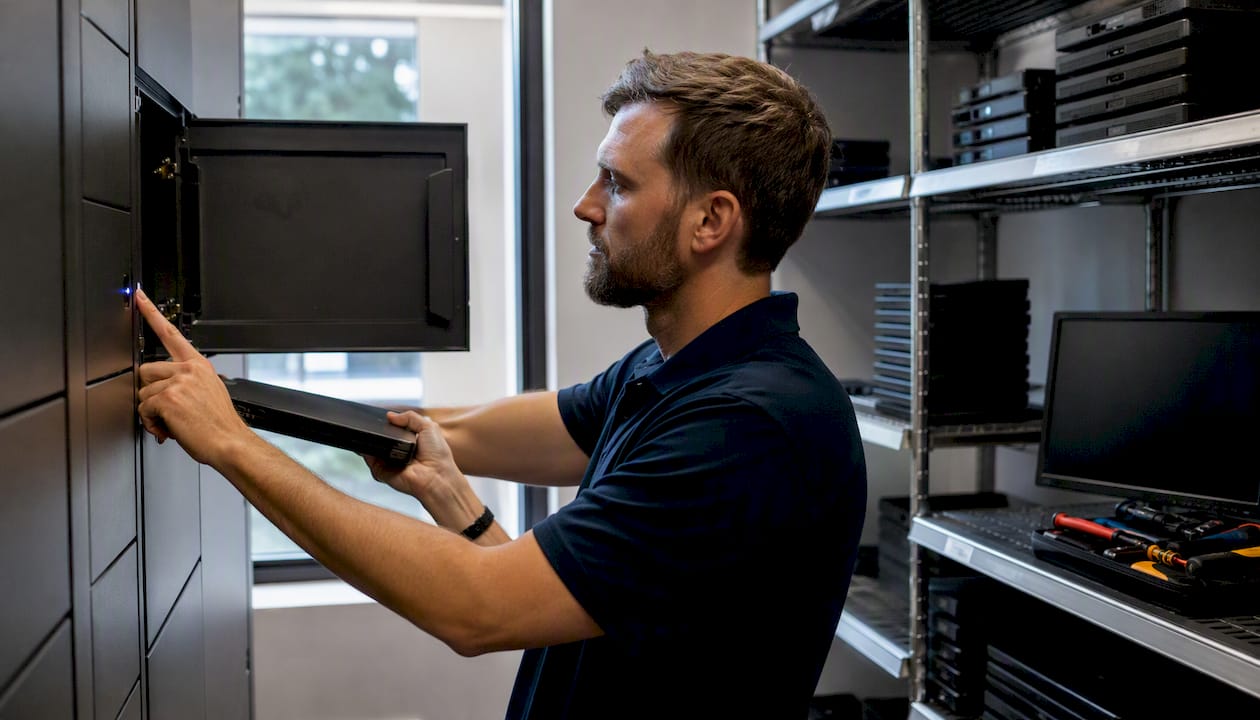
Used employee lockers for ServiceNow device handovers
Buying used employee lockers for ServiceNow-controlled device handovers is a viable procurement option, but only under three non-negotiable conditions: the hardware must support native Smart Collect® orchestration, firmware provenance must be documented and auditable, and spare-parts availability must be contractually guaranteed for the full deployment lifecycle.
- Integration first. Hardware that cannot be controlled natively through Smart Collect® inside your ServiceNow tenant creates a parallel integration layer, adding cost and audit risk that erodes any upfront saving.
- Firmware and warranty. Refurbished units without a documented firmware chain, signed-update pipeline, and minimum warranty window carry security exposure that ISO 27001-aligned programmes cannot accept.
- Spares and SLA. Without a contractual spare-parts commitment and penalty-linked SLA, a single failed actuator can stall device fulfilment across a site.
The procurement posture: prefer new hardware with a ServiceNow-native platform unless you can contractually close all three gaps above. If you can close them, used hardware can reduce capital expenditure meaningfully on a 24–60 month TCO model.
Key takeaways
Enterprise IT teams evaluating used Smart Lockers for ServiceNow device handovers must close three contractual gaps before hardware condition becomes relevant: native integration, firmware provenance, and spare-parts commitment.
| Point | Details |
|---|---|
| Integration is the primary risk | Used hardware without confirmed Smart Collect® compatibility creates audit and security gaps that outweigh any capital saving. |
| Acceptance tests are non-negotiable | Run firmware, actuator, integration, and failover tests on every unit before sign-off, not after deployment. |
| TCO over a multi-year period | Budget for firmware remediation and spare-parts premiums when modelling used-hardware TCO. |
| UK compliance obligations | Specify CMDB audit-trail ownership, WEEE disposal routes, and ISO evidence at contract stage for UK procurements. |
| Velocity-smart Smart Collect® | A Built on Now app running inside your tenant; ISO 9001, ISO 27001, and ServiceNow Service Specialist Partner certified. |
Table of Contents
- What “used employee lockers” means in this context
- Procurement checklist for used Smart Lockers in a ServiceNow programme
- Used versus new Smart Lockers: what the trade-offs actually look like
- How to validate a used-locker vendor before you commit
- Why ServiceNow-native platforms change the used-versus-new calculation
- Delivery timeline, cost drivers, and ROI metrics for your business case
- Which operational model fits your device distribution needs?
- UK contract and compliance requirements for used Smart Locker procurements
- How to run a low-risk pilot with used locker hardware
- How procurement decisions shift when ServiceNow is the orchestration layer
- Smart Collect® as a ServiceNow-native procurement option
- Sources
What “used employee lockers” means in this context
This article is about networked, electronic Smart Lockers used for IT device handovers — units that receive, store, and dispense laptops, peripherals, and other employee devices under ServiceNow orchestration. The term “used employee lockers” here refers to refurbished or pre-owned hardware of this type, procured for enterprise IT programmes.
What this article does not cover:
- Non-networked metal or wood storage lockers sold as second-hand staff storage
- Consumer-grade or gym-style lockers with no electronic control plane
- Generic parcel lockers without an enterprise ITSM integration layer
The ServiceNow integration boundary is the defining criterion. A locker unit that cannot be brought under Smart Collect® control — with CMDB asset records, RBAC-governed access, and a full audit trail inside your tenant — is not fit for purpose in a ServiceNow-native IT programme, regardless of its physical condition or price.
Procurement checklist for used Smart Lockers in a ServiceNow programme
Use this checklist in your RFP or tender when evaluating refurbished locker hardware. Every item should appear as a contractual requirement, not a preference.
Integration requirements
- Confirmed compatibility with Smart Collect® on the ServiceNow Store as a Built on Now application
- Native CMDB asset record creation on device handover and return
- RBAC inheritance from the customer’s existing ServiceNow tenant
- Full audit trail written to ServiceNow, not to a vendor-side database
Security and firmware
- Documented firmware version history and provenance for each unit
- Secure boot and signed firmware update pipeline
- Evidence of ISO 27001 certification from the vendor or refurbisher
- Network security scan results from the refurbishment process
Warranty and spares
- Minimum 12-month warranty on all mechanical and electronic components
- Contractual spare-parts availability for the full deployment term (24–60 months)
- Written obsolescence plan covering end-of-life component substitution
Acceptance tests
- End-to-end device fulfilment test: raise a ServiceNow request, fulfil from locker, confirm CMDB update
- Audit-trail verification: confirm every transaction writes a native ServiceNow record
- Failover test: disconnect network, confirm manual override and offline logging function correctly
- Lock cycle test: run each door actuator through a minimum of 500 cycles before sign-off
Operational clauses
- On-site commissioning by a certified engineer before go-live
- Remote diagnostics access with defined response SLAs
- Software maintenance aligned to ServiceNow release schedule
- Escalation path to the hardware OEM, not only the reseller
Pro Tip: Require the vendor to demonstrate the Smart Collect® integration in a sandbox ServiceNow instance before contract signature. A live demo in your own tenant is the only reliable acceptance test for native orchestration.
Used versus new Smart Lockers: what the trade-offs actually look like
| Dimension | Used / refurbished | New hardware |
|---|---|---|
| Upfront cost | Lower capital outlay | Higher initial spend |
| Warranty and SLA | Limited; must be negotiated explicitly | Standard OEM warranty included |
| ServiceNow integration | Requires verification; risk of firmware gaps | Certified and current from day one |
| Security posture | Depends on refurbishment rigour and ISO evidence | Known, documented from manufacture |
| Lead time | Often faster from stock | Subject to manufacturing lead times |
| TCO over 24–60 months | Higher if remediation, spares, or integration labour is needed | Predictable; lower remediation risk |
| Scalability | Component obsolescence risk at scale | Full roadmap and upgrade path available |
The headline saving on used hardware can disappear quickly. Integration labour to remediate firmware gaps, spare-parts premiums for older components, and the engineering time to validate each unit against your smart locker security standards all add to the real cost. Over a typical multi-year deployment, upfront savings on hardware can be consumed by a firmware remediation cycle and parts-obsolescence events.
Lead time is the one area where used hardware consistently wins. Pre-owned units available from stock can reach a site in days rather than weeks, which matters when a new-starter programme or a site expansion is time-critical. That advantage is real, but it is a one-time benefit weighed against multi-year operational risk.
How to validate a used-locker vendor before you commit
Provenance and reference checks
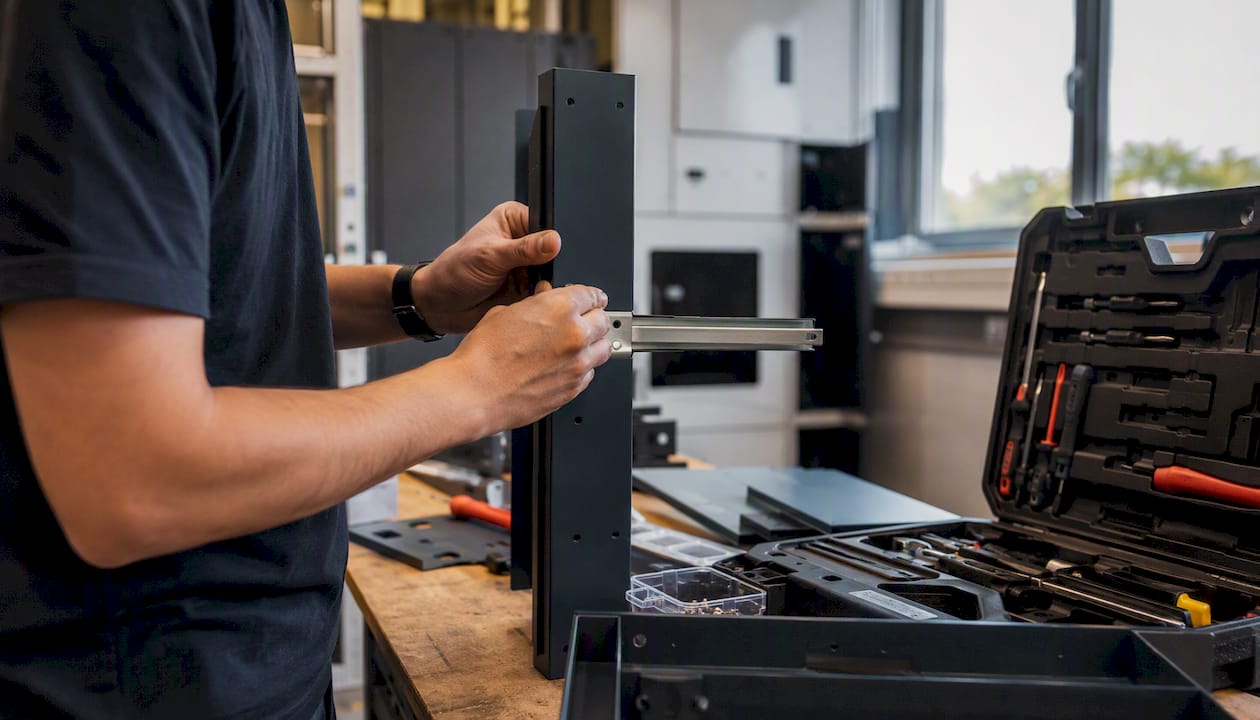
- Request the full refurbishment record for each unit: who performed it, what was replaced, and what testing was completed
- Ask for references from at least two enterprise deployments of the same hardware model in a ServiceNow environment
- Confirm component traceability: every replaced part should have a documented source
Technical tests on arrival
- Firmware checksum: verify the installed firmware version matches the documented build
- Door actuator cycle test: 500 cycles minimum per door before acceptance
- Network security scan: confirm no open ports or legacy protocols active
- Smart Collect® integration test: end-to-end transaction in a non-production ServiceNow instance
Contractual safeguards
- Buyback or replacement clause if a unit fails acceptance testing
- Penalty-linked SLA for response and resolution times
- Documentary evidence of spare-parts inventory held by the vendor or a named third party
Red flags that should stop a procurement
- No documented firmware source or update pipeline
- Inability to demonstrate Smart Collect® integration in a live or sandbox environment
- No ISO 27001 evidence from the refurbisher or OEM
- Spare-parts availability described as “best efforts” rather than contractually committed
Why ServiceNow-native platforms change the used-versus-new calculation
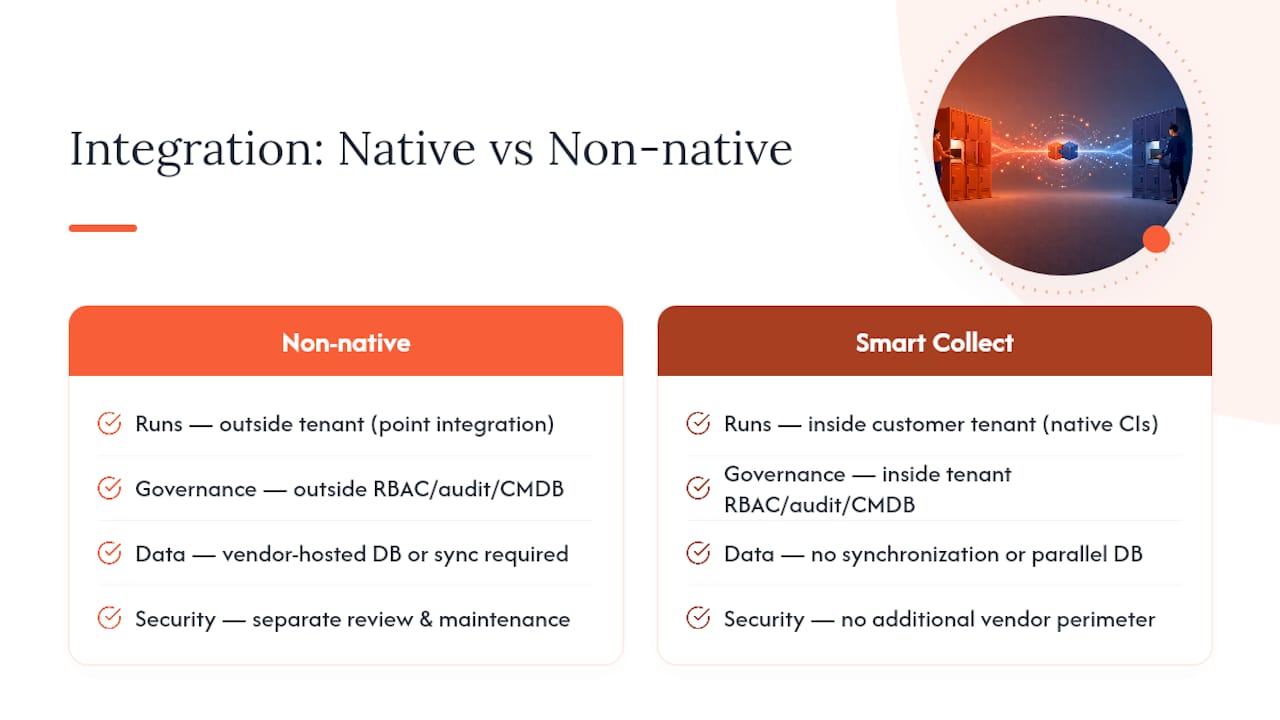
The integration question is where most used-locker procurements either succeed or fail. A locker unit that requires a middleware layer, a custom API, or a vendor-hosted database to connect to ServiceNow is not a ServiceNow-native deployment. It is a point integration that sits outside your tenant’s RBAC, audit trail, and CMDB, and it will require its own security review, its own maintenance window, and its own failure mode.
Smart Collect® operates differently. As a Built on Now application on the ServiceNow Store, it runs inside the customer’s own tenant. Asset state, device location, and custody records are native ServiceNow configuration items. There is no data synchronisation, no parallel database, and no additional vendor security perimeter to manage.
A global pharma customer achieved a greater than 500% increase in IT service throughput following Smart Collect® deployment, with 83% faster fulfilment and 74% less employee downtime — outcomes delivered on traditional ITSM workflows before agentic AI was driving the process.
The certification posture matters here too. ISO 9001 and ISO 27001 certification, alongside ServiceNow Service Specialist Partner status, are the minimum trust signals to require from any vendor whose hardware will sit inside a regulated enterprise environment. These are not differentiators; they are baseline requirements.
When hardware is used or refurbished, native orchestration through Smart Collect® reduces the integration labour risk significantly. The software layer is known and certified; the variable is the hardware condition, which your acceptance tests must resolve.
Delivery timeline, cost drivers, and ROI metrics for your business case
Typical phased timeline
- Discovery (weeks 1–2): site survey, integration requirements, firmware audit of proposed units
- Pilot (weeks 3–6): single-site deployment, Smart Collect® integration test, user acceptance testing
- Commissioning (weeks 7–10): sign-off on acceptance tests, CMDB population, SLA activation
- Scale (months 3–12): phased rollout across additional sites with checkpoint reviews
Velocity-smart’s implementation services position discovery-to-live in weeks for standard deployments, though used-hardware programmes should budget additional time for firmware validation and acceptance testing.
Primary cost drivers
| Cost category | New hardware | Used / refurbished |
|---|---|---|
| Hardware acquisition | Higher | Lower |
| Integration and commissioning | Predictable | Variable; allow for remediation |
| Firmware remediation | Minimal | Budget 10% of hardware cost |
| Spare parts (annual) | OEM-priced | Premium for older components |
| End-of-life disposal (WEEE) | Planned | May be accelerated |
ROI metrics to model
- IT fulfilment throughput (transactions per FTE per day)
- Average fulfilment time (request raised to device collected)
- IT staff travel avoided (site visits replaced by locker fulfilment)
- Asset loss and damage rate (a UK utility reduced shared-equipment loss by 90% post-deployment)
Which operational model fits your device distribution needs?
Three hardware form factors address different points in the device lifecycle, and they are most effective when deployed together under a single ServiceNow orchestration layer.
Smart Lockers (Element Series) handle full-device handovers: new-starter kit delivery, broken-laptop swaps, loaner equipment, and end-of-life returns. The workflow is order-in-ServiceNow, fulfil-from-locker, return-to-locker, with every step writing a native CMDB record.
Smart Vending (IDEA Series) dispenses peripherals, consumables, and accessories on demand, 24/7, without requiring a fulfilment engineer. Restocking is triggered by inventory thresholds in ServiceNow, not by manual checks.
Smart Kiosk™ replaces the traditional tech bar with an AI-assisted walk-up experience. Integrated with smart lockers, it handles device exchange, ticket creation, and self-service collection in a single interaction, without a support agent present.
- Favour lockers when items are large, high-value, or require custody transfer documentation
- Favour vending when throughput is high and items are small, standardised, and low-risk
- Favour kiosks at high-footfall locations where employees need guided self-service
Pro Tip: For geo-distributed rollouts, map restocking cadence to ServiceNow inventory thresholds rather than calendar schedules. This reduces local agent dependency and keeps remote workforce deployments operationally consistent across sites.
UK contract and compliance requirements for used Smart Locker procurements
UK procurements of used Smart Locker hardware carry specific compliance obligations that must be written into the contract, not left to vendor discretion.
- Data protection and audit custody: specify that all device access logs, custody records, and audit trails are owned by your organisation and stored within your ServiceNow tenant. No vendor-side retention of access data without explicit data processing agreements under UK GDPR.
- WEEE disposal obligations: used hardware approaching end-of-life must be disposed of by a certified WEEE-registered carrier. The contract should name the disposal route and assign liability for data-wipe certification before transfer.
- Indemnities and spare-parts obligations: include long-tail spare-parts obligations (minimum 5 years post-deployment) and indemnity clauses covering firmware defects introduced during refurbishment.
- Evidence to request at contract stage: ISO 9001 and ISO 27001 certificates, penetration test reports from the refurbishment process, and documented proof of Smart Collect® tenancy integration in a comparable enterprise deployment.
That outcome depends on the audit data being native to the tenant, not held by a third party.
How to run a low-risk pilot with used locker hardware
Pilot checklist
- Select a single site with an existing ServiceNow instance and a defined device fulfilment workflow
- Run the full acceptance test suite (firmware, actuator cycles, integration, failover) before go-live
- Reconcile inventory in ServiceNow CMDB before the first transaction
- Define user acceptance criteria: fulfilment time target, audit-trail completeness, and error rate threshold
KPIs to track during pilot
- Fulfilment time from ServiceNow request to device collection
- Ticket deflection rate (requests resolved without engineer dispatch)
- Spare-part usage rate (early indicator of hardware condition)
- Incident rate per 1,000 transactions
Change management essentials
- Train support staff on manual override procedures before go-live, not after the first failure
- Publish a runbook for offline mode: what happens when a locker loses network connectivity
- Define a clear escalation path to the hardware vendor and to Velocity-smart’s support team
How procurement decisions shift when ServiceNow is the orchestration layer
The conventional wisdom in hardware procurement is that used equipment is a cost lever and new equipment is a quality lever. When ServiceNow is the orchestration layer, that framing is incomplete.
The real variable is not hardware condition. It is integration fidelity. A used locker that integrates natively with Smart Collect® inside your tenant, passes all acceptance tests, and carries contractual spare-parts cover is a lower operational risk than a new locker connected through a middleware layer that sits outside your CMDB and audit trail.
The negotiation levers that matter most in a ServiceNow-centric programme are not headline price and delivery date. They are tenancy-native integration proof, auditability of every transaction, and a spare-parts commitment that survives vendor consolidation. Procurement teams that anchor negotiation on those three points consistently achieve better TCO outcomes than those who lead on unit price.
The one procurement truth worth stating plainly: if a vendor cannot demonstrate Smart Collect® integration in your sandbox tenant before contract signature, the price is irrelevant.
Smart Collect® as a ServiceNow-native procurement option
Disclosure: this article is published by Velocity Smart Technology, the developer of Smart Collect®.
Smart Collect® is a Built on Now application that runs inside your ServiceNow tenant, not alongside it. For procurement teams evaluating used or new Smart Locker hardware, that distinction changes the risk equation:
- Integration without middleware: CMDB records, RBAC, and audit trails are native ServiceNow objects from day one, with no parallel database to secure or maintain.
- Certified and auditable: ISO 9001, ISO 27001, and ServiceNow Service Specialist Partner status are documented on the Velocity-smart corporate page and available for vendor due diligence.
- Proven operational outcomes: customers across pharma, energy, and utilities have achieved measurable throughput and fulfilment gains with Smart Collect® deployments.
Download the Smart Locker Whitepaper for detailed procurement guidance, security architecture, and deployment design considerations.
Sources
- AI Workplace Support Hub – Ergonomic Corporation Hongkong Ltd
Recommended
See what Smart Collect® could save you
Model your savings in two minutes, or book a 60-minute workshop to pressure-test the numbers against your estate.