Physical IT automation for enterprise IT leaders
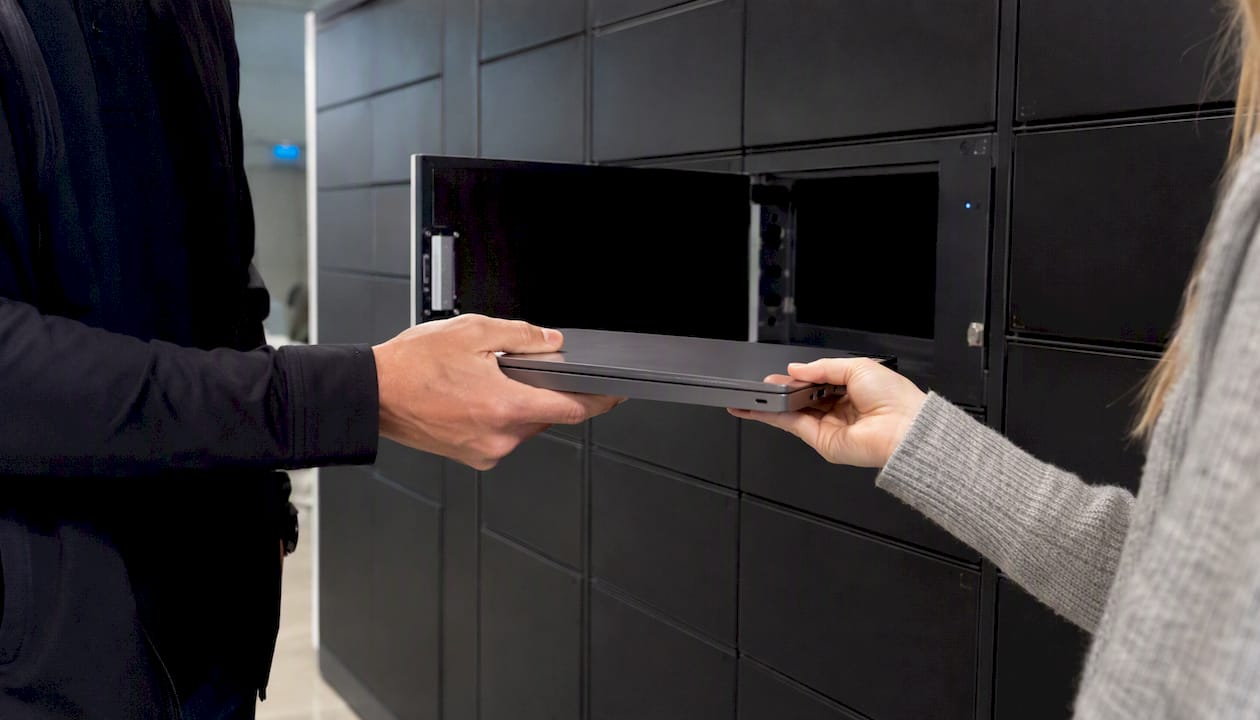
In enterprise IT, “automation anywhere” means automating the physical layer of device lifecycle management: the smart lockers, smart vending units, and smart kiosks that fulfil and close onsite handover tickets without dispatching an engineer. The platform that delivers this is Smart Collect®, a ServiceNow-native application that orchestrates physical device handovers as first-class ITSM workflow steps inside your existing tenant.
The core components involved:
- Smart Lockers (Element Series): automated full-device handovers, new-starter kit delivery, swap and return
- Smart Vending (IDEA Series): on-demand peripheral and consumable dispensing, 24/7
- Smart Kiosk™: AI-powered virtual tech bar replacing the traditional walk-up help desk
- ServiceNow HAM/CMDB: single source of truth for asset state, ownership history and audit records
Key takeaways
Physical IT automation, delivered through ServiceNow-native orchestration of smart lockers, smart vending and smart kiosks, closes onsite handover tickets without engineer dispatch and produces measurable throughput, fulfilment and travel outcomes before agentic AI enters the workflow.
| Point | Details |
|---|---|
| Definition | Physical IT automation means closing device handover tickets via smart lockers, vending and kiosks inside ServiceNow, with no engineer dispatch. |
| Platform foundation | Smart Collect® runs natively in your ServiceNow tenant, inheriting RBAC, audit trail and CMDB without middleware. |
| Measured outcomes | Vendor-reported results include a substantial throughput uplift, much faster fulfilment, and a significant reduction in onsite tickets. |
| Pilot starting point | Begin with high-volume, low-complexity tickets: new-starter onboarding and peripheral requests deliver the fastest ROI. |
| Velocity-smart | Smart Collect® is the Built on ServiceNow certified platform that orchestrates all three hardware form factors from a single ITSM workflow layer. |
Table of Contents
- Why does physical IT automation matter for CIOs right now?
- What are the core components of physical IT automation?
- What capabilities should IT leaders expect from physical automation?
- What business outcomes does physical IT automation deliver?
- Which workflows should IT operations automate first?
- What do IT teams need to plan before deployment?
- What evidence supports physical IT automation at enterprise scale?
- How does ServiceNow-native physical automation fit your 24-month strategy?
- Smart Collect® closes the physical ticket gap
- Sources
Why does physical IT automation matter for CIOs right now?
The distributed workplace has made physical device fulfilment a budget problem that digital tools cannot solve. Distributed IT support requires a hybrid model: remote tools resolve many issues, but physical device deployment and hardware tasks still need local coordination. When that coordination relies on engineer dispatch, costs compound across every site.
ServiceNow Hardware Asset Management automates procurement, deployment and disposal using the CMDB as a single source of truth, with AI agents and prescriptive workflows maintaining data accuracy across the full lifecycle. The Now Platform’s CMDB and HAM modules provide the governance layer; Zero Touch Mobility (ZTM) extends that to mobile-native fields including IMEI, carrier and SIM status. Smart Collect® sits on top of all three, translating digital workflow steps into physical device events at the locker, vending unit or kiosk.
The strategic case is straightforward: physical handover tickets currently cost roughly three times more than digital ones. As agentic AI collapses digital cost-to-serve, that gap widens. Organisations that automate the physical layer now build a structural cost advantage before the gap becomes a CFO conversation.
Pro Tip: Start your automation programme with high-volume, low-complexity physical tickets: peripheral requests, loaner device collection and new-starter kit delivery. These generate the fastest measurable ROI and build the operational confidence needed to tackle swap and repair flows.
What are the core components of physical IT automation?
The architecture has four distinct layers that IT teams need to map against their environment.
Hardware endpoints
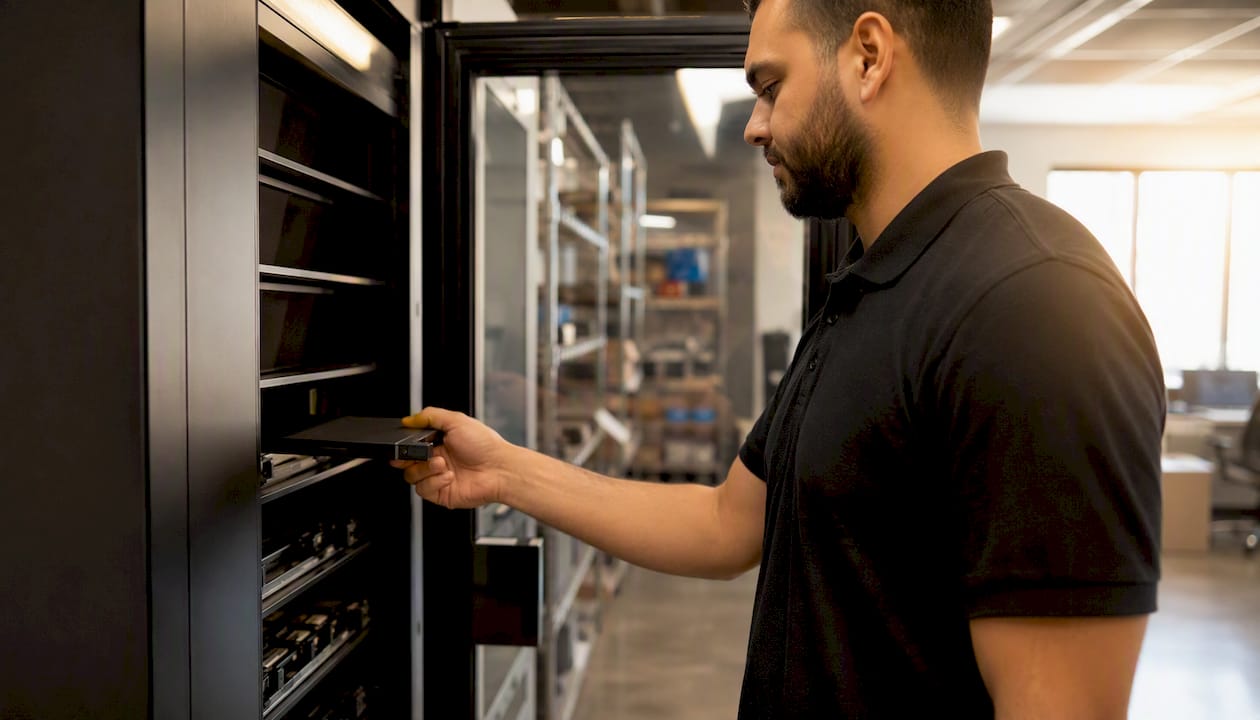
Three form factors cover the full range of physical handover scenarios. Smart Lockers handle full-device transactions: new-starter kits, broken-laptop swaps, equipment loans and returns. Smart Vending units dispense peripherals, consumables and accessories on demand. Smart Kiosk™ provides a walk-up support experience with an AI-powered video resolver group, replacing the traditional in-office help desk without requiring a technician to be present.
Platform and orchestration
Smart Collect® runs natively inside the customer’s ServiceNow tenant. It inherits existing RBAC, audit trail and security posture without a separate database or middleware layer. ServiceNow IT Asset Management runs on the Now Platform to automate full asset lifecycles, using AI agents to maintain data accuracy across contracts, costs and compliance. Every physical device event maps to a native HAM/CMDB record, queryable like any other configuration item.
Integration layer
Key integration points include:
- EMM/UEM platforms: device enrolment, policy push and unenrolment triggered by locker or kiosk events
- Carrier and VAR APIs: direct-ship orchestration so devices arrive pre-configured at the locker
- Stockroom/WMS: inventory position updates in real time as units are dispensed or returned
- Identity and RBAC: employee authentication at the hardware endpoint tied to ServiceNow user records
Data and automation flows
AI agents within the Now Platform orchestrate approval, fulfilment and return workflows. Every transaction generates an audit trail entry and updates the CMDB record automatically, removing the manual data-entry step that typically introduces inaccuracy.
| Layer | Component | Role |
|---|---|---|
| Hardware | Smart Lockers, Smart Vending, Smart Kiosk™ | Physical device handover and support |
| Platform | ServiceNow HAM, CMDB, Now Platform | Workflow orchestration and asset record |
| Integration | EMM/UEM, carrier/VAR, WMS | Enrolment, shipping and inventory sync |
| Automation | AI agents, audit trail, RBAC | Governance, accuracy and compliance |
What capabilities should IT leaders expect from physical automation?
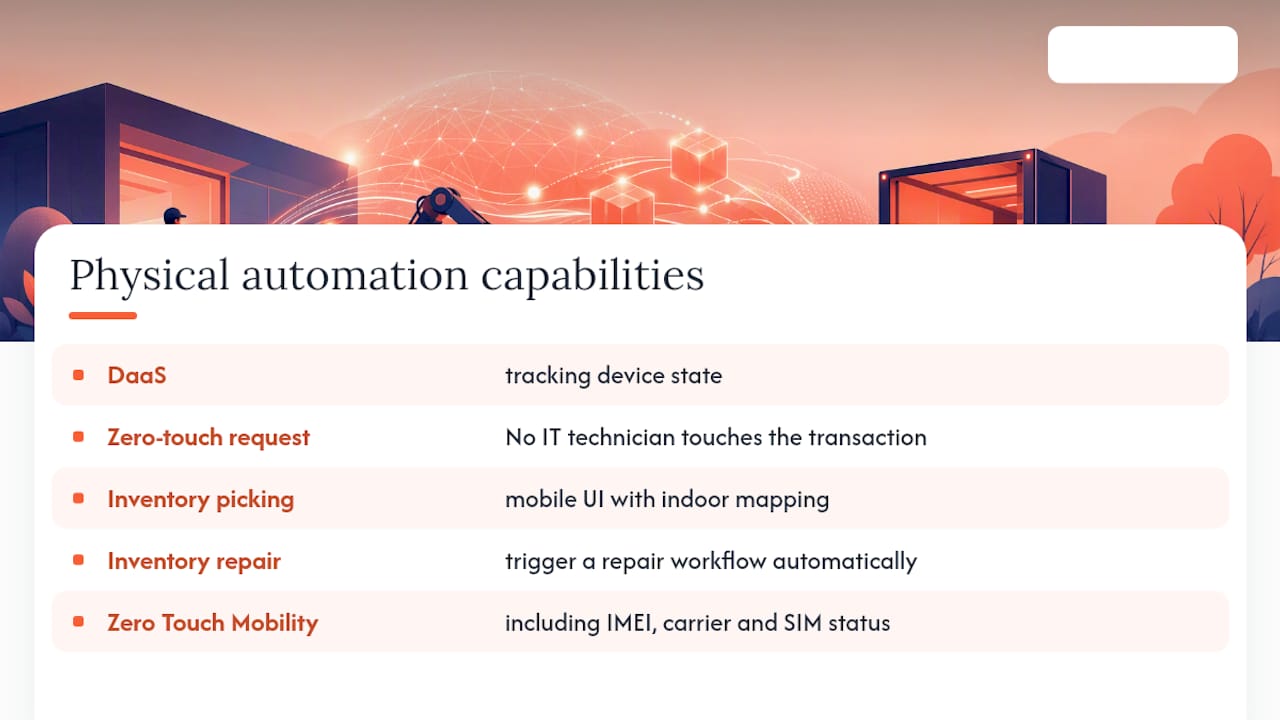
The Now Platform Xanadu release added four HAM capabilities central to device lifecycle automation: Device as a Service (DaaS), zero-touch request, inventory picking with indoor maps, and inventory repair. Smart Collect® exposes and runs each of these inside ServiceNow HAM/CMDB.
Device as a Service (DaaS): Smart Collect® functions as an inventory command centre, tracking device state from procurement through disposal. DaaS models become operationally viable when the return and refresh cycle is automated at the locker rather than managed manually.
Zero-touch request fulfilment: Employees request a device through the ServiceNow service catalogue. The workflow triggers VAR drop-ship or stockroom pick, the device lands in the locker, and the employee collects it with a PIN or badge. No IT technician touches the transaction.
Inventory picking with indoor maps: Stockroom staff use a mobile UI with indoor mapping to locate and pick devices efficiently. This matters at scale: a 34-site aerospace deployment cannot rely on ad hoc stockroom navigation.
Inventory repair and RMA handling: Devices returned to a locker trigger a repair workflow automatically. The CMDB record updates to reflect repair status, and replacement dispatch begins without manual intervention.
Zero Touch Mobility extends HAM with mobile-specific fields and workflows, including IMEI, carrier and SIM status, and EMM orchestration, enabling native mobile device lifecycle automation within the same platform.
What business outcomes does physical IT automation deliver?
The metrics below are drawn from Velocity Smart Technology’s internal customer data and should be treated as vendor-reported proof points rather than independently audited benchmarks.
KPIs that procurement and operations teams should track:
- Fulfilment time: time from ticket creation to device collection at the locker or kiosk
- First-touch close rate: percentage of physical tickets closed without engineer dispatch
- Engineer dispatch rate: direct measure of automation coverage
- Stockroom accuracy: CMDB record accuracy versus physical inventory count
- Employee downtime: time lost waiting for a replacement or new device
Workflow-driven asset management provides a practical framework for building the business case around these KPIs, including ROI assumptions tied to fulfilment time reduction.
Which workflows should IT operations automate first?
Four workflow categories cover the majority of physical ticket volume in enterprise environments.
- New-starter onboarding: automated order triggers VAR drop-ship to the nearest locker; employee collects on day one with no IT involvement
- Swap and repair: employee returns broken device to locker, repair workflow triggers automatically, replacement dispatched to the same or nearest locker
- BYOD and shared device management: enrolment and unenrolment orchestrated through EMM at the kiosk, with privacy-preserving offboarding built into the workflow
- Loaner and shared device pools: dynamic assignment tracked in CMDB, reconciliation automated at return
ServiceNow’s own zero-touch process, built during the remote-work transition, demonstrated that automating ordering, tagging, delivery and setup via VARs removes the IT preconfiguration bottleneck entirely.
| Workflow | Ticket volume | Complexity | Pilot priority |
|---|---|---|---|
| New-starter onboarding | High | Low | First |
| Peripheral/consumable request | High | Low | First |
| Loaner device pool | Medium | Low | Second |
| Swap and repair | Medium | Medium | Second |
| BYOD enrolment/offboarding | Medium | Medium | Third |
What do IT teams need to plan before deployment?
Implementation blockers fall into four categories. Addressing them in sequence prevents the most common pilot failures.
Integration prerequisites
- CMDB cleanliness: device records must be accurate before automation amplifies any existing inaccuracies
- EMM/UEM field mappings confirmed before locker or kiosk go-live
- Carrier and VAR APIs tested for direct-ship orchestration
- Stockroom WMS integrated for real-time inventory position
Security and governance
Smart Collect® operates inside the customer’s ServiceNow tenant, inheriting RBAC, audit trail and security posture without a separate vendor security review. ISO 9001 and ISO 27001 certifications apply at the platform level. Every asset event writes a native CMDB record.
Licensing and certification
Smart Collect® carries Built on ServiceNow certification. ZTM licensing includes HAM for mobile lifecycles. Confirm ServiceNow HAM module licensing covers the intended device scope before pilot.
Change management and timeline
Scaling onsite IT support requires documented playbooks, unified ticketing and technician training before go-live. A realistic pilot timeline runs eight to twelve weeks: CMDB audit and cleanse, integration configuration, hardware installation, service catalogue item creation, and a controlled pilot cohort before full rollout.
What evidence supports physical IT automation at enterprise scale?
The proof points below combine vendor internal data with platform certifications relevant to procurement and security stakeholders.
Key evidence for RFP and internal briefings:
- a substantial throughput uplift and much faster fulfilment (global pharma, vendor internal data)
- 60% reduction in onsite tickets and 31–42% IT staff time reclaimed (US nuclear energy, vendor internal data)
- 35% travel reduction across 34+ sites (US aerospace and defence, vendor internal data)
- 90% reduction in shared-equipment loss and damage (UK utility, vendor internal data)
- Built on ServiceNow certification: no middleware, no parallel database, no separate security review
- ISO 9001 and ISO 27001: applicable to regulated industries including pharma, defence and financial services
When presenting these in an RFP, label them as vendor-reported outcomes and request reference calls with named customers in your sector.
How does ServiceNow-native physical automation fit your 24-month strategy?
The case for ServiceNow-native orchestration over bolt-on systems is strongest in regulated environments. A bolt-on locker product creates a parallel data store, a separate security perimeter and a vendor dependency that sits outside your existing governance framework. Native operation eliminates all three risks simultaneously.
The more consequential strategic question is timing. Now Assist and agentic AI features are maturing inside the Now Platform on a predictable release cadence. The outcomes Smart Collect® delivers today, before AI drives the workflow end-to-end, represent the floor. As AI agents take over approval, routing and exception handling, the same physical infrastructure produces higher throughput with less human intervention.
Three scalability risks deserve attention in 24–36 month planning. Inventory fragmentation across sites without a centralised command view erodes the CMDB accuracy that the whole model depends on. Governance erosion happens when pilot-phase exceptions become permanent workarounds. Carrier and VAR dependency creates fulfilment risk if direct-ship SLAs are not contractually defined. A hub-and-spoke model with standardised golden images and centralised ITSM provides the structural foundation that keeps these risks manageable as site count grows.
The strategic recommendation: deploy physical automation in the same budget cycle as Now Assist investment. The two capabilities are complementary, not sequential.
Smart Collect® closes the physical ticket gap
Physical IT automation delivers measurable outcomes before agentic AI enters the workflow. Smart Collect® is the ServiceNow-native platform that orchestrates smart lockers, smart vending and Smart Kiosk™ from inside your existing tenant, inheriting your RBAC, audit trail and CMDB without a separate integration layer or security review. The vendor-reported outcomes, a substantial throughput uplift, a significant reduction in onsite tickets, a notable reduction in travel, were achieved on traditional ITSM workflows. As Now Assist matures, those figures represent a starting point.
For procurement and architecture teams, the Smart Locker Whitepaper covers pilot design, integration patterns and outcome benchmarks in detail. To evaluate the kiosk capability, the Smart Kiosk product page sets out deployment models and hardware specifications. Contact Velocity-smart to scope a pilot against your highest-volume physical ticket categories.
Sources
The following references support technical evaluation and procurement due diligence.
ServiceNow platform and product documentation
- Manage asset inventory from end-to-end with ServiceNow’s Xanadu
- ZTM and ServiceNow HAM mobile lifecycle (Samsung SDS blog)
Distributed IT support and scaling guidance
Velocity Smart Technology
Recommended
See what Smart Collect® could save you
Model your savings in two minutes, or book a 60-minute workshop to pressure-test the numbers against your estate.