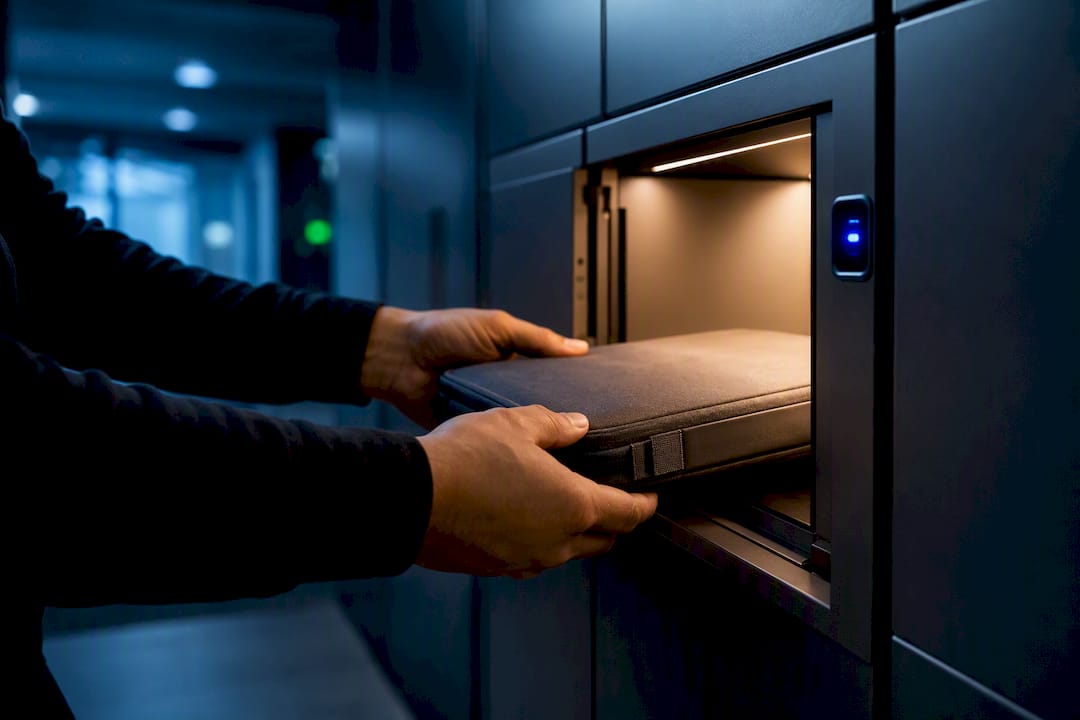
ServiceNow CIOs: Make Issuance the Last Mile Your AI Can Trust
IT asset issuance is the process of handing a physical device, from laptop to badge reader, to an employee while updating the authoritative system of record to reflect that new ownership and location. It matters because the handover is where compliance, security and inventory accuracy either hold together or quietly fall apart. Get issuance wrong and every downstream workflow, including AI-driven ones, inherits bad data.
TL;DR:
- Automating issuance with timestamped, immutable records reduces phantom assets, audit failures, and security risks by accurately reflecting physical asset handovers.
- Integration of issuance with ITSM workflows enables real-time updates to ownership, location, and history, eliminating manual reconciliation and stale data.
- Controls for high-value assets should include multi-factor authentication, chain-of-custody records, and approval steps, while low-risk items can be self-served to reduce friction.
- A successful rollout requires site readiness, correct role-based access, verified audit trails, proper inventory sizing, and clear replenishment plans across multiple locations.
- KPIs such as fulfillment time, reduction of support tickets, staff hours reclaimed, and audit pass rate assess the effectiveness of automated issuance programs.
Table of Contents
- What is IT asset issuance and why does it matter to ITAM and compliance?
- How does issuance integrate with ITSM and the CMDB?
- What issuance models and risk controls do enterprises use?
- What does an operational checklist for automated issuance look like?
- What do auditors look for in issuance compliance?
- Which KPIs actually prove issuance is working?
- Why the “last mile” is the part most ITAM strategies ignore
- How to pilot a ServiceNow-native issuance platform
- Sources
- FAQ
What is IT asset issuance and why does it matter to ITAM and compliance?
Issuance is the deployment node in the IT asset lifecycle, the point where a device moves from stockroom or storage locker into an employee’s hands and becomes an active, assigned asset. Everything that happens before it (procurement, staging, configuration) is preparation. Everything after it (maintenance, refresh, retirement) depends on issuance having been recorded correctly.
When issuance is handled manually, through spreadsheets, email chains or a service desk agent updating records after the fact, the gap between physical reality and the configuration management database widens with every handover. That gap produces:
- Phantom assets that exist in the CMDB but were never actually deployed, or devices in circulation with no record at all.
- Audit failures, because auditors cannot trace who received a device, when, or under what approval.
- Security exposure, since a lost or unreturned laptop with no verified custody trail is a breach waiting to be discovered late.
The fix is not more paperwork. It is making the issuance event itself an atomic transaction. A timestamped, immutable handover record, created the moment a device leaves secure storage and lands with a named individual, closes the gap before it opens. That single design choice is what separates enterprises with a trustworthy CMDB from those still reconciling spreadsheets every quarter.
How does issuance integrate with ITSM and the CMDB?
Issuance is not a standalone event. It is a workflow trigger that should fire a specific, predictable set of updates the instant a device changes hands. Get this sequence right and the CMDB stays trustworthy without manual reconciliation.
- Update ownership and location fields. The CMDB record for the asset needs a new assigned user, a new site or desk location, and a status change from “in stock” to “deployed”, all in the same transaction as the physical handover.
- Write the assignment history. Every prior owner, location and date should remain queryable, not overwritten, so an auditor can reconstruct the full chain of custody for any asset on demand.
- Trigger the linked ITSM ticket closure. If the issuance was fulfilling a request or incident, the ticket should close automatically, with the handover record attached as evidence, rather than waiting for an agent to update it manually.
Integrating issuance directly with ITSM workflows allows for real-time CMDB updates and cuts the manual administrative effort that otherwise drives human error into asset location and ownership records. The alternative, a parallel database or middleware layer that syncs back to the CMDB on a delay, introduces exactly the failure modes native integration is meant to eliminate: stale records, RBAC mismatches, and a second source of truth that someone eventually has to reconcile by hand. For deeper detail on how automated distribution workflows keep stock records accurate at scale, see this breakdown of IT inventory management workflow design.
What issuance models and risk controls do enterprises use?
Not every device warrants the same level of ceremony. A spare HDMI cable and an encrypted laptop loaded with regulated data should never move through identical approval chains, and treating them the same is how enterprises end up either over-controlling low-risk items or under-controlling high-risk ones.
Professional ITAM practice classifies assets by criticality and matches the issuance procedure to the risk. That typically breaks down as:
- Low-risk peripherals (mice, cables, headsets): delegated self-service, dispensed on demand with minimal friction.
- Mid-tier devices (standard laptops, monitors): self-service with identity verification, but no additional approval gate.
- High-value or regulated assets (encrypted devices, specialist hardware, anything touching regulated data): controlled handover requiring authentication, an approval gate, and immediate CMDB write-back.
The controls that make controlled handover defensible are consistent: single sign-on or multi-factor authentication to verify identity at the point of collection, a verified chain-of-custody record, and, where the asset justifies it, time-bound access or an approval step before release.
Pro Tip: Default to self-service for anything an employee could reasonably lose without triggering a security incident. Reserve controlled handover for the assets where a missing device becomes a reportable event.
What does an operational checklist for automated issuance look like?
Rolling out automated issuance across a multi-site enterprise is a physical infrastructure project as much as a software one. Missing any of the following turns a clean pilot into a stalled programme.
- Site readiness. Confirm power and network availability at the proposed location, secure placement away from unsupervised areas, and enough floor or wall footprint for the hardware form factor chosen, whether that’s a locker bank, a vending unit, or a kiosk.
- Identity integration. Align the issuance platform’s authentication to existing single sign-on and multi-factor setup, and make sure role-based access control mirrors what’s already enforced elsewhere in the ITSM stack, not a parallel permission model.
- Audit trail configuration. Verify that every issuance and return event writes a timestamped record with actor identity, tied directly into the CMDB rather than a separate log file.
- Inventory sizing. Size locker or vending capacity against actual site headcount and device churn, not a generic template, so stock doesn’t run dry mid-week at a busy site.
- Restock and replenishment planning. Multi-site rollouts fail operationally, even with sound technical integration, when replenishment workflows aren’t planned as part of the programme itself. Restocking needs an owner, a cadence and a trigger threshold before go-live, not after.
- Service and support SLAs. Edge hardware needs defined maintenance response times, especially at remote sites where a broken locker means a support gap, not just an inconvenience.
None of this needs to happen simultaneously across every site. A phased rollout, validated at one or two locations before scaling, catches sizing and network issues cheaply rather than expensively.
What do auditors look for in issuance compliance?
Auditors reviewing IT asset controls are not looking for a good story. They want evidence, and evidence means artefacts that existed at the moment of the transaction, not ones reconstructed afterwards.
IAM guidance recommends embedding asset management into an organisation’s broader management system, aligning issuance controls with ISO 55000 principles rather than treating them as a standalone IT process. ISO 55001 sets out a risk-based approach that gives enterprises a defensible framework to point to when justifying why certain assets receive stricter controls than others.
A handover record that satisfies most auditors needs:
- A precise timestamp of the physical transaction, not an end-of-day batch update.
- Verified actor identity on both sides, issuer and recipient.
- Any approval step that preceded release, with who approved it and when.
- A change history showing every prior assignment, not just the current one.
The practical tip most programmes miss: build the audit artefact automatically as a byproduct of the issuance transaction, not as a separate compliance task bolted on afterwards. Teams that treat audit evidence as an afterthought spend far more time each cycle assembling it retroactively. More detail on what auditors specifically probe is covered in this asset auditing guidance for device management.
Which KPIs actually prove issuance is working?
Five metrics tell you whether modernised issuance is delivering: fulfilment time (request to device in hand), reduction in on-site support tickets, IT staff hours reclaimed from manual logistics, reduction in phantom assets identified during audit, and compliance pass rate on asset-related audit findings.
Enterprises that automate issuance have reported measurable uplifts once the handover step stops relying on manual coordination: documented customer outcomes include a significant increase in throughput, much faster fulfilment, and notably less employee downtime, alongside a separate case of 60% fewer on-site tickets and 31 to 42% of IT staff time reclaimed.
Baseline these five metrics before any change, using ticket logs and time-tracking data you likely already hold, then re-measure at 90 days post-rollout. The true cost of issuance is rarely the hardware; it’s the labour spent configuring, dispatching and manually re-entering CMDB data; staff time recovered is usually the metric that justifies the investment, not device savings.
Why the “last mile” is the part most ITAM strategies ignore
Most ITAM conversations focus on procurement optimisation and licence reclamation because those are the easiest wins to quantify. Issuance gets treated as administrative plumbing, something a service desk agent handles between more important tasks. That’s backwards.
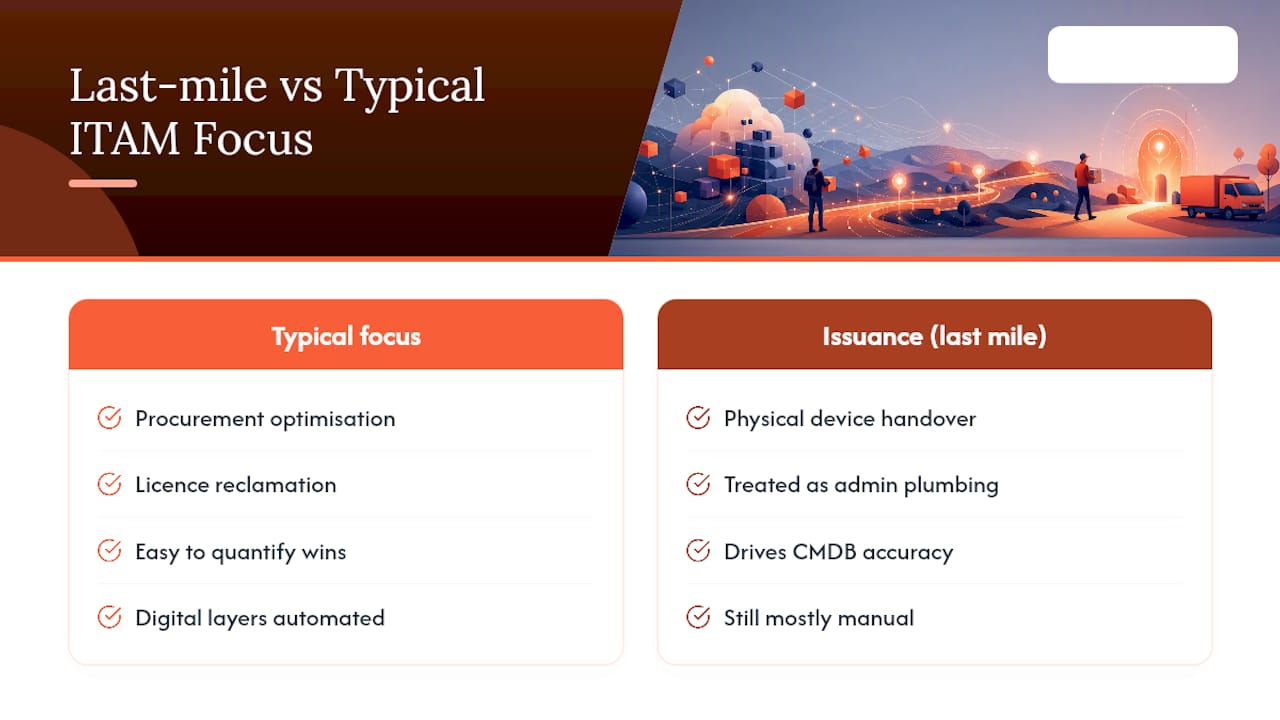
Issuance is where the CMDB either stays true or starts drifting from reality, and a CMDB that drifts is a CMDB no AI agent can be trusted to act on. ServiceNow’s Now Assist and comparable agentic tools can only close a ticket autonomously if the underlying asset record is accurate at the moment the agent queries it. An AI workflow orchestrating a device swap against a CMDB full of phantom assets and stale locations isn’t automation, it’s a faster way to make the same mistake.
The uncomfortable truth for most enterprise IT leaders is that they have spent years automating the digital layers of service management while the physical handover stayed exactly as manual as it was a decade ago. That imbalance is now the bottleneck, not a peripheral inefficiency.
— Anthony
How to pilot a ServiceNow-native issuance platform
A ServiceNow-native platform earns its keep specifically when the CMDB, RBAC and audit trail need to stay in one place rather than syncing across systems. Smart Collect® runs inside the customer’s existing ServiceNow tenant, so issuance records inherit the same permissions and audit posture already governing every other configuration item, with no middleware layer and no parallel database to reconcile.

A short pilot should validate three things before wider rollout: whether CMDB fields update accurately at the moment of handover, whether fulfilment times actually drop against your baseline, and how much staff time is reclaimed from manual logistics. Velocity-smart’s Implementation Services include a Use Case Validation phase and a Live Pilot Programme built for exactly this kind of test, whether the form factor is a Smart Locker for full-device swaps or Smart Vending for on-demand peripherals. If a full pilot feels premature, the Smart Collect® product page is the sensible starting point to see how native ServiceNow integration works before committing to a scoped trial.
Sources
For further technical grounding beyond this article, consult ISO 55001’s risk-based asset management requirements, the IAM’s practical guidance on aligning asset processes to ISO 55000, and ServiceNow’s vendor-neutral ITAM explainer. To model expected returns for your own environment, Velocity-smart’s ROI calculator is a useful starting point.
- Implementing and improving a management system for asset management | IAM
- What is IT Asset Management (ITAM)? | ServiceNow
FAQ
What is IT asset issuance?
IT asset issuance is the formal handover of a physical device, such as a laptop or peripheral, to an employee, paired with an immediate update to the organisation’s CMDB reflecting new ownership, location and status. It’s the deployment step in the wider IT asset lifecycle, sitting between procurement and active use.
How does IT asset issuance differ from IT asset management?
IT asset management (ITAM) is the entire discipline covering procurement, deployment, maintenance and retirement of devices. Issuance is one specific stage within that lifecycle, the physical handover moment, and it’s often the stage where ITAM strategies break down because it’s the hardest to automate.
Why does poor issuance cause audit failures?
Poor issuance leaves no verifiable record of who received a device, when, or under what approval, which means auditors cannot reconstruct chain-of-custody on demand. ISO 55001’s risk-based framework and IAM governance guidance both point to timestamped, immutable handover records as the fix.
What is the cost of the Smart Collect® platform?
Velocity-smart doesn’t publish standard pricing for Smart Collect® online; current details are available directly through the Smart Collect® product page or by requesting a pilot assessment.
What KPIs prove an issuance programme is working?
The core metrics are fulfilment time, on-site ticket reduction, staff hours reclaimed, phantom asset reduction, and audit pass rates. Customer-reported outcomes include cases of 60% fewer on-site tickets with 31 to 42% of staff time reclaimed after automating issuance.
Recommended
See what Smart Collect® could save you
Model your savings in two minutes, or book a 60-minute workshop to pressure-test the numbers against your estate.