
What Is Process Automation and Why It Matters
Process automation is reshaping how British businesses operate, with more than 60 percent of enterprises now relying on digital solutions to handle critical tasks. As organisations look for smarter ways to boost productivity, the pressure grows to automate repetitive work while reducing costly mistakes. This guide explains how process automation in modern IT delivers practical benefits for British companies and reveals which solutions are making the biggest impact on daily operations.
Table of Contents
- Defining Process Automation In Modern IT
- Types Of Process Automation Solutions
- How Process Automation Improves Enterprise Workflows
- Integrating Process Automation With ITSM Platforms
- Risks And Challenges In Automation Adoption
Key Takeaways
| Point | Details |
|---|---|
| Importance of Process Automation | |
| Process automation enhances operational efficiency by replacing manual tasks with intelligent technologies, enabling organisations to focus on strategic initiatives. | |
| Types of Automation Solutions | |
| Diverse technologies, such as Robotic Process Automation (RPA) and Intelligent Process Automation (IPA), cater to various complexity levels in workflows, providing tailored efficiency improvements. | |
| Integration with ITSM Platforms | |
| Integrating automation with IT service management enhances workflow consistency and allows IT teams to prioritise strategic tasks over routine administrative work. | |
| Challenges in Adoption | |
| Organisations face risks like skills obsolescence and workforce disruption, necessitating robust change management strategies to ensure successful automation implementation. |
Defining Process Automation in Modern IT
Process automation represents a strategic technological approach that transforms how organisations manage complex operational workflows. At its core, process automation involves using advanced software and intelligent technologies to replace manual, repetitive tasks with efficient electronic systems. By leveraging sophisticated digital tools, businesses can streamline intricate processes, reducing human error and dramatically improving operational efficiency.
In modern IT environments, process automation technologies enable organisations to create intelligent workflows that seamlessly integrate software, artificial intelligence, and machine learning capabilities. These systems can automatically capture documents, make data-driven decisions, and execute complex sequences of tasks without continuous human intervention. The result is a more agile, responsive operational framework that reduces administrative overhead and allows IT professionals to focus on strategic initiatives rather than routine administrative work.
The fundamental components of process automation typically include workflow design tools, robotic process automation (RPA) technologies, intelligent document processing systems, and integration platforms. These technologies work together to create comprehensive automation solutions that can handle everything from simple task replication to complex, multi-step business processes. By implementing such systems, enterprises can achieve significant improvements in speed, accuracy, and overall operational performance.
Pro Tip: Begin your process automation journey by mapping existing workflows and identifying repetitive tasks that consume substantial administrative time. Start small with low-risk, high-impact processes to build confidence and demonstrate immediate value to stakeholders.
Types of Process Automation Solutions
Process automation solutions encompass a diverse range of technological approaches designed to streamline organisational workflows and enhance operational efficiency. These solutions are strategically categorised to address different levels of complexity and operational requirements across various business environments.
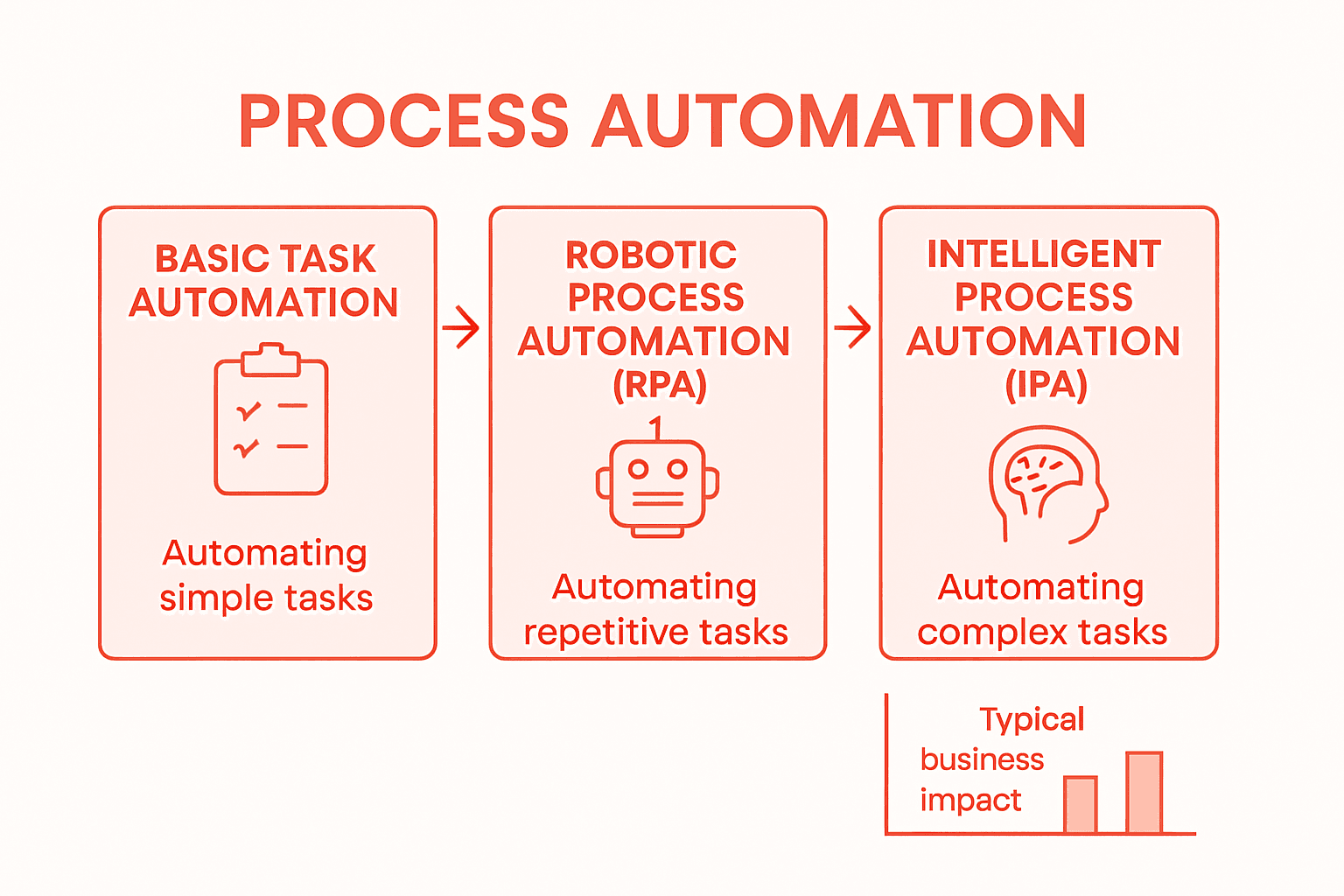
One prominent category is Robotic Process Automation (RPA), which focuses on automating repetitive, rule-based tasks through software robots that mimic human interactions with digital systems. Another sophisticated approach is hyperautomation technologies, which combine artificial intelligence, machine learning, and advanced analytics to create more intelligent, adaptive automation frameworks. These solutions can handle complex, multi-step processes that extend beyond simple task replication.
The primary types of process automation solutions include:
- Basic Task Automation: Focuses on simple, repetitive digital tasks
- Robotic Process Automation (RPA): Employs software robots for rule-based process execution
- Intelligent Process Automation (IPA): Integrates AI and machine learning for adaptive workflows
- Workflow Automation: Designs comprehensive process maps with predefined rules and logic
- Document Process Automation: Specialises in intelligent document capture and processing
Pro Tip: Conduct a comprehensive process audit before implementing automation solutions to identify the most impactful areas for digital transformation. Prioritise processes with high transaction volumes and clear, repeatable patterns for maximum return on investment.
Here’s a comparison of major process automation solution types and their typical business impact:
| Automation Type | Core Technology | Typical Use Case | Business Impact |
|---|---|---|---|
| Basic Task Automation | Scripting or macros | Simple data entry replacement | Frees up admin staff time |
| Robotic Process Automation | Software robots | Repetitive, rule-based digital operations | Increases transaction accuracy |
| Intelligent Process Automation | AI and machine learning | Adaptive workflows and decision-making | Enables smarter operations |
| Workflow Automation | Logical process mapping | Multi-step approvals or project flows | Enhances cross-team coordination |
| Document Process Automation | OCR and NLP systems | Invoice, contract, or form processing | Reduces processing cycle time |
How Process Automation Improves Enterprise Workflows
Enterprise workflows are complex ecosystems of interconnected tasks and processes that traditionally consume substantial organisational resources. Process automation fundamentally transforms these workflows by introducing intelligent technologies that dramatically reduce manual intervention and operational inefficiencies.

Robotic process automation (RPA) enables organisations to systematically redesign their operational infrastructure by automating repetitive, rule-based tasks across multiple departments. This technological approach allows businesses to reallocate human talent from mundane, repetitive activities towards more strategic, creative endeavours that drive genuine organisational value. By implementing sophisticated automation strategies, enterprises can achieve unprecedented levels of operational efficiency, accuracy, and scalability.
The key improvements process automation brings to enterprise workflows include:
- Reduced Human Error: Eliminating manual data entry and repetitive tasks
- Enhanced Productivity: Accelerating process completion times
- Cost Optimisation: Minimising operational expenses and resource allocation
- Improved Compliance: Standardising processes and reducing variability
- Real-time Performance Tracking: Enabling comprehensive workflow monitoring and analytics
Pro Tip: Prioritise incremental automation by first mapping existing workflows and identifying high-volume, low-complexity processes that offer immediate potential for digital transformation. Start with pilot projects in specific departments to demonstrate tangible benefits before scaling across the entire organisation.
Integrating Process Automation with ITSM Platforms
Integrating process automation with IT service management (ITSM) platforms represents a transformative approach to digital workplace strategy. By seamlessly connecting automation technologies with existing service management infrastructures, organisations can create more intelligent, responsive, and efficient operational ecosystems.
IT process automation (ITPA) facilitates the comprehensive orchestration of technological tools, human resources, and complex business workflows through sophisticated automated systems. This integration enables enterprises to standardise their operational processes, reduce manual intervention, and create more predictable, reliable service delivery mechanisms. The ability to programme repeatable tasks and workflows allows IT teams to focus on strategic initiatives rather than getting bogged down in routine administrative activities.
Key considerations for successful ITSM platform integration include:
- Seamless Workflow Design: Ensuring smooth process transitions
- Compatibility Assessment: Evaluating existing technological infrastructure
- Security Configuration: Implementing robust access controls
- Performance Monitoring: Establishing comprehensive analytics frameworks
- Scalability Planning: Designing flexible automation architectures
Pro Tip: Conduct a thorough technical audit of your existing ITSM platform before initiating automation integration. Identify potential compatibility challenges and create a phased implementation strategy that allows for incremental testing and refinement of automated workflows.
The following table summarises key differences between integration with ITSM platforms and standalone automation:
| Factor | ITSM Integration | Standalone Automation |
|---|---|---|
| Scope | Organisation-wide service workflows | Isolated departmental tasks |
| Scalability | Easily expanded across IT services | Often limited by siloed design |
| Governance | Unified IT policies and reporting | Requires separate oversight |
| Change Management | Centralised process updates | Manual adjustments per system |
Risks and Challenges in Automation Adoption
Process automation, while transformative, presents complex organisational challenges that extend far beyond technological implementation. Enterprises must navigate a nuanced landscape of technical, operational, and human-centric considerations to successfully integrate automation strategies.
The ‘Ironies of Automation’ research reveals critical insights into the unintended consequences of widespread technological automation. When organisations automate most operational tasks while leaving humans responsible for exceptional or non-automated scenarios, they inadvertently create new systemic risks. Employees may experience skill degradation, reduced situational awareness, and increased cognitive load during rare but crucial intervention moments.
Key risks and challenges in automation adoption include:
- Skills Obsolescence: Potential loss of critical manual process knowledge
- Workforce Disruption: Potential job displacement and role transformations
- Technical Complexity: Integration challenges with existing technological infrastructures
- High Initial Investment: Significant upfront costs for implementation
- Continuous Maintenance: Ongoing requirements for system updates and refinement
Pro Tip: Develop a comprehensive change management strategy that prioritises workforce reskilling and creates clear communication channels about automation’s role in organisational transformation. Involve employees in the automation design process to mitigate resistance and leverage their practical insights.
Transform Your Enterprise Workflows with Smart Process Automation
The article highlights challenges like complex workflows, manual task errors, and the need for seamless ITSM integration that many organisations face today. If you recognise the pain points of inefficient equipment and consumables management slowing down your processes or causing unnecessary GDPR risks, Velocity Smart Technology offers a cutting-edge solution tailored for precisely these needs. Our Velocity Smart Collect system automates the issuing, tracking, and replacement of assets directly within your ServiceNow platform, eliminating the headaches of data rekeying and compliance concerns.
Elevate your workplace support with a ServiceNow-certified smart locker and vending solution designed to reduce support costs, improve employee experience and unlock the full power of process automation. Explore how integrating smart automation can bring the benefits of reduced manual intervention, real-time tracking, and enhanced operational agility by visiting Velocity Smart Technology. Start transforming your enterprise workflows today and see why our solution is trusted by leading organisations across sectors.
Frequently Asked Questions
What is process automation?
Process automation is the use of advanced software and technologies to replace manual, repetitive tasks with efficient, electronic systems, enhancing operational efficiency and reducing human error.
How does process automation improve business workflows?
Process automation streamlines interconnected tasks, significantly reducing manual intervention, enhancing productivity, and optimising costs in enterprise workflows.
What are the different types of process automation solutions?
The main types include Basic Task Automation, Robotic Process Automation (RPA), Intelligent Process Automation (IPA), Workflow Automation, and Document Process Automation, each suited for varying levels of task complexity.
What are the risks associated with adopting process automation?
Adopting process automation can lead to challenges such as skills obsolescence, potential workforce disruption, technical complexity, high initial investment costs, and the need for continuous maintenance.
Recommended
See what Smart Collect® could save you
Model your savings in two minutes, or book a 60-minute workshop to pressure-test the numbers against your estate.