What is robotic automation for enterprise device handovers?
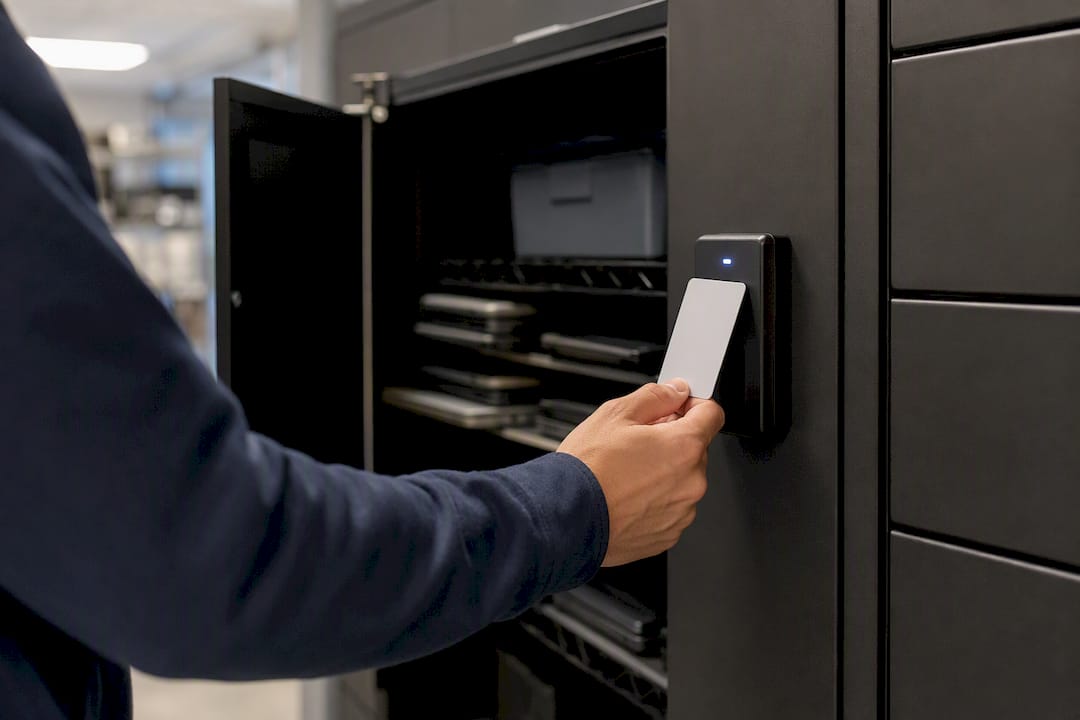
Robotic automation, in this context, is the physical automation of device handovers, laptop swaps, peripheral dispensing, and walk-up support, run natively inside ServiceNow so a ticket closes without an engineer ever leaving their desk. Smart lockers, smart vending machines and smart kiosks handle the physical exchange; the ServiceNow platform handles the workflow, the CMDB record, and the audit trail.
Combining device intelligence with the ServiceNow AI Platform can reduce IT support costs by up to 30%, speed onboarding by up to 50%, and resolve up to 40% of issues before they ever reach a user.
For a CIO or ServiceNow platform owner, the immediate payoff looks like this:
- Fewer engineer dispatches for routine hardware handovers
- Device state updates written natively to the CMDB, not a side database
- Fulfilment measured in minutes at a locker, not days on a support queue
- An audit trail that matches your existing RBAC and compliance posture
Key Takeaways
Physical automation only delivers its measured gains when hardware events write directly into the ServiceNow CMDB as authoritative records, not into a separate database.
| Point | Details |
|---|---|
| Definition anchors to ServiceNow | Physical robotic automation means lockers, vending, and kiosks running in-tenant, closing tickets without dispatch. |
| CMDB accuracy comes first | Reconcile physical inventory against CMDB records before any locker or kiosk goes live. |
| KPIs drive the business case | Track fulfilment speed, throughput, ticket reduction, and staff time recovered from day one. |
| Pilot before scaling | Start with one use case, such as new-hire kits, to surface data gaps with minimal disruption. |
| Velocity-smart runs natively | Smart Collect® is a ServiceNow-certified, in-tenant application inheriting existing RBAC and audit trails. |
Table of Contents
- How do the hardware and ServiceNow-native software fit together?
- Which hardware form factor fits which use case?
- What business outcomes and KPIs should you expect?
- What do you need in place before you deploy?
- What goes wrong in real deployments?
- Who backs these figures, and what proof exists?
- What the article’s evidence actually supports
- Where Velocity-smart fits into your rollout
- Sources
How do the hardware and ServiceNow-native software fit together?
Picture the flow as four linked stages: endpoint, ServiceNow application, CMDB/HAM, workflow. An employee interacts with a locker, vending unit, or kiosk. That endpoint fires an event into a ServiceNow-native application, not a third-party API bolted onto the side. The application reads and writes directly into your Configuration Management Database and Hardware Asset Management module, and the resulting task, approval, or notification runs through your existing workflow engine.
“In-tenant, ServiceNow-native” is the detail that matters most here. It means the application inherits your existing role-based access control, your audit logging, and your security review, rather than requiring a fresh one. ServiceNow’s Hardware Asset Management module is built to make the CMDB the single source of truth for hardware lifecycle events, and a physical automation layer that writes into that same record set, rather than a parallel database, is what keeps that claim true in practice.
Three integration points deserve explicit design before go-live:
- Event mapping — define which locker or kiosk events (collection, return, fault report) trigger which CMDB state changes.
- RBAC inheritance — confirm the application uses existing ServiceNow roles rather than a separate permission model.
- UEM/MDM handoff — decide the exact point where device enrolment passes from your mobility platform to the physical fulfilment workflow.
Pro Tip: Map every locker or kiosk event to a specific CMDB state transition before deployment, not after. Retrofitting lifecycle logic once devices are already circulating is far harder than designing it up front.
Which hardware form factor fits which use case?
Three form factors cover most enterprise physical IT scenarios, and they are rarely interchangeable.
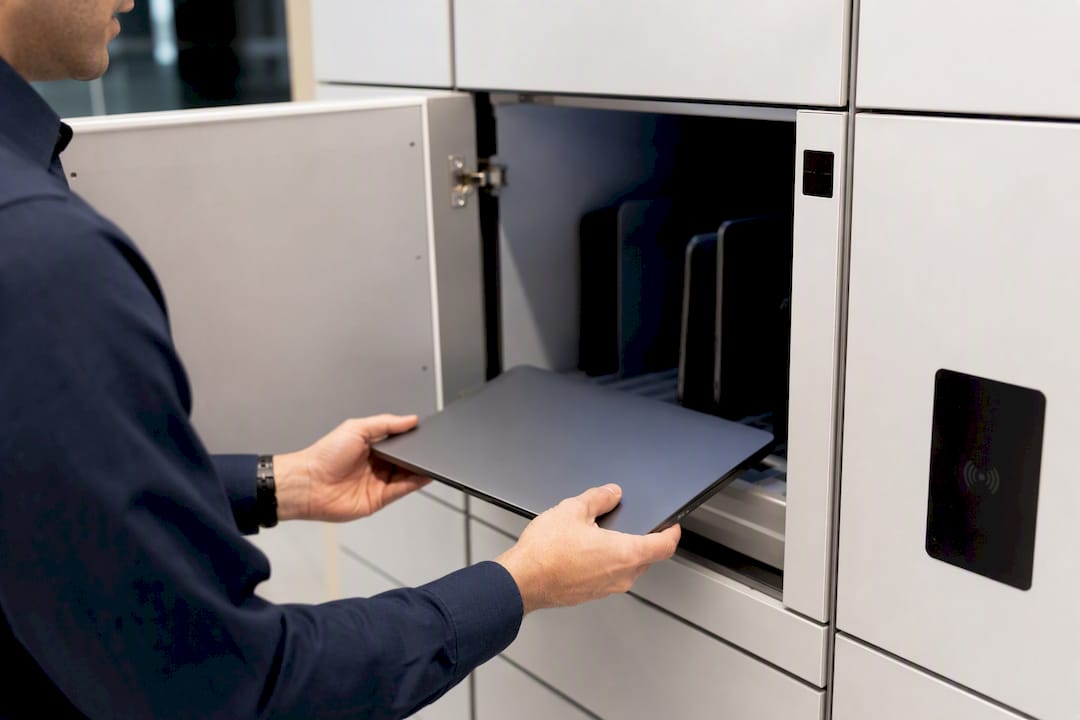
Smart lockers handle full-device transactions: new-starter kit collection, broken-laptop swaps, loaner returns, and any handover that needs a hard audit record of who took what, when. Their strength is auditability, since every open event is logged against a named ServiceNow record rather than a sign-out sheet.
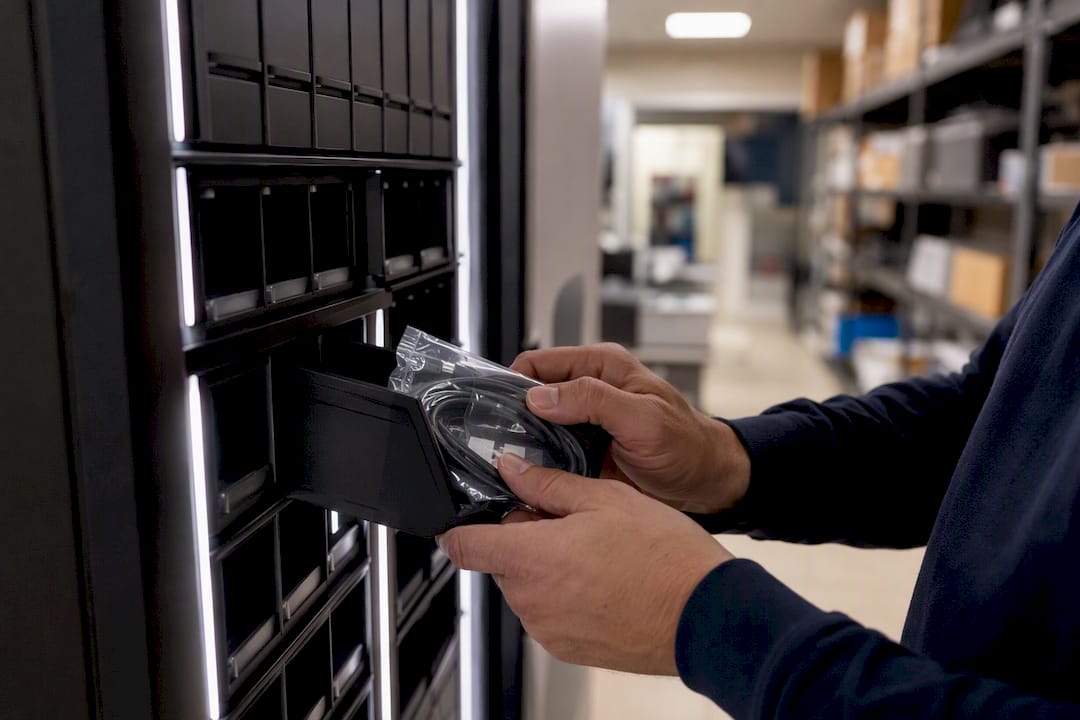
Smart vending covers the higher-frequency, lower-value layer: peripherals, cables, headsets, and consumables that employees need on demand, at 3am or on a Sunday shift, without waiting for a service desk to open. This is where 24/7 self-service actually earns its keep, because the transaction volume would otherwise bury a helpdesk in low-value tickets.
Smart kiosks replace the walk-up help desk itself. A video-based, AI-supported resolver group handles the conversations that used to require a physical tech bar, cutting the number of employees who need to queue for a desk visit at all.
Placement follows density, not headcount alone:
- Campus hubs suit lockers and kiosks together, where footfall justifies both.
- Regional nodes with smaller headcounts often need vending only, for consumables and peripherals.
- Retail or distributed sites benefit most from lockers positioned near existing facilities traffic, minimising the detour cost for employees.
What business outcomes and KPIs should you expect?
Five KPIs build the business case that finance actually approves: fulfilment speed, throughput per site, ticket volume reduction, staff time recovered, and employee downtime avoided. Each maps directly to a line item a CFO already tracks.
A global pharmaceutical customer running Smart Collect® recorded throughput uplift exceeding 500%, 83% faster fulfilment, and 74% less employee downtime, delivered under traditional ITSM workflows, before agentic AI was driving the ticket itself.
Industry data backs the direction of travel even before you add case-specific figures. Combining device intelligence with ServiceNow’s AI platform can cut IT support costs by up to 30% and resolve up to 40% of issues proactively. A separate deployment integrating ServiceNow with smart lockers cut asset loss by 85% in a campus setting, alongside a meaningful drop in helpdesk ticket volume.
Build your KPI dashboard around:
- Fulfilment time from ticket creation to device in hand
- Throughput per locker, vending unit, or kiosk per month
- Percentage reduction in desk-side support tickets
- IT staff hours reclaimed from manual collection and return
- Employee downtime between request and resolution
As Now Assist and agentic AI mature, device intelligence and workflow orchestration become the mechanism that closes the remaining gap between digital and physical cost-to-serve, which makes these baseline figures a floor rather than a ceiling.
What do you need in place before you deploy?
Readiness is a data and governance question before it is a hardware question. Run through this sequence before committing to a pilot.
- Audit CMDB accuracy — reconcile physical inventory against CMDB records; canonical identifiers must exist before any locker or kiosk can trust the data behind it.
- Confirm RBAC and audit trail requirements — the application should inherit existing ServiceNow permissions rather than introduce a parallel access model.
- Define UEM/MDM handoff points — structured onboarding workflows that connect HR triggers to provisioning and zero-touch enrolment remove manual handoffs, but only if the handoff point between mobility management and physical fulfilment is explicit.
- Design receiving and stockroom logistics — decide who restocks vending units, who receives locker returns, and how exceptions get logged.
- Select a pilot site and success criteria — a single use case, such as new-hire kits or laptop swaps, reveals CMDB mismatches quickly and produces measurable results without disrupting the whole estate.
Pro Tip: Run your first reconciliation wave, scanning existing inventory against CMDB records, before the locker or kiosk goes live, not during week one of the pilot. Finding the data gaps early is far cheaper than finding them mid-rollout.
MDM tools alone cannot resolve physical retrieval or cross-border logistics; a physical automation layer complements MDM by covering the procurement, shipping, and retrieval steps that mobility management was never designed to touch. Our guide to reducing IT hardware support tickets walks through the sequencing in more detail.
What goes wrong in real deployments?
Most failures trace back to four predictable causes, each with a direct fix.
- Data mismatch between physical assets and CMDB. Run an initial reconciliation wave before automating anything; scanning existing stock into the system surfaces every discrepancy up front rather than mid-deployment.
- Assuming lockers fix a broken process. Document lifecycle ownership, who owns receiving, deployment, retrieval, wipe, and disposal, before automation, because successful hardware lifecycle management treats each stage as a defined state, not an afterthought.
- Underestimating regional logistics. Set local pickup and return policies with explicit SLA definitions per site rather than a single global assumption.
- Governance gaps. Build audit and RBAC requirements into the pilot scope from day one; retrofitting compliance after go-live is where most projects lose momentum.
The pattern across all four is the same: automating before cleaning up the underlying process only makes the process’s flaws faster and more visible.
Who backs these figures, and what proof exists?
This analysis is written by Anthony, drawing on his affiliation with Velocity Smart Technology, a UK-headquartered ServiceNow Service Specialist Partner. The company holds ISO 9001 and ISO 27001 certification, and its Smart Collect® application runs as a ServiceNow-certified, in-tenant platform rather than a bolt-on integration.
Recorded customer outcomes include throughput uplift exceeding 500% for a global pharmaceutical customer, an on-site ticket reduction of 60% for a nuclear energy operator, and IT staff travel cut by 35% across more than 34 sites for a defence and aerospace customer.
The proof points that matter to a platform owner:
- ServiceNow Service Specialist Partner status, not a third-party middleware badge
- ISO 9001 and ISO 27001 certification covering quality and information security
- Case outcomes recorded under traditional ITSM workflows, before agentic AI was driving the ticket
- Smart Collect® runs natively inside the customer’s own ServiceNow tenant
What the article’s evidence actually supports
The conventional advice on physical IT automation treats the hardware as the innovation. It isn’t. The evidence throughout this piece points the other way: the locker, the vending unit, and the kiosk are commodities compared to the discipline of writing every event back into the CMDB as an authoritative record. Skip that discipline and you have an expensive vending machine, not an automation programme.
Most CIOs underestimate how much of the payoff comes from data hygiene rather than hardware capability. That is the uncomfortable part of the business case: the ROI depends on work your team does before deployment, not the vendor’s install date.
Prioritise the pilot, one use case, one site, measured against CMDB accuracy before and after. Everything else, including the AI layer that will eventually close these tickets end-to-end, compounds on top of that foundation. It does not replace it.
— Anthony
Where Velocity-smart fits into your rollout
Velocity-smart gives you the one piece most physical automation projects lack: a ServiceNow-certified application that runs inside your tenant, not alongside it, so device handovers close as native CMDB transactions with your existing RBAC and audit trail intact.
That distinction matters because it removes the usual blocker to enterprise rollout, the fresh security review a bolt-on integration always triggers. Smart Collect® orchestrates lockers, vending, and kiosks from a single platform, and it suits IT directors who need to prove ROI on a pilot before scaling across regions. If your organisation already runs regulated workflows through ServiceNow, in pharma, energy, defence, financial services, or higher education, the integration path is shorter than most teams expect. Explore the Smart Collect® product page to see the ServiceNow-native architecture in detail, or review the global pharma case study for the throughput figures behind a comparable deployment before scoping your own pilot.
Sources
- ServiceNow and Lenovo help organizations reduce costs, accelerate productivity, and improve governance with AI-native operations
- Stop tracking devices. Start managing the hardware lifecycle
- Enterprise IT Asset Management | Accessa Case Study
- ZTM enterprise device onboarding challenges
Recommended
See what Smart Collect® could save you
Model your savings in two minutes, or book a 60-minute workshop to pressure-test the numbers against your estate.