Why every enterprise should track device lifecycle
Tracking device lifecycle is the single most effective control an enterprise IT team can apply to reduce total cost of ownership, close security gaps at offboarding, and maintain operational predictability across a distributed workforce. Most organisations manage procurement and deployment reasonably well, but lose reliable visibility almost immediately after a device ships. That visibility gap is where cost overruns, compliance failures, and security incidents accumulate.
Three outcomes that justify the investment:
- Cost control: Real-time asset tracking prevents duplicate purchases, enables warranty recovery, and supports planned refresh cycles rather than emergency replacements.
- Security and compliance: Devices that fall outside the managed inventory become unmanaged endpoints. Gartner’s cybersecurity predictions identify asset visibility as a foundational security control, and untracked devices at offboarding are a primary source of data leakage.
- Employee productivity: Accurate lifecycle data reduces fulfilment delays, cuts desk-side support tickets, and gives employees working equipment on day one.
Key takeaways
Tracking device lifecycle is the foundational control that connects cost governance, security posture, and operational performance across a distributed enterprise IT estate.
| Point | Details |
|---|---|
| Visibility gap is the core risk | Most organisations lose reliable tracking after deployment; automated CMDB integration closes that gap. |
| Recovery rate drives ROI | Improving device recovery from 75% to 90% on a 10,000-device estate saves approximately £120,000 annually at £800 per device. |
| Compliance requires audit trails | UK GDPR and WEEE obligations demand certified disposal records; lifecycle tracking creates the evidence chain regulators expect. |
| Offboarding is the highest-risk stage | Retrieval workflows triggered by HR leaver events recover significantly more devices than manual processes. |
| Velocity Smart Collect® | The only ServiceNow-native platform that closes physical-handover tickets, with a 500%+ throughput uplift evidenced at global pharma scale. |
Table of Contents
- What is device lifecycle management and what stages does it cover?
- Why does tracking device lifecycle matter for enterprise IT?
- How do enterprises actually track devices in practice?
- Which KPIs should you track and how do you calculate ROI?
- What governance and processes make lifecycle tracking reliable?
- What are the risks of not tracking devices, and what does UK regulation require?
- What outcomes should you expect from enterprise lifecycle deployments?
- The lifecycle control plane: a CIO’s perspective for 2026
- Automate device lifecycle inside ServiceNow with Velocity Smart Collect®
- Sources
What is device lifecycle management and what stages does it cover?
Device lifecycle management (DLM) is the discipline of tracking and governing every hardware asset from the moment it is ordered to the moment it is certified for disposal. The important distinction is that DLM treats devices as a connected system, not a series of isolated tasks. A decision made at procurement (which model, which configuration standard) directly affects support costs three years later. A missed step at offboarding creates a compliance liability that procurement never anticipated.
Endpoint lifecycle management (ELM) extends this scope further, covering not just the physical device but the software stack, identity credentials, and compliance posture attached to it. For regulated industries, ELM is the correct framing: an unmanaged endpoint is not just a missing asset, it is an open security surface.
The canonical stages most enterprise programmes use are:
- Planning and procurement: Define standards, negotiate contracts, set configuration baselines, and record the asset in the CMDB before it arrives.
- Configuration and enrolment: Zero-touch provisioning via MDM/UEM, software deployment, identity binding, and warranty registration.
- Deployment: Physical handover to the end user, ownership assignment in the ITSM, and confirmation of receipt.
- Monitoring and tracking: Continuous automated discovery, usage telemetry, warranty alerts, and support ticket correlation.
- Retrieval and offboarding: Triggered by HR events (leaver, mover, role change), with physical return workflows and data sanitisation before reassignment.
- Retirement and disposal: Certified data wiping, e-waste routing to accredited recyclers, and closure of the CMDB record.
Failure in one stage cascades into the next. A device that skips enrolment never appears in monitoring. A device that skips retrieval never reaches certified disposal.
Pro Tip: Set warranty alerts 90 days before expiry and plan refresh events at 80% of a device’s planned operational life. Both actions convert reactive spend into planned budget lines.
Why does tracking device lifecycle matter for enterprise IT?
The business case for lifecycle tracking sits across four dimensions, each with measurable outcomes.
Cost control and TCO reduction
Untracked assets generate three categories of avoidable spend: duplicate purchases when existing stock is not visible, emergency procurement when refresh cycles are missed, and warranty claims that expire unclaimed. Organisations with real-time device tracking reduce hardware spend per employee by avoiding these patterns and by recovering warranty value on devices that would otherwise be written off. The true costs of IT inefficiency compound quickly across a large estate.
Security, compliance, and audit readiness
Every device that leaves the managed inventory without a certified data wipe is a potential data breach. For UK enterprises subject to the UK GDPR and sector-specific regulators, that is not a theoretical risk. Lifecycle tracking creates the audit trail that demonstrates due diligence: who held the device, when it was returned, and which sanitisation standard was applied. Without that record, a regulator asking for evidence of secure disposal has no answer to work with.
Operational performance and employee experience
DLM reduces reactive IT logistics time so teams can focus on strategic work rather than chasing missing equipment. Faster fulfilment, fewer desk-side tickets, and accurate inventory mean new starters receive working kit on day one and leavers are offboarded cleanly. The operational gains are measurable: reducing IT hardware support tickets is a direct downstream effect of accurate lifecycle data.

Sustainability and e-waste obligations
The Global E-Waste Monitor 2024 reports that electronic waste is rising five times faster than documented recycling. For UK enterprises with ESG commitments or public-sector reporting obligations, certified disposal and reuse programmes are no longer optional. Lifecycle tracking is the prerequisite: you cannot route a device to a certified recycler if you do not know where it is.
How do enterprises actually track devices in practice?
Manual versus automated approaches
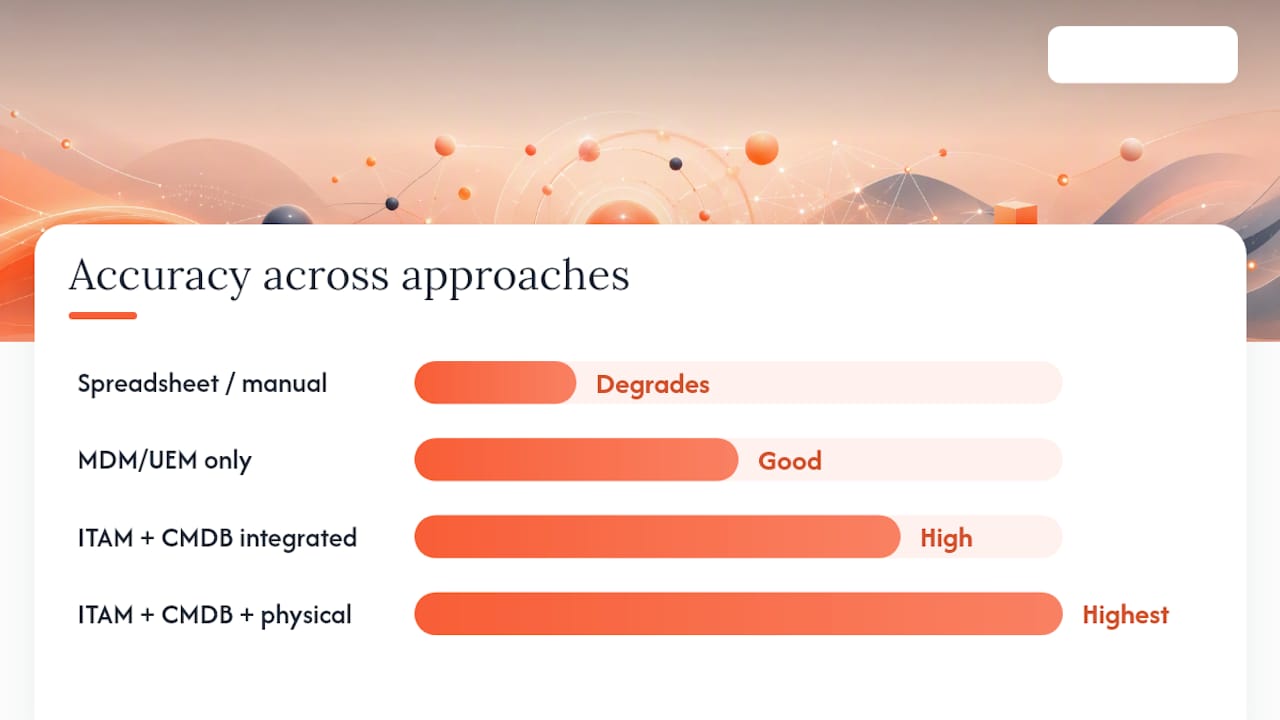
Spreadsheets and ad-hoc processes work at small scale and fail at enterprise scale. The core problem is staleness: a spreadsheet updated at deployment is accurate on day one and increasingly wrong every day after. Without automated syncs to MDM/UEM and ITAM platforms, tracking accuracy collapses within months of a deployment wave. Continuous automated discovery is the baseline expectation for enterprise endpoint coverage; periodic audits leave exploitable gaps between cycles.
| Approach | Accuracy over time | Scalability | Compliance evidence | Typical tools |
|---|---|---|---|---|
| Spreadsheet / manual | Degrades rapidly | Low | Weak | Excel, shared drives |
| MDM/UEM only | Good for enrolled devices | Medium | Partial | Microsoft Intune, Jamf |
| ITAM + CMDB integrated | High, near real-time | High | Strong | ServiceNow ITAM, Lansweeper |
| ITAM + CMDB + physical tracking | Highest, including off-network | Enterprise | Audit-grade | ServiceNow + smart lockers/kiosks |
Integration points that matter
The most reliable enterprise programmes connect four systems: the MDM/UEM for software and compliance state, the CMDB for the authoritative asset record, the ITSM for workflow triggers, and the HRIS for leaver/mover events. When an HR system fires a leaver event, a ServiceNow workflow should automatically open a retrieval ticket, notify the manager, and update the CMDB record. Without that integration, retrieval depends on someone remembering to act.
Physical tracking methods, including barcodes, RFID tags, smart lockers and kiosks, and courier APIs, extend visibility to devices that are off-network or in transit. A smart locker records the exact moment a device is deposited or collected, creating a timestamped chain of custody that feeds directly into the CMDB.
ServiceNow-centred deployment checklist
- Map every asset class to a CMDB configuration item (CI) type before go-live.
- Enforce RBAC at the workflow layer so only authorised roles can update asset state.
- Enable audit trails on all CI updates: who changed what, and when.
- Connect MDM discovery to auto-update CI records on a scheduled or event-driven basis.
- Integrate HRIS leaver events to trigger offboarding workflows automatically.
- Use smart lockers or kiosks as physical endpoints that write directly to ServiceNow on each transaction.
Pro Tip: A remote device management workflow that triggers automatically on an HR leaver event recovers significantly more devices than one that relies on manual IT intervention.
Which KPIs should you track and how do you calculate ROI?
Organisations that adopt full lifecycle practices see measurable reductions in downtime and improved inventory accuracy. The following KPIs give a finance-facing view of programme performance.
A straightforward ROI calculation for recovery rate improvement: multiply the number of additional devices recovered per year by the average replacement cost. If an estate of 10,000 devices has a 75% recovery rate and moves to 90%, that is 150 additional devices recovered. At an average replacement cost of £800 per device, the annual hardware saving is £120,000 before factoring in disposal and data-sanitisation costs avoided.
Planned refresh cycles produce a parallel saving. Emergency procurement typically carries a 15–25% cost premium over planned procurement. An estate that moves from reactive to planned refresh on even a portion of its devices converts that premium into budget.
What governance and processes make lifecycle tracking reliable?
Process checklist
- Procurement handoff: Every purchase order generates a CMDB record before the device ships. No asset enters the estate without a CI.
- Zero-touch configuration: MDM/UEM enrols the device automatically on first boot; no manual imaging steps that can be skipped.
- Deployment validation: The ITSM ticket closes only when the end user confirms receipt, creating a signed chain of custody.
- Continuous discovery: Automated scans run on a defined schedule (daily minimum) and update CI records without human intervention.
- Offboarding retrieval: HR leaver events trigger a ServiceNow workflow that opens a retrieval task, notifies the line manager, and sets a return deadline.
- Certified disposal: Devices reach only accredited recyclers; disposal certificates are attached to the CMDB record before the CI is retired.
An IT hardware management checklist gives a practical template for operationalising these steps across a large estate.
Roles and ownership
| Lifecycle stage | Primary owner | Supporting roles |
|---|---|---|
| Planning and procurement | IT procurement | Finance, vendor management |
| Configuration and enrolment | IT operations | Security, MDM team |
| Deployment | IT operations / facilities | HR (new starter triggers) |
| Monitoring and tracking | IT asset management | Service desk |
| Retrieval and offboarding | IT asset management | HR, line managers |
| Disposal | IT asset management | Facilities, approved recycler |
Change management for distributed teams
UK enterprises with sites across multiple regions face an additional challenge: local teams often develop their own informal processes when central IT is slow to respond. The result is shadow inventory that never reaches the CMDB. Addressing this requires training that explains why the process exists, not just what to do. Teams that understand the compliance and cost consequences of an untracked device are more likely to follow retrieval workflows consistently. For global programmes, country-specific constraints (local data-protection law, regional recycling regulations) should be documented in the governance framework rather than left to local interpretation.
What are the risks of not tracking devices, and what does UK regulation require?
The consequences of poor lifecycle tracking fall into three categories.
- Data leakage at offboarding: A device returned without data sanitisation, or not returned at all, carries personal and commercially sensitive data outside the organisation’s control. Under UK GDPR, that is a reportable incident if personal data is involved.
- Shadow devices and unmanaged endpoints: Devices outside the CMDB are outside the security programme. Shadow IT creates exploitable gaps that endpoint detection tools cannot see because the device is not enrolled.
- Financial overruns: Duplicate purchases, missed warranty claims, and emergency procurement are all direct consequences of poor inventory accuracy. The cost compounds across a large estate over a three-to-five-year refresh cycle.
On the regulatory side, UK enterprises should reference the ICO’s guidance on data sanitisation under UK GDPR, the Environment Agency’s requirements for waste electrical and electronic equipment (WEEE) disposal, and, for regulated sectors, the FCA’s operational resilience framework and NHS DSPT requirements where applicable. The Global E-Waste Monitor 2024 provides the macro context: e-waste is the fastest-growing waste stream globally, and enterprises that cannot demonstrate certified disposal chains face increasing scrutiny from regulators and investors alike.
A short mitigation checklist:
- Enforce data sanitisation to NIST 800-88 or equivalent before any device leaves the managed estate.
- Attach disposal certificates to CMDB records as mandatory fields before CI retirement.
- Run automated discovery weekly at minimum to surface shadow devices.
- Integrate IT asset security controls into the offboarding workflow, not as a separate manual step.
What outcomes should you expect from enterprise lifecycle deployments?
Enterprise programmes that move from manual tracking to integrated CMDB/ITSM workflows with physical distribution infrastructure consistently produce measurable gains across three dimensions.
These outcomes were delivered using traditional ITSM workflows, before agentic AI was driving the orchestration layer. As Now Assist matures and AI agents close tickets end-to-end, the operational floor these figures represent will rise.
On the timeline question: most enterprise programmes reach a working pilot within 8–12 weeks of a ServiceNow-native deployment. Operational scale across multiple sites typically follows within six months. The first cost benefits appear in hardware recovery rates and warranty salvage, often within the first quarter of operation. Fulfilment speed improvements are visible shortly after smart locker or kiosk deployment. The proactive IT desk-side support model that emerges from integrated lifecycle tracking is a structural shift, not an incremental improvement.
The lifecycle control plane: a CIO’s perspective for 2026
The framing that most enterprise IT teams still use, treating device lifecycle as an asset management task, is the wrong frame. Lifecycle tracking is the operational control plane for distributed IT. Every security posture assessment, every compliance audit, every workforce productivity metric traces back to whether you know where your devices are, who has them, and what state they are in.
The priority for 2026 is not choosing between MDM tools or ITAM platforms. It is closing the physical layer. Most enterprises have reasonable software-layer visibility. The gap is in physical handover, retrieval, and certified disposal, and that gap is where the majority of cost and compliance risk sits. A ServiceNow-native approach that writes physical transactions directly to the CMDB, enforces RBAC at the workflow layer, and triggers retrieval automatically on HR events is the architecture worth building toward.
If you are a new programme sponsor starting today, the single most valuable action is to instrument your offboarding workflow first. Recovery rate is the KPI that most directly reveals the health of your entire lifecycle programme, and improving it produces measurable financial and compliance returns.
Automate device lifecycle inside ServiceNow with Velocity Smart Collect®
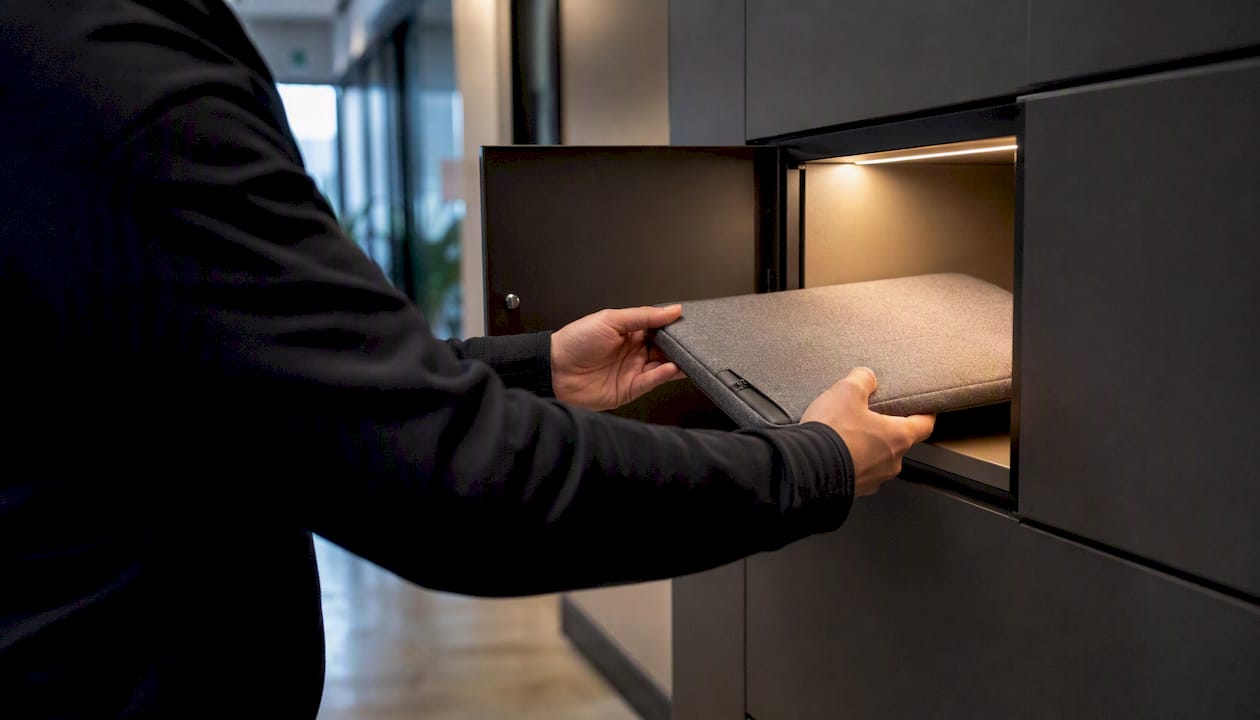
Velocity Smart Collect® is the only ServiceNow-certified application that closes physical-handover tickets without dispatching an engineer. It runs natively inside your ServiceNow tenant, inheriting your existing RBAC, audit trail, and CMDB, with no parallel database and no additional vendor security review. Asset state, device location, ownership history, and disposal records sit as native CI records, queryable alongside every other configuration item in your estate.
For IT leaders who want direct evidence of what integrated lifecycle tracking produces at enterprise scale, the global pharma case study details the 500%+ throughput uplift, 83% faster fulfilment, and 74% reduction in employee downtime delivered before agentic AI was driving the workflow. Request the case study or arrange a technical demonstration to see how Smart Collect maps to your ServiceNow environment.
Sources
The following sources informed this article and are recommended for further reading:
- Endpoint Lifecycle Management: A Guide - N-able
- End-to-End Device Management: From Procurement to Disposal Explained
- What Is Device Lifecycle Management? A 6-Stage Guide
- Global e‑waste monitor 2024: electronic waste rising five times faster than documented e‑waste recycling
- Gartner unveils top 8 cybersecurity predictions for 2023–2024
Recommended
See what Smart Collect® could save you
Model your savings in two minutes, or book a 60-minute workshop to pressure-test the numbers against your estate.