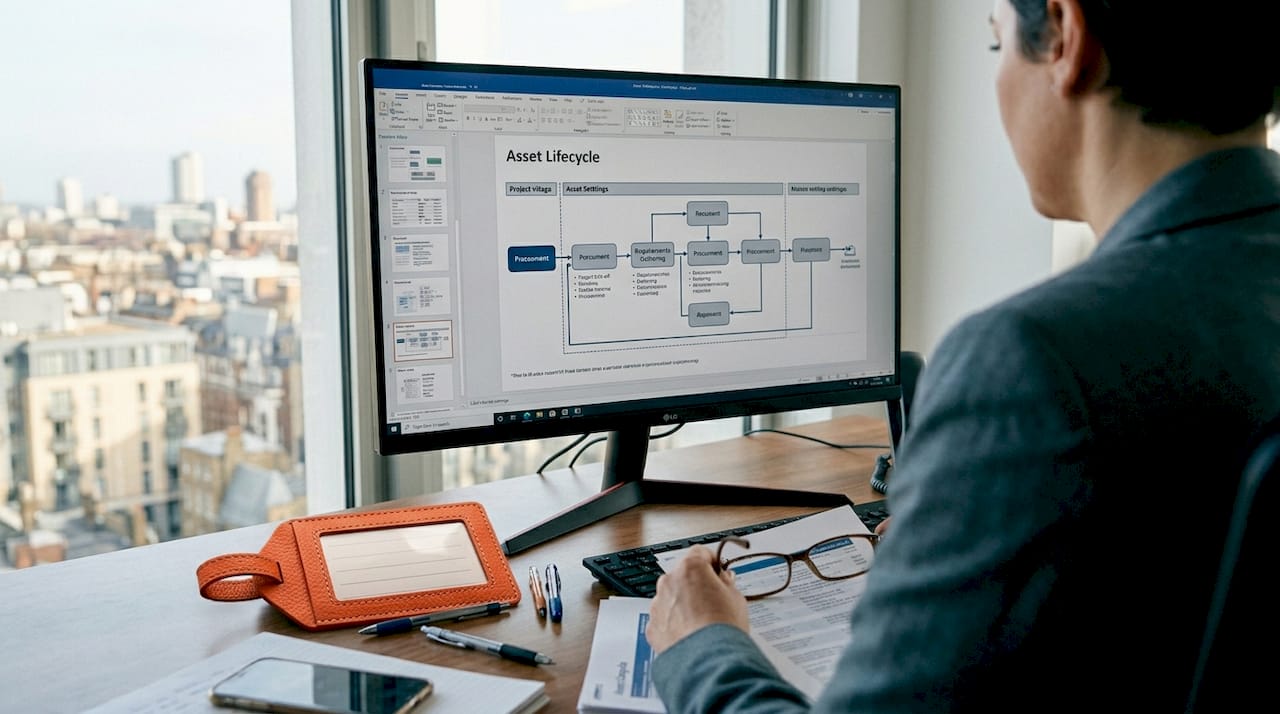
 Workflow-driven asset management: 70% automation ROI">
Workflow-driven asset management: 70% automation ROI
TL;DR:
- Workflow-driven asset management automates up to 70% of asset tracking tasks, reducing costs and errors.
- Scaling enterprise asset management requires real-time, automated processes to mitigate compliance and productivity risks.
- Successful implementation depends on process redesign, full platform utilization, and continuous performance measurement.
Most enterprise IT leaders assume their existing asset management tools are doing the job. The inventory is tracked, the spreadsheets are updated, and the helpdesk is fielding tickets. But beneath that surface, manual processes are quietly draining budget, slowing audits, and leaving distributed teams without the support they need. Workflow-driven asset management changes this fundamentally. By embedding automation directly into how assets are requested, tracked, maintained, and retired, organisations can automate up to 70% of tracking tasks while delivering measurable cost savings and compliance improvements. This article explains what workflow-driven asset management is, why it matters at scale, and how to implement it effectively.
Table of Contents
- What is workflow-driven asset management?
- Why workflow-driven asset management matters for large enterprises
- Key features and technology platforms
- Real-world results and implementation lessons
- Why many enterprises miss the full ROI of workflow-driven asset management
- Next steps: transform asset management with automation
- Frequently asked questions
Key Takeaways
| Point | Details |
|---|---|
| Automation delivers ROI | Workflow-driven asset management enables up to 30% cost savings and 70% automation of key tasks. |
| Reduced incidents and downtime | Enterprises see 25-40% fewer support incidents and faster resolution with automated workflows. |
| Faster audits and compliance | Automated tracking and reporting cut audit time by 30-50%, streamlining compliance. |
| Platform choice and process matter | The best results come from combining modern platforms with redesigned processes and thorough adoption. |
What is workflow-driven asset management?
Workflow-driven asset management is the practice of using automated, rule-based processes to govern every stage of an asset’s lifecycle. Rather than relying on manual data entry, email chains, or periodic audits, the system responds to triggers. A device is requested, a workflow fires. A laptop is returned, another workflow updates the CMDB, schedules diagnostics, and flags it for redeployment. Nothing waits for a human to remember.
This is fundamentally different from traditional enterprise IT asset management, which typically centres on a database of records that staff update reactively. Static asset management tells you what you own. Workflow-driven asset management tells you what is happening, what needs to happen next, and triggers the right action automatically.
The core components of a workflow-driven approach include:
- Process automation: Rules and triggers that initiate actions without human intervention
- CMDB integration: Real-time synchronisation between physical assets and their digital records
- Approval and escalation workflows: Automated routing of requests, exceptions, and compliance checks
- Reporting and alerting: Dashboards that surface anomalies, overdue returns, or licence gaps instantly
- Cross-system integrations: Connections to HR, procurement, and service desk platforms
The importance of asset tracking cannot be overstated in this context. Without accurate, real-time tracking, workflows have nothing reliable to act on. The two capabilities are inseparable.
According to market analysis, enterprise asset environments are growing in complexity faster than manual processes can keep up. The volume of devices, software licences, and support requests across distributed sites makes human-led management increasingly untenable.
Statistic: Up to 70% of asset tracking and management tasks can be automated with workflow-driven solutions, freeing IT teams to focus on higher-value work.
This is not a minor efficiency gain. It represents a structural shift in how IT operations function, moving from reactive firefighting to proactive, automated governance.
Why workflow-driven asset management matters for large enterprises
Scale changes everything. A 500-person organisation can manage assets with spreadsheets and goodwill. A 10,000-person enterprise operating across 30 sites cannot. At that scale, manual processes do not just slow things down. They create risk.
Consider the costs. Every untracked device is a potential compliance failure. Every manual audit is a drain on skilled IT staff. Every delayed replacement is lost productivity for an employee waiting on a laptop. These costs compound quietly, and most IT leaders only notice them when something goes wrong.
The business case for workflow-driven asset management is well-evidenced. Organisations that adopt it report 30% ROI and 25-40% fewer incidents and downtime events. Audit and compliance cycles that previously took weeks can be completed in days.

| Capability | Traditional asset management | Workflow-driven asset management |
|---|---|---|
| Asset tracking | Manual, periodic updates | Real-time, automated synchronisation |
| Audit preparation | Weeks of manual reconciliation | Automated reports, 30-50% faster |
| Incident response | Reactive, ticket-based | Predictive, trigger-based workflows |
| Compliance | Spot-check dependent | Continuous, automated monitoring |
| Device replacement | Manual request and fulfilment | Self-service, workflow-triggered |
The risks of staying with legacy approaches are equally concrete. Compliance failures in regulated industries such as financial services, healthcare, or government carry significant penalties. Asset loss and theft are harder to detect without automated alerts. And the hidden cost of reducing the impact of asset loss is far higher than most organisations account for in their IT budgets.
Centralised asset tracking across all sites is a prerequisite for effective workflow automation. Without a single source of truth, workflows act on incomplete data and the benefits erode quickly.
- Faster onboarding: New employees receive devices automatically, triggered by HR system events
- Reduced shadow IT: Approved self-service channels reduce ad hoc procurement
- Stronger audit trails: Every action is logged, timestamped, and attributable
- Lower support burden: Automated resolution of common requests frees helpdesk capacity
Pro Tip: Before selecting a platform, map your current asset lifecycle manually. Identify where delays, errors, and compliance gaps occur most frequently. These are the processes that will deliver the fastest ROI when automated.
Key features and technology platforms
Not all workflow-driven asset management platforms are equal. The features that distinguish leading solutions from basic ITAM tools are worth understanding before you evaluate vendors.
The most impactful capabilities include:
- Workflow automation engine: The ability to define, trigger, and manage complex multi-step processes without custom code
- AI-driven ticket routing: Machine learning models that classify and route incidents to the right team or automated resolution path
- Predictive maintenance alerts: Proactive flags based on device age, usage patterns, or failure history
- Self-service portals: Employee-facing interfaces that allow device requests, returns, and fault reporting without helpdesk involvement
- CMDB integration: Bidirectional synchronisation so every physical change is reflected in the digital record instantly
Integrating CMDB automation with physical asset systems such as smart lockers or vending machines creates a closed loop. When a device is collected from a smart locker system, the CMDB updates automatically. No manual scanning, no re-keying, no lag.
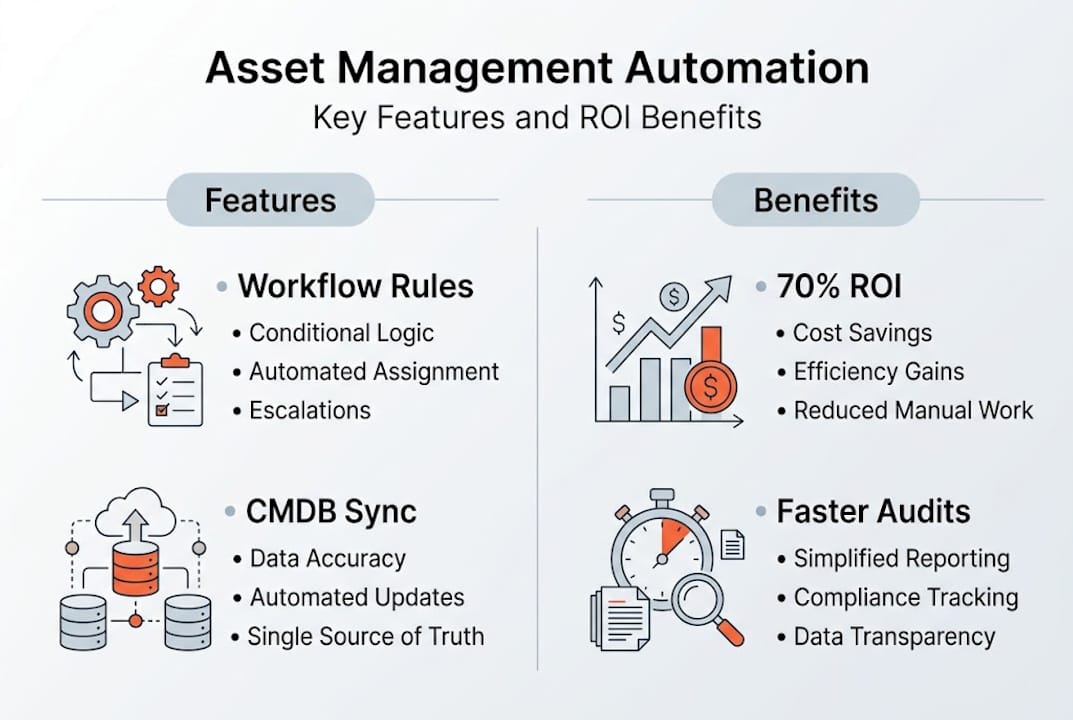
Leading platforms in this space include ServiceNow, BMC Helix, and InvGate, each offering integrated workflow and AI-driven automation capabilities. ServiceNow is particularly strong for enterprises already invested in its ecosystem, given its native CMDB, workflow engine, and service portal capabilities.
| Platform | Workflow automation | AI/ML features | CMDB integration | Self-service capability |
|---|---|---|---|---|
| ServiceNow | Native, extensive | Advanced | Native | Strong |
| BMC Helix | Strong | Moderate | Strong | Moderate |
| InvGate | Moderate | Emerging | Good | Good |
Despite the maturity of these platforms, fewer than 40% of enterprise environments have fully implemented cloud-based, AI-driven asset management. The gap between what platforms can do and what organisations actually use is significant. Most enterprises activate basic workflows and stop there, leaving advanced automation, predictive features, and self-service capabilities unused.
The workflow-enabled asset management opportunity is therefore not just about choosing the right platform. It is about committing to use it fully.
Real-world results and implementation lessons
The evidence from enterprise deployments is consistent. Organisations that implement workflow-driven asset management properly see material improvements across cost, speed, and compliance.
Cost reductions of 30 to 40% are reported across asset lifecycle management. Audit cycles become 30-50% faster through automation of reporting and reconciliation. Incident volumes drop as predictive workflows catch problems before they escalate. These are not aspirational targets. They are outcomes from real deployments.
Five lessons from organisations that have done this well:
- Start with your highest-volume workflows. Device requests, returns, and replacements affect every employee. Automating these first delivers the fastest visible impact.
- Integrate physical and digital systems from day one. Automating support workflow automation without connecting physical asset points creates gaps that undermine the whole system.
- Invest in change management. The technology is rarely the hard part. Getting employees and IT staff to trust and use new processes consistently is where implementations stall.
- Automate device returns as rigorously as distribution. The return journey is where most asset loss and CMDB drift occurs.
- Measure continuously. Use benchmark studies to set targets and review performance quarterly, not annually.
“The organisations that see the strongest ROI are not the ones with the most sophisticated platforms. They are the ones that redesign their processes before they automate them.”
Pro Tip: Run a 90-day pilot on one asset category, such as laptops, before rolling out enterprise-wide. This surfaces integration issues, user adoption gaps, and reporting blind spots in a controlled environment.
The pitfalls are equally instructive. Organisations that treat workflow-driven asset management as a technology project rather than an operational transformation consistently underperform. Platform underutilisation is the most common failure mode, followed by insufficient training and a lack of executive sponsorship to drive sustained adoption.
Why many enterprises miss the full ROI of workflow-driven asset management
Having worked with large organisations across financial services, healthcare, and government, a pattern emerges consistently. Enterprises implement a workflow platform, activate the basics, and then declare success. Six months later, the ROI looks modest, and the appetite for further investment wanes.
The uncomfortable truth is that most of the value in workflow-driven asset management sits in the features organisations never switch on. Advanced AI routing, predictive maintenance, self-service kiosks, and closed-loop CMDB integration are where the real savings accumulate. But they require process redesign, not just configuration.
ROI also matures over time. The real ROI insights from mature deployments show that year-one gains are real but modest. Years two and three, when workflows are refined and adoption is embedded, are where the numbers become transformative. Organisations that measure too early and stop iterating miss this entirely. No workflow-driven system is set and forget. Leadership commitment to continuous improvement is what separates the top performers from the rest.
Next steps: transform asset management with automation
For IT operations leaders who are ready to move beyond incremental improvements, the right platform and the right physical infrastructure make a decisive difference.
Velocity Smart Technology’s solutions are built to close the gap between workflow automation and physical asset management. Our smart IT support kiosk enables employees to access real-time IT support, device diagnostics, and equipment exchange at any workplace location, without requiring an onsite technician. Every interaction feeds directly into your ServiceNow workflows, keeping your CMDB accurate and your processes closed-loop. If you want to see automation in action and understand what a fully integrated, workflow-driven asset environment looks like in practice, we would welcome the conversation.
Frequently asked questions
How does workflow-driven asset management reduce IT downtime?
Workflow automation eliminates manual handoffs and routes incidents faster, producing a 25-40% reduction in downtime and support incidents across enterprise environments.
What is the adoption rate of workflow-driven asset management in large enterprises?
Fewer than 40% of large enterprises have fully implemented cloud-based, AI-driven asset management platforms, indicating a substantial adoption gap despite the available technology.
Can workflow-driven asset management improve compliance audits?
Yes. Automation of reporting and reconciliation processes can reduce audit and compliance time by 30-50%, making regulatory cycles faster and less resource-intensive.
What technology platforms offer workflow-driven asset management?
Leading platforms include ServiceNow, BMC Helix, and InvGate, all of which provide integrated workflow engines, CMDB connectivity, and AI-driven automation capabilities.
What is the main challenge when implementing workflow-driven asset management?
The primary challenge is organisational resistance to process change, compounded by a tendency to underutilise advanced automation features once a platform is deployed.
Recommended
See what Smart Collect® could save you
Model your savings in two minutes, or book a 60-minute workshop to pressure-test the numbers against your estate.